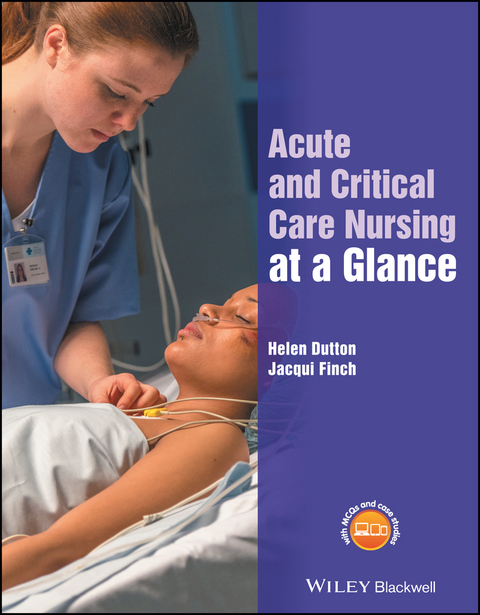
Acute and Critical Care Nursing at a Glance (eBook)
John Wiley & Sons (Verlag)
978-1-118-81516-8 (ISBN)
From the publishers of the market-leading at a Glance series comes a comprehensive yet accessible overview of all the fundamental elements of acute and critical care nursing.
Acute and Critical Care Nursing at a Glance provides an introduction to the key knowledge and skills for patient assessment and problem identification, as well as how to plan, implement and evaluate care management strategies. It also explores clinical decision-making processes and their impact on care delivery, as well as key psychosocial issues, pain management, and safe transfer. All information is presented in a clear, double-page spread with key information accompanied by tables, illustrations, photographs and diagrams.
Key features:
- Superbly illustrated, with full colour illustrations throughout
- An accessible, evidence-based, introduction to a complex topic
- Presents information structured according to the Resuscitation Council's systematic ABCDE framework for ease of understanding
- Accompanied by patient case studies to help apply theory to practice
Acute and Critical Care Nursing at a Glance is ideal for nursing students, healthcare assistants, and registered nurses working within the acute and critical care setting.
Jacqui Finch is a Senior Lecturer in Adult Nursing at the University of West London, UK
Helen Dutton is a Senior Lecturer in Adult Nursing at the University of West London, UK
Jacqui Finch is a Senior Lecturer in Adult Nursing at the University of West London, UK Helen Dutton is a Senior Lecturer in Adult Nursing at the University of West London, UK
Contributors vii
Acknowledgements viii
Preface ix
Abbreviations x
About the companion website xii
Part 1 Nursing in acute and critical care 1
1 Critical care without walls 2
2 Recognising risk of deterioration: ABCDE assessment 4
3 Early warning tools and care escalation 6
4 Hospital-acquired infection: infection prevention and control 8
5 Pain management 10
6 Psychosocial issues 12
7 Safe transfer of the acutely unwell patient 14
Part 2 Airway: maintaining airway patency 17
8 Upper airway: assessment and management 18
9 Advanced airway management 20
10 Airway management: tracheostomy 22
Part 3 Breathing: patients with breathing problems 25
11 Respiratory physiology: oxygenation 26
12 Respiratory physiology: ventilation 28
13 Assessment of breathing 30
14 Respiratory investigations 32
15 Oxygen therapy 34
16 Respiratory failure 36
17 Breathing problems: obstructive disorders 38
18 Breathing problems: lung (parenchymal) disorders 40
19 Breathing problems: pleural disorders 42
20 Respiratory support: non-invasive ventilation 44
21 Principles of thoracic surgery 46
Part 4 Circulation: patients with circulatory problems 49
22 Circulatory physiology 1: circulation 50
23 Circulatory physiology 2: the heart and cardiac cycle 52
24 Circulatory physiology 3: control of circulation 54
25 Assessment of circulation 56
26 Cardiac investigations 58
27 Fluid, electrolytes and intravenous fluids 60
28 Haemodynamic monitoring 62
29 Acute chest pain 64
30 The 12-lead electrocardiogram 66
31 Altered heart rhythm 68
32 Physiology of the immune system 70
33 Acute circulatory failure 1: distributive (sepsis) 72
34 Acute circulatory failure 2: distributive (anaphylaxis and neurogenic) 74
35 Acute circulatory failure 3: hypovolaemia 76
36 Acute circulatory failure 4: obstructive 78
37 Acute circulatory failure 5: heart failure 80
38 Principles of cardiac surgery 82
39 Physiology of the gastrointestinal system 84
40 Acute medical and surgical gastrointestinal problems 86
41 Physiology of the renal system 88
42 Acute kidney injury 90
43 Burns: immediate care 92
44 Major trauma 94
45 Resuscitation 96
Part 5 Disability: patients with neurological impairment 99
46 Physiology of the brain 100
47 Neurological assessment 102
48 Neurological impairment 104
49 Drug overdose and poisoning 106
50 Acute endocrine problems 108
Part 6 Exposure 111
51 Skin integrity 112
52 Nutritional assessment and support 114
Part 7 Decision making in acute and critical care 117
53 Summary of decision making 118
54 Professional, legal and ethical considerations 120
55 Mental health concerns 122
56 Last days of life 124
Appendix 126
References and further reading 127
Glossary 136
Index 148
Abbreviations
- A
-
Aorta
- ABCDE
-
Airway, breathing, circulation, disability circulation
- ABG
-
Arterial blood gas
- ACEI
-
Angiotensin converting enzyme inhibitors
- ACP
-
Advance care plan
- ACS
-
Acute coronary syndrome
- ACTH
-
Adrenocorticotrophic hormone
- ADH
-
Antidiuretic hormone
- AECOPD
-
Acute exacerbations of COPD
- AF
-
Atrial fibrillation
- AKI
-
Acute kidney injury
- ALS
-
Adult advanced life support
- AMI
-
Acute myocardial infarction
- AMPLE
-
Allergies, Medications, Past medical history, Last ate and drank, Events leading (to injury)
- AMTS
-
Abbreviated Mental Test Score
- ANNT
-
Aseptic non-touch technique
- ANS
-
Autonomic nervous system
- ARB
-
Angiotensin receptor blockers
- ARDS
-
Acute respiratory distress syndrome
- ATOMFC
-
Airway, tension pneumothorax, open pneumothorax, massive haemothorax, flail chest, cardiac tamponade
- ATP
-
Adenosine triphosphate
- AV
-
Atrioventricular
- AVN
-
Atrioventricular node
- AVPU
-
Alert, voice, pain, unresponsive
- BBB
-
Blood–brain barrier
- BiPAP
-
Bi-level positive airways pressure
- BMI
-
Body mass index
- BMR
-
Basal metabolic rate
- BNP
-
B-type natriuretic peptide
- BP
-
Blood pressure
- CA
-
Cardiac arrest
- Ca+
-
Calcium ion
- CABG
-
Coronary artery bypass grafting
- CAM ICU
-
Confusion assessment method: Intensive care unit
- CAP
-
Community-acquired pneumonia
- CCF
-
Congestive cardiac failure
- CCOT
-
Critical care outreach team
- CHF
-
Chronic heart failure
- CO
-
Cardiac output
- COPD
-
Chronic obstructive pulmonary disease
- CPAP
-
Continuous positive airways pressure
- CPB
-
Cardiopulmonary bypass
- CPR
-
Cardiopulmonary resuscitation
- CQC
-
Care Quality Commission
- CRBSI
-
Catheter-related blood stream infection
- CRF
-
Chronic respiratory failure
- CRP
-
C-reactive protein
- CRT
-
Capillary refill time
- CSF
-
Cerebrospinal fluid
- CT
-
Computed tomography
- CTPA
-
Computerised tomographic pulmonary angiography
- CURB 65
-
Confusion, urea, respiratory rate, systolic blood pressure (age ≥65)
- CVA
-
Cerebrovascular accident
- CVC
-
Central venous catheter/cardiovascular centre
- CVP
-
Central venous pressure
- CXR
-
Chest X-ray
- DDAVP
-
1- deamino-8-D-arginine vasopressin
- DI
-
Diabetes insipidus
- DINAMAP
-
Direct non-invasive automated mean arterial blood pressure measurement
- DKA
-
Diabetic ketoacidosis
- DNAR
-
Do not attempt to resuscitate
- DVT
-
Deep vein thrombosis
- ECG
-
Electrocardiogram
- EPAP
-
End positive airways pressure
- ERCP
-
Endoscopic retrograde cholangio-pancreatogram
- ERV
-
Expiratory reserve volume
- ETT
-
Endotracheal tube
- EWS
-
Early warning systems
- FBAO
-
Foreign body airway obstruction
- FEV1
-
Forced expiratory volume in one second
- FRC
-
Functional residual capacity
- FVC
-
Forced vital capacity
- GABA
-
Gabba amino butyric acid
- GAD-7
-
Generalised anxiety disorder assessment
- GCS
-
Glasgow Coma Scale
- GFR
-
Glomerular filtration rate
- GI
-
Gastrointestinal
- GTN
-
Glyceryl trinitrate
- H+
-
Hydrogen ions
- HADS
-
Hospital anxiety and depression scale
- HAP
-
Hospital-acquired pneumonia
- HCO3-
-
Bicarbonate ion
- HCAI
-
Healthcare-associated infection
- HDU
-
High dependency unit
- HF
-
Heart failure
- HFNC
-
High flow nasal cannula
- HFPEF
-
Heart failure with preserved ejection fraction
- HHS
-
Hyperglycaemic hyperosmolar syndrome
- HME
-
Heat and moisture exchanger
- HR
-
Heart rate
- I:E ratio
-
The ratio of inspiration to expiration
- ICD
-
Implantable cardioverter
- ICP
-
Intracranial pressure
- ICU
-
Intensive care unit
- IPAP
-
Inspiratory positive airways pressure
- IV
-
Intravenous
- JVD
-
Jugular venous distension
- JVP
-
Jugular venous pressure
- K+
-
Potassium ion
- LMA
-
Laryngeal mask airway
- LMWH
-
Low molecular weight heparin
- LOC
-
Level of consciousness
- LPA
-
Lasting power of attorney
- LV
-
Left ventricle
- LVF
-
Left ventricular failure
- LVSD
-
Left ventricular systolic dysfunction
- mAChR
-
Muscarinic receptors
- MAP
-
Mean arterial pressure
- Mg++
-
Magnesium ion
- MgSO4
-
Magnesium sulphate
- MI
-
Myocardial infarction
- MILS
-
Manual in-line stabilisation
- MODS
-
Multiple organ dysfunction syndrome
- MRI
-
Magnetic resonance imaging
- MUST
-
Malnutrition universal screening tool
- Na+
-
Sodium ion
- NATMIST
-
Name, age, time of injury, mechanism of injury, injuries sustained, signs and symptoms, treatments given
- NC
-
Nasal cannula
- NEWS
-
National Early Warning Score
- NICE
-
The National Institute for Health and Care Excellence
- NIV
-
Non-invasive ventilation
- NSTEMI
-
Non-ST-segment elevated myocardial infarction
- NPA
-
Nasopharyngeal airway
- NSAID
-
Non-steroidal anti-inflammatory drugs
- OPA
-
Oropharyngeal airway
- PA
-
Pulmonary artery
- PAO2
-
The partial pressure of oxygen in the alveoli
- PAINAD
-
Pain Assessment in Advanced Dementia
- PaO2
-
The partial pressure of oxygen in arterial blood
- PCA
-
Patient-controlled analgesia
- PCI
-
Percutaneous coronary intervention
- PCT
-
Proximal convoluted tubule
- PE
-
Pulmonary embolism
- PEEP
-
Positive end expired pressure
- PEF
-
Peak expiratory flow
- PEFR
-
Peak expiratory flow rate
- PNS
-
Parasympathetic nervous system
- PPCI
-
Primary percutaneous coronary intervention
- PPE
-
Personal protective equipment
- PS
-
Pressure support
- PSP
-
Primary spontaneous pneumothorax
- qSOFA
-
Quick Sequential (Sepsis Related) Organ Failure Assessment
- RA
-
Right atrium
- RAAS
-
Renin-angiotensin-aldosterone system
- REM
-
Rapid eye movement
- ROSC
-
Return of spontaneous circulation
- RR
-
Respiratory rate
- RV
-
Residual volume/Right ventricle
- SAN
-
Sinoatrial node
- SAH
-
Subarachnoid haemorrhage
- SBAR
-
Situation, background, assessment, recommendation
- SBP
-
Systolic blood pressure
- SIADH
-
Syndrome of inappropriate ADH
- SNS
-
Sympathetic nervous system
- SOCRATES
-
Site, onset, character, radiation, associated symptoms, time course, exacerbating and relieving factors, severity
- SP
-
Secondary pneumothorax
- SpO2
-
Oxygen saturation of peripheral capillary blood
- SSP
-
Secondary spontaneous pneumothorax
- SSRI
-
Selective Serotonin re-uptake inhibitor
- STEMI
-
ST elevation myocardial infarction
- Sup.VC
-
Superior vena cava
- SV
-
Stroke volume
- SVR
-
Systemic vascular resistance
- SVT
-
Supraventricular...
| Erscheint lt. Verlag | 15.2.2018 |
|---|---|
| Reihe/Serie | At a Glance (Nursing and Healthcare) |
| Wiley Series on Cognitive Dynamic Systems | Wiley Series on Cognitive Dynamic Systems |
| Sprache | englisch |
| Themenwelt | Pflege ► Fachpflege ► Anästhesie / Intensivmedizin |
| Schlagworte | ABCDE • Acute • Acute, Critical & Emergency Care • Assessment • Care • Critical • Decision-Making • General Clinical Nursing • Intensiv- u. Notfallpflege • Klinische Krankenpflege • Krankenpflege • Management • nursing • Pain • Psychosocial • Resuscitation • Transfer |
| ISBN-10 | 1-118-81516-5 / 1118815165 |
| ISBN-13 | 978-1-118-81516-8 / 9781118815168 |
| Informationen gemäß Produktsicherheitsverordnung (GPSR) | |
| Haben Sie eine Frage zum Produkt? |
 EPUB (Adobe DRM)
Kopierschutz: Adobe-DRM
Adobe-DRM ist ein Kopierschutz, der das eBook vor Mißbrauch schützen soll. Dabei wird das eBook bereits beim Download auf Ihre persönliche Adobe-ID autorisiert. Lesen können Sie das eBook dann nur auf den Geräten, welche ebenfalls auf Ihre Adobe-ID registriert sind.
Details zum Adobe-DRM
Dateiformat: EPUB (Electronic Publication)
EPUB ist ein offener Standard für eBooks und eignet sich besonders zur Darstellung von Belletristik und Sachbüchern. Der Fließtext wird dynamisch an die Display- und Schriftgröße angepasst. Auch für mobile Lesegeräte ist EPUB daher gut geeignet.
Systemvoraussetzungen:
PC/Mac: Mit einem PC oder Mac können Sie dieses eBook lesen. Sie benötigen eine
eReader: Dieses eBook kann mit (fast) allen eBook-Readern gelesen werden. Mit dem amazon-Kindle ist es aber nicht kompatibel.
Smartphone/Tablet: Egal ob Apple oder Android, dieses eBook können Sie lesen. Sie benötigen eine
Geräteliste und zusätzliche Hinweise
Buying eBooks from abroad
For tax law reasons we can sell eBooks just within Germany and Switzerland. Regrettably we cannot fulfill eBook-orders from other countries.
aus dem Bereich