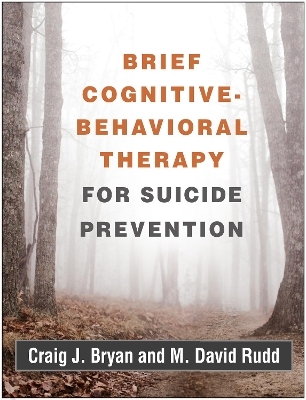
Brief Cognitive-Behavioral Therapy for Suicide Prevention
Guilford Press (Verlag)
978-1-4625-3666-5 (ISBN)
Craig J. Bryan, PsyD, ABPP, is Professor of Psychiatry and the Director of the Suicide Care Clinic at the University of Vermont. Dr. Bryan is an internationally recognized expert on suicide prevention, trauma, and resilience. He is an associate editor of the journal Suicide and Life-Threatening Behavior and previously served on the board of directors of the American Association of Suicidology. Dr. Bryan has received honors including the Charles S. Gersoni Military Psychology Award from Division 19 (Society for Military Psychology) and the Peter J. N. Linnerooth National Service Award from Division 18 (Psychologists in Public Service) of the American Psychological Association, as well as the Citizen Scientist Award and the Edwin S. Shneidman Award from the American Association of Suicidology. From 2005 to 2009, he served on active duty in the U.S. Air Force as a clinical psychologist, including a deployment to Iraq in 2009. Dr. Bryan’s primary research interests include testing treatments for reducing suicidal behaviors, developing innovative methods to identify and detect high-risk individuals, and facilitating recovery after trauma. He has published hundreds of scientific articles and several books. M. David Rudd, PhD, ABPP, is President of the University of Memphis, where he is also Distinguished University Professor of Psychology. He is Co-Founder and Scientific Director of the National Center for Veterans Studies at the University of Utah. Dr. Rudd is a Fellow of the American Psychological Association, the International Academy of Suicide Research, and the Academy of Cognitive and Behavioral Therapies, and has been elected a Distinguished Practitioner and Scholar of the National Academies of Practice in Psychology. He previously served as chair of the Texas State Board of Examiners of Psychologists, president of the Texas Psychological Association, president of the American Association of Suicidology, and a member of the American Psychological Association’s Council of Representatives. Dr. Rudd’s research focuses on the treatment of suicidal patients. He has published over 200 scientific articles and numerous books on the clinical care of suicidal individuals, and is considered an international leader in suicide prevention.
I. Background and Conceptual Foundation
1. Why Brief Cognitive-Behavioral Therapy to Prevent Suicide?
2. Conceptualizing Suicide: The Suicidal Mode
3. Core Principles of Treatment with Suicidal Patients
4. Suicide Risk Assessment and Its Documentation
5. Monitoring Treatment Progress
6. An Overview of Brief Cognitive-Behavioral Therapy
II. The First Session
7. Describing the Structure of Brief Cognitive-Behavioral Therapy
8. Narrative Assessment
9. Treatment Log and Case Conceptualization
10. Crisis Response Plan
III. Phase One: Emotion Regulation and Crisis Management
11. Treatment Planning and Commitment to Treatment Statement
12. Means Safety Counseling and Crisis Support Plan
13. Targeting Sleep Disturbance
14. Relaxation and Mindfulness Skills Training
15. Reasons for Living List and Survival Kit
IV. Phase Two: Undermining the Suicidal Belief System
16. ABC Worksheets
17. Challenging Questions Worksheets
18. Patterns of Problematic Thinking Worksheets
19. Activity Planning and Coping Cards
V. Phase III: Relapse Prevention
20. Relapse Prevention Task and Ending Treatment
Appendix A. Patient Forms and Handouts
A1. The Suicidal Mode
A2. Patient Information Sheet about Brief Cognitive-Behavioral Therapy (BCBT) to Prevent Suicide Attempts
A3. Treatment Plan Template
A4. Commitment to Treatment Statement
A5. Means Safety Plan
A6. Crisis Support Plan
A7. Improving Your Sleep Handout
A8. ABC Worksheet
A9. Challenging Questions Worksheet
A10. Patterns of Problematic Thinking Worksheet
Appendix B. Clinician Tools
B1. Fidelity Checklists
B2. Suicide Risk Assessment Documentation Template
B3. Crisis Response Plan Template
B4. Possible Warning Signs
B5. Common Self-Management Strategies
B6. Relaxation Script
B7. Mindfulness Script
| Erscheinungsdatum | 14.08.2018 |
|---|---|
| Verlagsort | New York |
| Sprache | englisch |
| Maße | 203 x 267 mm |
| Gewicht | 641 g |
| Themenwelt | Geisteswissenschaften ► Psychologie |
| Medizin / Pharmazie ► Medizinische Fachgebiete ► Psychiatrie / Psychotherapie | |
| ISBN-10 | 1-4625-3666-2 / 1462536662 |
| ISBN-13 | 978-1-4625-3666-5 / 9781462536665 |
| Zustand | Neuware |
| Informationen gemäß Produktsicherheitsverordnung (GPSR) | |
| Haben Sie eine Frage zum Produkt? |
aus dem Bereich