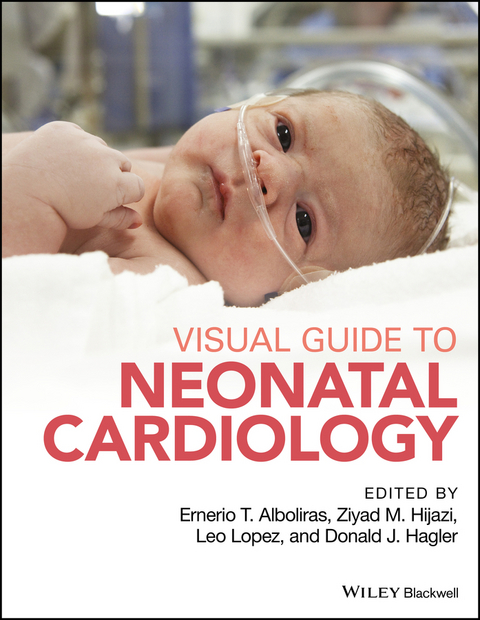
Visual Guide to Neonatal Cardiology (eBook)
John Wiley & Sons (Verlag)
978-1-118-63534-6 (ISBN)
- Contains over 900 color illustrations, including patient photographs, chest roentgenograms, electrocardiograms, echocardiograms, angiocardiograms, 3D computed tomogramphy, magnetic resonance imaging, pathologic specimens, and other relevant visual aids
- Discusses the natural history of fetal heart disease and the rationale, indications, technique, and impact of fetal cardiac intervention
- Reviews the anatomy and physiology of the neonatal cardiovascular system, including differences within the fetal, transitional, neonatal, child and adult circulatory system
- Highlights key steps for taking a patient history, including detailed discussion of the cardiac examination (inspection, palpation and auscultation of heart sounds and murmurs)
- Presents over 35 morphologic conditions with sections covering introduction, epidemiology, etiology with accepted or postulated embryogenesis, pathophysiology, clinical presentation, physical examination findings, diagnostic evaluation, management, and prognosis
- Includes a neonatal formulary reviewing selected medications currently used for treatment of perioperative low cardiac output, congestive heart failure, pulmonary hypertension, sedation, pain and anticoagulation in neonates
Ernerio T. Alboliras, MD is a Fetal and Pediatric Cardiologist, Medical Director, Genus Heart Center, Scottsdale, Arizona and formerly was with Division of Cardiology, Phoenix Children's Hospital, Phoenix, Arizona, USA
Ziyad M. Hijazi, MD, MPH is a Professor of Pediatrics, Weill Cornell Medical College and Acting Chief Medical Officer - Chair of the Department of Pediatrics and Director, Sidra Cardiovascular Center of Excellence, Doha, Qatar
Leo Lopez, MD is a Director of Cardiac Non-Invasive Imaging, Nicklaus Children's Hospital, Miami, Florida, USA
Donald J. Hagler, MD is a Professor of Pediatrics and Medicine, Division of Pediatric Cardiology, Mayo Clinic, Rochester, Minnesota, USA
The Visual Guide to Neonatal Cardiology is a comprehensive, highly illustrated, reference covering the evaluation, diagnosis and management of cardiac disease in the newborn. Contains over 900 color illustrations, including patient photographs, chest roentgenograms, electrocardiograms, echocardiograms, angiocardiograms, 3D computed tomogramphy, magnetic resonance imaging, pathologic specimens, and other relevant visual aids Discusses the natural history of fetal heart disease and the rationale, indications, technique, and impact of fetal cardiac intervention Reviews the anatomy and physiology of the neonatal cardiovascular system, including differences within the fetal, transitional, neonatal, child and adult circulatory system Highlights key steps for taking a patient history, including detailed discussion of the cardiac examination (inspection, palpation and auscultation of heart sounds and murmurs) Presents over 35 morphologic conditions with sections covering introduction, epidemiology, etiology with accepted or postulated embryogenesis, pathophysiology, clinical presentation, physical examination findings, diagnostic evaluation, management, and prognosis Includes a neonatal formulary reviewing selected medications currently used for treatment of perioperative low cardiac output, congestive heart failure, pulmonary hypertension, sedation, pain and anticoagulation in neonates
Ernerio T. Alboliras, MD is a Fetal and Pediatric Cardiologist, Medical Director, Genus Heart Center, Scottsdale, Arizona and formerly was with Division of Cardiology, Phoenix Children's Hospital, Phoenix, Arizona, USA Ziyad M. Hijazi, MD, MPH is a Professor of Pediatrics, Weill Cornell Medical College and Acting Chief Medical Officer - Chair of the Department of Pediatrics and Director, Sidra Cardiovascular Center of Excellence, Doha, Qatar Leo Lopez, MD is a Director of Cardiac Non-Invasive Imaging, Nicklaus Children's Hospital, Miami, Florida, USA Donald J. Hagler, MD is a Professor of Pediatrics and Medicine, Division of Pediatric Cardiology, Mayo Clinic, Rochester, Minnesota, USA
Cover 1
Title Page 5
Copyright 6
Dedication 7
Contents 9
Preface 23
List of Contributors 25
Part I Prenatal and Perinatal Issues 31
Chapter 1 Cardiac Embryology and Embryopathy 33
Initial Stages of Development 33
Looping of the Heart Tube 33
The Process of Ballooning 35
Formation of the Atrial Chambers 35
Atrial Septation 37
Ventricular Development 42
Development and Maldevelopment of the Outflow Tract 45
Development of the Coronary Circulation 49
Acknowledgments 51
References 51
Chapter 2 Maternal, Familial, and Non?Cardiac Fetal Conditions Affecting the Fetal and Neonatal Heart 53
Maternal Factors 53
Metabolic 53
Autoimmune 53
Infection 53
Cardiac Teratogens 55
Twins 55
Familial 55
Non?cardiac Fetal Conditions 57
High Output Lesions 57
Space?Occupying Thoracic Lesions 59
Placental Abnormalities 59
References 59
Chapter 3 The Natural and Unnatural History of Fetal Heart Disease 61
References 69
Part II General Neonatal Issues 71
Chapter 4 Epidemiology of Heart Defects 73
Prevalence of Individual Lesions 73
Changes in Prevalence Over Time 73
Regional and Racial Variation 73
Impact of Fetal Testing 75
Non?Genetic Risk Factors 75
References 76
Chapter 5 The Transitional and Neonatal Heart and Cardiovascular System 78
Birth and Neonatal Period 78
Acknowledgment 82
References 82
Chapter 6 History and Physical Examination 83
History 83
Physical Examination 84
Further Reading 85
Chapter 7 The Cyanotic Newborn 86
Reference 87
Further Reading 88
Chapter 8 The Tachypneic Newborn 89
Reference 90
Further Reading 90
Chapter 9 The Hypoperfused Newborn 91
Etiology 91
History 91
Physical Examination 91
Cardiac causes 92
Non?cardiac causes 92
Diagnostic Tests 92
Management 92
Further Reading 93
Chapter 10 The Dysmorphic Newborn 94
Further Reading 99
Part III Diagnostic Procedures 101
Chapter 11 Chest Roentgenogram 103
Pulmonary Vascularity 103
Cardiomegaly 104
Situs 104
Great Vessels 105
Extracardiac Evaluation 106
Lines and Tubes in Patients With Congenital Heart Disease 108
Complications 108
Chapter 12 Electrocardiogram 110
ECG?Leads 110
Basic ECG?Setup 110
Wave Morphologies 110
ECG?Intervals 110
Heart Rate 111
Cardiac Rhythm 111
Axis 111
Right?sided Chest Leads 111
Abnormalities on the?ECG 112
Atrial Enlargement 112
Ventricular Hypertrophy 112
Low Voltage?QRS 112
QRS?Duration 112
Wolff–Parkinson–White 113
Abnormal?Q?Waves 113
T?wave Changes 114
ST?Segments 114
Further Reading 114
Chapter 13 Echocardiogram 115
History 115
Physics 115
Performance of a Pediatric Echocardiogram 115
Subcostal (Subxiphoid) View 116
Apical View 117
Parasternal View 117
Suprasternal View 120
References 120
Chapter 14 Cardiac Catheterization and Angiocardiography 121
Patent Ductus Arteriosus (Figures 14.1 and 14.2) 121
Pulmonary Valve Stenosis (Figure 14.3) 121
Critical Aortic Valve Stenosis (Figure 14.4) 121
Coarctation of the Aorta (Figure 14.5) 121
Major Aorto?Pulmonary Collateral Arteries (Figure 14.6) 121
Transposition of the Great Arteries (Figure 14.7) 125
Hypoplastic Left Ventricle (Figure 14.8) 125
Total Anomalous Pulmonary Venous Connection (Figure 14.9) 126
Rotational Angiography (Figure 14.10) 126
References 127
Chapter 15 Computed Tomography 128
Scanning Technique for Cardiac CTA in Neonates 128
Advantages of Cardiac CTA Over Other Imaging Modalities 130
Postprocessing of Cardiac CTA 132
Further Reading 133
Chapter 16 Magnetic Resonance Imaging 134
Indications for Neonatal CMR 136
Intrathoracic Vascular Evaluation 136
Native Intracardiac Anatomy and Surgical Planning 137
Postoperative Assessment 138
Neonatal Tumor Evaluation 138
References 138
Chapter 17 Electrophysiologic Testing, Transesophageal Pacing and Pacemakers 139
Pacemakers 139
Implantable Cardioverter?Defibrillators 139
Electrophysiology Studies 139
Transesophageal and Temporary Pacing 140
Reference 141
Part IV Specific Morphologic Conditions 143
Chapter 18 Total Anomalous Pulmonary Venous Connection 145
Definition 145
Etiology 145
Embryologic Basis 145
Anatomy 145
Pathophysiology 148
Total Anomalous Pulmonary Venous Drainage 149
Treatment 149
References 150
Chapter 19 Other Anomalies of Pulmonary and Systemic Venous Connections 151
Achnowledgment 155
References 155
Chapter 20 Anomalies of Atrial Septation 157
Background and Anatomy 157
Neonatal Presentation 157
Management and Treatment Options 159
References 162
Chapter 21 Atrial Chamber Obstruction 163
Cor Triatriatum Sinister 163
Background and Anatomy 163
Neonatal Presentation 163
Investigations to Make the Diagnosis 163
Management 165
Cor Triatriatum Dexter 165
References 166
Chapter 22 Common Atrioventricular Canal Defects 167
Pathophysiology 167
Clinical Manifestation 167
Investigations 168
Management 169
References 173
Chapter 23 Ventricular Septal Defect 175
Pathophysiology 175
Clinical Presentation and Diagnosis 175
Nomenclature and Anatomy 175
Management 179
References 181
Chapter 24 Tricuspid Atresia 182
Anatomy 182
Physiology 182
Type I: Normally Related Great Arteries 182
Type I?A: Pulmonary Atresia 182
Type I?B: Pulmonary Stenosis and Restrictive VSD 183
Type I?C: Large VSD and No PS 183
Type II: D?Transposition of the Great Arteries 183
Type II?A: D?TGA with Pulmonary Atresia 183
Type II?B: D?TGA with PS 183
Type II?C: D?TGA with no PS 183
Physical Examination 183
Electrocardiogram 186
Chest X?Ray 186
Echocardiography 186
Cardiac Catheterization 187
Preoperative Management 187
Surgical Management 187
Postoperative Management 187
References 187
Chapter 25 Ebstein Malformation and Tricuspid Valve Dysplasias 188
Ebstein Malformation 188
Clinical Presentation 188
Newborn 188
Children and Adults 188
Preoperative Evaluation 188
Indications for Surgery 188
Neonates 188
Children and Adults 189
Surgical Techniques 189
Neonate 189
Children and Adults 189
Postoperative Management 193
Mayo Clinic Experience 194
Tricuspid Valve Dysplasia 194
Uhl Anomaly 195
References 195
Chapter 26 Pulmonary Valve and Pulmonary Arterial Stenosis 197
Pulmonary Valve Stenosis 197
Pulmonary Arterial Stenosis 201
References 202
Chapter 27 Pulmonary Atresia with Intact Ventricular Septum 203
Embryology 203
Pathology 203
Physical Examination 204
Chest X?ray 204
Electrocardiography 204
Echocardiography 204
Cardiac Catheterization 205
Medical Therapy 206
Surgery 207
Transcatheter Therapy 208
Outcomes 208
Conclusions 208
References 208
Chapter 28 Tetralogy of Fallot with Pulmonary Stenosis or Atresia 209
Tetralogy of Fallot with Pulmonary Stenosis 209
Morphologic and Anatomic Features 209
Clinical Manifestations 209
Laboratory and Imaging Investigations 211
Management 211
Outcome 212
Pulmonary Valve Atresia with Ventricular Septal Defect (Tetralogy of Fallot with Pulmonary Atresia) 213
Morphologic and Anatomic Features 213
Clinical Manifestations 216
Laboratory and Imaging Investigations 216
Management 218
Outcome 219
Further Reading 219
Chapter 29 Absent Pulmonary Valve 220
References 223
Chapter 30 Transposition of the Great Arteries 224
References 228
Chapter 31 Congenitally Corrected Transposition of the Great Arteries 229
Morphology and Associated Lesions 229
Clinical Presentation 231
Outcomes and Interventions 232
References 234
Chapter 32 Common Arterial Trunk (Truncus Arteriosus) 235
References 239
Chapter 33 Mitral Valve Apparatus Abnormalities 240
Normal Mitral Valve Complex 240
Embryology 240
Abnormalities of Mitral Valve Apparatus 240
Abnormality of Leaflet 240
Mitral Valve Prolapse 240
Cleft Mitral Valve 241
Double Orifice Mitral Valve 241
Supramitral Ring 241
Ebstein Malformation of Mitral Valve 242
Accessory Mitral Valve 242
Mitral Valve Duplication 242
Anomalies of the Chordae and Papillary Muscles (Tensor Apparatus) 242
Chordal Anomalies 242
Anomalies of the Papillary Muscles (Most Common of All Described Abnormalities) 243
Conclusions 244
References 245
Chapter 34 Hypoplastic Left Heart Syndrome 247
Anatomy 247
Physiology 248
Diagnosis 250
Management 252
Prognosis 253
References 255
Chapter 35 Aortic Stenosis 256
Aortic Valve Stenosis 256
Definition 256
Incidence 256
Pathology 256
Pathophysiology 256
Natural History 256
Clinical Manifestations 257
Electrocardiography 257
Chest X?ray 257
Echocardiography 257
Cardiac Catheterization 259
Treatment 259
Follow?up 259
Subaortic Stenosis 261
Supravalvar Aortic Stenosis 262
References 262
Further Reading 262
Chapter 36 Coronary Artery Anomalies 263
References 267
Chapter 37 Aorto?Left Ventricular Tunnel 268
Aorto?Left Ventricular Tunnel: Anatomic Characteristics 268
Associated Anomalies 269
Clinical Presentation 269
Diagnostic Methods 271
Management 273
Conclusions 274
References 274
Chapter 38 Coronary Cameral Fistulas 275
Definition 275
Etiology 275
Pathophysiology and Natural History 275
Diagnosis 275
Management Strategies 277
Interventional Catheterization 277
Surgical Therapy 277
Conclusions 278
References 278
Chapter 39 Aortopulmonary Window 279
Reference 282
Further Reading 282
Chapter 40 Anomalous Origin of a Branch Pulmonary Artery From the Ascending Aorta (Hemitruncus) 283
Further Reading 284
Chapter 41 Interrupted Aortic Arch 285
References 289
Chapter 42 Coarctation of the Aorta 290
Pathophysiology 290
Clinical Manifestation 290
Investigations 290
Management 291
References 294
Chapter 43 Vascular Rings and Pulmonary Slings 295
Anomalies of the Aortic Arch 295
Embryology 295
Vascular Rings 295
Double Aortic Arch 296
Anomalous Subclavian Artery (Kommerell diverticulum) 297
Diagnosis 300
Pulmonary Artery Slings 301
References 303
Chapter 44 Double Outlet Right Ventricle 304
Acknowledgments 308
References 309
Chapter 45 Double Outlet Left Ventricle 310
Etiology 310
Morphology 310
Pathophysiology 311
Surgical Repair 312
Long?term Outcomes 312
References 312
Chapter 46 Single Ventricle and Biventricular Hearts with Hypoplasia of One Ventricle 313
Embryology and Genetics 313
Prenatal Circulation 313
Dominant Right Ventricle 313
Dominant Left Ventricle 313
Postnatal Circulation and Clinical Presentation 316
Preoperative Evaluation 316
Management 317
Prostaglandin E1 317
Balloon Atrial Septostomy 317
Other Medical Therapies 317
Surgical Strategies 317
Biventricular Repair 317
No Critical Outflow Obstruction 319
Single Ventricle Palliation 319
Outcomes 319
Conclusions 320
References 320
Chapter 47 Dextrocardia and the Heterotaxy Syndromes 322
Heterotaxy Syndrome 322
Definitions 322
Associated Non?Cardiac Anomalies 323
Associated Cardiac Anomalies 324
Management 326
Outcomes 326
Conclusions 326
References 327
Chapter 48 Ectopia Cordis and Thoracopagus Twins 328
Ectopia Cordis 328
Thoracopagus Twins 328
References 331
Chapter 49 Patent Ductus Arteriosus 332
Clinical Findings 336
Imaging 336
Management 336
References 337
Chapter 50 Neonatal Hypertrophic Cardiomyopathy and Syndromes with Infantile Cardiac Hypertrophy 338
Hypertrophic Cardiomyopathy 338
Common Causes of Cardiac Hypertrophy in Neonates 338
Characteristics of Neonatal HCM and Syndromes with Concomitant Cardiac Hypertrophy 339
Genetics of Neonatal HCM, Noonan Syndrome, and Pompe Disease 340
Survival and Outcomes in Neonatal HCM and Syndromes with Concomitant LVH 342
Conclusions 342
References 342
Chapter 51 Dilated Cardiomyopathy and Myocarditis 343
Etiology 343
Presentation 343
Testing 344
Neonatal Myocarditis 346
Etiology 346
Incidence 346
Presentation 346
Testing 347
References 347
Chapter 52 Cardiac Chamber Aneurysms and Diverticula 349
Ventricular Diverticula and Aneurysms 349
Background and Anatomy 349
Neonatal Presentation 349
Investigations 349
Management 351
Atrial Diverticula and Aneurysms 352
References 352
Chapter 53 Cardiac Tumors 353
Cardiac Rhabdomyoma 353
Intrapericardial Teratoma 353
Fibromas 354
Cardiac Hemangioma 356
Benign vascular tumors 357
References 358
Chapter 54 Arteriovenous Malformations 360
Intracranial 360
Extracranial Arteriovenous Malformations 363
Intrahepatic 363
Other Systemic Arteriovenous Malformations 363
Pulmonary Arteriovenous Malformation 364
Conclusions 365
Acknowledgement 365
References 365
Chapter 55 Pericardial Defects 366
Manifestations 366
Diagnosis 367
Treatment 367
Ectopia Cordis 367
Treatment 369
References 370
Chapter 56 Miscellaneous Chest Abnormalities Affecting the Heart: Diaphragmatic Hernia and Eventration Congenital Cystic Adenomatoid Malformation of the Lung
Diaphragmatic Hernia 372
Embryologic Development of the Diaphragm 372
Postnatal Anatomy and Physiology of the Diaphragm 373
Types of Congenital Diaphragmatic Hernia 373
Etiology of CDH 373
Congenital Heart Disease in CDH 373
Newborn Pathophysiology in CDH 374
Diagnosis of CDH 374
Pre? and Postnatal Management of CDH 374
Outcome and Prognosis of CDH 375
Eventration and Diaphragm Paresis 375
Eventration 375
Epidemiology of Eventration and Acquired Diaphragm Paralysis 375
Pathogenesis of Eventration 375
Clinical Features of Eventration 376
Diagnosis of Eventration 376
Management of Eventration 376
Congenital Cystic Adenomatoid Malformation of the Lung (Congenital Pulmonary Airway Malformation) 376
References 377
Chapter 57 Persistent Pulmonary Hypertension of the Newborn 380
Circulatory Pathophysiology 380
Diagnostic Work?up 380
Management Considerations 380
Conclusions 381
References 388
Chapter 58 Hydrops Fetalis 389
Presentation 389
Causes 389
Evaluation 390
Evaluation for Immune Hydrops 390
Evaluation for Non?immune Hydrops 390
Treatment 391
Maternal Complications 391
Prognosis 391
Fetal Hydrops for the Perinatal Cardiologist 392
Counseling 393
Antepartum 393
Delivery 393
CV Profile Score in Hydrops 393
Umbilical and Ductus Venous Doppler 393
Cardiomegaly 395
Abnormal Myocardial Function 395
Arterial Doppler Redistribution of Fetal Cardiac Output 396
Cardiovascular Profile Score 397
Conclusions 397
References 397
Part V Rhythm Disturbances in the Newborn 399
Chapter 59 Structural, Metabolic, and Genetic Abnormalities Affecting the Neonatal Conduction System 401
References 409
Chapter 60 Tachydysrhythmias 410
Supraventricular Tachycardia 410
Evaluation and Treatment 413
Ventricular Tachydysrhythmias 413
Evaluation and Treatment 414
References 414
Chapter 61 Bradydysrhythmias 416
Diagnosis of Abnormal Atrioventricular Conduction 416
Etiologies of Abnormal Atrioventricular Conduction 418
Inherited Causes of Bradycardia 419
Non?Cardiac Causes of Bradycardia 420
Evaluation 420
Management 420
Conclusions 421
References 422
Chapter 62 Atrial and Ventricular Ectopies 424
Premature Atrial Contractions 424
Clinical Presentation 424
Evaluation 425
Management 426
Premature Ventricular Contractions 426
Clinical Presentation 427
Evaluation 427
Management 427
References 429
Part VI Special Issues in the Newborn 431
Chapter 63 Balloon Atrial Septostomy 433
References 435
Chapter 64 Interventional Therapeutic Procedures in the Newborn 436
Opening of Atrial Communication 437
Atrial Septostomy 437
Blade Atrial Septostomy and Static Balloon Dilation 438
Atrial Septal Stenting 438
Transcatheter Balloon Dilation of Cardiac Valves 438
Pulmonary Valvuloplasty 438
Aortic Valvuloplasty 439
Mitral Balloon Valvuloplasty 441
Balloon Angioplasty and/or Stent Placement 441
Native Coarctation of the Aorta and Recoarctation 441
Pulmonary Artery Stenosis 443
Systemic and Pulmonary Veins Balloon Angioplasty 443
PDA Stenting 443
Transcatheter Vascular Occlusion 443
PDA Occlusion 443
Aortopulmonary Collateral Vessels 443
Closure of Intracardiac Communications (ASD, VSD) 445
References 448
Chapter 65 The Hybrid Procedure 449
Hybrid Palliation of Hypoplastic Left Heart Syndrome 449
Background 449
Stage I Hybrid Palliation 449
Creating a Non?Restrictive Atrial Communication 449
The Interstage Period 451
Perventricular Closure of Ventricular Septal Defects 456
Hybrid Balloon Aortic or Pulmonary Valvuloplasty 458
References 459
Chapter 66 Neonatal Cardiac Surgical Procedures 460
Hypoplastic Left Heart Syndrome (Figure 66.1) 460
Procedure: Norwood Procedure with Sano Modification (Figures 66.2, 66.3, and 66.4) 461
Transposition of the Great Arteries (Figure 66.5) 462
Surgical Correction (Figures 66.6, 66.7, and 66.8) 462
Procedure 463
Systemic to Pulmonary Artery Shunt (Figure 66.9) 464
Procedure 464
Neonatal Repair of Coarctation 464
Extended End?To?End Resection and Anastomosis (Figures 66.10, 66.11, 66.12, and 66.13) 465
Total Anomalous Pulmonary Venous Connection 466
Surgical Correction of Supracardiac TAPVC (Figures 66.14, 66.15, and 66.16) 466
Infracardiac TAPVC (Figures 66.17, 66.18, and 66.19) 468
Interrupted Aortic Arch (Figures 66.20 and 66.21) 468
Truncus Arteriosus (Figures 66.22, 66.23, 66.24, and 66.25) 469
Patent Ductus Arteriosus (Figures 66.26 and 66.27) 470
Indications 470
Procedure 472
Chapter 67 Extracorporeal Membrane Oxygenation and Ventricular Assist Devices 473
Indications for Circulatory Support 473
Types of Mechanical Circulatory Support Devices 473
Cannulation Techniques and Circuit Designs 475
Management During Circulatory Support 475
Anticoagulation 476
Nutrition and Fluid/Electrolyte Management 476
Complications 478
Experience with Berlin Heart EXCOR 478
Conclusions 479
The Future 479
References 479
Chapter 68 Neonatal Cardiac Transplantation 481
History 481
Demographics of Transplant 481
Epidemiology 481
Post?Transplant Survival 481
Congenital heart disease 483
Cardiomyopathy 483
Quality of Life 483
Immunosuppression 483
Morbidity 483
Waitlist Mortality 483
Benefits 484
Transplantation and Hypoplastic Left Heart Syndrome 484
Heart Transplant Technique 484
Conclusions 484
References 484
Chapter 69 Postoperative Care of the Newborn 486
General Principles 486
Inotropic Support of the Postoperative Patient 493
Mechanical Support of the Failing Heart After Surgery 494
Sedation, Analgesia, and Neuromuscular Blockade 495
Postoperative Arrhythmias 495
Special Considerations 496
Patients With Pulmonary Hypertension 496
Preterm or Low Birth Weight Children 496
Issues on Postoperative Care in the Newborn for Specific Lesions (see also chapters on specific cardiac defects) 497
Surgery for Hypoplastic Left Heart Syndrome 497
Timing of Surgery 497
Norwood Operation 497
Sano Modification 498
Hybrid Procedure (see also Chapter 65) 498
Heart Transplantation (see also Chapter 68) 498
Surgery for Complete Transposition of the Great Arteries 499
Timing of Surgery 499
Neonatal Tetralogy of Fallot Repair 499
Timing of Surgery 499
Part VII Neonatal Formulary 501
Chapter 70 Drugs 503
Further Reading 512
Chapter 71 Nutrition 513
Stress Response to Surgery or Shock 513
Metabolic Needs in Uncorrected CHD 513
Feeding 514
References 517
Index 519
EULA 531
| Erscheint lt. Verlag | 5.2.2018 |
|---|---|
| Sprache | englisch |
| Themenwelt | Medizin / Pharmazie ► Allgemeines / Lexika |
| Medizin / Pharmazie ► Medizinische Fachgebiete ► Innere Medizin | |
| Medizin / Pharmazie ► Medizinische Fachgebiete ► Pädiatrie | |
| Schlagworte | abnormal heart • cardiac disease • Cecilio Lopez • Donald J. Hagler • Embryogenesis • Ernerio T. Alboliras • genetics • heart • Interventional cardiology • Invasive Kardiologie • Kardiologie • Medical Science • Medizin • neonatal cardiac disease • neonatal cardiology • neonatal heart • neonates neonatal formulary • neonatologists • Pädiatrische Kardiologie • pediatric cardiac pathologists • pediatric cardiologists • pediatric cardiology • Ziyad M. Hijazi |
| ISBN-10 | 1-118-63534-5 / 1118635345 |
| ISBN-13 | 978-1-118-63534-6 / 9781118635346 |
| Informationen gemäß Produktsicherheitsverordnung (GPSR) | |
| Haben Sie eine Frage zum Produkt? |
 PDF (Adobe DRM)
Kopierschutz: Adobe-DRM
Adobe-DRM ist ein Kopierschutz, der das eBook vor Mißbrauch schützen soll. Dabei wird das eBook bereits beim Download auf Ihre persönliche Adobe-ID autorisiert. Lesen können Sie das eBook dann nur auf den Geräten, welche ebenfalls auf Ihre Adobe-ID registriert sind.
Details zum Adobe-DRM
Dateiformat: PDF (Portable Document Format)
Mit einem festen Seitenlayout eignet sich die PDF besonders für Fachbücher mit Spalten, Tabellen und Abbildungen. Eine PDF kann auf fast allen Geräten angezeigt werden, ist aber für kleine Displays (Smartphone, eReader) nur eingeschränkt geeignet.
Systemvoraussetzungen:
PC/Mac: Mit einem PC oder Mac können Sie dieses eBook lesen. Sie benötigen eine
eReader: Dieses eBook kann mit (fast) allen eBook-Readern gelesen werden. Mit dem amazon-Kindle ist es aber nicht kompatibel.
Smartphone/Tablet: Egal ob Apple oder Android, dieses eBook können Sie lesen. Sie benötigen eine
Geräteliste und zusätzliche Hinweise
Buying eBooks from abroad
For tax law reasons we can sell eBooks just within Germany and Switzerland. Regrettably we cannot fulfill eBook-orders from other countries.
aus dem Bereich