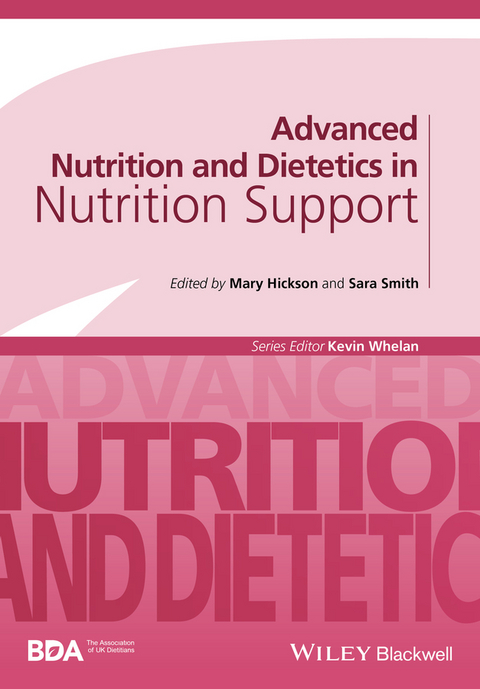
Advanced Nutrition and Dietetics in Nutrition Support (eBook)
John Wiley & Sons (Verlag)
978-1-118-99387-3 (ISBN)
Written in conjunction with the British Dietetic Association, Advanced Nutrition and Dietetics in Nutrition Support provides a thorough and critical review of the fundamental and applied literature in nutrition support.
Extensively evidence-based and internationally relevant, it discusses undernutrition, nutritional screening, assessment and interventions, as well as key clinical conditions likely to require nutrition support, and the approaches to managing this in each of these conditions.
Clinically oriented, Advanced Nutrition and Dietetics in Nutrition Support is the ideal reference for all those managing undernutrition in a range of clinical areas.
About the Editors
Mary Hickson PhD RD, is Professor of Dietetics at the University of Plymouth, UK.
Sara Smith PhD RD, is Senior Lecturer in Dietetics at Queen Margaret University, UK.
About the Series Editor
Kevin Whelan PhD RD FBDA, is Professor of Dietetics in the Department of Nutritional Sciences, King's College London, UK.
Written in conjunction with the British Dietetic Association, Advanced Nutrition and Dietetics in Nutrition Support provides a thorough and critical review of the fundamental and applied literature in nutrition support. Extensively evidence-based and internationally relevant, it discusses undernutrition, nutritional screening, assessment and interventions, as well as key clinical conditions likely to require nutrition support, and the approaches to managing this in each of these conditions. Clinically oriented, Advanced Nutrition and Dietetics in Nutrition Support is the ideal reference for all those managing undernutrition in a range of clinical areas.
About the Editors Mary Hickson PhD RD, is Professor of Dietetics at the University of Plymouth, UK. Sara Smith PhD RD, is Senior Lecturer in Dietetics at Queen Margaret University, UK. About the Series Editor Kevin Whelan PhD RD FBDA, is Professor of Dietetics in the Department of Nutritional Sciences, King's College London, UK.
Preface ix
Foreword xi
Editor biographies xii
Contributors xiii
Abbreviations xvii
Section 1 Background to Undernutrition 1
1.1 Definitions and prevalence of undernutrition 3
1.2 Physiological causes of undernutrition 6
1.3 Socioeconomic causes of undernutrition 15
1.4 Institutional causes of undernutrition 25
1.5 Consequences of undernutrition 33
Section 2 Identification of Undernutrition 43
2.1 Nutritional screening 45
2.2 Nutritional assessment 50
2.3 Anthropometric assessment of undernutrition 55
2.4 Biochemical assessment in undernutrition 65
2.5 Clinical assessment of undernutrition 74
2.6 Dietary assessment in undernutrition 82
2.7 Advanced imaging techniques for assessment of undernutrition 91
Section 3 Nutritional Requirements in Nutrition Support 107
3.1 Fluid requirements and assessment in nutrition support 109
3.2 Energy requirements in nutrition support 117
3.3 Protein requirements in nutrition support 127
3.4 Water-soluble vitamins in nutrition support 135
3.5 Fat-soluble vitamins in nutrition support 144
3.6 Minerals in nutrition support 155
Section 4 Nutritional Interventions to Prevent and Treat Undernutrition 167
4.1 Population and community interventions to prevent and treat undernutrition 169
4.2 Institutional interventions to prevent and treat undernutrition 176
4.3 Oral nutrition support to prevent and treat undernutrition 184
4.4 Enteral nutrition to prevent and treat undernutrition 194
4.5 Parenteral nutrition to prevent and treat undernutrition 207
Section 5 Undernutrition and Nutrition Support in Clinical Specialties 217
5.1 Nutrition support in paediatrics 219
5.2 Nutrition support in anorexia nervosa 231
5.3 Nutrition support in older adults 241
5.4 Nutrition support in neurological disorders 251
5.5 Nutrition support in spinal cord injury 259
5.6 Nutrition support in pulmonary and cardiac disease 270
5.7 Nutrition support in diabetes 278
5.8 Nutrition support in pancreatitis 286
5.9 Nutrition support in inflammatory bowel disease 296
5.10 Nutrition support in intestinal failure 302
5.11 Nutrition support in liver disease 313
5.12 Nutrition support in kidney disease 326
5.13 Nutrition support in critical care 339
5.14 Nutrition support in burn injury 351
5.15 Nutrition support in orthopaedics 358
5.16 Nutrition support in HIV infection 367
5.17 Nutrition support in oncology 376
5.18 Nutrition support in palliative care 389
Index 399
Chapter 1.1
Definitions and prevalence of undernutrition
Mary Hickson1 and Sara Smith2
1 Plymouth University Institute of Health and Community, Peninsula Alllied Health Centre, Plymouth, UK
2 Department of Dietetics, Nutrition and Biological Sciences, Queen Margaret University, Edinburgh, UK
1.1.1 Undernutrition: definition and diagnostic criteria
A universal definition for undernutrition is lacking, but it is generally accepted that malnutrition is defined as ‘a state of nutrition in which a deficiency or excess (or imbalance) of energy, protein and other nutrients causes measurable adverse effects on tissue and body form (body shape, size and composition) and function and clinical outcome’ [1]. Such a definition refers to both undernutrition and overnutrition; in this book, the term ‘undernutrition’ is used rather than ‘malnutrition’, to distinguish between the issues of undernutrition and overnutrition.
Global consensus work to develop universal diagnostic criteria and documentation for undernutrition is in progress and is led by the world’s four largest parenteral and enteral nutrition societies [2]. The ongoing work recognises the value of unified terminology, which reflects contemporary understanding and practices, to allow global comparisons and improve clinical care [3] and ultimately aims to seek the adoption of consensus criteria by the World Health Organization and the International Classification of Disease. Early discussions have identified that consensus criteria will need to take account of differences in global practices, such as financial reimbursement and the sometimes limited availability of assessment methods in clinical practice to assess body composition, for example fat‐free mass [2].
Diagnostic criteria have generally focused on dietary intake and clinically relevant changes in body mass (e.g. body mass index (BMI) and involuntary percentage weight loss) [1]. However, it is increasingly recognised that criteria should consider additional factors, such as the presence of acute or chronic inflammation and changes in muscle function [2–5]. This more aetiological approach to diagnosis would allow the recognition of important differences in the pathophysiology of undernutrition and potential response to intervention [5]. The assessment of muscle function and inflammatory markers could therefore result in earlier recognition of risk and the implementation of more effective targeted interventions [4].
The European Society of Enteral and Parenteral Nutrition [3] has proposed a more aetiological approach to the diagnosis of different categories of undernutrition (Figure 1.1.1). These categories are disease‐related undernutrition with inflammation, disease‐related undernutrition without inflammation and undernutrition without disease. However, further work is required to agree specific diagnostic indices for each of these categories. Furthermore, it is acknowledged that some patients may present with mixed aetiologies (e.g. disease‐related undernutrition together with economic‐related undernutrition). This book addresses the causes, consequences and management of undernutrition in the categories outlined in Figure 1.1.1, but the focus is on issues arising primarily in economically developed countries. The book does not attempt to explore the wide‐ranging and complex issues surrounding hunger‐related undernutrition in famine or conflict situations found more frequently in developing countries, particularly affecting children.
Figure 1.1.1 Diagnosis tree for undernutrition. COPD, chronic obstructive pulmonary disease.
Source: Adapted with permission of Elsevier from Cederholm et al. [3].
1.1.2 Prevalence of undernutrition
The reported prevalence of undernutrition in hospitals varies widely due to differences in study populations, assessment tools and settings. Interpretation of the data is also complicated by small and unrepresentative sample sizes, single‐centre studies, geographical variations, the use of tools without validation and failure to screen the total population. In Europe, several large studies indicate rates in the range of 20–30%, with a higher prevalence in older adults (32–58%) and in cancer (31–39%). Asian studies show a prevalence of 27–39%, again increasing with age (88%), and higher rates in critically ill (87%), surgical (56%) and gastrointestinal malignancy (48%) populations. Similar prevalence is found North America (37–45%) and Australia (23–42%). Prevalence of undernutrition in Latin American hospitals appears to be slightly higher with most studies indicating rates of 40–60%. Consistent with other countries, rates were higher in gastrointestinal surgery patients (55–66%) and older adults (44–71%) [6].
Over 20 years of data are available in the UK since the seminal paper by McWhirter and Pennington [7] was published, and include a national survey called ‘Nutritional Screening Week’ carried out by the British Association of Parenteral and Enteral Nutrition (BAPEN) over a 4‐year period, controlling for the time of the year [8]. This group of datasets shows similar patterns to those described above and also suggests that there has been little change in prevalence during this time [8]. Data on hospital incidence are completely lacking but are extremely challenging to collect and are unlikely to be available unless routine screening and storing in electronic records become the norm.
One obvious factor that will affect undernutrition is food intake during hospital stay. This has been examined by the ‘Nutrition Day’ survey, which is an annual 1‐day survey of hospital patients’ food intake. These important data show that almost half of all hospital patients (n = 91 245) did not eat a full meal. The factors associated with this lower intake are eating less the week before, physical immobility, female sex, old or young age, and a very low BMI [9]. This suggests that interventions to address poor food intake, targeted at those at risk, will be crucial to reduce prevalence of undernutrition in the future.
The prevalence of undernutrition in other settings has also been examined but far fewer data exist. Nursing and residential homes have reported rates of 17–71% for defined undernutrition and up to 97% for those at risk of undernutrition [10]. The UK Nutrition Screening Week data show rates of 41% with little variation across geographical regions or types of care home [11].
Overall, it is clear that undernutrition commonly occurs concurrently with disease and at particular life stages. It is important to note that the methods used to detect undernutrition in prevalence studies are designed to identify protein and energy undernutrition. The identification of micronutrient deficiencies requires different tools and tests.
Despite decades of identifying undernutrition as a prevalent and problematic condition, it remains an elusive challenge in institutional and community settings. Understanding the causes and consequences of undernutrition is essential to subsequently designing multicomponent approaches to reducing its burden.
References
- 1. Todorovic V, Russell CA, Elia M. The ‘MUST’ Explanatory Booklet. A Guide to the Malnutrition Universal Screening Tool (MUST) for Adults. Redditch: BAPEN, 2011.
- 2. Cederholm T, Jensen GL. To create a consensus on malnutrition diagnostic criteria: a report from the Global Leadership Initiative on Malnutrition (GLIM) meeting at the ESPEN Congress 2016. Clin Nutr 2017; 36(1): 7–10.
- 3. Cederholm T, Barazzoni R, Austin P, Ballmer P, Biolo G, Bischoff SC, Compher C, Correia I, Higashiguchi T, Holst M, et al. ESPEN guidelines on definitions and terminology of clinical nutrition. Clin Nutr 2017; 36(1): 49–64.
- 4. Smith S, Madden AM. Body composition and functional assessment of nutritional status in adults: a narrative review of imaging, impedance, strength and functional techniques. J Hum Nutr Diet 2016; 29(6): 714–732.
- 5. White JV, Guenter P, Jensen G, Malone A, Schofield M, Academy of Nutrition and Dietetics Malnutrition Work Group, ASPEN Malnutrition Task Force, ASPEN Board of Directors. Consensus statement of the Academy of Nutrition and Dietetics/American Society for Parenteral and Enteral Nutrition: characteristics recommended for the identification and documentation of adult malnutrition (undernutrition). J Acad Nutr Diet 2012; 112(5): 730–738.
- 6. Correia MI, Perman MI, Waitzberg DL. Hospital malnutrition in Latin America: a systematic review. Clin Nutr 2017; 36: 958–967.
- 7. McWhirter JP, Pennington CR. Incidence and recognition of malnutrition in hospital. BMJ 1994; 308(6934): 945–948.
- 8. Ray S, Laur C, Golubic R. Malnutrition in healthcare institutions: a review of the prevalence of under‐nutrition in hospitals and care homes since 1994 in England. Clin Nutr 2014; 33(5): 829–835.
- 9. Schindler K, Themessl‐Huber M, Hiesmayr M, Kosak S, Lainscak M, Laviano A, Ljungqvist O, Mouhieddine M, Schneider S, de van der Schueren M, et al. To eat or not to eat? Indicators for reduced food intake in 91,245 patients hospitalised on Nutrition Days 2006–2014 in 56 countries worldwide: a descriptive analysis. Am J Clin Nutr 2016; 104(5): 1393–1402.
- 10. Bell CL,...
| Erscheint lt. Verlag | 23.1.2018 |
|---|---|
| Reihe/Serie | Advanced Nutrition and Dietetics (BDA) |
| Advanced Nutrition and Dietetics (BDA) | Advanced Nutrition and Dietetics (BDA) |
| Sprache | englisch |
| Themenwelt | Medizin / Pharmazie ► Gesundheitsfachberufe ► Diätassistenz / Ernährungsberatung |
| Medizin / Pharmazie ► Medizinische Fachgebiete | |
| Schlagworte | Advanced Nutrition and Dietetics in Nutrition Support • British Dietetic Association • cancer patient nutrition support • child nutrition support • Clinical Nutrition • Clinical Specialities • diabetes patient nutrition support • diet • Dietary needs • dietary supplements for those in need • Dietetics • dietetic support • dietetic support for anorexics • dietetic support for bulimics • dietetic support for cancer victims • dietetic support for diabetics • dietitian • dietry management • Eating Disorders • elderly nutrition support • Enteral nutrition • Ernährung u. Diätetik • food access improvement • food interventions • Gesundheits- u. Sozialwesen • Health & Social Care • Health Care Professionals • infant nutrition support • Klinische Ernährung • Krankenpflege • malnourished children • malnourished elderly • Malnourishment • Malnutrition • nursing • Nutrition • nutritional ability in haemodialysis patients • Nutritional intervention • Nutritional screening • Nutritional Therapy • Nutrition & Dietetics General • nutrition support • nutrition support for HIV patient • nutrition support for patients with eating disorders • oral nutrition support • Parenteral nutrition • Spezialaufgaben i. d. klinischen Krankenpflege • treating malnourished • treating under-nourished • Under-nutrition |
| ISBN-10 | 1-118-99387-X / 111899387X |
| ISBN-13 | 978-1-118-99387-3 / 9781118993873 |
| Informationen gemäß Produktsicherheitsverordnung (GPSR) | |
| Haben Sie eine Frage zum Produkt? |
 EPUB (Adobe DRM)
Kopierschutz: Adobe-DRM
Adobe-DRM ist ein Kopierschutz, der das eBook vor Mißbrauch schützen soll. Dabei wird das eBook bereits beim Download auf Ihre persönliche Adobe-ID autorisiert. Lesen können Sie das eBook dann nur auf den Geräten, welche ebenfalls auf Ihre Adobe-ID registriert sind.
Details zum Adobe-DRM
Dateiformat: EPUB (Electronic Publication)
EPUB ist ein offener Standard für eBooks und eignet sich besonders zur Darstellung von Belletristik und Sachbüchern. Der Fließtext wird dynamisch an die Display- und Schriftgröße angepasst. Auch für mobile Lesegeräte ist EPUB daher gut geeignet.
Systemvoraussetzungen:
PC/Mac: Mit einem PC oder Mac können Sie dieses eBook lesen. Sie benötigen eine
eReader: Dieses eBook kann mit (fast) allen eBook-Readern gelesen werden. Mit dem amazon-Kindle ist es aber nicht kompatibel.
Smartphone/Tablet: Egal ob Apple oder Android, dieses eBook können Sie lesen. Sie benötigen eine
Geräteliste und zusätzliche Hinweise
Buying eBooks from abroad
For tax law reasons we can sell eBooks just within Germany and Switzerland. Regrettably we cannot fulfill eBook-orders from other countries.
aus dem Bereich