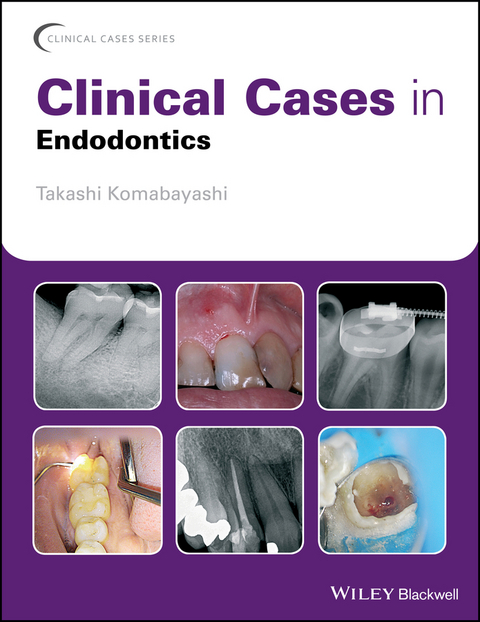
Clinical Cases in Endodontics (eBook)
John Wiley & Sons (Verlag)
978-1-119-14706-0 (ISBN)
A problem-based text that presents a wide range of real cases in endodontics
Clinical Cases in Endodontics presents actual clinical cases, accompanied by academic commentary, that question and educate the reader about essential topics in endodontic therapy. It begins with sets of cases illustrating the most common diagnoses and the steps involved in preparing a treatment plan. Subsequent chapters continue in this style, presenting exemplary cases as the basis of discussing various treatment options, including nonsurgical root canal treatment, re-treatment, periapical surgery, internal and external resorption, emergencies and trauma, and treating incompletely developed apices. The progression from common to increasingly challenging clinical cases enables readers to build their skills, aiding the ability to think critically and independently.
The Clinical Cases series is designed to recognize the centrality of clinical cases to the profession by providing actual cases with an academic backbone. Clinical Cases in Endodontics applies both theory and practice to real-life cases in a clinically relevant format. This unique approach supports the trend in case-based and problem-based learning, thoroughly covering the full range of endodontic treatment.
- Unique case-based format supports problem-based learning
- Promotes independent learning through self-assessment and critical thinking
- Covers all essential topics within endodontics
- Presents numerous illustrations and photographs throughout to depict the concepts described
Clinical Cases in Endodontics is an ideal resource for students mastering endodontic treatment, residents preparing for board examinations, and clinicians wanting to learn the most recent evidence-based treatment protocols.
The Editor
Takashi Komabayashi, DDS, MDS, PhD, is a Diplomate of the American Board of Endodontics and Clinical Professor at the University of New England College of Dental Medicine in Portland, Maine, USA.
The Editor Takashi Komabayashi, DDS, MDS, PhD, is a Diplomate of the American Board of Endodontics and Clinical Professor at the University of New England College of Dental Medicine in Portland, Maine, USA.
Clinical Cases in Endodontics v
Contributors ix
Acknowledgements xi
Chapter 1 Introduction 1
Takashi Komabayashi
Chapter 2 Diagnostic Case I 5
Tooth Fracture: Unrestorable
Suanhow Howard Foo
Chapter 3 Diagnostic Case II 11
Exploratory Surgery: Repairing Incomplete Fracture
Keivan Zoufan, Takashi Komabayashi, Qiang Zhu
Chapter 4 Emergency Case I 20
Interprofessional Collaboration between Medical and Dental
Andrew Xu
Chapter 5 Emergency Case II 27
Pulpal Debridement, Incision and Drainage (Intra-oral)
Victoria E. Tountas
Chapter 6 Emergency Case III 37
Pulpal Debridement, Incision and Drainage (Extra-oral)
Amr Radwan, Katia Mattos
Chapter 7 Non-surgical Root Canal Treatment Case I 45
Maxillary Anterior, Denise Foran
Chapter 8 Non-surgical Root Canal Treatment Case II 53
Mandibular Anterior
Jessica Russo Revand, John M. Russo
Chapter 9 Non-surgical Root Canal Treatment
Case III 63
Maxillary Anterior/Difficult case (Calcified Coronal ½ Canal System)
Andrew L. Shur
Chapter 10 Non-surgical Root Canal Treatment Case IV 72
Maxillary Premolar, Daniel Chavarría-Bolaños, David Masuoka-Ito, Amaury J. Pozos-Guillén
Chapter 11 Non-surgical Root Canal Treatment Case V 79
Mandibular Premolar
Takashi Okiji
Chapter 12 Non-surgical Root Canal Treatment
Case VI 91
Mandibular Premolar / Difficult Anatomy (three canals)
Savita Singh, Gayatri Vohra
Chapter 13 Non-surgical Root Canal Treatment Case VII 98
Maxillary Molar/Four Canals (MB1, MB2, DB, P)
Khaled Seifelnasr
Chapter 14 Non-surgical Root Canal Treatment Case VIII 105
Mandibular Molar
Ahmed O Jamleh, Nada Ibrahim
Chapter 15 Non-surgical Root Canal Treatment Case IX 113
Maxillary Molar /Difficult Anatomy (Dilacerated Molar Case Management)
Priya S. Chand, Jeffrey Albert
Chapter 16 Non-Surgical Re-treatment Case I 122
Maxillary Anterior
Kana Chisaka-Miyara
Chapter 17 Non-surgical Re-treatment Case II 129
Maxillary Premolar
Yoshio Yahata
Chapter 18 Non-surgical Re-treatment Case III 136
Mandibular Molar
Bruce Y. Cha
Chapter 19 Periapical Surgery Case I 147
Maxillary Premolar
Pejman Parsa
Chapter 20 Periapical Surgery Case II 154
Apical Infection Spreading to Adjacent Teeth
Takashi Komabayashi, Jin Jiang, Qiang Zhu
Chapter 21 Periapical Surgery Case III 164
Maxillary Molar
Parisa Zakizadeh
Chapter 22 Perio-Endo Interrelationships 172
Abdullah Alqaied, Maobin Yang
Chapter 23 Traumatic Injuries 179
Avulsed and Root-Fractured Maxillary Central Incisor
Bill Kahler, Louis M. Lin
Chapter 24 Incompletely Developed Apices 188
Nathaniel T. Nicholson
Chapter 25 External/Internal Resorption 200
Keivan Zoufan, Takashi Komabayashi, Qiang Zhu
Index
Chapter 2
Diagnostic Case I:
Tooth Fracture: Unrestorable
Suanhow Howard Foo
- To apply knowledge of dental anatomy to clinical procedures involving a cracked tooth.
- To be able to interpret radiographs used in endodontic diagnosis.
- To formulate a correct endodontic diagnosis and treatment plan based on a variety of clinical testing procedures, taking into account factors such as loss of tooth structure, bruxism, age, and gender.
- To understand the prognosis and incidence rates of the various types of root fractures.
Chief Complaint
“I had excruciating pain last night, now I can't touch my tooth.”
Medical History
The patient (Pt) was a 58-year-old male Caucasian. He presented with nothing significant in medical history and no allergies to any medications or to latex. Vital signs were: Blood pressure (BP) 132/87 mmHg, pulse 82 beats per minute (BPM), respiratory rate (RR) 17 breaths per minute.
The Pt was American Society of Anesthesiologists Physical Status Scale (ASA) Class II.
Dental History
Pt had on-and-off pain on the lower right quadrant for a few weeks and was referred for an evaluation of tooth #31. The tooth had a mesial (M) to distal (D) crack. The tooth was painful to touch and the Pt could not eat or bite on that tooth. Pt reported a history of bruxism.
Clinical Evaluation (Diagnostic Procedures)
Examinations
Extra-oral Examination (EOE)
No asymmetry, no lymphadenopathy, no deviation of jaw when opening, no swelling, and temporomandibular joint (TMJ) was within normal limits (WNL).
Intra-oral examination (IOE)
Oral cancer screening performed with all tissues WNL. Tooth #31 had a M to D crack. Periodontal exam showed probing depths from M to D of Facial (4 mm, 3 mm and 8 mm) and M to D of Lingual (4 mm, 4 mm and 8 mm). Tooth #31 had type 1 mobility. Tooth #30 had probing depths from M to D of Facial (4 mm, 3 mm and 4 mm) and M to D of Lingual (4 mm, 4 mm and 4 mm). Tooth #31 had pain with bite test and pain when occluding. Methylene blue dye and fiber optics showed fracture was through and through and extended below the cementoenamel junction (CEJ).
Diagnostic Tests
| Tooth | #29 | #30 | #31 |
| Percussion | – | – | + |
| Palpation | – | – | – |
| Cold | Normal | Normal | – |
| Mobility | None | None | Class 1 |
| Bite | – | – | + |
+: Response to percussion, or bite stick test;
– : No response to percussion, palpation, cold, or on bite stick test
Radiographic Findings
Tooth #31 had a radiolucency that extended from the D cervical area to the apex of the D root. A crack could be seen on the D portion of tooth #31 with the D restorative material fractured. (See Figures 2.1 and 2.2.)
Figure 2.1 The initial radiograph of tooth #31. Notice the shallow restoration and the periapical rarefaction at the root apices.
Figure 2.2 The extent of rarefaction in the distal root of tooth #31. Note how the radiolucency moves up to the alveolar crest.
Pretreatment Diagnosis
Pulpal
Pulp Necrosis, tooth #31
Apical
Symptomatic Apical Periodontitis, tooth #31
Treatment Plan
Recommended
Emergency:Extraction, tooth #31
Definitive:Extraction, tooth #31
Alternative
No treatment
Restorative
Implant or Fixed Prosthetics
Prognosis
| Favorable | Questionable | Unfavorable |
| X |
Clinical Procedures: Treatment Record
First visit (Day 1): Exam: Pt was referred for an evaluation of tooth #31. Medical history (Hx) and vital signs were taken. Three periapical (PA) radiographs were prescribed in order to evaluate the PA area for possible infection and to determine the extent of the crack. The radiographs showed PA rarefactions (Figures 2.1 and 2.2) at root tips and bone loss in D root area. Clinical tests and exams were performed. Tooth #31 had an M to D crack that was verified with methylene blue (Figure 2.3) and a fiber optic light (Figures 2.4 and 2.5). The tooth could be separated in a buccal–lingual (B–L) manner with light touch. The defect could be seen extending to the pulpal floor. Pt was informed that the prognosis of the tooth was unfavorable and that extraction was needed to alleviate his pain and for healing to occur. The Pt accepted treatment (Tx) of extraction of Tooth #31. The extracted tooth was photographed and confirmed the initial diagnosis of a root fracture and split tooth (Figure 2.6).
Figure 2.3 Mesial to distal crack of tooth #31, stained with methylene blue to better visualize the extent of the crack.
Figure 2.4 Fiber optic light illumination of tooth #31 shows that the crack goes below the CEJ. The light does not pass through from lingual to buccal.
Figure 2.5 Fiber optic light was used on the buccal surface to confirm the crack.
Figure 2.6 Diagnosis of a split tooth is confirmed after the extraction of tooth #31.
Post-Treatment Evaluation
Second visit (1-week follow-up): Pt returned for a post-operative (PO) follow-up. The area around the extraction site of tooth #31 was neither inflamed nor swollen. Gingival tissue had already begun to fill in the socket. The Pt was able to eat and brush his teeth in the lower right quadrant.
-
A. How is a fractured tooth diagnosed?
-
B. What are the types of cracks one may see in a suspected tooth fracture?
-
C. What is the prognosis for a cracked tooth?
-
D. How is a cracked tooth treated?
-
E. What is the incidence rate of fractures?
-
A.
There are multiple ways to determine whether or not a tooth is fractured. It is important to start with a good dental history of the tooth. A clinical exam should include a bite stick, ice for vitality testing, and a periodontal probing to check for deep narrow pockets. A radiographic exam is important to check for periapical rarefactions or possibly to reveal a fracture itself if it is large enough. Finally, a stain (methylene blue), or trans-illumination may be used to visualize the fracture. Sometimes the tooth may be mobile or a sinus tract may have developed due to fracture necrosis. If a tooth is non-vital with minimal or no restorations, suspect a crack or fracture (Berman & Kuttler 2010). The older the tooth, the more susceptible it is to fracture (Berman & Kuttler 2010). Cracked teeth are more commonly found in lower molars, followed by maxillary premolars (Cameron 1976). Another study found that lower 2nd molars were more likely to have cracks after root canal treatment (Kang, Kim & Kim 2016).
-
B.
According to the American Association of Endodontics (Rivera & Walton 2008), there are five categories of crack:
- Craze lines: Only involving the enamel;
- Split tooth: Complete fracture through the tooth, usually centered mesial to distal;
- Fractured cusp: Usually non-centered and affecting one cusp;
- Cracked tooth: An incomplete fracture that extends from the crown to the subgingival area of the tooth; and
- Vertical Root Fracture (VRF): This may be symptomatic or non- symptomatic. The majority of the VRFs are associated with root-filled teeth. It may be a complete or an incomplete fracture.
-
C.
The prognosis for a cracked tooth is always going to be questionable (Rivera & Walton 2008). The prognosis is always better if the crack does not extend to the pulp chamber floor (Turp & Gobetti 1996; Sim et al. 2016). Vital is better than necrotic (Turp & Gobetti 1996). The quality of the restoration and whether a full coverage crown may cover the crack and other defects are considerations (Rivera & Walton 2008), as is whether an abscess or radiographic rarefaction is present prior to treatment. These two factors would lower the prognosis of the tooth in question (Berman & Kuttler 2010). One study found that cracked teeth had a two-year survival rate of 85.5% (Tan et al. 2006). Another study found that after five years, the survival rate of root-filled cracked teeth was 92%, with the odds of extraction increasing if the cracks were in the root (Sim et al. 2016). Finally, a recent study from Korea showed a 90%, two-year survival rate for a cracked tooth, probing depths greater than 6 mm being a significant factor in the prognosis (Kang et al. 2016).
-
D.
After removal of all caries or previous restorations,...
| Erscheint lt. Verlag | 27.12.2017 |
|---|---|
| Reihe/Serie | Clinical Cases (Dentistry) |
| Clinical Cases (Dentistry) | Clinical Cases (Dentistry) |
| Sprache | englisch |
| Themenwelt | Medizin / Pharmazie ► Allgemeines / Lexika |
| Medizin / Pharmazie ► Gesundheitsfachberufe | |
| Medizin / Pharmazie ► Zahnmedizin | |
| Schlagworte | anatomy • Biomedical Science • Clinical Dentistry • DDS degrees • Dental education • Dental Hygiene • dental research • Dental School • Dental Surgery • dental therapy • dentistry • dentists • Einführung i. d. Zahnmedizin • endodontic • Endodontics • endodontic therapy • Endodontie • Endodontik • external resorption • Histology • internal resorption • Introductions to Dentistry • introductory dentistry • Maxillofacial Pathology • Medical Science • nonsurgical root canal treatment • Oral Biology • oral bioscience • oral hygiene • oral microbiology • Oral Science • Oral surgery • orthodontia • Periapical Surgery • Physiology • Pulp Regeneration • root canal • Zahnmedizin |
| ISBN-10 | 1-119-14706-9 / 1119147069 |
| ISBN-13 | 978-1-119-14706-0 / 9781119147060 |
| Informationen gemäß Produktsicherheitsverordnung (GPSR) | |
| Haben Sie eine Frage zum Produkt? |
 EPUB (Adobe DRM)
Kopierschutz: Adobe-DRM
Adobe-DRM ist ein Kopierschutz, der das eBook vor Mißbrauch schützen soll. Dabei wird das eBook bereits beim Download auf Ihre persönliche Adobe-ID autorisiert. Lesen können Sie das eBook dann nur auf den Geräten, welche ebenfalls auf Ihre Adobe-ID registriert sind.
Details zum Adobe-DRM
Dateiformat: EPUB (Electronic Publication)
EPUB ist ein offener Standard für eBooks und eignet sich besonders zur Darstellung von Belletristik und Sachbüchern. Der Fließtext wird dynamisch an die Display- und Schriftgröße angepasst. Auch für mobile Lesegeräte ist EPUB daher gut geeignet.
Systemvoraussetzungen:
PC/Mac: Mit einem PC oder Mac können Sie dieses eBook lesen. Sie benötigen eine
eReader: Dieses eBook kann mit (fast) allen eBook-Readern gelesen werden. Mit dem amazon-Kindle ist es aber nicht kompatibel.
Smartphone/Tablet: Egal ob Apple oder Android, dieses eBook können Sie lesen. Sie benötigen eine
Geräteliste und zusätzliche Hinweise
Buying eBooks from abroad
For tax law reasons we can sell eBooks just within Germany and Switzerland. Regrettably we cannot fulfill eBook-orders from other countries.
aus dem Bereich