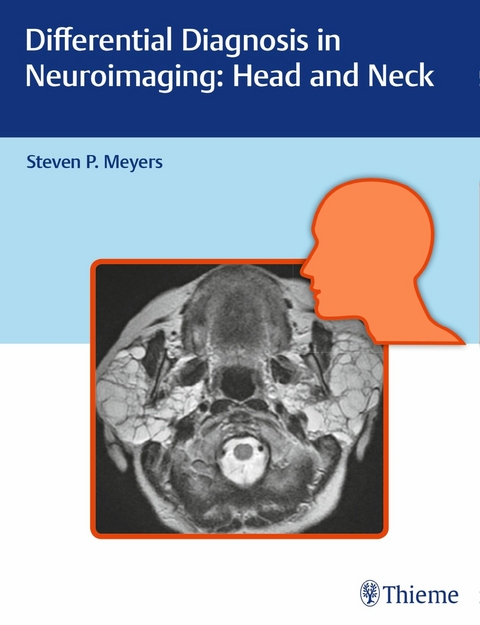
Differential Diagnosis in Neuroimaging: Head and Neck (eBook)
664 Seiten
Georg Thieme Verlag KG
978-1-62623-476-5 (ISBN)
1 Skull and Temporal Bone
2 Orbit
3 Paranasal Sinuses and Nasal Cavity
4 Suprahyoid Neck
5 Infrahyoid Neck
6 Lesions That Can Involve Both Suprahyoid and Infrahyoid Neck
7 Brachial Plexus
Chapter 2
Orbit
2.1 Congenital and developmental abnormalities
2.2 Acquired lesions involving the eye
2 Orbit
Table 2.1 Congenital and developmental abnormalities
Table 2.2 Acquired lesions involving the eye
Table 2.3 Extraocular lesions of the orbit
Introduction
Bony Orbit
The bony orbit is a four-sided pyramidal structure within which are the eye (globe), fat, extraocular muscles, nerves, and blood vessels.1,2,3,4,5 The medial orbital wall is composed of the frontal process of the maxilla, lacrimal bone, lamina papyracea, and sphenoid bone (Fig. 2.1). The lateral orbital wall is composed of the zygoma, frontal bone, and greater wing of the sphenoid bone (Fig. 2.2). The orbital floor is composed of the zygoma and orbital plate of the maxilla. At the posterolateral aspect of the orbital floor is the inferior orbital fissure, which the second division of the trigeminal nerve traverses. The V2 nerve enters the orbit from the pterygopalatine fossa. The V2 nerve is located in a sulcus along the posterior orbital floor, where it eventually enters the infraorbital canal and emerges from the infraorbital foramen. Other structures that pass through the inferior orbital fissure are the inferior ophthalmic vein, infraorbital branch of the maxillary artery, and autonomic branches of the pterygopalatine ganglion. The orbital roof is composed mostly of the frontal bone, as well as the lesser wing of the sphenoid bone posteriorly.
Superior Orbital Fissure
The superior orbital fissure is located between the greater and lesser sphenoid wings (Fig. 2.3). The superior orbital fissure is a passage through which nerves from the cavernous sinus (Fig. 2.4) enter the orbits, including the ophthalmic (V1) division of the trigeminal nerve, trochlear nerve (CN IV), oculomotor nerve (CN III), abducens nerve (CN VI), and sympathetic nerve fibers. The annulus of Zinn (annulus tendineus communis) at the superior orbital fissure is a fibrous ring to which the extraocular muscles attach. The superior ophthalmic vein also crosses through the superior orbital fissure.
Fig. 2.1 Illustration showing the osseous components of the medial wall of the orbit. From THIEME Atlas of Anatomy: Head and Neuroanatomy, Thieme 2007, Illustration by Karl Wesker.
Fig. 2.2 Illustration showing the osseous components of the lateral wall of the orbit. From THIEME Atlas of Anatomy: Head and Neuroanatomy, © Thieme 2007, Illustration by Karl Wesker.
Fig. 2.3 Illustration showing the posterior osseous components of the orbits as well as the superior orbital fissures, optic canals, and adjacent nasal cavity and paranasal sinuses. From THIEME Atlas of Anatomy: Head and Neuroanatomy, © Thieme 2007, Illustration by Karl Wesker.
Fig. 2.4 Coronal view of the contents of the cavernous sinuses and adjacent anatomic structures. From THIEME Atlas of Anatomy: Head and Neuroanatomy, © Thieme 2007, Illustration by Karl Wesker.
Orbital Apex
The orbital apex is located posteriorly and contains the superior orbital fissure between the lateral orbital wall and orbital roof, the optic canal in the lesser wing of the sphenoid bone, and the inferior orbital fissure (Fig. 2.5).
Optic Canal
The optic canal is located within the lesser wing of the sphenoid bone and is medial to the anterior clinoid process and superomedial to the superior orbital fissure. A thin bone wall separates the optic canal and superior orbital fissure. The optic canal contains the optic nerve and ophthalmic artery.
Extraocular Muscles
The extraocular muscles include the medial, lateral, superior, and inferior rectus muscles that originate from the annulus of Zinn and course through orbital fat before inserting onto their respective positions on the globe (Fig. 2.6). The superior oblique muscle also originates from the annulus of Zinn and courses anteriorly to the trochlea, where its tendon turns to insert on the posterolateral margin of the globe. The inferior oblique muscle originates from the periorbita at the inferomedial aspect of the globe and courses anteriorly, where its tendon inserts on the inferolateral aspect of the globe. The seventh extraocular muscle, the levator palpebrae superioris, originates from the lesser sphenoid wing and extends anteriorly to become the aponeurosis, which inserts onto the tarsal plate and eyelid skin. CN III innervates the levator palpebrae superioris and inferior oblique muscles, as well as the medial, superior, and inferior rectus muscles. The motor nucleus of CN III is located in the dorsal portion of the midbrain ventral to the periaqueductal gray at the level of the superior colliculi. CN VI innervates the lateral rectus muscle, and CN IV innervates the superior oblique muscle.
Sensory Nerves
The ophthalmic division of CN V within the lateral wall of the cavernous sinus divides into three branches (lacrimal, frontal, and nasociliary nerves), which then enter the orbit through the superior orbital fissure. The lacrimal nerve provides postganglionic secretomotor fibers to the lacrimal gland and sensory fibers in the conjunctiva and skin. The frontal nerve is located in the upper orbit between the levator palpebrae and periorbita and provides sensory input from the forehead and medial eyelid. The nasociliary nerve passes between the superior oblique and medial rectus muscles and divides into anterior and posterior ethmoidal nerves, nerve branches to the ciliary ganglion, and the infratrochlear nerve, which receives sensory input from the globe, medial upper eyelid, and forehead.
Branches from the maxillary division of CN V enter the inferior orbital fissure from the pterygomaxillary fossa and pass anteriorly through the orbit in the infraorbital canal to receive sensory input from the lower eyelid, conjunctiva, cheek, and upper lip. A branch of the infraorbital nerve is the superior alveolar nerve, which receives sensory input from the upper anterior teeth. The zygomatic V2 branch of CN V enters the inferior orbital fissure and receives sensory input from the skin at the lateral orbit and supplies additional secretomotor fibers to the lacrimal gland.
Fig. 2.5 Coronal view of the anatomic relationship of structures at the orbital apex. From THIEME Atlas of Anatomy: Head and Neuro anatomy, © Thieme 2007, Illustration by Karl Wesker.
Fig. 2.6 Axial view of the extraocular muscles and their anatomic relationships to adjacent structures. From THIEME Atlas of Anatomy: Head and Neuroanatomy, © Thieme 2007, Illustration by Karl Wesker.
Periorbita, Tenon’s Capsule, and Orbital Fat
Along the inner bony walls of the orbit is a fibrous lining referred to as the periorbita that is tightly attached to bone at the orbital margins anteriorly (orbital septum), suture lines and fissures, and anterior lacrimal crest. Tenon’s capsule is a fascial sheath that surrounds the eye, separating the globe from the adjacent orbital fat. This fascial sheath fuses anteriorly with the sclera at the scleral-corneal junction and bulbar conjunctiva. Structures that extend through Tenon’s capsule include the tendons of the extraocular muscles, optic nerve, ciliary nerves, and veins from the choroid and sclera (vortex veins). The potential space that can occur between the sclera and Tenon’s capsule is referred to as the episcleral or Tenon’s space, which is a site where infection, inflammation, and neoplasms can enter. Orbital fat surrounds the globe, extraocular muscles, and optic nerve. Connective tissue septa separate the intraconal fat deep to extraocular muscles from the extraconal fat.
Eye
The eye (globe) has three primary layers (sclera, uveal tract, and retina; Fig. 2.7).
The sclera is the outermost layer, which consists of the transparent cornea anteriorly and a fibrous opaque portion that extends posteriorly where it fuses with the dural sheath of the optic nerve.
The uveal tract is a pigmented vascular layer between the sclera and retina. The uveal tract includes the iris, ciliary body, and choroid. The choroid extends from the optic nerve to the ora serrata (anterior-most margin of the retina). The choroid has firm attachments to the adjacent sclera anteriorly at the ora serrata/ciliary body and posteriorly...
| Erscheint lt. Verlag | 14.12.2016 |
|---|---|
| Verlagsort | NEW YORK |
| Sprache | englisch |
| Themenwelt | Medizinische Fachgebiete ► Chirurgie ► Neurochirurgie |
| Medizinische Fachgebiete ► Innere Medizin ► Pneumologie | |
| Medizin / Pharmazie ► Medizinische Fachgebiete ► Neurologie | |
| Medizinische Fachgebiete ► Radiologie / Bildgebende Verfahren ► Nuklearmedizin | |
| Medizinische Fachgebiete ► Radiologie / Bildgebende Verfahren ► Radiologie | |
| Schlagworte | Differential Diagnosis • Head and Neck • neuroimaging |
| ISBN-10 | 1-62623-476-0 / 1626234760 |
| ISBN-13 | 978-1-62623-476-5 / 9781626234765 |
| Informationen gemäß Produktsicherheitsverordnung (GPSR) | |
| Haben Sie eine Frage zum Produkt? |
 EPUB (Wasserzeichen)
DRM: Digitales Wasserzeichen
Dieses eBook enthält ein digitales Wasserzeichen und ist damit für Sie personalisiert. Bei einer missbräuchlichen Weitergabe des eBooks an Dritte ist eine Rückverfolgung an die Quelle möglich.
Dateiformat: EPUB (Electronic Publication)
EPUB ist ein offener Standard für eBooks und eignet sich besonders zur Darstellung von Belletristik und Sachbüchern. Der Fließtext wird dynamisch an die Display- und Schriftgröße angepasst. Auch für mobile Lesegeräte ist EPUB daher gut geeignet.
Systemvoraussetzungen:
PC/Mac: Mit einem PC oder Mac können Sie dieses eBook lesen. Sie benötigen dafür die kostenlose Software Adobe Digital Editions.
eReader: Dieses eBook kann mit (fast) allen eBook-Readern gelesen werden. Mit dem amazon-Kindle ist es aber nicht kompatibel.
Smartphone/Tablet: Egal ob Apple oder Android, dieses eBook können Sie lesen. Sie benötigen dafür eine kostenlose App.
Geräteliste und zusätzliche Hinweise
Buying eBooks from abroad
For tax law reasons we can sell eBooks just within Germany and Switzerland. Regrettably we cannot fulfill eBook-orders from other countries.
aus dem Bereich