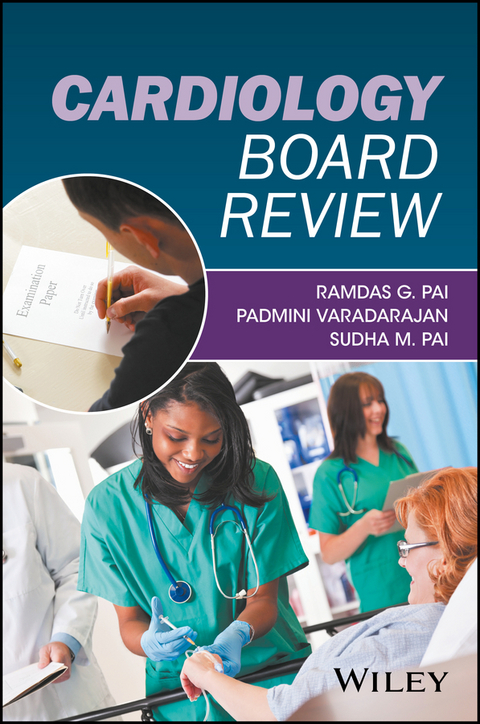
Cardiology Board Review (eBook)
John Wiley & Sons (Verlag)
978-1-118-69901-0 (ISBN)
- Features over 1200 questions with answers and clear explanations
- Includes over 400 accompanying images
- Covers all key areas of cardiology practice, from history/physicial examination through all major diseases/disorders, along with special topics, e.g. consultative cardiology, covered on the exam
- Complements standard textbook reading
- Written by an internationally-recognized, well-respected and well-published senior cardiologist, expert in valvular heart disease and cardiovascular imaging
Ramdas G. Pai MD, FRCP (Edin), FACC, Professor and Chairman of Medicine, Chair of Clinical Sciences, Director of Cardiovascular Fellowship Program, University of California Riverside School of Medicine, Riverside, CA, USA
Padmini Varadarajan MD, FACC, Professor of Medicine, Division of Cardiology, Loma Linda University Medical Center, Loma Linda, CA, USA
Sudha M. Pai MD, MRCP (UK), FACC, Associate Professor of Medicine, Division of Cardiology, Loma Linda University Medical Center, Loma Linda, CA, USA
This compact but comprehensive board review includes everything you need to successfully prepare for the ABIM Cardiology Board Review examination. Features over 1200 questions with answers and clear explanations Includes over 400 accompanying images Covers all key areas of cardiology practice, from history/physicial examination through all major diseases/disorders, along with special topics, e.g. consultative cardiology, covered on the exam Complements standard textbook reading Written by an internationally-recognized, well-respected and well-published senior cardiologist, expert in valvular heart disease and cardiovascular imaging
Ramdas G. Pai MD, FRCP (Edin), FACC, Professor and Chairman of Medicine, Chair of Clinical Sciences, Director of Cardiovascular Fellowship Program, University of California Riverside School of Medicine, Riverside, CA, USA Padmini Varadarajan MD, FACC, Professor of Medicine, Division of Cardiology, Loma Linda University Medical Center, Loma Linda, CA, USA Sudha M. Pai MD, MRCP (UK), FACC, Associate Professor of Medicine, Division of Cardiology, Loma Linda University Medical Center, Loma Linda, CA, USA
Preface ix
1 History and Physical Examination 1
Ramdas G. Pai
2 Electrocardiography 13
Ramdas G. Pai and SudhaM. Pai
3 Chest X-Ray in Cardiology 5
Padmini Varadarajan and Ramdas G. Pai
4 Stress Testing and Risk Stratification of Asymptomatic Subjects 80
Padmini Varadarajan and Ramdas G. Pai
5 Echocardiography 95
Ramdas G. Pai and Padmini Varadarajan
6 Cardiac Magnetic Resonance Imaging 150
Padmini Varadarajan and Ramdas G. Pai
7 Cardiac Computed Tomography 172
Ramdas G. Pai
8 Cardiac Catheterization 199
Prabhdeep S. Sethi
9 Acute Coronary Syndromes 210
Ramdas G. Pai
10 Chronic Coronary Artery Disease 229
Padmini Varadarajan
11 Heart Failure, Transplant, Left Ventricular Assist Devices, Pulmonary Hypertension 245
Ramdas G. Pai
12 Cardiomyopathies 270
Ramdas G. Pai and Padmini Varadarajan
13 Hypertension 288
Padmini Varadarajan and Ramdas G. Pai
14 Diabetes Mellitus 298
Padmini Varadarajan
15 Lipids 305
Padmini Varadarajan and Ramdas G. Pai
16 Valvular Heart Disease 318
Ramdas G. Pai
17 Adult Congenital Heart Disease 351
Padmini Varadarajan and Ramdas G. Pai
18 Pericardial Disea ses 376
Ramdas G. Pai
19 Aortic Diseases 385
Ahmed Shafter and AshishMukherjee
20 Carotid and Vertebral Artery Disease 403
Prabhdeep S. Sethi
21 Peripheral Vascular Disease 416
Ahmed Shafter and AshishMukherjee
22 Cardiac Arrhythmias 435
SudhaM. Pai
23 Pacemakers and Defibrillators 463
SudhaM. Pai
24 Cardiac Masses 468
Padmini Varadarajan
25 Systemic Disorders Affecting the Heart 501
Ramdas G. Pai
26 Interdisciplinary Consultative Cardiology 505
Ramdas G. Pai
27 Heart Disease and Pregnancy 515
Padmini Varadarajan and Ramdas G. Pai
28 Racial and Gender Disparities 521
SudhaM. Pai and Ramdas G. Pai
29 Pharmacological Principles of Cardiac Drugs 524
Christopher Hauschild and Lily Yam
30 Anticoagulation 535
Padmini Varadarajan
31 Aspirin and Antiplatelet Therapy 547
Christopher Hauschild and Lily Yam
32 Statistical Concepts 553
Ramdas G. Pai
33 Genetics 562
Padmini Varadarajan
34 Cardiac Emergencies and Resuscitation 565
Ramdas G. Pai
Index 571
1
History and Physical Examination
-
A 25-year-old woman has a 2/6 ejection systolic murmur best heard in the second left intercostal space with normal S1. The S2 is split during inspiration, and P2 intensity is normal. No apical or parasternal heave. The murmur diminishes during expiration and standing up. What is the murmur likely due to?
- Physiological or normal
- Atrial septal defect (ASD)
- Bicuspid aortic valve
- Hypertrophic obstructive cardiomyopathy (HOCM)
-
A 29-year-old pregnant woman was found to a have a systolic murmur best heard in the second left intercostal space. It is rough and there was a palpable thrill in the same area and in the suprasternal notch. Patient is asymptomatic and has normal exercise tolerance. What is the likely explanation of the murmur?
- Pulmonary stenosis (PS)
- Normal flow murmur due to increased cardiac output
- Posterior mitral leaflet prolapse causing an interiorly directed jet
- Mammary soufflé
-
A 22-year-old patient has a hypoplastic radial side of the forearm and fingerized thumb. What this may be associated with?
- ASD
- Tetralogy of Fallot
- Coarctation of aorta
- Ebstein's anomaly
-
A 28-year-old man presented with a history of shortness of breath on exertion. On examination, the pulse rate was 76 bpm and blood pressure (BP) 126/80 mmHg. The left ventricular apex was prominent and forceful. The S1 and S2 were normal, but there was a 2/6 ejection systolic murmur best heard in the third right intercostal space. There was no appreciable variation with respiration, but there was an increase in intensity with the Valsalva maneuver and standing up. It seemed to be less prominent on squatting. There was no audible click. What is the murmur likely due to?
- Valvular aortic stenosis
- HOCM
- Mitral valve prolapse (MVP)
- Innocent murmur
-
A 36-year-old asymptomatic woman was found to have a systolic murmur best heard in the apex, but also in the aortic area. It was mid to late systolic and was associated with a sharp systolic sound. What is the likely cause of the murmur?
- Posterior mitral leaflet prolapse
- Anterior mitral leaflet prolapse
- Valvular aortic stenosis
- Aortic subvalvular membrane
-
A 78-year-old man with hypertension and diabetes mellitus presented with exertional shortness of breath of 6 months’ duration. Examination revealed a 4/6 crescendo–decrescendo murmur best heard in the second right intercostal space. The first component of the second sound was soft. The murmur was also heard along the right carotid artery. What is this patient likely to have?
- Mild aortic stenosis
- Moderate or severe aortic stenosis
- Pulmonary stenosis
- MR
-
A thrill and a continuous machinery murmur in the left infraclavicular area is indicative of what?
- Patent ductus arteriosus (PDA)
- Increased flow due to left arm arteriovenous (AV) fistula for dialysis
- Venous hum
- Pulmonary AV fistula
-
Which of the following is not a feature of aortic coarctation?
- A continuous murmur on the back
- Lower blood pressure in legs compared with arm
- Radiofemoral delay
- Pistol shot sounds on femoral arteries
-
A 22-year-old newly immigrant woman was referred to high-risk pregnancy clinic because of clubbing and cyanosis. Examination in addition revealed a parasternal heave, 4/6 ejection systolic murmur in the third left intercostal space, normal jugular venous pressure (JVP), and oxygen saturation of 75%. What will you recommend after confirmation of the diagnosis?
- Continue pregnancy with sodium restriction
- Continue pregnancy, but deliver at 28 weeks
- Advise termination of pregnancy
- Perform percutaneous ASD closure and continue pregnancy
-
What is the murmur of ASD?
- Continuous due to flow across the defect
- Ejection systolic due to increased flow across the pulmonary valve
- Mid-diastolic due to increased flow across the tricuspid valve
- Continuous over lung fields due to increased flow in lungs
-
What is a systolic click that disappears on inspiration likely due to?
- Pulmonary valvular stenosis
- Bicuspid aortic valve
- MVP
- Pulmonary hypertension
-
A 36-year-old woman presented with an 8-month history of progressive exertional dyspnea. Physical examination revealed heart rate of 74 bpm, regular, BP 126/78 mmHg, no pedal edema. JVP and carotid upstroke were normal. Cardiac auscultation revealed normal S1, an accentuated P2 with narrow splitting of S2, an ejection click, and a 2/6 ejection systolic murmur. What is the likely diagnosis?
- Pulmonary hypertension
- PS
- Aortic stenosis
- ASD
-
Causes of prominent “a” wave in jugular venous pulsations include all of the following except which option?
- PS
- Pulmonary hypertension
- Tricuspid stenosis
- Aortic stenosis
- ASD
-
What is a 6-year-old Amish boy in Pennsylvania with short stature, polydactyly, short limbs, absent upper incisor teeth with dysplasia of other teeth, and a systolic murmur most likely to have?
- ASD
- Ventricular septal defect
- Aortic coarctation
- PS
-
Which of the following describes ventricular septal defect murmur?
- Holosystolic
- Ejection systolic
- Systolico-diastolic
- None of the above
-
Clubbing and cyanosis in lower limbs, but not upper limbs, is indicative of which of the following?
- PDA with coarctation of aorta
- PDA with pulmonary hypertension
- Ventricular septal defect Eisenmenger's
- ASD Eisenmenger's with coarctation of aorta
-
A 46-year-old man presented with progressive fatigue and leg swelling. He had no significant past medical history except a front-on collision in a car he was driving. Examination revealed 2+ edema, raised JVP, and an enlarged liver, which seemed to expand during systole. What is the likely diagnosis?
- Severe tricuspid stenosis
- Severe tricuspid regurgitation (TR)
- Constrictive pericarditis
- Restrictive cardiomyopathy
-
A 23-year-old has a mid-diastolic rumble and sharp early diastolic sound. What is the likely explanation?
- Mitral stenosis
- Constriction
- Restriction
- Bicuspid aortic valve
-
A 28-year-old man has history of progressive fatigue and exertional shortness of breath over the last 6 months. Examination revealed raised JVP that seemed to increase with inspiration and a sharp precordial sound in early diastole. What is the most likely diagnosis?
- Right ventricular infarct
- Tricuspid stenosis
- Constrictive pericarditis
- Restrictive cardiomyopathy
-
A 66-year-old woman with left breast cancer post mastectomy, radiation, and chemotherapy was admitted with shortness of breath, heart rate of 120 bpm, and BP of 90/60 mmHg. On slow cuff deflation during BP measurement, Korotkoff's sounds started at 90 mmHg during expiration only and throughout the respiratory cycle at a cuff pressure of 70 mmHg. An echocardiogram was obtained. What is this likely to show?
- Akinesis of left anterior descending area
- Thick pericardium
- Large pericardial effusion
- Large, globally hypokinetic left ventricle.
-
Features of restrictive cardiomyopathy may include all of the following except which option?
- Raised JVP
- Loud S3
- Kussmaul's sign
- A diastolic knock in pulmonary area
-
Pulsus paradoxus despite tamponade may not be present in which of the following?
- ASD
- Aortic stenosis
- Mitral stenosis
- Old age
-
Pulsus paradoxus may occur in all of the following except which option?
- Tamponade
- Status asthmaticus
- Pulmonary embolism
- Aortic stenosis
-
Square sign during Valsalva maneuver occurs in which of the following?
- HOCM
- MVP
- Aortic stenosis
- Congestive heart failure
-
An abnormal Schamroth's test may be found in all of the following except which option?
- Tetralogy of Fallot
- Subacute bacterial endocarditis
- Left atrial myxoma
- Aortic stenosis
-
1.26–1.31. For the jugular vein or RA pressure tracings shown in Figures 1.26–1.31, match...
| Erscheint lt. Verlag | 5.12.2017 |
|---|---|
| Sprache | englisch |
| Themenwelt | Medizin / Pharmazie ► Allgemeines / Lexika |
| Medizinische Fachgebiete ► Innere Medizin ► Kardiologie / Angiologie | |
| Schlagworte | ABIM • American Board Internal Medicine • board exam • board review • Cardiology Board Review • Cardiology Boards • Cardiovascular Disease • Kardiovaskuläre Erkrankungen • Medical Science • Medizin • Padmini Varadarajan • Ramdas G. Pai • Sudha M. Pai |
| ISBN-10 | 1-118-69901-7 / 1118699017 |
| ISBN-13 | 978-1-118-69901-0 / 9781118699010 |
| Informationen gemäß Produktsicherheitsverordnung (GPSR) | |
| Haben Sie eine Frage zum Produkt? |
 EPUB (Adobe DRM)
Kopierschutz: Adobe-DRM
Adobe-DRM ist ein Kopierschutz, der das eBook vor Mißbrauch schützen soll. Dabei wird das eBook bereits beim Download auf Ihre persönliche Adobe-ID autorisiert. Lesen können Sie das eBook dann nur auf den Geräten, welche ebenfalls auf Ihre Adobe-ID registriert sind.
Details zum Adobe-DRM
Dateiformat: EPUB (Electronic Publication)
EPUB ist ein offener Standard für eBooks und eignet sich besonders zur Darstellung von Belletristik und Sachbüchern. Der Fließtext wird dynamisch an die Display- und Schriftgröße angepasst. Auch für mobile Lesegeräte ist EPUB daher gut geeignet.
Systemvoraussetzungen:
PC/Mac: Mit einem PC oder Mac können Sie dieses eBook lesen. Sie benötigen eine
eReader: Dieses eBook kann mit (fast) allen eBook-Readern gelesen werden. Mit dem amazon-Kindle ist es aber nicht kompatibel.
Smartphone/Tablet: Egal ob Apple oder Android, dieses eBook können Sie lesen. Sie benötigen eine
Geräteliste und zusätzliche Hinweise
Buying eBooks from abroad
For tax law reasons we can sell eBooks just within Germany and Switzerland. Regrettably we cannot fulfill eBook-orders from other countries.
aus dem Bereich