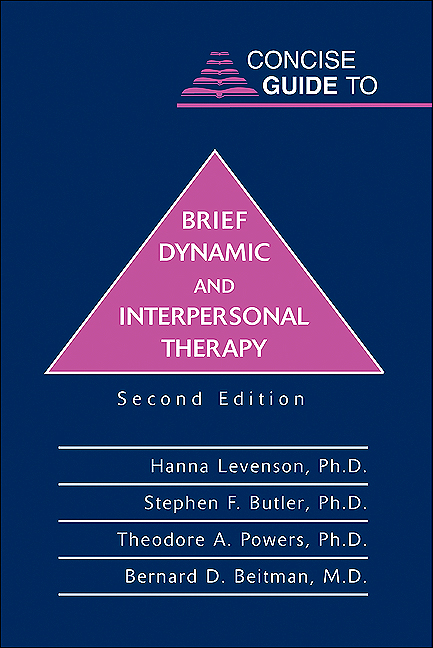
Concise Guide to Brief Dynamic and Interpersonal Therapy (eBook)
232 Seiten
American Psychiatric Publishing (Verlag)
978-1-58562-773-8 (ISBN)
The second edition of this Concise Guide is intended to help educate both beginning and experienced clinicians in the strategies and techniques of time-attentive models and to foster more positive and optimistic attitudes toward using brief therapy.
In today's world of managed care -- characterized by limited mental health resources, emphasis on accountability, concerns of third-party payers, and consumer need -- the demand for mental health professionals to use briefer therapeutic approaches is on the rise. Fully 84% of all clinicians are doing some form of planned brief therapy (6-20 sessions per year per patient).
Yet despite clinical advances and outcome data that demonstrate the effectiveness of short-term therapy, many therapists -- in fact, 90% of those whose theoretical orientation is psychodynamic rather than cognitive-behavioral -- are reluctant to learn briefer interventions, seeing value only in long-term, depth-oriented work. The second edition of this Concise Guide is intended to help educate both beginning and experienced clinicians in the strategies and techniques of time-attentive models and to foster more positive and optimistic attitudes toward using these important therapies. The seven therapeutic models presented here -- including an entirely new chapter on time-limited group therapy -- highlight the importance of the interpersonal perspective.
The seven models, one per chapter, represent well-established short-term approaches to clinical issues that therapists commonly encounter in their clinical practices. These models also have clearly defined intervention techniques and formulation strategies and can be used within the 10- to 20-session time frame of most managed care settings.
The first part of each chapter dealing with a therapeutic model lists the various presenting problems the authors deem most suitable for treatment by that particular approach. The authors discuss the overall framework of each model, selection criteria, goals, therapeutic tasks and strategies, empirical support, and relevance for managed care, with clinical cases to illustrate the application of each model.
The authors include updated chapters on supportive, time-limited, and interpersonal therapies; time-limited dynamic psychotherapy; short-term dynamic therapy for patients with posttraumatic stress disorder; brief dynamic therapy for patients with substance abuse disorders; an entirely new chapter on time-limited group therapy; and a final chapter on the reciprocal relationship between pharmacotherapy and psychotherapy.
Meant to complement the more detailed information found in lengthier psychiatric texts, this Concise Guide (it is designed to fit into a jacket or lab coat pocket) is a practical and convenient reference for psychiatrists, psychiatric residents, and medical students working in a variety of treatment settings, such as inpatient psychiatry units, outpatient clinics, consultation-liaison services, and private offices.
Hanna Levenson, Ph.D., is the Founder of the Levenson Institute for Training (LIFT) and Director of the Brief Psychotherapy Program at California Pacific Medical Center in San Francisco. She also maintains a private practice in San Francisco and Oakland, California. For 20 years she was Clinical Professor in the Department of Psychiatry at the University of California School of Medicine. Past positions include Director of Brief Therapy Training at the Veterans Administration Medical Centers in San Francisco and Palo Alto, California.
Stephen F. Butler, Ph.D., is Senior Vice President and Chief Science Officer at Inflexxion (formerly Innovative Training Systems), a research and consulting firm based in Massachusetts that develops scientifically based solutions in the areas of health education, prevention, and disease management. Before serving in this position, he held faculty appointments in the Vanderbilt University Psychology Department and the Psychiatry Department of the Medical College of Virginia. He was also Director of Psychology at Nashua Brookside Hospital, Nashua, New Hampshire.
Theodore A. Powers, Ph.D., is an Assistant Professor in the Department of Psychology at the University of Massachusetts Dartmouth. Previously, he was Clinical Director of the Short-Term Therapies Unit at Massachusetts General Hospital and an Instructor at Harvard Medical School.
Bernard D. Beitman, M.D., is Professor and Chairman in the Department of Psychiatry and Neurology at the University of Missouri--Columbia School of Medicine.
About the AuthorsIntroduction to the Concise Guides SeriesChapter 1. IntroductionChapter 2. Supportive Therapy: Treatment for Lower-Functioning Patients...and Others?Chapter 3. Time-Limited TherapyChapter 4. Interpersonal Psychotherapy for Patients With DepressionChapter 5. Time-Limited Dynamic PsychotherapyChapter 6. Short-Term Dynamic Therapy for Patients With Posttraumatic Stress DisorderChapter 7. Brief Dynamic Psychotherapy for Patients With Substance Abuse DisordersChapter 8. Time-Limited Group TherapyChapter 9. The Reciprocal Relationship Between Pharmacotherapy and PsychotherapyIndex
| Erscheint lt. Verlag | 13.8.2008 |
|---|---|
| Verlagsort | Washington |
| Sprache | englisch |
| Maße | 110 x 110 mm |
| Gewicht | 181 g |
| Themenwelt | Medizin / Pharmazie ► Gesundheitsfachberufe |
| Medizin / Pharmazie ► Medizinische Fachgebiete ► Psychiatrie / Psychotherapie | |
| ISBN-10 | 1-58562-773-9 / 1585627739 |
| ISBN-13 | 978-1-58562-773-8 / 9781585627738 |
| Informationen gemäß Produktsicherheitsverordnung (GPSR) | |
| Haben Sie eine Frage zum Produkt? |
 EPUB (Adobe DRM)
Kopierschutz: Adobe-DRM
Adobe-DRM ist ein Kopierschutz, der das eBook vor Mißbrauch schützen soll. Dabei wird das eBook bereits beim Download auf Ihre persönliche Adobe-ID autorisiert. Lesen können Sie das eBook dann nur auf den Geräten, welche ebenfalls auf Ihre Adobe-ID registriert sind.
Details zum Adobe-DRM
Dateiformat: EPUB (Electronic Publication)
EPUB ist ein offener Standard für eBooks und eignet sich besonders zur Darstellung von Belletristik und Sachbüchern. Der Fließtext wird dynamisch an die Display- und Schriftgröße angepasst. Auch für mobile Lesegeräte ist EPUB daher gut geeignet.
Systemvoraussetzungen:
PC/Mac: Mit einem PC oder Mac können Sie dieses eBook lesen. Sie benötigen eine
eReader: Dieses eBook kann mit (fast) allen eBook-Readern gelesen werden. Mit dem amazon-Kindle ist es aber nicht kompatibel.
Smartphone/Tablet: Egal ob Apple oder Android, dieses eBook können Sie lesen. Sie benötigen eine
Geräteliste und zusätzliche Hinweise
Buying eBooks from abroad
For tax law reasons we can sell eBooks just within Germany and Switzerland. Regrettably we cannot fulfill eBook-orders from other countries.
aus dem Bereich