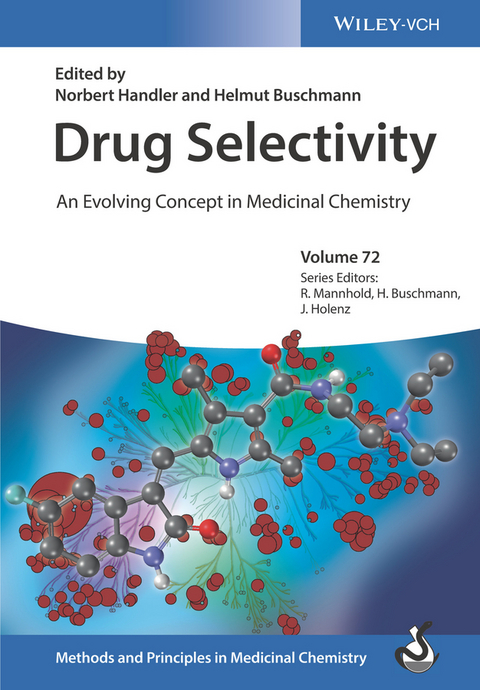
Drug Selectivity (eBook)
Wiley-VCH Verlag GmbH & Co. KGaA
978-3-527-67440-4 (ISBN)
The result is a broad survey of current and future strategies for drug selectivity in medicinal chemistry with theoretical but also practical aspects. Different strategies are presented and evaluated, such as various design approaches, merged multiple ligands, discovery technologies and a broad range of successful examples of unselective drugs taken from all major disease areas. With its wide-ranging view of an emerging new paradigm in drug development, this handbook is of prime importance for every medicinal and pharmaceutical chemist.
Norbert Handler holds a PhD in Medicinal Chemistry from the University of Vienna, where he worked for several years as a postdoc scientist in the field of Medicinal Chemistry. He received an Erwin-Schrodinger-Scholarship and moved to ETH Zurich where he joined Professor Schubigers Group at the Center of Radiopharmaceutical Sciences. After his return to Vienna, he managed the technology transfer office at the University of Vienna before he joined Savira pharmaceuticals, Vienna, as Head of Drug Discovery and Development. Together with Helmut Buschmann he founded RD&C Research, Development & Consulting in Vienna, where he currently is working as Managing Partner. He contributed to more than 25 scientific papers and several patent applications.
Helmut Buschmann has a PhD in organic chemistry from Aachen University and extensive industrial experience in medicinal chemistry, drug discovery and development, scale-up, pharmaceutical development, CMC, patent filing and prosecution. Helmut has over 25 years of international experience in drug discovery research and drug development in the pharmaceutical/biotechnology sectors, both in industry and academia. During his career he worked with a broad range of different targets in different therapeutic areas from pain research to anti-infectives. He has a long publication and patent record, being an author/co-author in more than 150 scientific publications, editor of various reference books and is a named inventor/co-inventor in more than 250 patent applications.
As a result of his research activities more than 15 NCEs within different therapeutic areas have entered the clinical phase (e.g. Rosonabant, Cizorlitine, Dulopetine, Axamadol,). Some of them have reached clinical phase III or are marketed (e.g. Tapentadol: Nucynta? Palexia?). Currently, he is Head of Chemistry, Pharmaceutical Development and Patent A_ airs at AiCuris, Wuppertal and cofounder and co-owner of RD&C Research, Development & Consulting in Vienna.
Norbert Handler holds a PhD in Medicinal Chemistry from the University of Vienna, where he worked for several years as a postdoc scientist in the field of Medicinal Chemistry. He received an Erwin-Schrödinger-Scholarship and moved to ETH Zürich where he joined Professor Schubigers Group at the Center of Radiopharmaceutical Sciences. After his return to Vienna, he managed the technology transfer office at the University of Vienna before he joined Savira pharmaceuticals, Vienna, as Head of Drug Discovery and Development. Together with Helmut Buschmann he founded RD&C Research, Development & Consulting in Vienna, where he currently is working as Managing Partner. He contributed to more than 25 scientific papers and several patent applications. Helmut Buschmann has a PhD in organic chemistry from Aachen University and extensive industrial experience in medicinal chemistry, drug discovery and development, scale-up, pharmaceutical development, CMC, patent filing and prosecution. Helmut has over 25 years of international experience in drug discovery research and drug development in the pharmaceutical/biotechnology sectors, both in industry and academia. During his career he worked with a broad range of different targets in different therapeutic areas from pain research to anti-infectives. He has a long publication and patent record, being an author/co-author in more than 150 scientific publications, editor of various reference books and is a named inventor/co-inventor in more than 250 patent applications. As a result of his research activities more than 15 NCEs within different therapeutic areas have entered the clinical phase (e.g. Rosonabant, Cizorlitine, Dulopetine, Axamadol,). Some of them have reached clinical phase III or are marketed (e.g. Tapentadol: Nucynta® Palexia®). Currently, he is Head of Chemistry, Pharmaceutical Development and Patent A_ airs at AiCuris, Wuppertal and cofounder and co-owner of RD&C Research, Development & Consulting in Vienna.
PART I. INTRODUCTION
Polypharmacology in Drug Discovery
PART II. SELECTIVITY OF MARKTETED DRUGS
Kinase Inhibitors
New Indications for Marketed Drugs
Discovery Technologies of New Indications
PART III. FIXED-DOSE COMBINATIONS
The Growing Market of Fixed-Dose Combinations
PART IV. UNSELECTIVE DRUGS IN DRUG DISCOVERY
The Growing Importance of Individualising Drugs
Drug Discovery Strategies for the Generation of Multi-Target Ligands against Neglected Tropical Diseases
Designing-In Approach
The Linker Approach (Drug-Conjugates)
Merged Multiple Ligands
Pharmacophore Generation of Multiple Ligands
Cellular Assays
PART V. THERAPEUTIC AREAS FOR DESIGNED MULTIPLE LIGANDS
5HT Transporter-Based Multiple Ligands for Depression
Multiple Ligands Targeting the Angiotensin System for Hypertension
PPAR-Based Multiple Ligands for Metabolic Disease
Antibiotics
Multiple Ligands in Cancer Therapy
Multiple Ligands in Neurodegenerative Diseases
Chapter 1
Polypharmacology in Drug Discovery
Oscar Méndez-Lucio1, J. Jesús Naveja2,3, Hugo Vite-Caritino2, Fernando D. Prieto-Martínez2 and José L. Medina-Franco2
1University of Cambridge, Centre for Molecular Informatics, Department of Chemistry, Lensfield Road, Cambridge, CB2 1EW, UK
2Universidad Nacional Autónoma de México, Facultad de Química, Departamento de Farmacia, Avenida Universidad 3000, 04510 Mexico City, Mexico
3Universidad Nacional Autónoma de México, Facultad de Medicina, PECEM, Department of Pharmacy, Avenida Universidad 3000, México, D.F., 04510, Mexico
1.1 Polypharmacology
Currently, the main paradigm in drug discovery is the development of target-specific inhibitors. This also implies molecules with high-fold potency and selectivity toward one isoform. This mainstream view has its origins in the so-called magic bullet as enunciated by Paul Ehrlich over 150 years ago. Indeed, such concept was engraved in the mind of many health professionals and researchers as the top achievement in drug discovery. However, as years came by, this has proven to be a disappointment mainly because of the off-target responses, which may involve toxicological concerns or side effects. For example, considering the wide array of enzymatic systems, classes, and isoforms identified in biology, it is no wonder that many target-specific agents had been developed via trial-and-error approaches [1].
Recent statistics show that pharmaceutical industry is struggling as many promising drugs fail during the early stages of drug development along with the associated significant economic disadvantages [2]. This shows we have reached an impasse: just between 1996 and 2001, a large number of drugs were withdrawn from the market because of similar reasons [3]. Furthermore, even selective drugs are not exempt of drug–drug interactions that also represent a drawback, especially for chronic therapies. After reaching this point, we must ask ourselves if this mainstream view needs refinement or a drastic change of perspective. So if target-based drug discovery has not lived up to expectations, what choices we have left? What if the so-called side effects are not “failures” after all? In the right context, multitarget modulation is desired or perhaps mandatory for successful therapies [4].
What exactly does polypharmacology mean? Strictly speaking, polypharmacology refers to molecules that are recognized by different molecular targets. The affinity shown toward the targets may vary, but as previously mentioned, such compounds may be discarded fearing this promiscuity may trigger off-target effects [5]. Thus, we are walking a fine line between positive and negative connotations. For that matter polypharmacology usually associates with positive outcomes. It involves the search of “master key compounds” to tackle chronic diseases, for example, CNS disorders share multifactorial processes that ultimately lead to degeneration, physiologically speaking. Therefore, a single-target inhibition is of no use here as complex processes require integral approaches [6].
Compound promiscuity is a concept closely related to polypharmacology. This of course tells us about a molecule that interacts with many proteins or receptors. Promiscuity is usually related to negative connotations, for example, it is conceptualized as unwanted characteristic such as toxic effects due to off-target interactions. In turn, compound promiscuity is related to the pan assay interference compounds (PAINS). These molecules appear to be a jack-of-all-trades with potent binding and activity, while the truth is they are a master of none. Baell and Waters first warned about these “con artists” as they lure naïve chemists or biologists who waste valuable resources with a lost cause [7]. Of note, PAINS are not always promiscuous. They can be flagged as active because they produce metal chelation, chemical aggregation, redox activity, compound fluorescence, cysteine oxidation, or other kinds of interference. Putting briefly these concepts together, the pressing matter here is to understand and give the right context to “polypharmacology,” meaning that while related to “chemical promiscuity,” we cannot put them on the same basket any longer.
Polypharmacy is one more concept related to polypharmacology. Polypharmacy “can mean the prescribing of either many drugs (appropriately) or too many drugs (inappropriately). The term is usually used in the second of these senses, and pejoratively. However, when talking about polypharmacy, it would be wise to qualify it as appropriate or inappropriate” [8].
As of 2014 the number of articles citing “polypharmacology” as part of its title and/or as a keyword has increased significantly, with almost 200 articles published in the past three years only [9]. So a multitarget approach is gaining adepts at steady pace. While this shows more promise in the grand scheme of drug discovery, we must be careful and correctly asses the opportunities and challenges of this transition era. We should not instantly accept polypharmacology as a panacea of sorts, but only time and advances in current knowledge will determine the success of such paradigm change; we must conserve an objective view on the subject with realistic expectations.
Although the road ahead in polypharmacology drug discovery may seem blurry or difficult to achieve, the development of polydrugs is currently possible. As discussed in this chapter, the development and application of computational methods and tools for in silico drug discovery should be a starting point and compass to navigate the “chemical wilderness.” Computational approaches include, but are not limited to, chemoinformatics, molecular similarity, docking, molecular dynamics, virtual screening, and quantitative structure–activity relationship (QSAR).
This chapter is organized in six sections. After this introduction, general aspects of multitarget versus target-specific drugs are discussed including the rationale, the “master key compound” concept, and the safety panels to address the possible unwanted effects of drug multitargeting. The next part elaborates on the relationship between polypharmacology and other major concepts in drug discovery, including drug repurposing, combination of drugs, and in vivo testing. The section after that describes briefly examples of applications of polypharmacology and polypharmacy to the development of epi-drugs and antiviral compounds, respectively. It follows a discussion on different modern approaches to study systematically polypharmacological relationships and design multitarget drugs. A special emphasis is made on the concept of chemogenomics. The last part of the chapter presents summary conclusions.
1.2 Multitarget versus Target-Specific Drugs
As discussed before, the increasing awareness of the large complexity of systems biology is shifting the paradigm in drug discovery from a single-target to a multitarget approach [10]. Despite the fact that the latter approach is significantly more complicated than the one-drug–one-target strategy (largely influenced by a reductionist perspective of systems biology) [11], it may lead to drugs that are more effective in the clinic. However, it has to be considered that multitarget drug design, and polypharmacology in general, highly depends on the dose to deliver an overall clinical benefit [12]. For instance, a drug may have a positive effect at therapeutic doses because of the interaction with multitargets. However, the interaction of the same compound with antitargets at higher doses will lead to undesirable side effects [12]. Thus, similar to the appropriate or inappropriate polypharmacy discussed by Aronson [8], polypharmacology can also lead to desirable or undesirable (e.g., unwanted promiscuity) multitarget drug interactions that will depend not only on the nature of the structures of the drugs and targets but also on the compound concentrations. The “dual face” of multitarget drugs is schematically illustrated in Figure 1.1.
Figure 1.1 The “dual face” of multitarget compounds and relationship with “master key drugs.”
1.2.1 “Master Key Compounds”
A “master key compound” (luckily “master key drug”) is a molecule that binds to a given number of targets that produce a desirable clinical effect without hitting (or with a minimum effect) off-targets that are related to undesirable secondary effects [10]. In a simple analogy with a master key, a “master key molecule” should have the ability to operate on a group/set of selected targets (doors) but not on any “doors,” in particular those antitargets that lead to undesirable side effects. Table 1.1 illustrates examples of master key drugs that are used in the market. The table summarizes the name, chemical structure, clinical use, and the associated molecular target receptors.
Table 1.1 Examples of master key drugs approved for clinical use
The name and targets are indicated.
Kinase inhibitors are representative yet controversial examples of master key compounds used in the clinic. Despite the fact there are differences in the kinase domains, the binding site of ATP is highly conserved across all the kinases. Since the ATP site is targeted by a large number of kinase inhibitors, there are selectivity issues, and there is a...
| Erscheint lt. Verlag | 23.11.2017 |
|---|---|
| Reihe/Serie | Methods & Principles in Medicinal Chemistry |
| Methods and Principles in Medicinal Chemistry | Methods and Principles in Medicinal Chemistry |
| Mitarbeit |
Herausgeber (Serie): Helmut Buschmann, Raimund Mannhold, Jörg Holenz |
| Sprache | englisch |
| Themenwelt | Medizin / Pharmazie ► Gesundheitsfachberufe |
| Medizin / Pharmazie ► Medizinische Fachgebiete ► Pharmakologie / Pharmakotherapie | |
| Naturwissenschaften ► Biologie | |
| Naturwissenschaften ► Chemie | |
| Schlagworte | Biowissenschaften • Cell & Molecular Biology • Chemie • Chemistry • Drug Discovery & Development • Life Sciences • Medical Science • Medizin • Medizinische Chemie • Pharmacology & Pharmaceutical Medicine • Pharmakologie • Pharmakologie u. Pharmazeutische Medizin • selective unselective drugs medicinal chemistry multi-target multi-specific combination drugs clinical development drug formulation regulatory aspects selective optimization of side activities SOSA merged multiple ligands fixed-dose combinations • Wirkstoffforschung • Wirkstoffforschung u. -entwicklung • Zell- u. Molekularbiologie |
| ISBN-10 | 3-527-67440-3 / 3527674403 |
| ISBN-13 | 978-3-527-67440-4 / 9783527674404 |
| Informationen gemäß Produktsicherheitsverordnung (GPSR) | |
| Haben Sie eine Frage zum Produkt? |
 EPUB (Adobe DRM)
Kopierschutz: Adobe-DRM
Adobe-DRM ist ein Kopierschutz, der das eBook vor Mißbrauch schützen soll. Dabei wird das eBook bereits beim Download auf Ihre persönliche Adobe-ID autorisiert. Lesen können Sie das eBook dann nur auf den Geräten, welche ebenfalls auf Ihre Adobe-ID registriert sind.
Details zum Adobe-DRM
Dateiformat: EPUB (Electronic Publication)
EPUB ist ein offener Standard für eBooks und eignet sich besonders zur Darstellung von Belletristik und Sachbüchern. Der Fließtext wird dynamisch an die Display- und Schriftgröße angepasst. Auch für mobile Lesegeräte ist EPUB daher gut geeignet.
Systemvoraussetzungen:
PC/Mac: Mit einem PC oder Mac können Sie dieses eBook lesen. Sie benötigen eine
eReader: Dieses eBook kann mit (fast) allen eBook-Readern gelesen werden. Mit dem amazon-Kindle ist es aber nicht kompatibel.
Smartphone/Tablet: Egal ob Apple oder Android, dieses eBook können Sie lesen. Sie benötigen eine
Geräteliste und zusätzliche Hinweise
Buying eBooks from abroad
For tax law reasons we can sell eBooks just within Germany and Switzerland. Regrettably we cannot fulfill eBook-orders from other countries.
aus dem Bereich