


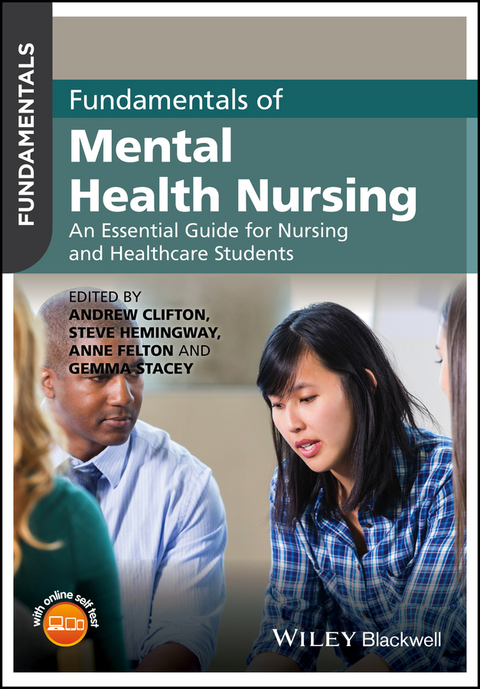
Fundamentals of Mental Health Nursing (eBook)
Fundamentals of Mental Health Nursing is an accessible evidence-based introduction to the role of the mental health nurse. This comprehensive overview explores concepts of mental health and distress, ethics and accountability, key nursing models to be aware of, and the prevalence, predisposing factors and features of the most commonly occurring mental health problems.
KEY FEATURES:
- Places mental health conditions and interventions within a wider holistic context
- Situates recovery at the centre of mental health nursing practice
- Links key concepts to mental health across the lifespan
- Contains learning outcomes in each chapter and includes vignettes, activities and reflective exercises to root concepts in real life practice
Information is placed in a practice context from the outset, making this an essential guide to both the theory and the practice of mental health nursing. It is ideal for students on courses relating to mental health care, as well as for registered nurses and health care practitioners looking to revise their knowledge of key concepts.
www.wiley.com/go/fundamentalsofmentalhealth
- Interactive multiple-choice questions
- Links to online resources
- Chapter summary sheets
Dr Andrew Clifton is Senior Lecturer in the Faculty of Health and Life Sciences at De Montfort University.
Dr Steve Hemingway is Senior Lecturer in Mental Health Nursing at the University of Huddersfield.
Dr Anne Felton is Associate Professor in Mental Health and Social Care at the Faculty of Medicine and Health Sciences at the University of Nottingham.
Dr Gemma Stacey is Associate Professor in Mental Health and Social Care at the Faculty of Medicine and Health Sciences at the University of Nottingham.
Fundamentals of Mental Health Nursing is an accessible evidence-based introduction to the role of the mental health nurse. This comprehensive overview explores concepts of mental health and distress, ethics and accountability, key nursing models to be aware of, and the prevalence, predisposing factors and features of the most commonly occurring mental health problems. KEY FEATURES: Places mental health conditions and interventions within a wider holistic context Situates recovery at the centre of mental health nursing practice Links key concepts to mental health across the lifespan Contains learning outcomes in each chapter and includes vignettes, activities and reflective exercises to root concepts in real life practice Information is placed in a practice context from the outset, making this an essential guide to both the theory and the practice of mental health nursing. It is ideal for students on courses relating to mental health care, as well as for registered nurses and health care practitioners looking to revise their knowledge of key concepts. www.wiley.com/go/fundamentalsofmentalhealth Interactive multiple-choice questions Links to online resources Chapter summary sheets
Dr Andrew Clifton is Senior Lecturer in the Faculty of Health and Life Sciences at De Montfort University. Dr Steve Hemingway is Senior Lecturer in Mental Health Nursing at the University of Huddersfield. Dr Anne Felton is Associate Professor in Mental Health and Social Care at the Faculty of Medicine and Health Sciences at the University of Nottingham. Dr Gemma Stacey is Associate Professor in Mental Health and Social Care at the Faculty of Medicine and Health Sciences at the University of Nottingham.
Preface vii
List of Contributors xi
About the Companion Website xv
Part 1 Fundamentals of Mental Health Nursing
Chapter 1 What is mental health? 3
Anne Felton, Gemma Stacey, Steve Hemingway and Andrew Clifton
Chapter 2 The policy context of mental health nursing in the UK 21
Karen Ozden
Chapter 3 Models and values of mental health nursing practice 39
Gemma Stacey
Chapter 4 Legal and ethical frameworks for mental health nursing practice 51
Alastair Morgan and Nigel Plant
Chapter 5 Facilitating evidence based practice 69
Karen-Leigh Edward
Chapter 6 Co-production: facilitating recovery with service users 83
Andrew Clifton and Jane Noble
Chapter 7 Communication and interpersonal skills 1: an introduction 97
Steve Lyon
Part 2 Mental Health Problems and Therapeutic Interventions
Chapter 8 Commonly occurring mental health problems 113
Andrew Ramtohul and Jo Higman
Chapter 9 Serious mental health problems 127
Jo Fox
Chapter 10 Organic mental health problems 143
Alan Pringle
Chapter 11 People with learning disabilities and mental health 157
Stacey Atkinson
Chapter 12 Substance misuse 171
Jane McGregor and Paul Cassedy
Chapter 13 Eating disorders 187
Fiona Joanne Trotter
Chapter 14 Personality disorder 205
Andrea Milligan and Cholena Mountain
Chapter 15 Communication and interpersonal skills 2: emotional engagement 225
Theo Stickley, Julie Gosling and Caroline Fox
Chapter 16 Cognitive behavioural therapy 239
Philip Kinsella
Chapter 17 Psychodynamic and other talking therapies 251
James Turner and John Wren
Chapter 18 Basics of psychopharmacology 269
Rebecca Burgess-Dawson and Steve Hemingway
Chapter 19 Assessment and therapeutic management of risk 289
Danielle Brady
Chapter 20 Working with self-harm and suicide 307
Charley Baker
Chapter 21 Mental health promotion 321
Sandra Moran
Part 3 Mental Health Nursing and the Lifespan
Chapter 22 Mental health and children, adolescents and younger people 337
Richard Glover and Joseph Kilgariff
Chapter 23 Mental health and adults 353
Ruth Brown, Kat Munn and Vikki Wilford
Chapter 24 Mental health in later life 373
Michaela Mallon
Part 4 Recovery in the Context of Mental Health Services
Chapter 25 Applying recovery based principles in practice 389
Ros Masamha
Chapter 26 Community based mental health services in action 401
Gary Payne, Kevin Somerton and Alyson Leeks
Chapter 27 In-patient services 421
Tim Carter and Nicola Wright
Chapter 28 Working with family and friends 437
Karen Machin and Emma Watson
Chapter 29 Embracing mental health and physical healthcare 451
Sheila Hardy and Jacquie White
Chapter 30 Clinical supervision for the new supervisee 473
Paul Cassedy Answers 487
Index 509
Preface
Thank you for taking the time to read this book Fundamentals of Mental Health Nursing: An Essential Guide for Nursing and Healthcare Students. In recent years we would like to think that attitudes towards mental health have improved to the extent that governments, policymakers and healthcare professionals are now focused on working in partnership with service users, including their families and friends, to support people who are experiencing or have experienced a mental health problem.
There has often been a tension between mental health service users and practitioners in agreeing what is the most effective way of working together to facilitate wellness and recovery. Perhaps many of these tensions remain unresolved. However, in this book we hope to introduce you to many of the fundamental ideas, issues and concepts that shape mental health nursing practice today. Therefore, we hope you will find this book stimulating and informative but most of all we hope the book will challenge the way you think about mental health.
We were very pleased to be asked to edit this book for Wiley, and are grateful to all of the contributors, who have a range of experience in the field of mental health including those who are service users, carers, practitioners and researchers and those involved with learning and teaching activities in higher education institutions. We believe this breadth of expertise will enable readers to engage with each of the chapters to develop their knowledge and understanding of topics that can often appear complex, confusing and, dare we say it, contradictory. That is not a criticism, it is merely an acknowledgement that unlike some other health conditions, concepts of mental health and mental health treatments are sometime contested by a variety of individuals and stakeholders. For example, there is often a debate surrounding the causation of mental health problems and certainly there are many differing and competing perspectives on what are the most effective treatments for a particular disorder.
Moreover, many people with mental health problems may not access traditional mental health services where nurses, doctors and other healthcare professionals practice. Therefore, it is important when reading this book that you are aware that mental well-being and recovery is not always a linear and homogenous process.
To make sense of these debates and healthy disagreements we have included 30 chapters divided into four sections to give you a basic and fundamental understanding of the ideas, issues and concepts that are relevant for students who have a desire to find out more or work with people experiencing a mental health problem. The sections are provided to bring meaning and shape to the book and each section contains individual chapters.
Each chapter in the book follows a similar pattern: they begin with learning outcomes, test your knowledge and then the introduction. In the main section of the chapter there are vignettes, learning activities and reflective exercises to test your understanding of the topic under discussion. Finally, all of the chapters conclude with test your understanding questions, a word search along with suggested further reading and websites. A companion website accompanies this book with multiple choice questions to further test your knowledge.
Although having a consistent structure, each of the chapters is ‘stand-alone’ and offered to the reader as separate entities. This means they are not crossed referenced to other chapters and you are not required to read the book in chronological order like some other textbooks. You may find similarities between some of the chapters in the book but the idea is that you can pick up the book on any page and you will find a nugget of information (or even inspiration) that can inform or influence your practice. For example, there are two chapters in this book on communication and interpersonal skills, each taking a different perspective on this topic – we hope you appreciate and value the differing approaches.
Part 1 Fundamentals of Mental Health Nursing provides an overview of the key policy, legal and conceptual issues underpinning mental health nursing in the UK which are important for understanding how mental health practice is organised and delivered in the UK. This section will introduce the reader to evidence based practice, a concept that allows for the integration of clinical expertise, patient values and the best research evidence into the decision making process for patient care. ‘Patient values’ as indicated here should be at the heart of all mental health practice, which is why there is a chapter on co-production, a term that has gained much currency in recent years and accentuates how positive relationships between service users and clinicians based on research evidence can lead to wellness and recovery.
It is important to remember when reading this book that each of the four regions of the UK – Northern Ireland, Wales, Scotland and England – have responsibility for managing their own healthcare systems, including mental health, although mental health nursing is regulated by a UK-wide body, the Nursing and Midwifery Council. Therefore, unless otherwise stated, when talking about mental health we are discussing this in the wider UK context where, in relation to service users, mental health problems, disease, interventions and treatment the focus is on evidence based practice which tends not to have a geographical regional dimension.
Part 2 Mental Health Problems and Therapeutic Interventions comprises of 14 chapters and is the longest section in the book. The focus here shifts onto the mental health problems and therapeutic interventions you will most commonly come across in practice or clinical settings. It would be impossible to include all mental health problems and conditions in this section; there are many rare and unusual classified and non-classified disorders that you may never come across in your personal or professional careers.
For example, Munchausen syndrome or alien hand syndrome are particularly unusual conditions. Thus we have focused on the most common types of mental health problems you will probably come across such as anxiety, mood disorders, psychosis, substance misuse, eating disorders, personality disorder and organic disorders. To supplement this we have attempted to present an overview of the pharmacological, psychological, sociological and health promotional interventions that are utilised on a daily basis to support wellness and recovery.
The shortest part of the book is Part 3 Mental Health Nursing and the Lifespan where we introduce the reader to mental health across the lifetime in three discrete chapters. Chapter 22 ‘Mental health and children, adolescents and younger people’ provides an overview and understanding of the impact of psychological, biological and environmental factors in relation to the positive development of children and young people's mental health and emotional well-being and it considers the nature of child and adolescent mental health services for children in the legislative context.
Chapter 23 ‘Adults and mental health’ focuses on mental health after childhood, which in the UK is not always, but usually, classified as those people between the working age of 18 and 65, although it is important to remember that categorising by age is problematic as people do not always develop and degenerate in a linear manner. However, there is an emphasis in this chapter on the prevalence and complexity of those mental health problems that impact on working age adults with consideration given to the positive interventions that are used to support the mental health of adults.
The final chapter in this section ‘Mental health in later life’ enables the reader to recognise the factors and key life events that impact on the mental health and well-being of older people and to understand the range of mental problems that commonly but not exclusively affect older people. Underpinning this chapter is the notion that healthy ageing can provide positive outcomes and many opportunities for older people.
Part 4 Recovery in the Context of Mental Health Services is the final section of the book, where attention is drawn to how we as healthcare professionals, in collaboration with service users and carers, can support and facilitate recovery in many of the contemporary mental health settings and services. This section begins with how to apply recovery based principles and the intention is that these principles can be applied in almost any clinical or non-clinical setting.
The recovery framework can be used to develop approaches to care and treatment that support individuals with their mental health needs and appreciate an individual's unique circumstances irrespective of the setting, and we would argue this is fundamental to mental health nursing. This section concludes with a chapter on clinical supervision which we feel is vitally important for those people supporting an individual with a mental problem. At the heart of supervision, the focus is on the service user, for safe practice and quality of care. As well as providing a rich learning experience, by offering space to think and reflect, supervision is there for support – essential because of the emotional labours of caring, which can often cause stress and burnout.
All of that said, as most if not all of the authors in this book will testify, caring or supporting someone with a mental health problem is a huge privilege and when we...
| Erscheint lt. Verlag | 1.11.2017 |
|---|---|
| Reihe/Serie | Fundamentals |
| Fundamentals | Fundamentals |
| Sprache | englisch |
| Themenwelt | Pflege ► Fachpflege ► Neurologie / Psychiatrie |
| Schlagworte | Einführungen in die Krankenpflege • fundamentals of mental health nursing • Gesundheits- u. Sozialwesen • Health & Social Care • Introductions to Nursing • key mental health nursing models • key mental health therapeutic inventions</p> • Krankenpflege • Krankenpflege i. d. Psychologie • <p>mental health nursing fundamentals • Mental Health • mental health care course guide • mental health concepts across lifespan • mental health ethics and accountability • mental health nurse role • Mental Health Nursing • mental health nursing theory and practice • mental health practice scenarios • mental health practitioner overview • nursing • Psychische Gesundheit • role of mental health nurse |
| ISBN-10 | 1-118-88022-6 / 1118880226 |
| ISBN-13 | 978-1-118-88022-7 / 9781118880227 |
| Informationen gemäß Produktsicherheitsverordnung (GPSR) | |
| Haben Sie eine Frage zum Produkt? |
 EPUB (Adobe DRM)
Kopierschutz: Adobe-DRM
Adobe-DRM ist ein Kopierschutz, der das eBook vor Mißbrauch schützen soll. Dabei wird das eBook bereits beim Download auf Ihre persönliche Adobe-ID autorisiert. Lesen können Sie das eBook dann nur auf den Geräten, welche ebenfalls auf Ihre Adobe-ID registriert sind.
Details zum Adobe-DRM
Dateiformat: EPUB (Electronic Publication)
EPUB ist ein offener Standard für eBooks und eignet sich besonders zur Darstellung von Belletristik und Sachbüchern. Der Fließtext wird dynamisch an die Display- und Schriftgröße angepasst. Auch für mobile Lesegeräte ist EPUB daher gut geeignet.
Systemvoraussetzungen:
PC/Mac: Mit einem PC oder Mac können Sie dieses eBook lesen. Sie benötigen eine
eReader: Dieses eBook kann mit (fast) allen eBook-Readern gelesen werden. Mit dem amazon-Kindle ist es aber nicht kompatibel.
Smartphone/Tablet: Egal ob Apple oder Android, dieses eBook können Sie lesen. Sie benötigen eine
Geräteliste und zusätzliche Hinweise
Buying eBooks from abroad
For tax law reasons we can sell eBooks just within Germany and Switzerland. Regrettably we cannot fulfill eBook-orders from other countries.
aus dem Bereich


