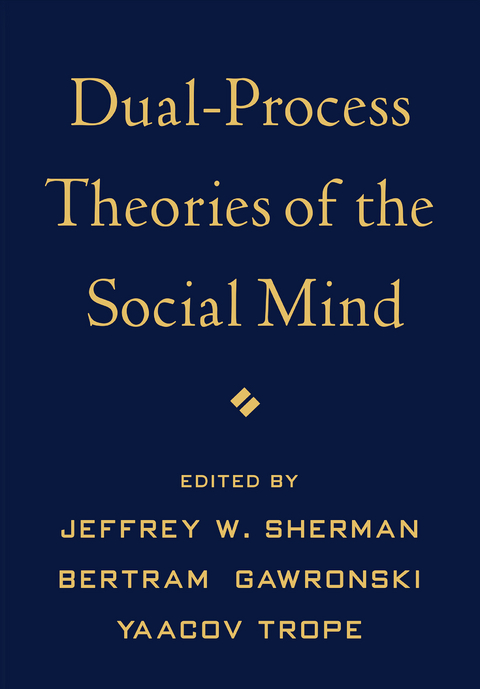
Dual-Process Theories of the Social Mind (eBook)
624 Seiten
The Guilford Press (Verlag)
978-1-4625-1444-1 (ISBN)
Jeffrey W. Sherman, PhD, is Professor of Psychology at the University of California, Davis. His research investigates the cognitive processes underlying social psychology and behavior, with particular interests in attitude formation and change and how stereotypes and prejudice affect social perception. Dr. Sherman is Editor of the journal Social Cognition. A Fellow of the Association for Psychological Science (APS), the Society for Personality and Social Psychology (SPSP), and the Society for Experimental Social Psychology (SESP), he is a recipient of other honors including the Theoretical Innovation Prize from SPSP and the Anneliese Maier Research Award from the Alexander von Humboldt Foundation and the German Federal Ministry of Education.Bertram Gawronski, PhD, is Professor of Psychology at the University of Texas at Austin. His research investigates the mental underpinnings and behavioral consequences of spontaneous and deliberate evaluations of objects, individuals, groups, and social issues. Dr. Gawronski's work has been recognized with honors including the Theoretical Innovation Prize from SPSP, the Career Trajectory Award from SESP, the Early Career Award from the International Social Cognition Network, the Early Researcher Award from the Ministry of Research and Innovation of Ontario, and the Charlotte and Karl Bühler Award from the German Psychological Society. He is a fellow of APS, SESP, and SPSP.Yaacov Trope, PhD, is Professor of Psychology at New York University. His research investigates the interrelations among cognition, motivation, and self-regulation in the social context. Particular interests include how psychological distance influences the representations of objects, and, thereby, the predictions, evaluations, and choices individuals make regarding those objects; self-control processes; and the role of affective states and personal desires in social judgment and decision making. Dr. Trope is a Fellow of the American Association for the Advancement of Science, APS, SESP, and SPSP.
I. The Basics1. Two of What?: A Conceptual Analysis of Dual-Process Theories, Bertram Gawronski, Jeffrey W. Sherman, and Yaacov Trope2. Examining the Mapping Problem in Dual-Process Models, Agnes Moors3. Conscious and Unconscious: Toward an Integrative Understanding of Human Mental Life and Action, Roy F. Baumeister and John A. Bargh4. What Is Control?: A Conceptual Analysis, Kentaro Fujita, Yaacov Trope, William A. Cunningham, and Nira LibermanII. Dual-Systems Models5. Two Systems of Reasoning: An Update, Steven Sloman6. Rationality, Intelligence, and the Defining Features of Type 1 and Type 2 Processing, Keith A. Stanovich, Richard F. West, and Maggie E. Toplak7. The Reflective-Impulsive Model, Fritz Strack and Roland DeutschIII. Measurement and Formal Modeling8. Dual-Process Theory from a Process Dissociation Perspective, B. Keith Payne and C. Daryl Cameron9. Process Models Require Process Measures, Jeffrey W. Sherman, Regina Krieglmeyer, and Jimmy Calanchini10. Random-Walk and Diffusion Models, Karl Christoph KlauerIV. Attitudes and Evaluation11. The MODE Model: Attitude-Behavior Processes as a Function of Motivation and Opportunity, Russell H. Fazio and Michael A. Olson12. The Elaboration Likelihood and Metacognitive Models of Attitudes: Implications for Prejudice, the Self, and Beyond, Richard E. Petty and Pablo Briñol13. The Associative-Propositional Evaluation Model: Operating Principles and Operating Conditions of Evaluation, Bertram Gawronski and Galen V. Bodenhausen14. The Systems of Evaluation Model: A Dual-Systems Approach to Attitudes, Allen R. McConnell and Robert J. RydellV. Social Perception15. Controlled Processing and Automatic Processing in the Formation of Spontaneous Trait Inferences, Randy J. McCarthy and John T. Skowronski16. The Dynamic Interactive Model of Person Construal: Coordinating Sensory and Social Processes, Jonathan B. Freeman and Nalini Ambady17. Person Perception: Integrating Category-Level and Individual-Level Information in Face Construal, Kimberly A. Quinn and C. Neil Macrae18. Dual-Process Models of Trait Judgments of Self and Other: An Overview and Critique, Stanley B. Klein19. Automaticity, Control, and the Social Brain, Robert P. Spunt and Matthew D. LiebermanVI. Thinking and Reasoning20. The Human Unconscious: A Functional Perspective, Ran R. Hassin and Asael Y. Sklar21. Metacognitive Processes and Subjective Experiences, Rainer Greifeneder and Norbert Schwarz22. Same or Different?: How Similarity versus Dissimilarity Focus Shapes Social Information Processing, Thomas Mussweiler23. Visual versus Verbal Thinking and Dual-Process Moral Cognition, Elinor Amit, Sara Gottlieb, and Joshua D. Greene24. Prolonged Thought: Proposing Type 3 Processing, Ap Dijksterhuis, Madelijn Strick, Maarten W. Bos, and Loran F. NordgrenVII. Habits, Goals, and Motivation25. Habits in Dual-Process Models, Wendy Wood, Jennifer S. Labrecque, Pei-Ying Lin, and Dennis Rünger26. Conscious and Unconscious Goal Pursuit: Similar Functions, Different Processes?, Ruud Custers and Henk Aarts27. The Implicit Volition Model: The Unconscious Nature of Goal Pursuit, Gordon B. Moskowitz28. Promotion and Prevention: How "0" Can Create Dual Motivational Forces, E. Tory HigginsVIII. Self-Regulation and Control29. Beyond Control versus Automaticity: Psychological Processes Driving Postsuppressional Rebound, Jens Förster and Nira Liberman30. The Explicit and Implicit Ways of Overcoming Temptation, Ayelet Fishbach and Luxi Shen31. Breaking the Prejudice Habit: Automaticity and Control in the Context of a Long-Term Goal, Patrick S. Forscher and Patricia G. Devine32. Emotion Generation and Emotion Regulation: Moving beyond Traditional Dual-Process Accounts, Gal Sheppes and James J. GrossIX. Criticism and Alternatives33. The Limits of Automaticity, Klaus Fiedler and Mandy Hütter34. The Unimodel Unfolding, Arie W. Kruglanski, Kristen M. Klein, Antonio Pierro, and Lucia Mannetti35. Why a Propositional Single-Process Model of Associative Learning Deserves to Be Defended, Jan De Houwer36. How Many Processes to Ground a Concept?, Gün R. Semin, Margarida V. Garrido, and Ana Rita Farias37. Dual Experiences, Multiple Processes: Looking Beyond Dualities for Mechanisms of the Mind, David M. Amodio38. Rethinking Duality: Criticisms and Ways Forward, Melissa J. Ferguson, Thomas C. Mann, and Michael T. Wojnowicz
| Erscheint lt. Verlag | 9.5.2014 |
|---|---|
| Sprache | englisch |
| Maße | 180 x 180 mm |
| Themenwelt | Geisteswissenschaften ► Psychologie ► Allgemeine Psychologie |
| Geisteswissenschaften ► Psychologie ► Psychoanalyse / Tiefenpsychologie | |
| Geisteswissenschaften ► Psychologie ► Sozialpsychologie | |
| Geisteswissenschaften ► Psychologie ► Verhaltenstherapie | |
| Medizin / Pharmazie ► Medizinische Fachgebiete ► Psychiatrie / Psychotherapie | |
| Schlagworte | attitudes • automatic processes • Cognitive • controlled processes • dual-process • dual-systems • Information Processing • Measurement • measures • Mind • Models • self-regulation • Social Cognition • social perception • Social Psychology • "substance abuse, behavior change, psychotherapy, interventions, addictions, ambivalence, resistance, therapy, counseling field, counseling students, interviewing skills, meth addiction, life coaching, helping professionals, therapeutic relationship, helping professions, professional counselor, core concepts, social workers, transpersonal, rationales, person-centered, exam, cognitive-behavioral, court-ordered, modality, clinicians, evidence-based, revisions, trainers, therapists, counselors, seminar, exerci • Theories • Unconscious |
| ISBN-10 | 1-4625-1444-8 / 1462514448 |
| ISBN-13 | 978-1-4625-1444-1 / 9781462514441 |
| Informationen gemäß Produktsicherheitsverordnung (GPSR) | |
| Haben Sie eine Frage zum Produkt? |
 EPUB (Adobe DRM)
Kopierschutz: Adobe-DRM
Adobe-DRM ist ein Kopierschutz, der das eBook vor Mißbrauch schützen soll. Dabei wird das eBook bereits beim Download auf Ihre persönliche Adobe-ID autorisiert. Lesen können Sie das eBook dann nur auf den Geräten, welche ebenfalls auf Ihre Adobe-ID registriert sind.
Details zum Adobe-DRM
Dateiformat: EPUB (Electronic Publication)
EPUB ist ein offener Standard für eBooks und eignet sich besonders zur Darstellung von Belletristik und Sachbüchern. Der Fließtext wird dynamisch an die Display- und Schriftgröße angepasst. Auch für mobile Lesegeräte ist EPUB daher gut geeignet.
Systemvoraussetzungen:
PC/Mac: Mit einem PC oder Mac können Sie dieses eBook lesen. Sie benötigen eine
eReader: Dieses eBook kann mit (fast) allen eBook-Readern gelesen werden. Mit dem amazon-Kindle ist es aber nicht kompatibel.
Smartphone/Tablet: Egal ob Apple oder Android, dieses eBook können Sie lesen. Sie benötigen eine
Geräteliste und zusätzliche Hinweise
Buying eBooks from abroad
For tax law reasons we can sell eBooks just within Germany and Switzerland. Regrettably we cannot fulfill eBook-orders from other countries.
aus dem Bereich