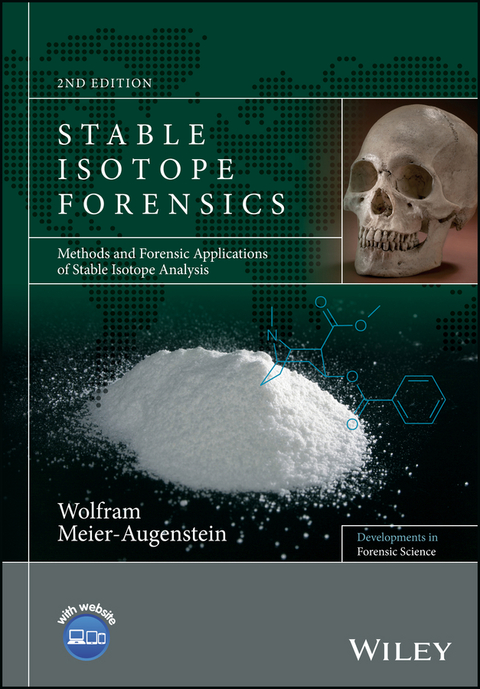
Stable Isotope Forensics (eBook)
John Wiley & Sons (Verlag)
978-1-119-08023-7 (ISBN)
The number-one guide, internationally, to all aspects of forensic isotope analysis, thoroughly updated and revised and featuring many new case studies
This edition of the internationally acclaimed guide to forensic stable isotope analysis uses real-world examples to bridge discussions of the basic science, instrumentation and analytical techniques underlying forensic isotope profiling and its various technical applications. Case studies describe an array of applications, many of which were developed by the author himself. They include cases in which isotope profiling was used in murder, and drugs-related crime investigations, as well as for pharmaceutical and food authenticity control studies.
Updated with coverage of exciting advances occurring in the field since the publication of the 1st edition, this 2nd edition explores innovative new techniques and applications in forensic isotope profiling, as well as key findings from original research. More than a simple update, though, this edition has been significantly revised in order to address serious problems that can arise from non-comparable and unfit-for-purpose stable isotope data. To that end, Part II has been virtually rewritten with greater emphasis now being placed on important quality control issues in stable isotope analysis in general and forensic stable isotope analysis in particular.
- Written in a highly accessible style that will appeal to practitioners, researchers and students alike
- Illustrates the many strengths and potential pitfalls of forensic stable isotope analysis
- Uses recent case examples to bridge underlying principles with technical applications
- Presents hands-on applications that let experienced researchers and forensic practitioners match problems with success stories
- Includes new chapters devoted to aspects of quality control and quality assurance, including scale normalisation, the identical treatment principle, hydrogen exchange and accreditation
Stable Isotope Forensics, 2nd Edition is an important professional resource for forensic scientists, law enforcement officials, public prosecutors, defence attorneys, forensic anthropologists and others for whom isotope profiling has become an indispensable tool of the trade. It is also an excellent introduction to the field for senior undergraduate and graduate forensic science students.
'All students of forensic criminology, and all law enforcement officers responsible for the investigation of serious crime , will want to study this book. Wolfram highlights the value, and future potential, of Stable Isotope Forensics as an emerging powerful tool in the investigation of crime.'
-Roy McComb, Deputy Director, Specialist Investigations, National Crime Agency (NCA), UK
'A single author text in these days is rare and the value of this book lies in the dedication and experience of the author which is evident in the clarity of prose, the honest illustration of evidence and the realistic practical application of the subject - it makes this a text of genuine scientific value.'
- Prof Dame Sue Black, PhD, DBE, OBE, FRSE, Leverhulme Research Centre for Forensic Science, University of Dundee, UK
Wolfram Meier-Augenstein, PhD is Professor in Stable Isotope Forensics at the Robert Gordon University in Aberdeen, Scotland, UK. He is a registered expert advisor with the National Crime Agency (NCA, UK) and holds a Diplom-Chemiker degree, as well as a Doctorate in Bio-organic Chemistry, both awarded by the University of Heidelberg, Federal Republic of Germany. Dr. Meier-Augenstein has assisted police forces and coroners' offices around the world in murder enquiries and drug-related crime investigations.
The number-one guide, internationally, to all aspects of forensic isotope analysis, thoroughly updated and revised and featuring many new case studies This edition of the internationally acclaimed guide to forensic stable isotope analysis uses real-world examples to bridge discussions of the basic science, instrumentation and analytical techniques underlying forensic isotope profiling and its various technical applications. Case studies describe an array of applications, many of which were developed by the author himself. They include cases in which isotope profiling was used in murder, and drugs-related crime investigations, as well as for pharmaceutical and food authenticity control studies. Updated with coverage of exciting advances occurring in the field since the publication of the 1st edition, this 2nd edition explores innovative new techniques and applications in forensic isotope profiling, as well as key findings from original research. More than a simple update, though, this edition has been significantly revised in order to address serious problems that can arise from non-comparable and unfit-for-purpose stable isotope data. To that end, Part II has been virtually rewritten with greater emphasis now being placed on important quality control issues in stable isotope analysis in general and forensic stable isotope analysis in particular. Written in a highly accessible style that will appeal to practitioners, researchers and students alike Illustrates the many strengths and potential pitfalls of forensic stable isotope analysis Uses recent case examples to bridge underlying principles with technical applications Presents hands-on applications that let experienced researchers and forensic practitioners match problems with success stories Includes new chapters devoted to aspects of quality control and quality assurance, including scale normalisation, the identical treatment principle, hydrogen exchange and accreditation Stable Isotope Forensics, 2nd Edition is an important professional resource for forensic scientists, law enforcement officials, public prosecutors, defence attorneys, forensic anthropologists and others for whom isotope profiling has become an indispensable tool of the trade. It is also an excellent introduction to the field for senior undergraduate and graduate forensic science students. "e;All students of forensic criminology, and all law enforcement officers responsible for the investigation of serious crime , will want to study this book. Wolfram highlights the value, and future potential, of Stable Isotope Forensics as an emerging powerful tool in the investigation of crime."e; Roy McComb, Deputy Director, Specialist Investigations, National Crime Agency (NCA), UK A single author text in these days is rare and the value of this book lies in the dedication and experience of the author which is evident in the clarity of prose, the honest illustration of evidence and the realistic practical application of the subject - it makes this a text of genuine scientific value. Prof Dame Sue Black, PhD, DBE, OBE, FRSE, Leverhulme Research Centre for Forensic Science, University of Dundee, UK The book provides an excellent, vivid and comprehensible introduction into the world of stable isotope science and analytics. Compared to the first edition, the aspects of quality control and assurance in the analysis of stable isotopes in general, and forensic application in particular, are now taking much more room. This allows the book to serve the target groups: students, academic professionals and practitioners, and serves as a solid resource of basic and applicable information about the strengths and potential pitfalls of the application of stable isotope signatures. The present high-quality book shows the great potential of stable isotopes and is a must for everyone interested in isotope forensics.M.E. B ttcher & U. Flenker, Isotopes in Environmental and Health Studies, January 2018.A list of errata is available at http://booksupport.wiley.com
Wolfram Meier-Augenstein, PhD is Professor in Stable Isotope Forensics at the Robert Gordon University in Aberdeen, Scotland, UK. He is a registered expert advisor with the National Crime Agency (NCA, UK) and holds a Diplom-Chemiker degree, as well as a Doctorate in Bio-organic Chemistry, both awarded by the University of Heidelberg, Federal Republic of Germany. Dr. Meier-Augenstein has assisted police forces and coroners' offices around the world in murder enquiries and drug-related crime investigations.
Introduction
Stable Isotope ‘Profiling’ or Chemical ‘DNA’: A New Dawn for Forensic Chemistry?
Starting with the conclusion first, I would say neither of the above two terms is appropriate, although I am convinced information locked into the stable isotopic composition of physical evidence may well represent a new dawn for forensic chemistry.
The title for this general introduction was chosen deliberately as an analogy for the term “DNA fingerprinting,” coined by Professor Sir Alec J. Jeffreys, to draw the reader's attention to the remarkable analogy between the organic, life-defining material DNA and the more basic, and on their own lifeless, chemical elements in their various isotopic forms when examined in the context of forensic sciences in general and human provenancing in particular. It is also my intention to alert readers from the start to the dangers of expecting miracles of stable isotope forensics. DNA evidence is at its most powerful when it can be matched against a comparative sample or a database entry, and the same is true to a degree for the information locked into the isotopic composition of a given material. Similarly, the random match probability of 1 in 1 billion for a DNA match based on 10 loci and the theoretical match probability of an accidental false positive match of a multi-isotope signature are also seemingly matched, with a multivariate or multifactor probabilistic equation being the common denominator for both. If we consider a material such as hair keratin and we make the simplifying assumption this material may exist naturally in as many different isotopic states per element as there are whole numbers in the natural abundance range for each stable isotope on the δ-scale (Fry, 2006), we can calculate a hypothetical figure for the accidental match probability of such a multi-element isotope analysis that is comparable to that of a DNA fingerprint.
For example, the widest possible natural abundance range for carbon-13 is 110 ‰ (Fry, 2006) so for the purpose of this example we could say keratin can assume 110 different integer carbon-13 values. Analysing hair keratin for its isotopic composition with regard to the light elements hydrogen (H), carbon (C), nitrogen (N), oxygen (O) and sulfur (S) could thus theoretically yield a combined specificity ranging from 1 in 638 million to 1 in 103.95 billion. In fact, one can calculate that the analysis of hair keratin for its isotopic composition with regards to H, C, N and S would theoretically yield a combined specificity of 1 in 1 billion, thus suggesting a “stable isotope profile” or “stable isotope signature” based on these four letters of the chemical alphabet having the same accidental match probability as a DNA fingerprint that ultimately is based on the four letters of the DNA alphabet, A (adenine), C (cytosine), G (guanine) and T (thymine) (see Box). However, it has to be stressed that it has as yet not been fully explored if this hypothetical level of random match probability, and hence level of discrimination, is actually achievable given that the natural abundance ranges in which compounds or materials can occur are usually much narrower than the widest possible theoretical range. We will learn more about this in the course this book. Forensic scientists and statisticians such as Jurian Hoogewerff (University of Canberra) and James Curran (University of Auckland) suggest more conservative estimates, putting the potentially realised random match probability of stable isotope signatures at levels between 1 in 10,000 and 1 in 1 million depending on the nature and history of the material under investigation. However, even at these levels stable isotope profiling is still a potentially powerful forensic tool.
| Analogies between DNA and stable isotopes of light elements |
| Biological DNA versus Chemical “DNA” |
| Alphabet of Biological DNA comprises the letters | Alphabet of Chemical “DNA” comprises the letters |
| A | 2H |
| C | 13C |
| G | 15N |
| D | 18O |
| [U] | [34S] |
The random match probability of Biological DNA is approximately 1 : 1 billion (1 × 10⁹) for a DNA profile based on 10 loci.
The random match probability of a five-element stable isotope profile can theoretically range from 1 : 693 million (6.93 × 10⁸) to as high as 1 : 1.04 × 10¹¹.
Note: This is for illustrative purposes only and does not denote any equivalence between DNA bases and chemical elements.
While one can make a good case that the isotopic abundances of 2H, 13C, 15N and 34S are independent variables and figures representing their abundance range can hence be combined in a probabilistic equation, the same is not entirely the case for 2H and 18O, which when originating from water may behave like dependent variables. More relevant to this issue is the question if and to what degree isotopic abundance varies for any given material or compound. While across all materials and compounds known to man 13C isotopic abundance may indeed stretch across a range of 110 δ-units, its range in a particular material, such as coca leaves, may only extend to 7 δ-units (Ehleringer et al., 2000).
Another reason why the analogy between DNA fingerprinting and stable isotope profiling should only be used in conjunction with qualifying statements is the fact that both a DNA fingerprint and a physical fingerprint are immutable, that is, they do not change over time. Drawing on an example from environmental forensics, calling a gas chromatography (GC) or gas chromatography-mass spectrometry (GC/MS) profile from a sample of crude oil spillage a fingerprint of that oil is a misnomer since ageing processes such as evaporation will lead to changes in the oil's composition with regard to the relative abundance of its individual constituents. Incidentally, due to isotopic fractionation during evaporation the isotopic composition of any residual oil compound will also have changed when compared to its isotopic composition at the point of origin. A more apt analogy would therefore be the use of the term stable isotope signature. Just as a person's signature can change over time or under the burden of stress, so the stable isotopic composition of the residual sample from a material susceptible to evaporative loss may have changed by the time it ends up in our laboratories. Furthermore, in the same way a forensic expert relies on more than one physicochemical characteristic as well as drawing on experience and contextual information to arrive at an interpretation regarding similarity or dissimilarity, the stable isotope scientist combines measured data with experience, expertise and contextual information to come to a conclusion as to what a given stable isotope signature does or does not reveal.
Despite these caveats it is easy to see why the prospect of having such powerful a tool at one's disposal for combating crime and terrorism has caused a lot of excitement in both the end-user and scientific communities. However, if the history of applying DNA fingerprinting in a forensic context has taught us anything then it is this: great potential is no substitute for good forensic science, and good forensic science cannot be rushed or packaged to meet externally driven agendas. At first there was no great interest in this new forensic technique, but after a few spectacular successes demand for what seemed to be the silver bullet to connect suspect perpetrators to victims or crime scenes increased faster than research still concerned with answering underlying fundamental questions could keep up with, and history has all but repeated itself recently on the subject of low template DNA. Good forensic science cannot be rushed but is the outcome of good forensic science teaching and research, which in turn become the foundation of good forensic practice. While the former requires proper funding the latter requires proper regulation, and both requirements must be addressed and met.
Not surprisingly, therefore, even at the time of writing the second edition of this book we still have a mountain to climb to turn stable isotope forensics into a properly validated forensic analytical tool or technique that is fit for purpose. Even though this technique has been successfully applied in a number of high-profile criminal cases where salient questions could be answered by comparative analysis, this should not blind us to the fact that a considerable amount of time, effort, money and careful consideration still has to be spent to develop and finely hone this technique into the sharp investigative tool it promises to be.
Similar to DNA, data have to be generated and databases have to be compiled for a statistically meaningful underpinning of this technique and the interpretation of its analytical results. Equally important, if not more so, all the steps from sample collection, sample storage and sample preparation to analytical measurement and the final data reduction have to be carefully examined either to avoid process artefacts or, if unavoidable, to quantify such artefacts and develop fit-for-purpose correction protocols to avoid stable isotope forensics suffering the same fate as low template DNA.
One way of ensuring appropriate and well-advised use of this technique in a forensic context is to advise and instruct current and future generations of forensic scientists in this technique as...
| Erscheint lt. Verlag | 6.10.2017 |
|---|---|
| Reihe/Serie | Developments in Forensic Science |
| Developments in Forensic Science | Developments in Forensic Science |
| Sprache | englisch |
| Themenwelt | Studium ► 2. Studienabschnitt (Klinik) ► Rechtsmedizin |
| Naturwissenschaften ► Chemie ► Analytische Chemie | |
| Recht / Steuern ► Strafrecht ► Kriminologie | |
| Sozialwissenschaften | |
| Schlagworte | Analytische Chemie • Analytische Chemie / Forensik • Chemie • Chemistry • forensic isotope analysis • Forensics • forensic stable analysis quality control • forensic stable isotope analysis • forensic stable isotope analysis breakthroughs • forensic stable isotope analysis cases • forensic stable isotope analysis examples • forensic stable isotope analysis for environmental assessments • forensic stable isotope analysis in food quality control • forensic stable isotope analysis pharmaceutical applications • forensic stable isotope analysis physical chemistry • forensic stable isotope analysis research • forensic stable isotope analysis sample collection • forensic stable isotope data analysis • forensic stable isotope data collection • forensic stable isotope instrumentation • forensic stable isotope methodologies • forensic stable isotope techniques • Isotope • Massenspektrometrie • Mass Spectrometry • stable isotope forensics • Wolfram Meier-Augenstein |
| ISBN-10 | 1-119-08023-1 / 1119080231 |
| ISBN-13 | 978-1-119-08023-7 / 9781119080237 |
| Informationen gemäß Produktsicherheitsverordnung (GPSR) | |
| Haben Sie eine Frage zum Produkt? |
 EPUB (Adobe DRM)
Kopierschutz: Adobe-DRM
Adobe-DRM ist ein Kopierschutz, der das eBook vor Mißbrauch schützen soll. Dabei wird das eBook bereits beim Download auf Ihre persönliche Adobe-ID autorisiert. Lesen können Sie das eBook dann nur auf den Geräten, welche ebenfalls auf Ihre Adobe-ID registriert sind.
Details zum Adobe-DRM
Dateiformat: EPUB (Electronic Publication)
EPUB ist ein offener Standard für eBooks und eignet sich besonders zur Darstellung von Belletristik und Sachbüchern. Der Fließtext wird dynamisch an die Display- und Schriftgröße angepasst. Auch für mobile Lesegeräte ist EPUB daher gut geeignet.
Systemvoraussetzungen:
PC/Mac: Mit einem PC oder Mac können Sie dieses eBook lesen. Sie benötigen eine
eReader: Dieses eBook kann mit (fast) allen eBook-Readern gelesen werden. Mit dem amazon-Kindle ist es aber nicht kompatibel.
Smartphone/Tablet: Egal ob Apple oder Android, dieses eBook können Sie lesen. Sie benötigen eine
Geräteliste und zusätzliche Hinweise
Buying eBooks from abroad
For tax law reasons we can sell eBooks just within Germany and Switzerland. Regrettably we cannot fulfill eBook-orders from other countries.
aus dem Bereich