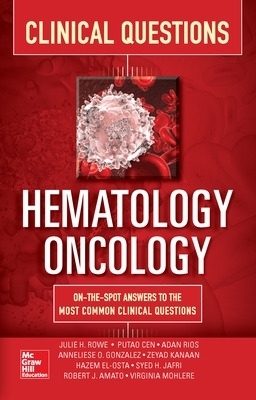
Hematology-Oncology Clinical Questions
McGraw-Hill Education (Verlag)
978-1-260-02662-7 (ISBN)
A unique point-of-care guide to clinical hematology-oncology that answers the most frequently asked questions
Hematology-Oncology Clinical Questions is the single-best resource for quickly converting the most current data and research into practical, diagnostic real-time solutions. This unique book answers more than 60 of the clinical hematology-oncology questions most commonly asked of the authors during consultation. The content flow simulates the consultation process: Question…Data…Synthesis…Solution.
The initial chapters prepare you with essential background fundamentals of hematology-oncology. Subsequent chapters are divided into tumor type, beginning with solid tumor types, and then hematological malignancies. Each chapter includes:
• Key Concepts
• The Clinical Scenario
• The Action Items
• Pearls
Hematology-Oncology Clinical Questions will prove to be a powerful tool to help learners from all points of the clinical spectrum understand the basic concepts of caring for a cancer patient.
Julie H. Rowe, MD; Anneliese O. Gonzalez, MD; SyedH. Jafri, MBBS.; Putao Chen, MD; Zeyad Kanaan, MD; and Robert J. Amato, DO, Adan Rios, MD, Hazem El-Osta, MD are affiliated with The University of Texas Health Scienceat Houston, McGovern Medical School.
Table of Contents
1. CHEMOTHERAPY AGENTS –WILL INCLUDE A SUMMARY OF EACH TYPE BEFORE CLINICAL QUESTIONS
a. Cytotoxic
b. Targeted Agents
c. Hormonal Agents
d. Immunotherapy
2. RADIATION THERAPY
3. MOST COMMON HEME QUESTIONS
a. Anemia
b. Thrombocytopenia
c. Thrombosis
d. Transfusion reactions
4. SCREENING
a. Breast cancer
b. Cervical
c. Colon Cancer
d. Prostate
e. Lung Cancer
5. BREAST CANCER
a. Non-invasive
b. Invasive
c. Inflammatory breast cancer
d. Phyllodes
e. Paget’s
6. HEAD AND NECK
7. THYROID CARCINOMAS
8. GI CANCER
a. Esophagus
b. Gastric/GEJ
c. Colon
d. Rectal
e. Anus
f. Pancreas
g. Cholangiocarcinoma
h. Hepatocellular Carcinoma
i. Neuroendocrine tumors
9. GU CANCER
a. Bladder
b. Kidney
c. Prostate
d. Testicular
10. GYNECOLOGICAL MALIGNANCIES
a. Cervical
b. Endometrial
c. Ovarian
d. Uterine
11. MELANOMAS
12. THORACIC
a. Small cell lung cancer
b. Non-small cell lung cancer
13. SARCOMAS
14. OCCULT PRIMARY
15. BASICS OF PATHOLOGY AND HEMATOLOGY
a. Bone Marrow, Flow Cytometry, Cytogenetics, Molecular testing.
b. Solid tumor pathology basics
16. BASICS OF BONE MARROW TRANSPLANTATION
a. Types (Allo, Auto)
b. Indications
17. LYMPHOMAS
a. Hodgkin’s Lymphoma
i. Classical HL
ii. Nodular lymphocyte-predominant HL
b. Non-Hodgkin’s Lymphoma
i. B-cell NHL
a) Diffuse large B-cell Lymphoma (DLBCL)
b) Follicular Lymphoma
c) Mantle Cell Lymphoma (MCL)
d) Small Lymphocytic Lymphoma (SLL)
e) Primary CNS Lymphoma
f) Primary Mediastinal Lymphoma (PML)
g) Burkitt Lymphoma (BL)
h) Primary Effusion Lymphoma
i) Double-hit Lymphoma
j) Primary Effusion Lymphoma (PEL)
ii. T-Cell NHL
a) Peripheral T-cell Lymphoma (PTCL)
b) Primary Cutaneous T-cell Lymphoma
c) Anaplastic Large Cell Lymphoma (ALCL)
d) Post-Transplant Lymphoproliferative
18. LEUKEMIAS
a) Acute Leukemias
i. Acute Myeloid Leukemia (AML)
ii. APL
i. Acute Lymphoblastic Leukemia (ALL)
b) Chronic Leukemias:
i. Chronic Myeloid Leukemia (CML)
ii. Chronic Lymphocytic Leukemia (CLL)
iii. Hairy Cell Leukemia
19. PLASMA CELL DISORDERS:
a. Monoclonal Gammopathy of Undetermined Significance (MGUS)
b. Multiple Myeloma (MM)
c. Lymphoplasmacyctic Lymphoma (including Waldenstrom’s Macroglobulinemia)
d. Solitary Plasmacytoma
e. AL Amyloidosis
f. POEMS Syndrome
20. MYELOPROLIFERATIVE NEOPLASMS
a. Polycythemia Vera (PV)
b. Essential Thrombocythemia (ET)
c. Primary Myelofibrosis (PMF)
d. Systemic Mastocytosis (SM)
21. MYELODYSPLASTIC SYNDROMES
22. GUIDELINES FOR SUPPORTIVE CARE
a. Management of Side Effects of Chemotherapy
i. Myelosuppression
ii. Nausea
iii. Vomiting
iv. Diarrhea
v. Mucositis
vi. Anorexia, weight loss
b. Management of Cancer-related pain
c. Management of Cachexia
23. ONCOLOGIC EMERGENCIES
a. Neutropenic Fever
b. Spinal Cord Compression
c. Tumor Lysis Syndrome
d. Superior vena cava syndrome
e. Hypercalcemia of malignancy
f. Hyperleukocytosis and leukostasis
24. GENETIC AND FAMILIAL ASSESSMENT
FOR FAMILIAL CANCER SYNDROMES
25. END OF LIFE
| Erscheinungsdatum | 20.12.2018 |
|---|---|
| Zusatzinfo | 60 Illustrations |
| Verlagsort | OH |
| Sprache | englisch |
| Maße | 114 x 178 mm |
| Gewicht | 522 g |
| Themenwelt | Medizinische Fachgebiete ► Innere Medizin ► Hämatologie |
| Medizin / Pharmazie ► Medizinische Fachgebiete ► Onkologie | |
| ISBN-10 | 1-260-02662-0 / 1260026620 |
| ISBN-13 | 978-1-260-02662-7 / 9781260026627 |
| Zustand | Neuware |
| Informationen gemäß Produktsicherheitsverordnung (GPSR) | |
| Haben Sie eine Frage zum Produkt? |
aus dem Bereich