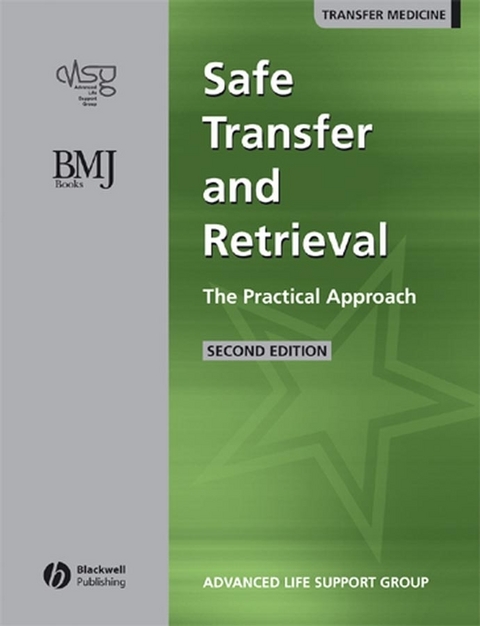
Safe Transfer and Retrieval (STaR) of Patients (eBook)
John Wiley & Sons (Verlag)
9781118289259 (ISBN)
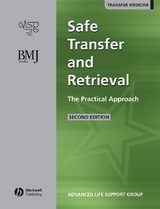
The safe transfer of all hospital patients, especially those who are critically ill, is of crucial importance, demanding organisational, as well as clinical skills,
Safe Transfer and Retrieval of Patients (STaR) is aimed at all health care workers involved with inter and intra-hospital transfers, It provides a much needed structured approach to transfer medicine, together with sound guidance on relevant clinical procedures,
The second edition has been extensively revised in line with new developments in transfer medicine, The book has been redesigned with five distinct sections covering:
- the principles of the STaR structured approach to transfers
- the management of the transfer or retrieval
- practical procedures related to transfer medicine
- an overview of clinical care during the assessment and stabilisation phases of transfer,
- the legal and safety aspects of transfers, specific differences in helicopter transfers and transfers involving children
A new chapter, the infectious or contaminated patient, has been added, in light of current concerns around the potential transfer of infection between patients and staff,
The major revisions to this STaR coursebook bring it into line with the latest thinking on patient transfers, making it an invaluable guide for anyone involved in this aspect of health care,
The Advanced Life Support Group (ALSG), Manchester UK, began life in 1990 and became a registered medical education charity in 1993, The organisation exists to 'preserve life by providing training and education to the general public and in particular but not exclusively to doctors, nurses and other members of the medical profession, in life saving techniques',
The book is written and edited by Emergency Medicine specialists who are Advanced Life Support Group (ALSG) trainers,
The safe transfer of all hospital patients, especially those who are critically ill, is of crucial importance, demanding organisational, as well as clinical skills. Safe Transfer and Retrieval of Patients (STaR) is aimed at all health care workers involved with inter and intra-hospital transfers. It provides a much needed structured approach to transfer medicine, together with sound guidance on relevant clinical procedures. The second edition has been extensively revised in line with new developments in transfer medicine. The book has been redesigned with five distinct sections covering: the principles of the STaR structured approach to transfers the management of the transfer or retrieval practical procedures related to transfer medicine an overview of clinical care during the assessment and stabilisation phases of transfer. the legal and safety aspects of transfers, specific differences in helicopter transfers and transfers involving children A new chapter, the infectious or contaminated patient, has been added, in light of current concerns around the potential transfer of infection between patients and staff. The major revisions to this STaR coursebook bring it into line with the latest thinking on patient transfers, making it an invaluable guide for anyone involved in this aspect of health care.
The Advanced Life Support Group (ALSG), Manchester UK, began life in 1990 and became a registered medical education charity in 1993. The organisation exists to "preserve life by providing training and education to the general public and in particular but not exclusively to doctors, nurses and other members of the medical profession, in life saving techniques". The book is written and edited by Emergency Medicine specialists who are Advanced Life Support Group (ALSG) trainers.
Part I: Introduction.
1 Introduction.
2 The structured approach to transfers.
Part II: Managing the transfer.
3 Assessment and control.
4 Communication.
5 Evaluation.
6 Preparation and packaging.
7 Transportation.
8 Putting ACCEPT into practice.
Part III: Practical aspects of transfer medicine.
9 Oxygen therapy and monitoring.
10 Securing and packaging.
Part IV: Assessment and clinical aspects of transfer
medicine.
Chapter 11 Introduction to the clinical assessment of
patients.
Chapter 12 Specific clinical conditions.
Part V: Special considerations.
13 Paediatric transfers - an introduction.
14 Air transfer - an introduction.
15 Keeping staff safe.
16 The infectious or contaminated patient.
17 Legal and insurance issues.
18 Documentation.
Part VI: Appendices.
Appendix A Levels of clinical care for hospitalised adults.
Appendix B The Transfer Master.
Appendix C Oxygen cylinder sizes and contents.
Appendix D Oxygen therapy guidelines.
Appendix E Paediatric transfers: an aide-mémoire.
Appendix F Paediatric transfer equipment list.
Appendix G Generic transfer checklists appropriate for the
inter-hospital transfer of level 3 patients.
Appendix H STaR-based general transfer checklist.
Appendix I Transfer competences.
References and further information.
Glossary.
Index
Chapter 1
Introduction
This book and its associated course are aimed at a multi-disciplinary audience and have been developed in an attempt to overcome the difficulties faced by all healthcare professionals when organising and carrying out the transfer of patients who may be critically ill or injured. There are essentially two components:
- Organisational and management strategy
- Practical problems that may be encountered during preparation, packaging and transportation of patients
Although the Safe Transfer and Retrieval (STaR) course focuses on transportation of patients between hospitals, the same approach should be applied to the transportation of any ill patients within hospitals.
In recent years, following concerns about the standard of head injury transfers, there has been a great deal of interest in improving the standards for the care of the critically ill who are transferred between hospitals.
In 1996, a multi-professional group from across the UK first met to devise a training system aimed at promoting a structured approach to the transfer of the critically ill. The vision was, and still is, that, in the same way that everybody now accepts the systematic ABCDE approach to resuscitation, healthcare professionals would adopt ACCEPT as the basis for a structured approach to transfer medicine.
In 1997 the Intensive Care Society (ICS) published its Guidelines for the Transport of the Critically Ill Adult; these were revised in 2002.
Safe Transfer and Retrieval: The Practical Approach was first published in 2002 as the core text for the STaR course.
Box 1.1 Primary diagnosis in transferred patients
Trauma (including head injuries)
Respiratory failure/pneumonia
Post-operative/surgical
Intracranial bleeds/subarachnoids
Post-cardiac/respiratory arrest
Overdose
Renal failure
Multi-organ failure/sepsis
Liver failure
Pancreatitis
Burns
Aortic aneurysm
Cardiac failure
Others:
- Asthma
- Neurological condition
- Status epilepticus
- Meningitis
- Diabetes
- Cancer
- Eclampsia
Source: Intensive Care Bed Information Service (ICBIS)
The number of inter-hospital transfers continues to rise. This increasing demand for intensive care beds is fuelled by patients’ and relatives’ expectations and improved resuscitation and surgical techniques.
In most cases, an Intensive Care transfer results from the lack of a functioning ICU bed in the primary hospital. This could be due to lack of either an available bed or the nursing staff to look after the patient. The second most common cause is the requirement for specialist management in a tertiary centre. Box 1.1 demonstrates the wide spectrum of clinical pathologies which may be encountered.
The source of these patients also varies widely (Box 1.2). Emergency Departments and ICUs are the most frequent starting places for the movementof intensive care patients.
Box 1.2 Transferring departments
Emergency Department
ICU
Theatre
Ward
HDU
CCU
Source: Intensive Care Bed Information Service (ICBIS)
Though it is to be expected that patients moving from ICU will be fully stabilised and packaged, the same assumption cannot be made when patients are moved from other departments. These patients, and those coming from wards and theatres, may require considerable time before they are adequately prepared and packaged for transfer.
Inter-hospital transfers are not infrequently associated with adverse events which may be recorded on transfer forms or spotted by independent auditors. Those reported most commonly are shown in Box 1.3.
Although the ICS guidelines and the STaR course were initially aimed at improving the care delivered to critically ill patients, it seems that there are an increasingly large number of ‘high dependency’ patients whose transfers are less than ideal. It therefore seems logical to extend the concepts of Safe Transfer and Retrieval to encompass a wider spectrum of patients.
Furthermore, recent published work has highlighted that transfers within hospitals (intra-hospital transfer) are a cause for concern. Although this Australian study looked at reported incidents around the intra-hospital transfer of critically ill patients, there are lessons to be learned by all who transfer less seriously ill patients within hospitals. Of the reported incidents, 39% identified equipment problems, relating predominantly to battery/power supply, transport ventilator or monitor function. Also in this group, access to lifts was a significant problem. More than half (61%) of the reported incidents related to staff issues in which communication and liaison problems were highlighted.
Box 1.3 Most commonly reported adverse events
- No capnography available (when clinically indicated, with potential for raised ICP)
- Cardiovascular instability during transfer
- Tachyarrythmias/bradycardias
- Hypotension
- Hypertension
- Hospital equipment problems
- Monitor failure
- Pump failure
- Equipment not available
- Mechanical ventilator not available
- Significant hypoxia
- Ambulance breakdown/lost en route
- Cardiac arrest in ambulance
- Death in transfer
Source: Intensive Care Bed Information Service (ICBIS)
The 2006 edition of Safe Transfer and Retrieval: The Practical Approach, the core text for the STaR course, has been redesigned in order to make the concept of a structured approach to transfers more widely available to healthcare professionals of all disciplines throughout hospitals.
The move towards competency-based medical education and the development of clinical levels of care for adults has enabled the authors to attempt to match the degree of illness with the competencies which will be required in order to successfully undertake transportation (Appendix A).
The “levels of critical care for adults’” allocates levels of care according to a patients’ clinical needs alone and ranges from level 0, which is general ward care in an acute hospital, through to level 3, which encompasses what was traditionally known as Intensive Care. Although not specifically designed for the purpose of informing the clinical needs of transfer medicine, these guidelines may be broadly appropriate for such work.
Furthermore, these levels of care can broadly be mapped across to the STaR Transfer Category Table (Chapter 5) which describes a structure for allocating vehicle and staffing resources based on clinical need, or levels of care, for ambulance transportation.
| Level of care | Triage category |
| Level 3 | Time Critical |
| Level 3 | Intensive |
| Level 2 | Ill-unstable |
| Level 1 | Ill-stable/Unwell |
| Level 0 | Well |
Competency-based training and education is increasingly accepted as the measure of the clinical competence of an individual. In the 1997 ICS guidelines the advice about the required skills recommended that the doctor should be ‘experienced in transfer medicine and have at least two years experience in anaesthetics and intensive care’. The recommendations for the accompanying nurse, or technician, specified ‘experience in transfers, at least 2 years in intensive care and hold the ENB 100 qualification’. By 2002, the new ICS guidelines now prescribed competencies for the accompanying medical attendant, which included resuscitation, airway care, ventilation and other organ support. This medical practitioner should have ‘demonstrated competencies in transport medicine, and be familiar with the transport equipment’. The assistant ‘should be suitably experienced nurse, paramedic or technician, familiar with intensive care procedures and with the transport equipment’.
Therefore, it seems logical that all staff who are involved in the transfer of patients should be able to demonstrate that their general clinical skills are appropriate to the level of care required by their patients. They should also be able to demonstrate that they have the specific clinical competencies required to deliver appropriate care to the patient during transportation. The necessary competencies should be assessed, either as part of continuing professional development, or specific training, and this achievement recorded.
The achievement of general clinical competence in a particular field or level of care is gained by experience and in-house training. Training in the use of appropriate medical equipment is best undertaken in-house, but is often not formally assessed and is rarely recorded. The addition of a Safe Transfer and Retrieval course, designed to encourage a structured approach to areas specific to transfer medicine, can build on these existing...
| Erscheint lt. Verlag | 19.7.2017 |
|---|---|
| Sprache | englisch |
| Themenwelt | Medizin / Pharmazie ► Allgemeines / Lexika |
| Medizin / Pharmazie ► Gesundheitswesen | |
| Medizin / Pharmazie ► Medizinische Fachgebiete ► Notfallmedizin | |
| Schlagworte | Care • centres • Common • Course • Department • District • Emergency Medicine & Trauma • Hospitals • investigation • Medical Science • Medicine • Medizin • Modern • Necessary • Notfallmedizin u. Traumatologie • Part • patients • Retrieval • SAFE • Skills • Specialist • Tertiary • Transfer • transfers around • Treatments • Unit • Vital |
| ISBN-13 | 9781118289259 / 9781118289259 |
| Informationen gemäß Produktsicherheitsverordnung (GPSR) | |
| Haben Sie eine Frage zum Produkt? |
 EPUB (Adobe DRM)
Kopierschutz: Adobe-DRM
Adobe-DRM ist ein Kopierschutz, der das eBook vor Mißbrauch schützen soll. Dabei wird das eBook bereits beim Download auf Ihre persönliche Adobe-ID autorisiert. Lesen können Sie das eBook dann nur auf den Geräten, welche ebenfalls auf Ihre Adobe-ID registriert sind.
Details zum Adobe-DRM
Dateiformat: EPUB (Electronic Publication)
EPUB ist ein offener Standard für eBooks und eignet sich besonders zur Darstellung von Belletristik und Sachbüchern. Der Fließtext wird dynamisch an die Display- und Schriftgröße angepasst. Auch für mobile Lesegeräte ist EPUB daher gut geeignet.
Systemvoraussetzungen:
PC/Mac: Mit einem PC oder Mac können Sie dieses eBook lesen. Sie benötigen eine
eReader: Dieses eBook kann mit (fast) allen eBook-Readern gelesen werden. Mit dem amazon-Kindle ist es aber nicht kompatibel.
Smartphone/Tablet: Egal ob Apple oder Android, dieses eBook können Sie lesen. Sie benötigen eine
Geräteliste und zusätzliche Hinweise
Buying eBooks from abroad
For tax law reasons we can sell eBooks just within Germany and Switzerland. Regrettably we cannot fulfill eBook-orders from other countries.
aus dem Bereich