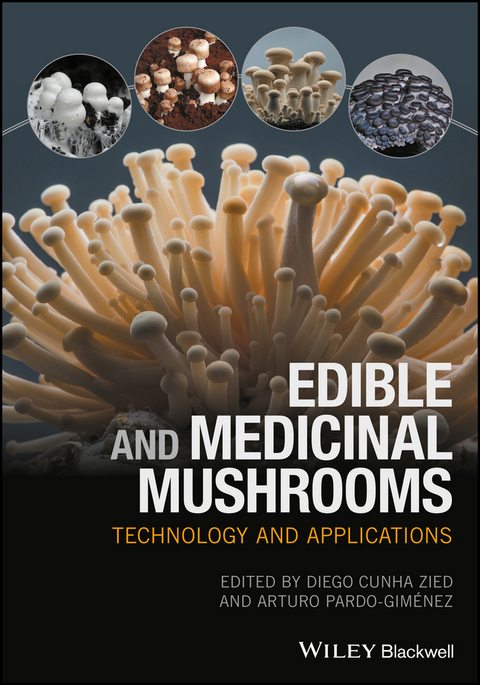
Edible and Medicinal Mushrooms (eBook)
John Wiley & Sons (Verlag)
978-1-119-14942-2 (ISBN)
Comprehensive and timely, Edible and Medicinal Mushrooms: Technology and Applications provides the most up to date information on the various edible mushrooms on the market. Compiling knowledge on their production, application and nutritional effects, chapters are dedicated to the cultivation of major species such as Agaricus bisporus, Pleurotus ostreatus, Agaricus subrufescens, Lentinula edodes, Ganoderma lucidum and others. With contributions from top researchers from around the world, topics covered include:
- Biodiversity and biotechnological applications
- Cultivation technologies
- Control of pests and diseases
- Current market overview
- Bioactive mechanisms of mushrooms
- Medicinal and nutritional properties
Extensively illustrated with over 200 images, this is the perfect resource for researchers and professionals in the mushroom industry, food scientists and nutritionists, as well as academics and students of biology, agronomy, nutrition and medicine.
Edited by
Professor Dr Diego Cunha Zied of Universidade Estadual Paulista (UNESP), Brazil and Researcher Dr Arturo Pardo-Giménez of Centro de Investigación, Experimentación y Servicios del Champiñón (CIES), Spain.
Comprehensive and timely, Edible and Medicinal Mushrooms: Technology and Applications provides the most up to date information on the various edible mushrooms on the market. Compiling knowledge on their production, application and nutritional effects, chapters are dedicated to the cultivation of major species such as Agaricus bisporus, Pleurotus ostreatus, Agaricus subrufescens, Lentinula edodes, Ganoderma lucidum and others. With contributions from top researchers from around the world, topics covered include: Biodiversity and biotechnological applications Cultivation technologies Control of pests and diseases Current market overview Bioactive mechanisms of mushrooms Medicinal and nutritional properties Extensively illustrated with over 200 images, this is the perfect resource for researchers and professionals in the mushroom industry, food scientists and nutritionists, as well as academics and students of biology, agronomy, nutrition and medicine.
Edited by Professor Dr Diego Cunha Zied of Universidade Estadual Paulista (UNESP), Brazil and Researcher Dr Arturo Pardo-Giménez of Centro de Investigación, Experimentación y Servicios del Champiñón (CIES), Spain.
Cover 1
Title Page 5
Copyright 6
Contents 7
List of Contributors 21
Acknowledgments 25
Preface 27
Chapter 1 Mushrooms and Human Civilization 29
1.1 Domestication of Mushrooms 30
References 31
Chapter 2 Current Overview of Mushroom Production in the World 33
2.1 Lentinula edodes 34
2.2 Pleurotus spp. 36
2.3 Auricularia spp. 38
2.4 Agaricus bisporus 38
2.5 Flammulina velutipes 39
2.6 Outlook 39
References 40
Chapter 3 Mushrooms: Biology and Life Cycle 43
3.1 Life Cycle of Fungi 43
3.2 The Subkingdom Dykaria 45
3.2.1 Dikaryosis: Concepts 45
3.3 Homothallism, Heterothallism, and Amphithallism 46
3.4 Heterothallism 47
3.5 Homothallism 47
3.6 Amphithallism 48
3.7 Mating-Type Genes 49
3.8 Agaricus brasiliensis (Syn = A. subrufescens or A. blazei): An Intriguing Example of Amphithallism 50
3.9 Life Cycle of Uncultivated Mushrooms 52
3.10 The Truffles 53
3.11 Morels 53
3.12 The Chanterelles 54
3.13 The Matsutake 55
3.14 Porcini 55
3.15 Decreased Production of Mycorrhizal Mushrooms in the Northern Hemisphere 56
3.16 Fitness of Filamentous Fungi 56
3.17 Final Considerations 58
References 59
Chapter 4 Genetic Aspects and Strategies for Obtaining Hybrids 63
4.1 Agaricus bisporus 64
4.1.1 Introduction 64
4.1.2 Understanding Reproductive Biology 65
4.1.2.1 Different Mating Systems in the Genus Agaricus 67
4.1.2.2 Different Mating Systems within Agaricus bisporus 67
4.1.3 Understanding and Collecting Variability 69
4.1.3.1 Distribution 69
4.1.3.2 Germplasm Collection 70
4.1.3.3 Natural Variability 70
4.1.4 Utilizing Variability 71
4.1.4.1 Direct Selection of Natural Variants 71
4.1.4.2 Tissue Culture, Multispore, and Single Spore Cultures 71
4.1.4.3 Mutations by Ionizing Radiation or Chemical Mutagens 73
4.1.4.4 Strain Mixing to Achieve Hybridization 73
4.1.5 Exploiting Variability Through Hybridization 73
4.1.5.1 Genetic Parameters: Heritability, Combining Ability, and So On 75
4.1.5.2 Genome Analysis 75
4.1.5.3 Variation in Isoenzymes, RAPD, RFLP, and Other Molecular Traits 76
4.1.6 Identification of Parental Strain 76
4.1.6.1 Economically Important Traits 76
4.1.7 Production and Identification of Homokaryons 79
4.1.7.1 Use of Non?Fertility as a Marker in Single Spore Isolates 79
4.1.7.2 Micromanipulation 79
4.1.7.3 Growth Rate and Downward Linear Growth on Compost 79
4.1.7.4 Environmental Factors Enhancing Tetrasporic Basidia 80
4.1.7.5 Use of the BSN Gene to Promote Production of Homokaryons 80
4.1.7.6 Molecular Methods – RAPD, ISSR, and So On 80
4.1.7.7 Protoplast Methods to Develop Homokaryons 80
4.1.8 Hybridization: Intermating of Homokaryons/Heterokaryons 81
4.1.8.1 Intermating of Homokaryons 81
4.1.8.2 Hybridization using Resistance Markers 81
4.1.8.3 Hybridization using Auxotrophs as Markers 82
4.1.8.4 Somatic Hybridization/Protoplast Fusion 84
4.1.8.5 Di?Mon Mating 85
4.1.8.6 Identification of Hybrids using Isoenzyme/Molecular Markers 86
4.1.9 Genetic Manipulation: Transformation 86
4.1.10 Selection 87
4.1.10.1 Direct Selection 87
4.1.10.2 Selection by Rejection 87
4.1.10.3 Marker?Assisted Selection (MAS) 87
4.2 Oyster Mushroom (Pleurotus Species) 88
4.2.1 Introduction 88
4.2.2 Reproductive Biology 89
4.2.3 Germplasm 90
4.2.4 Genetic Variability 90
4.2.5 Genetic Parameters: Heterosis, Heritability, Combing Ability 92
4.2.6 Hybridization 93
4.2.6.1 Conventional Breeding 93
4.2.6.3 Protoplast Fusion 95
4.2.6.4 Di?Mon Mating 96
4.2.6.5 Non?Conventional Breeding 96
4.2.7 Desired Traits 97
4.2.7.1 Yield 97
4.2.7.2 Sporelessness 98
4.2.7.3 Wide Temperature Range 99
4.2.7.4 Chemical Tolerance 100
4.2.7.5 Bioactive Molecules 100
4.2.7.6 Other Traits 100
4.2.7.3.7 Environmental Bioremediation 100
4.3 Conclusion 100
References 101
Chapter 5 Spawn Production 117
5.1 Our Spawn Industry Today 117
5.2 Basics 118
5.2.1 Terminology 118
5.2.2 The Mushroom Production Pyramid 119
5.3 Spawn Production Techniques 120
5.3.1 Grain/Sawdust Spawn Production in Small Bags 120
5.3.2 Grain Spawn in Large Bags 122
5.3.2.1 Individual Bags 123
5.3.2.2 Bulk 125
5.3.3 Liquid Spawn 127
5.3.4 Liquefied Spawn 129
5.3.5 Grain Spawn in Plastic Bottles or Glass Jars 129
5.4 Strain Selection 129
5.5 Strain Preservation and Degeneration 130
5.5.1 Deep Freezing 131
5.5.2 Cooling 132
5.5.3 Subculturing 133
5.5.4 Strain Refreshment 133
5.6 Production of Mother Cultures and Mother Spawn 135
5.6.1 Making Agar 135
5.6.2 Subculturing 135
5.6.3 Making Mother Spawn 137
5.6.4 Product Flow and Hygiene Rules in the Mother Spawn Department 140
5.7 Hygiene 142
5.8 Sterilization, Disinfection, and Filtration 144
5.8.1 Heat Treatment 144
5.8.2 Chemical Treatment 148
5.8.3 Mechanical Treatment – Filtration 148
5.8.4 UV Treatment 149
5.8.5 Radiation Treatment 150
5.9 Substrate Composition 150
5.10 Incubation 151
5.10.1 Temperature 152
5.10.2 pH 153
5.10.3 Gas Concentration 153
5.10.4 Inoculation Method and Mixing 153
5.10.5 Incubation Rooms 154
5.11 Conservation and Transport 155
References 156
Chapter 6 Compost as a Food Base for Agaricus bisporus 157
6.1 The Place of Agaricus strains in Nature 157
6.1.1 Bacteria 157
6.2 Compost Process Phase I 158
6.3 Preparing Raw Materials 160
6.3.1 Prewetting 160
6.3.2 Mixing and Mixing Systems 162
6.3.3 Different Systems of Fermentation 164
6.3.4 Aerated Floors 164
6.4 Phase II 166
6.4.1 What Phase II Means and What Happens in Tunnels During the Process 166
6.4.2 Systems 168
6.4.3 Tunnel Building for Phase II 170
6.5 Phase III 172
6.5.1 Spawning 172
6.5.2 Spawn Run 174
References 175
Chapter 7 Casing Materials and Techniques in Agaricus bisporus Cultivation 177
7.1 General Aspects of Casing and Fruiting 177
7.2 Casing Materials 181
7.2.1 Materials of Mineral Origin 181
7.2.1.1 Natural Materials 181
7.2.1.2 Processed Materials and Waste Products 182
7.2.2 Materials of Vegetal Origin 182
7.2.2.1 Natural Materials 182
7.2.2.2 Processed Materials and Waste Products 183
7.2.3 Synthetic Materials 184
7.2.4 Other Materials 185
7.3 Casing Related Techniques 186
7.3.1 Reuse of Casing 186
7.3.2 Ruffling 187
7.3.3 CACing Technique 188
7.3.4 Commercial Casing Inoculums 189
7.3.5 Other Techniques 190
7.3.5.1 Supplementary Casing Material Addition (“Patching”) 190
7.3.5.2 Compacting 190
7.3.5.3 Double Cropping: Casing Substitution 190
7.3.5.4 Double Cropping: Re?Supplementing and Re?Casing 190
7.3.5.5 Plastic Film Coverage 191
7.3.5.6 Sandwich Technique 191
7.3.5.7 Ditch Technique 191
References 191
Chapter 8 The Bag or Block System of Agaricus Mushroom Growing 203
8.1 Overview of the System 203
8.2 Bags and Blocks in Use 204
8.3 Practical Use of the System – Phase I and Phase II 206
8.4 Practical Use of the System – Spawning and Phase III 206
8.5 Practical Use of the System – Casing through Cropping 214
References 223
Chapter 9 The Mushroom Industry in the Netherlands 225
References 237
Chapter 10 New Technology in Agaricus bisporus Cultivation 239
10.1 Introduction 239
10.2 Stages and Operations of the Production System 239
10.2.1 Compost Phase I, II, and III 239
10.2.2 Supplementation 241
10.2.3 Trays 241
10.2.4 Casing 242
10.2.5 Growing Rooms and Cultivation Cycle Management 244
10.2.6 Production and Harvest 245
10.2.7 Compost Discard 247
10.3 Conclusion 248
References 248
Chapter 11 Insect, Mite, and Nematode Pests of Commercial Mushroom Production 249
11.1 Fly Pests 249
11.1.1 Dark?Winged Fungus Gnat 249
11.1.1.1 Damage 250
11.1.1.2 Identification 250
11.1.1.3 Life History 251
11.1.1.4 Management Strategies 251
11.1.2 Gall Midges, Cecids 254
11.1.2.1 Damage 254
11.1.2.2 Identification 254
11.1.2.3 Life History 255
11.1.2.4 Management Strategies 255
11.1.3 Phorid Flies 255
11.1.3.1 Damage 256
11.1.3.2 Identification 256
11.1.3.3 Life History 256
11.1.3.4 Management Strategies 257
11.2 Mite Pests 258
11.2.1 Pyemotid mites 258
11.2.1.1 Damage 258
11.2.1.2 Identification 258
11.2.1.3 Life History 258
11.2.1.4 Management Strategies 259
11.2.1.5 Chemical Management 259
11.2.2 Gamasid Mites 259
11.2.3 Other Mites Associated with Mushroom Cultivation 259
11.3 Nematode Pests 259
11.3.1 Saprophytic Nematodes 260
11.3.1.1 Symptoms and Signs 260
11.3.1.2 Causal Agents 260
11.3.1.3 Disease Cycle and Epidemiology 260
11.3.1.4 Management Strategies 261
11.3.2 Parasitic Nematodes 261
11.3.2.1 Causal Agents 261
11.3.2.2 Symptoms and Signs 261
11.3.2.3 Disease Cycle and Epidemiology 261
11.3.2.4 Management Strategies 262
11.3.3 Beneficial Nematodes 262
11.3.3.1 Endoparasitic Nematodes 262
11.3.3.2 Entomopathogenic Nematodes 262
References 263
Chapter 12 Mushroom Diseases and Control 267
12.1 Introduction 267
12.2 Fungal Diseases 267
12.2.1 Dry Bubble 267
12.2.1.1 Control 269
12.2.2 Wet Bubble 270
12.2.2.1 Control 271
12.2.3 Cobweb 272
12.2.3.1 Control 273
12.2.4 Trichoderma Diseases 273
12.2.4.1 Control 276
12.2.5 False Truffle 277
12.2.5.1 Control 278
12.2.6 White Plaster Mold 279
12.2.6.1 Control 279
12.2.7 Brown Plaster Mold 280
12.2.7.1 Control 280
12.3 Bacterial Diseases 281
12.3.1 Bacterial Blotch or Brown Blotch 281
12.3.1.1 Control 282
12.3.2 Internal Stipe Necrosis 283
12.3.2.1 Control 283
12.4 Viral Diseases 284
12.4.1 La France Disease or Die?Back 284
12.4.1.1 Control 285
Further Reading 285
Chapter 13 Harvesting and Processing of Mushrooms 289
13.1 Introduction 289
13.2 Manual Harvesting 290
13.3 Mechanical Harvesting 293
13.4 Automatic Harvesting Systems 293
13.5 Washing Mushrooms 295
13.6 Canning Mushrooms 296
13.7 Conclusions 296
References 297
Chapter 14 Mushroom Farm Design and Technology of Cultivation 299
14.1 Selection of Site and Pre-Requisites 300
14.2 Components of a Mushroom Farm 301
14.2.1 General Layout/Location of Various Units 302
14.2.2 Composting Unit 303
14.2.2.1 Covered Outdoor Composting Platform 303
14.2.2.2 Pasteurization Facility 304
14.2.2.3 Cooling in Tropical Areas of Compost in Summer Months: Special Requirements in the Compost Bulk Chamber 306
14.2.2.4 Casing Pasteurization Chamber 307
14.2.3 Spawn Unit 307
14.2.4 Cropping Unit 308
14.2.4.1 Seasonal Cropping Rooms 308
14.2.4.2 Structural Details Special to Low Cost Growing Rooms 309
14.2.4.3 Environmentally Controlled Cropping Rooms 310
14.2.4.4 Structural Details Special to Cropping Rooms 311
14.3 Mushroom Cultivation Technology 314
14.3.1 Substrate Preparation/Composting 314
14.3.2 Materials 314
14.3.2.1 Base Materials 315
14.3.2.2 Recommended Formulations for Composting in India (One Ton Base Material) 315
14.3.2.3 Earlier Formulations Recommended in India (European Adoptions) 316
14.3.3 Composting Procedure 316
14.3.3.1 Phase I 317
14.3.3.2 Phase II 318
14.4 Environmental Crop Management 321
14.4.1 Watering 321
14.4.2 Harvesting and After Care 322
14.5 Cultivated Edible Specialty Mushrooms 323
14.5.1 Gray Oyster Mushroom 324
14.5.1.1 Substrate Materials 324
14.5.1.2 Substrate Preparation 325
14.5.1.3 Spawning and Spawn Run 325
14.5.1.4 Opening of the Bags for Cropping 325
14.5.1.5 Cropping and Crop Management 325
14.5.1.6 Post?Harvest Handling and Marketing in India 326
14.5.2 Black Oyster Mushroom 326
14.5.3 White Oyster Mushroom 327
14.5.4 Pink Oyster Mushroom 327
14.5.5 Yellow Oyster Mushroom 327
14.5.6 King Oyster Mushroom 328
14.5.6.1 Substrate Materials 328
14.5.6.2 Substrate Preparation 328
14.5.6.3 Spawning and Spawn Run 328
14.5.6.4 Opening of Bags for Fruiting 329
14.5.7 Black Ear Mushroom 330
14.5.8 Buna Shimeji Mushroom 330
14.5.9 Shiitake Mushroom 331
14.5.10 Milky Mushroom 331
14.5.11 Paddy Straw Mushroom 332
14.5.12 Enoki Mushroom 332
14.5.13 Portobello Brown 333
14.5.13.1 Raw Materials Used 333
14.5.13.2 Composting Procedure 333
14.5.13.3 Spawning and Spawn Run 334
14.5.13.4 Casing and Case Run 334
14.5.13.5 Airing/Pinhead Formation/Cropping 335
14.5.13.6 Harvesting 335
References 335
Chapter 15 Cultivation of Mushrooms in Plastic Bottles and Small Bags 337
15.1 Introduction 337
15.2 Characteristics of Mushroom Cultivation in Plastic Bottles and Small Bags 338
15.2.1 Plastic Bottles 338
15.2.2 Small Bags 338
15.2.3 Cultivation Containers 338
15.2.4 Substrate Materials 340
15.2.5 Mushroom Cultivation Processes in Plastic Bottles and Small Bags 340
15.2.5.1 Substrate Mixing and Filling 341
15.2.5.2 Sterilization 343
15.2.5.3 Cooling and Inoculation 344
15.2.5.4 Spawn Run (Incubation) 345
15.2.5.5 Scratching (Kinkaki) in Bottle Cultivation 345
15.2.5.6 Growing (Seiiku) 345
15.2.5.7 Harvesting and Packaging 346
15.2.5.8 Emptying the Substrate 346
15.3 Cultivation Methods 347
15.3.1 Flammulina velutipes (Enokitake) 347
15.3.1.1 Substrate and Filling 348
15.3.1.2 Inoculation and Spawn Run 348
15.3.1.3 Scratching and Sprouting (Medashi) 348
15.3.1.4 Preceding Period of Growth 348
15.3.1.5 Late Period of Growth 349
15.3.1.6 Harvesting and Packing 349
15.3.2 Hypsizygus marmoreus (Buna?shimeji) 351
15.3.2.1 Substrate and Filling 351
15.3.2.2 Inoculation and Spawn Run 351
15.3.2.3 Scratching and Growing 351
15.3.2.4 Harvesting and Packaging 352
15.3.3 Pleurotus eryngii (King Oyster) 353
15.3.3.1 Substrate and Filling 353
15.3.3.2 Inoculation and Spawn Run 353
15.3.3.3 Scratching and Growing 353
15.3.3.4 Harvesting and Packaging 354
15.3.4 Pholiota nameko (Nameko) 355
15.3.4.1 Substrate and Filling 355
15.3.4.2 Inoculation and Spawn Run 355
15.3.4.3 Growing and Harvesting 355
15.3.5 Pleurotus ostreatus (Oyster Mushroom, Hiratake) 355
15.3.5.1 Substrate and Filling 355
15.3.5.2 Inoculation and Spawn Run 356
15.3.5.3 Growing and Harvesting 356
15.3.6 Grifola frondosa (Maitake) 356
15.3.6.1 Substrate and Filling 357
15.3.6.2 Inoculation and Spawn Run 357
15.3.6.3 Growing and Harvesting 358
15.3.7 Lentinula edodes (Shiitake) 358
15.3.7.1 Substrate and Filling 359
15.3.7.2 Inoculation and Spawn Run 359
15.3.7.3 Primordia Formation 359
15.3.7.4 Growing and Harvesting 359
15.3.7.5 Resting 361
15.4 Diseases in Mushroom Cultivation in Plastic Bottles and Small Bags 361
15.4.1 Fungal Diseases 361
15.4.1.1 Trichoderma Diseases 361
15.4.1.2 Cobweb Disease, Cladobotryum Infection 362
15.4.1.3 Other Fungal Diseases 363
15.4.2 Bacterial Diseases 363
15.5 Pests in Mushroom Cultivation in Plastic Bottles and Small Bags 365
References 366
Chapter 16 Cultivation of Pleurotus ostreatus 367
16.1 Pleurotus Species as Edible Fungi 367
16.2 Pleurotus spp. as Recyclers 367
16.3 Cultivation of Pleurotus ostreatus 370
16.3.1 Pleurotus ostreatus Strains (Cultures) 371
16.3.2 Spawn 372
16.3.3 Substrate 373
16.3.4 Delayed?Release Nutrients 375
16.3.5 Substrate Pasteurization 375
16.3.6 Alternative Methods of Substrate Preparation 375
16.3.7 Substrate Packing 376
16.3.8 Inoculation 377
16.3.9 Incubation 377
16.3.10 Primordia Formation and Development of Mature Basidiomata 377
16.3.11 Harvesting 378
16.3.12 Spent Substrate 379
16.4 Diseases and Pests 379
16.4.1 Green Mold Diseases 379
16.4.2 Dry Bubble 380
16.4.3 Brown Blotch Disease 380
16.4.4 Pink Mold 381
16.4.5 Scarids 381
16.4.6 Phorids 382
16.4.7 Cecids 382
16.4.8 Springtails (Collembola) 383
16.4.9 Viral Diseases 383
16.5 Pleurotus spp. in Biotechnology 383
16.6 Future Challenges 383
References 384
Chapter 17 Characteristics, Production, and Marketing of the Sun Mushroom: The New Medicinal Cultivated Mushroom 389
17.1 Introduction 389
17.2 Morphological Characteristics 390
17.3 Spawn Production 391
17.4 Compost (Phase I and II) 392
17.4.1 Other Methods for Compost Production 395
17.5 Spawning and Mycelium Run 396
17.6 Casing Layer 396
17.7 Facilities used in the Production Process 398
17.8 Pinning and Harvest 399
17.9 Post-Harvest and Marketing 401
17.10 Medicinal and Chemical Characteristics of Mushrooms 403
17.11 Diseases and Pests 406
17.12 Spent Mushroom Substrate (SMS) 410
Acknowledgments 410
References 410
Chapter 18 Cultivation of Ganoderma lucidum 413
18.1 Introduction 413
18.2 Growing Conditions of Lingzhi 414
18.2.1 Nutritional Factors 414
18.2.1.1 Carbon Sources 414
18.2.1.2 Nitrogen Sources 414
18.2.1.3 Inorganic Salts 415
18.2.1.4 Growth Factors 415
18.2.1.5 Moisture Content 415
18.2.2 Environmental Factors 415
18.2.2.1 Temperature Range 415
18.2.2.2 Moisture Requirement 415
18.2.2.3 Oxygen Level 415
18.2.2.4 Light Conditions 416
18.3 Cultivating Patterns 416
18.3.1 Production of Fruiting Bodies 416
18.3.1.1 Wood?Log Cultivation 416
18.3.1.2 Substitute Cultivation 417
18.3.2 Production of Mycelial Biomass 418
18.3.2.1 LSF 419
18.3.2.2 SSF 419
18.4 Production of the Substrate 420
18.4.1 Preparation of Logs 420
18.4.1.1 Tree Species and Log Size 420
18.4.1.2 Bagging and Sterilization 421
18.4.2 Preparation of Substrates 421
18.4.2.1 Substrate Formulations 421
18.4.2.2 Packaging Substrate and Sterilization 421
18.5 Preparation of Spawn and Inoculation 422
18.5.1 Preparation of Spawn 422
18.5.2 Inoculation 422
18.6 Facilities 423
18.6.1 General Facilities 423
18.6.2 Equipment System for Preparation of Substrate 423
18.6.3 Mechanization and Automation Control System 423
18.6.4 Other Facilities 424
18.7 Genetic Breeding 425
18.7.1 Selective Breeding 425
18.7.2 Cross Breeding 425
18.7.3 Mutation Breeding 426
18.7.4 Protoplast Fusion for Breeding 426
18.7.5 Gene Engineering Breeding 427
18.8 Duration, Number of Flushes 428
18.8.1 Spawn Running 428
18.8.2 Buried Colonized Logs in Soil 429
18.8.3 Management of Fruiting Body Development 429
18.8.4 Number of Flushes 430
18.9 Diseases and Pests in the Cultivation of Lingzhi 431
18.9.1 Main Lingzhi Diseases and Insect Pests 431
18.9.1.1 Fungi and Harm Caused 431
18.9.1.2 Insect Pests and Harm Caused 431
18.9.2 Prevention Strategies for Diseases and Pests 432
18.10 Medicinal Values 433
18.10.1 Polysaccharides 433
18.10.2 Triterpenes 434
18.10.3 Fungal Immunomodulatory Proteins 434
Acknowledgments 435
References 435
Chapter 19 Naturally Occurring Strains of Edible Mushrooms: A Source to Improve the Mushroom Industry 443
19.1 Edible Species and Their Cultivation 443
19.2 Steps for the Domestication of Naturally Occurring Species 444
19.3 Finding New Species for the Mushroom Production Industry: A Look Back at the Last Few Years 446
19.4 Conclusions 451
References 451
Chapter 20 Spent Mushroom Substrate Uses 455
20.1 Introduction 455
20.2 Characteristics of Spent Substrate 456
20.3 Bioremediation 457
20.3.1 Air 457
20.3.2 Water 457
20.3.3 Soil 458
20.3.4 Pesticides 458
20.4 Crop Production 459
20.4.1 Greenhouse Crops 459
20.4.2 Field Crops 459
20.4.3 General Soil Amendment/Fertilizer 460
20.4.4 Nursery and Landscape 460
20.5 Reuse in the Cultivation of Mushrooms 460
20.5.1 Casing Material for Agaricus bisporus 460
20.5.2 Cultivation Substrate for Mushrooms 460
20.6 Food for Animals and Fish 461
20.6.1 Aquaculture 461
20.7 Pest Management 461
20.7.1 Disease Management 462
20.8 Other Varied Uses 462
20.8.1 Renewable Energy 462
20.9 Conclusion 463
References 463
Chapter 21 Chemical, Nutritional, and Bioactive Potential of Mushrooms 483
21.1 Brief Introduction 483
21.2 Chemical Composition and Nutritional Properties 483
21.3 Bioactive Properties 504
21.3.1 Antioxidant Properties 504
21.3.2 Antimicrobial Properties 513
21.3.3 Antitumor Properties 517
21.3.4 Other Bioactivities 520
21.4 Conclusions 521
References 521
Chapter 22 Medicinal Properties and Clinical Effects of Medicinal Mushrooms 531
22.1 Introduction 531
22.2 Current Perspectives and Advances 533
22.3 Medicinal Mushroom Drugs 535
22.4 Medicinal Mushroom Dietary Supplements 536
22.4.1 Safety and Standardization of Medicinal Mushroom DSs 536
22.4.2 Submerged Culturing as the Best Technique for Obtaining Consistent and Safe Mushroom Products 539
22.5 Evidences, Challenges, and Unsolved Problems 539
22.5.1 Taxonomy and Nomenclature of MMs 540
22.5.2 The Study of Culinary?Medicinal Mushrooms in Pure Culture 541
22.5.3 Medicinal Mushroom DS Problems 542
22.6 Medicinal Mushroom Natural Products as an Unclaimed Source for Drug Discovery 543
22.7 Unsolved Problems in the Study of Structural Characteristics, Isolation Process, Receptor-Mediated Mechanism and Antitumor Activity of MM ?-Glucans 545
22.8 Medicinal Mushroom Clinical Studies 546
22.8.1 Clinical Trials 546
22.8.2 Observational Studies 547
22.8.3 Regulation Issues 548
22.8.4 Dosage Consideration 559
22.8.5 Pharmacokinetic Issues 559
22.8.6 Preclinical?Clinical Scaling 560
22.8.7 Toxicity Issues 560
22.9 Conclusions 561
References 562
Index 569
Supplemental Images 591
EULA 603
| Erscheint lt. Verlag | 11.7.2017 |
|---|---|
| Sprache | englisch |
| Themenwelt | Medizin / Pharmazie ► Gesundheitsfachberufe ► Diätassistenz / Ernährungsberatung |
| Naturwissenschaften ► Biologie ► Mykologie | |
| Technik ► Lebensmitteltechnologie | |
| Weitere Fachgebiete ► Land- / Forstwirtschaft / Fischerei | |
| Schlagworte | Agaricus bisporus • Agaricus subrufescens • Agriculture • bioactive mechanisms of mushrooms • Biowissenschaften • control of mushroom pests and diseases • crops • cultivation of major mushroom species • edible and medicinal mushrooms • edible mushroom nutrition • edible mushrooms • Feldfrüchte • Food Science & Technology • Functional Food • Functional Food, Nutraceuticals • Functional Foods & Nutraceuticals • Ganoderma lucidum • global mushroom research • Landwirtschaft • Lebensmittelforschung u. -technologie • Lentinula edodes • Life Sciences • medicinal mushroom production • Medicinal mushrooms • mushroom biodiversity and biotechnological applications • Mushroom cultivation • mushroom cultivation technologies • mushroom industry research • mushroom market overview • mushroom medicinal and nutritional properties • mushroom nutrition • mushroom research • Mycology • Mykologie • Pilze • Pleurotus ostreatus |
| ISBN-10 | 1-119-14942-8 / 1119149428 |
| ISBN-13 | 978-1-119-14942-2 / 9781119149422 |
| Informationen gemäß Produktsicherheitsverordnung (GPSR) | |
| Haben Sie eine Frage zum Produkt? |
 PDF (Adobe DRM)
Kopierschutz: Adobe-DRM
Adobe-DRM ist ein Kopierschutz, der das eBook vor Mißbrauch schützen soll. Dabei wird das eBook bereits beim Download auf Ihre persönliche Adobe-ID autorisiert. Lesen können Sie das eBook dann nur auf den Geräten, welche ebenfalls auf Ihre Adobe-ID registriert sind.
Details zum Adobe-DRM
Dateiformat: PDF (Portable Document Format)
Mit einem festen Seitenlayout eignet sich die PDF besonders für Fachbücher mit Spalten, Tabellen und Abbildungen. Eine PDF kann auf fast allen Geräten angezeigt werden, ist aber für kleine Displays (Smartphone, eReader) nur eingeschränkt geeignet.
Systemvoraussetzungen:
PC/Mac: Mit einem PC oder Mac können Sie dieses eBook lesen. Sie benötigen eine
eReader: Dieses eBook kann mit (fast) allen eBook-Readern gelesen werden. Mit dem amazon-Kindle ist es aber nicht kompatibel.
Smartphone/Tablet: Egal ob Apple oder Android, dieses eBook können Sie lesen. Sie benötigen eine
Geräteliste und zusätzliche Hinweise
Buying eBooks from abroad
For tax law reasons we can sell eBooks just within Germany and Switzerland. Regrettably we cannot fulfill eBook-orders from other countries.
aus dem Bereich