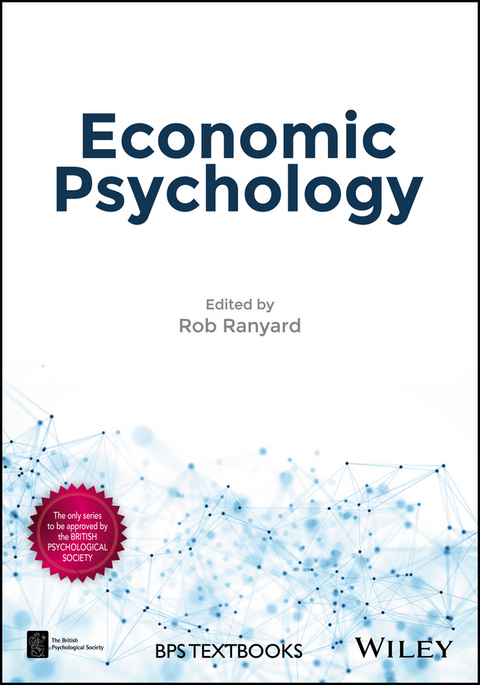
Economic Psychology (eBook)
John Wiley & Sons (Verlag)
978-1-118-92639-0 (ISBN)
A comprehensive overview of contemporary economic psychology
Economic Psychology presents an accessible overview of contemporary economic psychology. The science of economic mental life and behavior is increasingly relevant as people are expected to take more responsibility for their household and personal economic decisions. The text will, in addition to reviewing current knowledge on each topic presented, consider the practical and policy implications for supporting economic decision making. Economic Psychology examines the central aspects of adult decision making in everyday life and includes the theories of economic decision making based on risk, value and affect, and theories of intertemporal choice. The text reviews the nature and behavioral consequences of economic mental representations about such things as material possessions, money and the economy.
The editor Robert Ranyard-a noted expert on economic psychology-presents a life-span developmental approach, from childhood to old age. He also reviews the important societal issues such as charitable giving and economic sustainability. This vital resource:
- Reviews the economic psychology in everyday life including financial behaviour such as saving and tax-paying and matters such as entrepreneurial activity
- Offers an introduction to the field and traces the emergence of the discipline, from Adam Smith to George Katona and Herbert Simon
- Includes information on societal issues such as charitable giving and pro-environmental behaviour
- Considers broader perspectives on economic psychology: life-span psychological development from childhood to old age
Written for students of psychology, Economic Psychology reviews the most important information on contemporary economic psychology with a focus on individual and household economic decision making, ranging widely across financial matters such as borrowing and saving, and economic activities such as buying, trading, and working.
ROB RANYARD is a freelance researcher and Visiting Professor affiliated to the Centre for Decision Research, University of Leeds, UK. He is the editor of A Handbook of Process Tracing Methods for Decision Research (2011) and has publishing articles in journals including The Journal of Economic Psychology. He is a well-known figure in the field, previously serving as treasurer of the International Association for Research in Economic Psychology (IAREP) and currently being the IAREP country representative for the UK.
A comprehensive overview of contemporary economic psychology Economic Psychology presents an accessible overview of contemporary economic psychology. The science of economic mental life and behavior is increasingly relevant as people are expected to take more responsibility for their household and personal economic decisions. The text will, in addition to reviewing current knowledge on each topic presented, consider the practical and policy implications for supporting economic decision making. Economic Psychology examines the central aspects of adult decision making in everyday life and includes the theories of economic decision making based on risk, value and affect, and theories of intertemporal choice. The text reviews the nature and behavioral consequences of economic mental representations about such things as material possessions, money and the economy. The editor Robert Ranyard a noted expert on economic psychology presents a life-span developmental approach, from childhood to old age. He also reviews the important societal issues such as charitable giving and economic sustainability. This vital resource: Reviews the economic psychology in everyday life including financial behaviour such as saving and tax-paying and matters such as entrepreneurial activity Offers an introduction to the field and traces the emergence of the discipline, from Adam Smith to George Katona and Herbert Simon Includes information on societal issues such as charitable giving and pro-environmental behaviour Considers broader perspectives on economic psychology: life-span psychological development from childhood to old age Written for students of psychology, Economic Psychology reviews the most important information on contemporary economic psychology with a focus on individual and household economic decision making, ranging widely across financial matters such as borrowing and saving, and economic activities such as buying, trading, and working.
ROB RANYARD is a freelance researcher and Visiting Professor affiliated to the Centre for Decision Research, University of Leeds, UK. He is the editor of A Handbook of Process Tracing Methods for Decision Research (2011) and has publishing articles in journals including The Journal of Economic Psychology. He is a well-known figure in the field, previously serving as treasurer of the International Association for Research in Economic Psychology (IAREP) and currently being the IAREP country representative for the UK.
Notes on Contributors
Gerrit Antonides is a Professor Emeritus of Economics of Consumers and Households at Wageningen University, The Netherlands. He obtained his PhD at Erasmus University, Rotterdam, in 1988 and has published in the areas of behavioural economics, economic psychology, and consumer behaviour. He has been an editor of the Journal of Economic Psychology, has (co-)authored several textbooks in consumer behaviour and economic psychology and is past President of the Society for the Advancement of Behavioural Economics (SABE). The behavioural aspects of consumer decision-making concerning issues of finance, household, environment and health, are an important part of his current research activities.
John K. Ashton is a Professor of Banking at Bangor University, UK, Editor of the Journal of Financial Regulation and Compliance and Academic Director of the Chartered Banker MBA at Bangor Business School. John has previously worked at the University of Leeds, the University of East Anglia and Bournemouth University, publishing numerous academic articles on pricing, regulation, monetary policy transmission and competition within retail banking markets. These academic outputs have been informed by a career teaching banking through universities and with appropriate professional bodies.
Jan Willem Bolderdijk received his PhD in Environmental Psychology in 2011 from the University of Groningen The Netherlands. He is fascinated by people’s tendency to make ‘irrational’ decisions, and frequently employs field experiments to explore new research ideas in realistic consumer settings. He currently works as an Assistant Professor at the Department of Marketing, University of Groningen, where he studies ways to promote sustainable consumer behaviour. He was awarded a ‘Veni’ career grant by the Dutch National Research Council (NWO) in 2014.
Nicolao Bonini is full Professor of Psychology of Consumer Choice in the Department of Economics and Management, at the University of Trento, Italy. His research training was at the University of Padua, from where he graduated in 1987. Then he was awarded a PhD on experimental psychology at the University of Trieste. Subsequently, he has held various research and lecturing posts in psychology, including Professor of Psychology at the University of Trento from 1999 to the present. He has undertaken psychological research using a range of methods, and has published widely on economic psychology and decision research. He has served the European Association of Decision Making as President, President-Elect, and a member of the steering board.
Christopher J. Boyce is currently a Research Fellow at Stirling Management School, the University of Stirling, UK. He graduated from the University of Surrey with a BSc in Economics in 2005 and then moved to the University of Warwick to complete an MSc in Economics. At Warwick, he completed a PhD in Psychology in 2009 on the topic of subjective well-being. After his PhD he held positions as a Research Fellow at the Paris School of Economics, the University of Manchester, and at the Institute of Advanced Studies. His current research crosses the boundaries of economics and psychology, and he tries to unite ideas from both disciplines. Specifically he is concerned with understanding how an individual’s health and happiness are influenced by the world around them.
Wändi Bruine de Bruin holds a University Leadership Chair in Behavioural Decision Making at the Leeds University Business School, UK, where she co-directs the Centre for Decision Research. She is also affiliated with Carnegie Mellon University, the University of Southern California, and the RAND Corporation. She holds a PhD in behavioural decision-making and psychology and an MSc in behavioural decision theory from Carnegie Mellon University, as well as an MSc in cognitive psychology and a BSc in psychology from the Free University Amsterdam. Her research focuses on judgement and decision-making, risk perception and communication, as well individual differences in decision-making competence across the life-span.
W. Ray Crozier is Honorary Professor in the School of Social Sciences, Cardiff University, UK. Previously, he has held chairs in psychology in Cardiff University and the University of East Anglia. He received research training at the University of Keele, where his PhD was on risky decision-making. He has published widely on topics in social and educational psychology including the emotions, shyness in childhood and adulthood, and artistic creativity. He is a Fellow of the British Psychological Society.
Michael Daly is a Reader affiliated to the Behavioural Science Centre of the Stirling Management School, the University of Stirling, UK. Previously, he has been a Fulbright Scholar visiting Florida State University, a lecturer in the University of Manchester School of Psychology, and a CARA Fellow at the University of Aberdeen Institute of Applied Health Sciences, funded by the Marie Curie Programme. His research focuses on how ideas shaped at the interface of psychology and economics can be investigated and applied to policy. Michael has published a broad set of papers on human health and well-being, how they are interrelated, and how they are determined by psychological traits (e.g., self-control) and economic circumstances (e.g., unemployment).
Liam Delaney is SIRE Professor of Economics and Co-director of the Behavioural Science Centre in the Stirling Management School, the University of Stirling, UK,. He is also PhD Director of the Scottish Graduate Programme in Economics, and Director of Research and Deputy Head of the Stirling Management School. He is a Marie Curie Career Integration Fellow and an investigator with the ESRC-funded Scottish Centre on Constitutional Change. In 2009, he received the Statistical and Social Inquiry Society of Ireland’s Barrington Medal. He was a 2011 Fulbright Fellow at Princeton University. His main research interests involve using novel measures of well-being and time preferences to shed light on long-running questions about the determinants of health and well-being.
Fabio Del Missier is senior research scientist and tenured Assistant Professor in the Department of Life Sciences at the University of Trieste, Italy, and an affiliated research scientist at Stockholm University, in the Department of Psychology. After graduating with a PhD in Psychology from the University of Trieste, he was a post-doc researcher at the University of Trento. His research focuses on memory and cognitive underpinnings of decision-making, basic memory and control processes, and decision-making competence across the adult life-span. His work has been published in the main cognitive psychology, neuropsychology, and decision-making journals.
Artur Domurat is an Assistant Professor in the Faculty of Psychology, at the University of Warsaw, Poland, where he graduated in 2004 with a PhD on psychological methods. His background lies both in economics (Warsaw School of Economics, M.Sc., 1998) and psychology (University of Warsaw, M.A., 2000). He has also been collaborating with the Centre for Economic Psychology and Decision Sciences at Kozminski University since 2001. His interdisciplinary research interests encompass studies in judgement and decision-making (risk-taking, heuristics and Bayesian reasoning) and economic psychology (psychology of entrepreneurship and investing).
Mark Egan is a PhD student at the Behavioural Science Centre, the Stirling Management School, the University of Stirling, UK. His research draws on large, longitudinal data-sets to examine how individual psychological differences in childhood and adolescence predict future economic and health outcomes. Prior to his PhD, he graduated from the MSc Human Decision Science programme at Maastricht University.
Antony Elliott is Chief Executive of the Fairbanking Foundation. He has a degree in Banking and International Finance from City University, London, and a Master’s degree in Operational Research from Imperial College, London. In 2014, he was awarded an OBE for services to bank customers. Antony has been actively involved in researching the field of financial well-being since 2004 and has published a large number of reports in the field. He was lead author for the Money Advice Service report, Transforming Financial Behaviour (2010), examining the role of behavioural economics in improving financial capability. He founded the Fairbanking Foundation in 2008, which conducts research, provides advice and is the certification body for the Fairbanking Mark.
Vera Rita de Mello Ferreira has a PhD in social psychology, and is a member of NEC, the Behavioural Studies Center at CVM (the Brazilian Securities Exchange Commission). She is an economic psychology lecturer at B3 Educacional, in São Paulo, and at other institutions in both São Paulo and other states, an independent consultant for organizations and policy-making (VERTICE PSI), in Brazil and abroad, and author of the first Brazilian books on economic psychology. She is the representative in Brazil of IAREP, and a former member of the Executive Committee of the International Confederation for the Advancement of Behavioral Economics and Economic Psychology (ICABEEP). Vera has been directly involved in the development of economic psychology in Brazil since 1994.
Bruno S. Frey is Professor of Economics at the University of Zurich, Switzerland, and Research Director of CREMA – Center for Research in Economics, Management and the Arts, Zurich, Switzerland. He was...
| Erscheint lt. Verlag | 22.6.2017 |
|---|---|
| Reihe/Serie | BPS Textbooks in Psychology |
| BPS Textbooks in Psychology | BPS Textbooks in Psychology |
| Sprache | englisch |
| Themenwelt | Geisteswissenschaften ► Psychologie |
| Medizin / Pharmazie ► Medizinische Fachgebiete ► Psychiatrie / Psychotherapie | |
| Wirtschaft ► Betriebswirtschaft / Management ► Marketing / Vertrieb | |
| Wirtschaft ► Volkswirtschaftslehre ► Mikroökonomie | |
| Schlagworte | Adam Smith • Behavioral Economics • economic cognitive psychology • economic decision making and taxes • economic psychology and borrowing • economic psychology and buying • economic psychology and decision making • economic psychology and emotions • economic psychology and entrepreneurs • economic psychology and money • economic psychology and responsibility • economic psychology and saving • economic psychology and trading • economic psychology and well-being • economic psychology and working • economic psychology life-span • economic psychology mental representations • George Katona • Herbert Simon</p> • household economic decision making • human rationality in the economic domain • <p>research on economic psychology • Organizational & Industrial Psychology • personal economic decision making • Psychologie • Psychologie i. d. Arbeitswelt • Psychology • society and economic psychology • Wirtschaftspsychologie |
| ISBN-10 | 1-118-92639-0 / 1118926390 |
| ISBN-13 | 978-1-118-92639-0 / 9781118926390 |
| Informationen gemäß Produktsicherheitsverordnung (GPSR) | |
| Haben Sie eine Frage zum Produkt? |
 EPUB (Adobe DRM)
Kopierschutz: Adobe-DRM
Adobe-DRM ist ein Kopierschutz, der das eBook vor Mißbrauch schützen soll. Dabei wird das eBook bereits beim Download auf Ihre persönliche Adobe-ID autorisiert. Lesen können Sie das eBook dann nur auf den Geräten, welche ebenfalls auf Ihre Adobe-ID registriert sind.
Details zum Adobe-DRM
Dateiformat: EPUB (Electronic Publication)
EPUB ist ein offener Standard für eBooks und eignet sich besonders zur Darstellung von Belletristik und Sachbüchern. Der Fließtext wird dynamisch an die Display- und Schriftgröße angepasst. Auch für mobile Lesegeräte ist EPUB daher gut geeignet.
Systemvoraussetzungen:
PC/Mac: Mit einem PC oder Mac können Sie dieses eBook lesen. Sie benötigen eine
eReader: Dieses eBook kann mit (fast) allen eBook-Readern gelesen werden. Mit dem amazon-Kindle ist es aber nicht kompatibel.
Smartphone/Tablet: Egal ob Apple oder Android, dieses eBook können Sie lesen. Sie benötigen eine
Geräteliste und zusätzliche Hinweise
Buying eBooks from abroad
For tax law reasons we can sell eBooks just within Germany and Switzerland. Regrettably we cannot fulfill eBook-orders from other countries.
aus dem Bereich