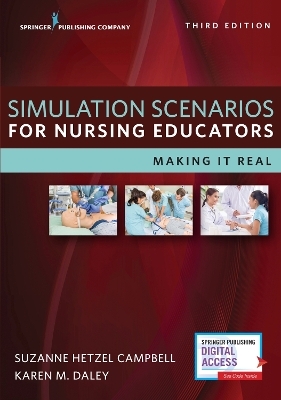
Simulation Scenarios for Nursing Educators
Springer Publishing Co Inc (Verlag)
978-0-8261-1936-0 (ISBN)
When employed as a substitute for real clinical time, simulation scenarios have proven effective in bridging the gap between theory and practice. This acclaimed text for nursing faculty provides detailed, step-by-step guidance on all aspects of clinical simulation. Appropriate for all levels of nursing students, from pre-licensure to doctoral level, the book contains the authors’ own advice and experiences working in simulation around the globe.
For the third edition, 20 new scenarios have been added, for a total of 57. All scenarios have been updated to adhere to best-practice simulation standards for design, facilitator and participant criteria, interprofessional criteria, and debriefing processes. Scenarios are presented in a structured format that includes objectives, pre-scenario checklists, implementation plans, evaluation criteria, debriefing guidelines, and recommendations for further use. A template for creating scenarios spans the text and includes student preparation materials, forms to enhance the realness of the scenario, and checklists for practice assessment and evaluation.
This comprehensive resource covers geriatric, pediatric, trauma, obstetric, and community-based patient scenarios. This revised edition includes scenarios easily adaptable to an instructor’s own lab, an international perspective, and a section on graduate nursing education.
New to the Third Edition:
20 brand new scenarios in anesthesia, midwifery, pediatric, disaster, and other specialty-focused situations, plus five new chapters
Updated to encompass new simulation pedagogy including best-practice standards
New scenarios easily adapted to an instructor’s own lab
Interprofessional and international scenarios focused on areas of global concern: obstetric hemorrhage, neonatal hypoglycemia, and deteriorating patients
Key Features:
Includes information on how to integrate simulation into curricula
Addresses conceptual and theoretical foundations of simulation in nursing education, including an expanded chapter on the Framework for Simulation Learning in Nursing Education
Includes a wide variety of practical scenarios in ready-to-use format with instructions
Provides a template for scenario development
Delivers recommendations for integration of point-of-care decision-making tools
Offers opportunities for enhancing complexity and incorporating interprofessional competencies
Suzanne Campbell is Associate Professor and Director of the University of British Columbia School of Nursing in Vancouver, BC. Karen M. Daley, PhD, RN, is the dean of the College of Health Professions at Davenport University in Grand Rapids, Michigan. She now oversees the Allied Health, Health Information Management, Occupational Therapy, and Nursing programs.
Contributors
Foreword Pamela R. Jeffries, PhD, RN, FAAN, ANEF
Preface
Acknowledgments
PART I: SETTING THE FOUNDATION FOR SIMULATION
1. Simulation-Focused Pedagogy for Nursing Education
Suzanne Hetzel Campbell and Karen M. Daley
2. Framework for Simulation Learning in Nursing Education
Karen M. Daley and Suzanne Hetzel Campbell
3. Integrating Simulation-Focused Pedagogy Into Curriculum
Karen M. Daley and Suzanne Hetzel Campbell
4. Teaching and Evaluating Therapeutic Communication in Simulated Scenarios
Suzanne Hetzel Campbell, Natalia Del Angelo Aredes, and Ranjit K. Dhari
5. Innovative Approaches to Simulation-Based Faculty Development
Suzanne Hetzel Campbell, Maura MacPhee, and Maureen M. Ryan
6. Building and Maintaining a Learning Resource Center
Karen M. Daley, Suzanne Hetzel Campbell, Diana R. Mager, and Cathryn Jackson
7. Lights, Camera, Action! The Process of Evaluating, Acquiring, and Implementing an Audiovisual Capturing Solution to Enhance Learning
Colleen H. Meakim and Leland J. Rockstraw
8. Integration of Disability in Nursing Education With Standardized Patients
Suzanne C. Smeltzer, Bette Mariani, and Colleen H. Meakim
9. IV Simulation Curriculum Development
Shannon Krolikowski
PART II: INNOVATIVE NURSING SCENARIOS IN DIVERSE SETTINGS FOR DIVERSE STUDENTS
A. Specialty Undergraduate Nursing: Medical–Surgical
10. Tune Into Simulation Through Physical Examination Using Your Five Senses
Catherine Napoli Rice and Carolynn Spera Bruno
11. Postoperative Care Following Appendectomy
Diana R. Mager and Jean W. Lange
12. Medical–Surgical Skill-Based Scenarios
Karen M. Daley
13. Acute Management of Respiratory Distress in the Adult Patient
Monica P. Sousa and Linda H. Warren
14. Trauma Resuscitation
Carolynn Spera Bruno and Catherine Napoli Rice
15. Advanced Cardiac Life Support
Sek-ying Chair and Ka-ming Chow
16. The Use of Simulation in the Recognition and Response of the Rapidly Deteriorating Patient
Sandra Goldsworthy
17. Medication Administration
Kellie Bryant and Beth Latimer
B. Specialty Undergraduate Nursing: Obstetrics and Pediatrics
18. Obstetric Emergency: Postpartum Hemorrhage
Suzanne Hetzel Campbell and Wendy A. Hall
19. Perinatal Grief: Threatened Spontaneous Abortion
Joan Esper Kuhnly and Meredith Dodge
20. High-Risk Infant of a Diabetic Mother: Hypoglycemia
Suzanne Hetzel Campbell, Natalia Del Angelo Aredes, Luciana Mara Monti Fonseca, and Julie de Salaberry
21. Pediatric Nursing Care Clinical Simulation Scenarios for Prelicensure Students
Mary Ann Cantrell, Colleen H. Meakim, and Kathryn M. Reynolds
22. Preparing Prelicensure Nursing Students for Clinical Practice in Pediatric Acute Care Settings and Interprofessional In Situ Simulation
Maureen M. Ryan and Melissa Holland
23. Developmental Assessment and Communication With Pediatric Patients and Their Families
Lee-Anne Stephen and Anne Kent
C. Specialty Undergraduate Nursing: Older Adults
24. Care of an Older Adult With Congestive Heart Failure
Alison Kris
25. The Older Adult in an ICU With Acute Respiratory Failure: Critical Care Nursing Senior-Year Elective
Sheila C. Grossman
26. Communication With an Elderly Client
Lillian A. Rafeldt, Heather Jane Bader, and Suzanne Turner
D. Specialty Undergraduate Nursing: Other Themes—Cultural Humility, QSEN, and Mental Health
27. Discharge Teaching for an Immigrant Woman With Congestive Heart Failure and Atrial Fibrillation
Mary Ann Cordeau and Leonie Rose Bovino
28. End-of-Life Scenario With Limited-English-Proficiency Patients
Desiree A. Díaz and Lynn Allchin
29. QSEN CAROUSEL for First-Year Nursing Students
Lillian A. Rafeldt
30. Assessing a Patient With a Mood Disorder
Audrey M. Beauvais and Joyce M. Shea
E. Advanced Practice Nurse Practitioners: FNP, CRNA, PsychMHNP, and DNP
31. Diabetes Management: Nurse Practitioners
Kellie Bryant
32. Assessment and Differential Diagnosis of the Patient Presenting With Chest Pain
Nancy A. Moriber
33. Abdominal Pain in a Woman of Childbearing Age: A Trauma-Informed Care Approach
Suzanne Hetzel Campbell and Jenna A. LoGiudice
34. Primary Care Patients With Gastrointestinal Problems: Graduate Program Advanced Physiology and Pathophysiology
Sheila C. Grossman
35. Using Simulation to Enhance Emotional Intelligence in Nurse Anesthesia Students
Nancy A. Moriber and Audrey M. Beauvais
36. Critical Care/Adult Gerontology Acute Care Nurse Practitioner: Aortic Emergencies
Joshua Squiers and Rose Milano
PART III: INTERDISCIPLINARY AND INTERPROFESSIONAL SCENARIOS
37. Placental Abruption After Motor Vehicle Accident: An Interprofessional Simulation
Jenna A. LoGiudice and Anka Roberto
38. Interprofessional End-of-Life Care of a Teenager
Mary Ann Cordeau, Darlene Rogers, Dennis J. Brown, Barbara Glynn, Margaret B. Gray, Tania Grgurich, Jennifer L. Herbst, Christine Kasinskas, Meghan A. Lewis, Laura Mutrie, Karen M. Myrick, and Tracy Van Oss
39. Interdisciplinary Education in Simulation: Bridging the Gap Between Academic and Career Competencies
Maureen M. Ryan, Anna Macdonald, Brian Farrell, and Darin Abbey
40. Cardiovascular Resuscitation: Code Simulation for Health Care Students
Gloria Brummer
41. Multiple Patient Medical–Surgical Scenario
Kathleen A. Gordon and Mary S. Cook
42. SIMCamp: Trauma Simulation, Rapid-Cycle Deliberate Practice Team Training
Kimberly Bilskey and Leslie Catron
43. Teaching Quality, Safety, and Process Improvement Through Root Cause Analysis Simulation
Jared M. Kutzin
44. Student-Generated Scenarios for Senior Simulation Day
Karen M. Daley and Robin S. Goodrich
45. Assessing for Elder Abuse: The Importance of Interprofessional Collaboration
Lee-Anne Stephen, Dawna Williams, and Pamela Causton
46. Post-Concussion Syndrome
Doris French, Andrew Booth, Michael J. Shoemaker, Jeanine Beasley, Geraldine Jacobus Terry, Margaret Devoest, Samantha Scanlon, and Philip Van Lente
47. Integrating Telehealth in a Simulated Multidisciplinary Rural Health Simulation
Rebecca J. Ventura
48. Interprofessional Team Simulation: Pediatric Rapid Sequence Intubation in Respiratory Failure Due to Severe Bronchiolitis
Jeff Bishop, Maureen M. Ryan, Melissa Holland, and Emma Carrick
49. Prevention and Management of Operating Room Fires
Nancy A. Moriber
50. Teaching and Learning Experiences on Safe Patient Transfers by Occupational Therapy and Nursing Students
Sharon R. Flinn and Julie L. Polanic
51. Professional Integrity in Interdisciplinary Simulation: Creating Workforce Relationships in Occupational Therapy and Nursing
Theresa L. Leto
52. Interprofessional Disaster Simulation
Doris French, Andrew Booth, Michael J. Shoemaker, Margaret Devoest, Jeanine Beasley, and Julie A. Bulson
PART IV: THE SIMULATION JOURNEY CONTINUES
53. Learning to Write Like a Nurse in Clinical Simulations
Lillian Campbell
54. How to Assess Our Own Expertise: Certification and Accreditation
Leland J. Rockstraw, Rita M. Coggins, Carol R. Sando, and Jared M. Kutzin
55. Publishing Your Simulation Work
Suzan Kardong-Edgren
56. Final Words of Wisdom on Simulation
Suzanne Hetzel Campbell and Karen M. Daley
Index
| Erscheinungsdatum | 02.12.2017 |
|---|---|
| Verlagsort | New York |
| Sprache | englisch |
| Maße | 178 x 254 mm |
| Themenwelt | Medizin / Pharmazie ► Pflege ► Ausbildung / Prüfung |
| Pflege ► Fachpflege ► Anästhesie / Intensivmedizin | |
| Studium ► 2. Studienabschnitt (Klinik) ► Anamnese / Körperliche Untersuchung | |
| ISBN-10 | 0-8261-1936-0 / 0826119360 |
| ISBN-13 | 978-0-8261-1936-0 / 9780826119360 |
| Zustand | Neuware |
| Informationen gemäß Produktsicherheitsverordnung (GPSR) | |
| Haben Sie eine Frage zum Produkt? |
aus dem Bereich