Essential Orthodontics (eBook)
John Wiley & Sons (Verlag)
978-1-119-16568-2 (ISBN)
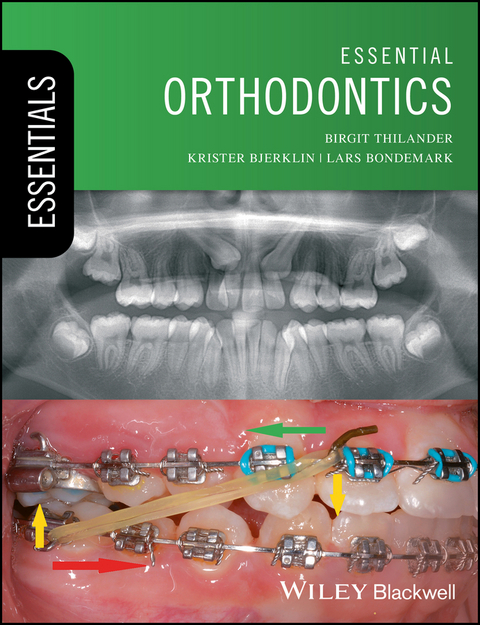
Essential Orthodontics is a comprehensive introduction to the biological principles of orthodontics. This book covers the why, when and how of orthodontics, enabling readers to identify which individuals need to be treated, to diagnose based on individual dentofacial development, and to understand the mechanical principles and tissue responses involved.
Divided into three parts, this authoritative resource covers pretreatment considerations, treatment principles of skeletal and dentoalveolar anomalies, and tissue response to orthodontic and orthopaedic forces. Classification of malocclusions and craniofacial growth and development are discussed, and the text explores how to distinguish between normal occlusion and malocclusions. Essential Orthodontics outlines how to perform a comprehensive orthodontic examination leading to an orthodontic diagnosis, and the formation of a treatment plan.
Following a student-friendly layout with key objectives and chapter summaries, Essential Orthodontics is an accessible yet comprehensive resource for both undergraduate and postgraduate dental students.
About the Authors
Birgit Thilander was formerly Professor Emerita at the Institute of Odontology, Sahlgrenska Academy, University of Gothenburg, Sweden.
Krister Bjerklin is Associate Professor at the Department of Orthodontics, The Institute for Postgraduate Dental Education in Jönköping, Sweden.
Lars Bondemark is Professor at the Department of Orthodontics, Faculty of Odontology, Malmö University, Sweden.
Essential Orthodontics is a comprehensive introduction to the biological principles of orthodontics. This book covers the why, when and how of orthodontics, enabling readers to identify which individuals need to be treated, to diagnose based on individual dentofacial development, and to understand the mechanical principles and tissue responses involved. Divided into three parts, this authoritative resource covers pretreatment considerations, treatment principles of skeletal and dentoalveolar anomalies, and tissue response to orthodontic and orthopaedic forces. Classification of malocclusions and craniofacial growth and development are discussed, and the text explores how to distinguish between normal occlusion and malocclusions. Essential Orthodontics outlines how to perform a comprehensive orthodontic examination leading to an orthodontic diagnosis, and the formation of a treatment plan. Following a student-friendly layout with key objectives and chapter summaries, Essential Orthodontics is an accessible yet comprehensive resource for both undergraduate and postgraduate dental students.
About the Authors Birgit Thilander was formerly Professor Emerita at the Institute of Odontology, Sahlgrenska Academy, University of Gothenburg, Sweden. Krister Bjerklin is Associate Professor at the Department of Orthodontics, The Institute for Postgraduate Dental Education in Jönköping, Sweden. Lars Bondemark is Professor at the Department of Orthodontics, Faculty of Odontology, Malmö University, Sweden.
Cover 1
Title Page 5
Copyright 6
Contents 7
List of Abbreviations 9
Preface 11
Acknowledgement 13
Part 1 Pretreatment Considerations 15
Chapter 1 Orthodontic panorama 17
Orthodontic panorama 18
Conclusions 19
Chapter 2 Classification of malocclusions 21
Normal occlusion and malocclusion 22
Discrepancies between the jaws 22
Functional disturbances 25
Anomalies within the jaws 25
Frequency of malocclusions 28
Orthodontic treatment needs 31
Conclusions 31
References 32
Chapter 3 Craniofacial growth and development 35
Introduction 36
Definitions of general growth 36
Developmental periods and growth in height (stature) 37
Standards of growth and development 37
Prenatal development of the face and jaws 38
Postnatal growth and development of the craniofacial complex 42
Development of the dentoalveolar complex 49
Growth of soft tissues 54
Prediction of growth 55
Conclusions 55
References 56
Chapter 4 Diagnostic examinations 59
Introduction 60
Interview and anamnesis 60
Extra oral examination 60
Functional examination 62
Intra oral examination 65
Model analysis 65
Radiographic analysis 65
Important examinations at different dental developmental stages 67
Conclusions 69
References 70
Part 2 Treatment Principles of Skeletal and Dentoalveolar Anomalies 71
Chapter 5 Sagittal, vertical and transversal discrepancies between the jaws 73
Introduction 74
Cephalometric analysis 74
Treatment of Angle Class II malocclusion 77
Treatment of Angle Class III malocclusion 80
Treatment of deep bite 83
Treatment of open bite 84
Treatment of posterior crossbite 86
Treatment of scissors bite 91
Conclusions 91
References 91
Chapter 6 Crowding of teeth 95
Introduction 96
Model analysis 96
Orthodontic appliances 97
Treatment strategies 97
Conclusions 104
References 104
Chapter 7 Spacing of teeth 105
Introduction 106
Median diastema 106
Missing maxillary incisors 106
Pathological migration of teeth due to periodontitis 109
Spacing in the posterior areas of the dentition 109
Partial edentulous dentitions 110
General spacing of teeth 110
References 111
Chapter 8 Malposition of single teeth 113
Introduction 114
Infraocclusion of primary molars 114
Ectopic eruption of maxillary first permanent molar 114
Impacted maxillary canines 117
Supernumerary teeth 121
Conclusions 122
References 122
Part 3 Tissue Response to Orthodontic and Orthopaedic Forces 125
Chapter 9 Tissue response to orthodontic forces 127
Introduction 128
Tooth-supporting tissues 128
Physiologic tooth migration 129
Orthodontic tooth movements 129
Hyalinisation phase 131
Transmission of orthodontic forces into cellular reactions 133
Biomechanical principles 136
Conclusions 140
References 140
Chapter 10 Tissue response to orthopaedic forces 141
Introduction 142
Response in condyles 142
Response in sutures 144
Conclusions 146
References 147
Chapter 11 Possible adverse tissue reactions 149
Introduction 150
Damage to teeth 150
Damage to tooth-supporting tissues 152
Allergic reactions 154
Pain during orthodontic treatment 156
Risk of temporomandibular disorders (TMD) 156
Conclusions 157
References 157
Chapter 12 Retention and post-retention outcome 161
Introduction 162
Retention 162
The concept relapse 163
Post-retention period 165
Conclusions 166
References 167
Index 169
EULA 173
| Erscheint lt. Verlag | 17.5.2017 |
|---|---|
| Reihe/Serie | Essentials (Dentistry) |
| Essentials (Dentistry) | Essentials (Dentistry) |
| Sprache | englisch |
| Themenwelt | Medizin / Pharmazie ► Allgemeines / Lexika |
| Medizin / Pharmazie ► Gesundheitsfachberufe | |
| Medizin / Pharmazie ► Zahnmedizin | |
| Schlagworte | classification of malocclusions • Craniofacial Growth and Development • crowding of teeth • dentistry • development of facial muscles • development of the dental arches and occlusion • development of the dentoalveolar complex • Einführung i. d. Zahnmedizin • eruption of teeth • extraoral examination • functional examination</p> • growth of soft tissues • growth of the cranial base • growth of the mandible • growth of the nasomaxillary complex • intraoral examination • Introductions to Dentistry • <p>guide to orthodontics • malposition of teeth • mechanism of bone growth • normal occlusion • Orthodontics • Orthodontik • postnatal growth and development of the craniofacial complex • prediction of growth • prenatal development of face and jaws • Sagittal discrepancy • spacing of teeth • transverse discrepancy • vertical discrepancy • Zahnmedizin |
| ISBN-10 | 1-119-16568-7 / 1119165687 |
| ISBN-13 | 978-1-119-16568-2 / 9781119165682 |
| Informationen gemäß Produktsicherheitsverordnung (GPSR) | |
| Haben Sie eine Frage zum Produkt? |
 PDF (Adobe DRM)
Kopierschutz: Adobe-DRM
Adobe-DRM ist ein Kopierschutz, der das eBook vor Mißbrauch schützen soll. Dabei wird das eBook bereits beim Download auf Ihre persönliche Adobe-ID autorisiert. Lesen können Sie das eBook dann nur auf den Geräten, welche ebenfalls auf Ihre Adobe-ID registriert sind.
Details zum Adobe-DRM
Dateiformat: PDF (Portable Document Format)
Mit einem festen Seitenlayout eignet sich die PDF besonders für Fachbücher mit Spalten, Tabellen und Abbildungen. Eine PDF kann auf fast allen Geräten angezeigt werden, ist aber für kleine Displays (Smartphone, eReader) nur eingeschränkt geeignet.
Systemvoraussetzungen:
PC/Mac: Mit einem PC oder Mac können Sie dieses eBook lesen. Sie benötigen eine
eReader: Dieses eBook kann mit (fast) allen eBook-Readern gelesen werden. Mit dem amazon-Kindle ist es aber nicht kompatibel.
Smartphone/Tablet: Egal ob Apple oder Android, dieses eBook können Sie lesen. Sie benötigen eine
Geräteliste und zusätzliche Hinweise
Buying eBooks from abroad
For tax law reasons we can sell eBooks just within Germany and Switzerland. Regrettably we cannot fulfill eBook-orders from other countries.
aus dem Bereich