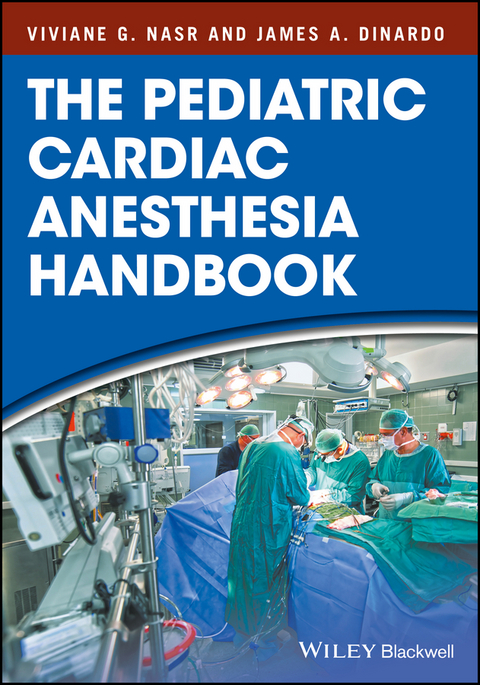
The Pediatric Cardiac Anesthesia Handbook (eBook)
John Wiley & Sons (Verlag)
978-1-119-09555-2 (ISBN)
Written by an expert author team at the renowned Boston Children's Hospital, USA, The Pediatric Cardiac Anesthesia Handbook provides a comprehensive yet concise overview of the anesthetic management of pediatric patients with congenital heart disease.
This book is divided into two parts. The first part provides an introduction to the basic assessment of patients, including cardiovascular physiology, pathophysiology and the underlying concepts in coronary heart disease, preoperative evaluation, intraoperative management, and interpretation of cardiac catheterization data. The second part of the book addresses disorders and diseases in a templated manner covering the anatomical and physiological features, surgical therapies, anesthetic approach and postoperative management. Chapters on the heart and heart and lung transplantation consider the additional complexities of those patients and anesthetic considerations for non-cardiac surgery after heart transplantation.
The anesthesiologist caring for patients with congenital heart disease faces a myriad of challenges in the perioperative management of these complex individuals. This book provides:
- A concise and easily referable guide ideal for use during anesthesiology residency training and fellowships.
- A templated chapter layout ideal for easy referral by wider members of the multidisciplinary team, such as cardiologists, cardiac intensivists, perfusionists, and surgeons.
- Helpful illustrations and a bulleted content for rapid reference.
- Guidelines on specific lesions for the pediatric anesthesiologist caring for cardiac patients presenting for non-cardiac surgery.
This book is a valuable resource for all anesthesiology and cardiac critical care providers who manage patients with congenital heart disease, and an ideal study aid.
Viviane G. Nasr, MD graduated from Medical School at the American University of Beirut (AUB), Lebanon in 2003, and pursued a residency in anesthesiology at AUB and Tufts Medical Center, Boston. She completed a pediatric anesthesia fellowship at Children's National Medical Center (CNMC) in Washington DC and a pediatric cardiac anesthesia fellowship at Boston Children's Hospital. She is American Board certified in Anesthesiology and Pediatric Anesthesiology and an active member of the Congenital Cardiac Anesthesia Society.
James A. DiNardo, MD graduated from Dartmouth College and Dartmouth Medical School (with honors). He completed his anesthesia residency and fellowship in Cardiac Anesthesia at Beth Israel Hospital in Boston. He joined faculty at Boston Children's Hospital in 1999 where he currently serves as the Chief of the Division of Cardiac Anesthesia. He spends approximately one third of this clinical time as an Attending in the Cardiac ICU.
Dr DiNardo is certified in perioperative TEE and is former Chairman of the PTEeXAM Committee. He is also a Senior Oral Board Examiner for the ABA, a member of the ABA Pediatric Examination Writing Committee, and Chair of the Pediatric MOCA Examination Committee. He is Past-President of both the Congenital Cardiac Anesthesia Society and the Association of Cardiac Anesthesiologists. He is currently the Anesthesia and Analgesia Executive Editor for Pediatric Anesthesia.
He is the author of a major textbook on cardiac anesthesia and of more than 160 peer-reviewed articles and book chapters.
Written by an expert author team at the renowned Boston Children's Hospital, USA, The Pediatric Cardiac Anesthesia Handbook provides a comprehensive yet concise overview of the anesthetic management of pediatric patients with congenital heart disease. This book is divided into two parts. The first part provides an introduction to the basic assessment of patients, including cardiovascular physiology, pathophysiology and the underlying concepts in coronary heart disease, preoperative evaluation, intraoperative management, and interpretation of cardiac catheterization data. The second part of the book addresses disorders and diseases in a templated manner covering the anatomical and physiological features, surgical therapies, anesthetic approach and postoperative management. Chapters on the heart and heart and lung transplantation consider the additional complexities of those patients and anesthetic considerations for non-cardiac surgery after heart transplantation. The anesthesiologist caring for patients with congenital heart disease faces a myriad of challenges in the perioperative management of these complex individuals. This book provides: A concise and easily referable guide ideal for use during anesthesiology residency training and fellowships. A templated chapter layout ideal for easy referral by wider members of the multidisciplinary team, such as cardiologists, cardiac intensivists, perfusionists, and surgeons. Helpful illustrations and a bulleted content for rapid reference. Guidelines on specific lesions for the pediatric anesthesiologist caring for cardiac patients presenting for non-cardiac surgery. This book is a valuable resource for all anesthesiology and cardiac critical care providers who manage patients with congenital heart disease, and an ideal study aid.
Viviane G. Nasr, MD graduated from Medical School at the American University of Beirut (AUB), Lebanon in 2003, and pursued a residency in anesthesiology at AUB and Tufts Medical Center, Boston. She completed a pediatric anesthesia fellowship at Children's National Medical Center (CNMC) in Washington DC and a pediatric cardiac anesthesia fellowship at Boston Children's Hospital. She is American Board certified in Anesthesiology and Pediatric Anesthesiology and an active member of the Congenital Cardiac Anesthesia Society. James A. DiNardo, MD graduated from Dartmouth College and Dartmouth Medical School (with honors). He completed his anesthesia residency and fellowship in Cardiac Anesthesia at Beth Israel Hospital in Boston. He joined faculty at Boston Children's Hospital in 1999 where he currently serves as the Chief of the Division of Cardiac Anesthesia. He spends approximately one third of this clinical time as an Attending in the Cardiac ICU. Dr DiNardo is certified in perioperative TEE and is former Chairman of the PTEeXAM Committee. He is also a Senior Oral Board Examiner for the ABA, a member of the ABA Pediatric Examination Writing Committee, and Chair of the Pediatric MOCA Examination Committee. He is Past-President of both the Congenital Cardiac Anesthesia Society and the Association of Cardiac Anesthesiologists. He is currently the Anesthesia and Analgesia Executive Editor for Pediatric Anesthesia. He is the author of a major textbook on cardiac anesthesia and of more than 160 peer-reviewed articles and book chapters.
Title Page 5
Copyright Page 6
Contents 7
Preface 19
Part I The Basics 21
Chapter 1 Cardiovascular Development 23
Embryology 23
Cardiovascular Physiology 23
Fetal Circulation 23
Closure of the Ductus Arteriosus 25
Closure of the Foramen Ovale 26
Closure of the Ductus Venosus 26
Pulmonary Vascular Changes 26
Myocardial Performance in the Neonate 27
Hemodynamic Changes at Birth 27
Chapter 2 Important Concepts in Congenital Heart Disease 29
Pathophysiology of CHD 29
Concepts of Shunting, Single?Ventricle Physiology, and Inter?Circulatory Mixing 29
Shunting 29
Effective Blood Flow 30
Total Pulmonary Blood Flow/Total Systemic Blood Flow 30
Single-Ventricle Physiology 30
Intercirculatory Mixing 33
Classification of Anatomic Shunts 35
Simple Shunts 35
Complex Shunts 35
Pulmonary Vascular Pathophysiology 38
Causes of Pre-Capillary PH in CHD 38
Causes of Post-Capillary PH in CHD 38
Control of Pulmonary Vascular Resistance 39
PaO2 39
PaCO2 39
pH 39
Variation in Lung Volumes 39
Vasodilator Agents 40
Sympathetic Nervous System Stimulation 40
Myocardial Ischemia 41
Aortic Diastolic Pressure 41
Subendocardial Pressure 41
Heart Rate 42
Anatomic Coronary Artery Lesions 42
Chapter 3 Preoperative Evaluation 43
Clinical History 43
Physical Examination 43
Associated Congenital Abnormalities 44
Laboratory Data 45
Pregnancy 46
Psychological Considerations 46
Preoperative Preparation 47
Preoperative Fluid Therapy 47
Preoperative Medications 49
Chapter 4 Intraoperative Management 51
Intraoperative Monitoring 51
ECG and Blood Pressure 51
Systemic Oxygen Saturation 52
End-Tidal CO2 52
Central Venous Pressure 52
Temperature 53
Near-Infra-Red Spectroscopy 53
Transcranial Doppler 54
Transesophageal Echocardiography (TEE) 55
Airway Management 55
Anesthesia Induction and Maintenance 56
Induction of Anesthesia 56
Mask Induction 56
Intravenous Induction 56
Maintenance of Anesthesia 57
Chapter 5 Interpretation of Cardiac Catheterization Data 59
Right-Heart Catheterization 59
Right Atrial Pressure (RAP) Waveform 59
Right Ventricular Pressure (RVP) Waveform 59
Pulmonary Artery Pressure (PAP) Waveform 60
Left-Heart Catheterization 60
Left Atrial Pressure (LAP) Waveform 61
Left Ventricular Pressure (LVP) Waveform 61
Aortic Pressure Waveform 61
Left Ventriculography 61
Coronary Angiography 63
Coronary Anatomy 63
Anatomic Coronary Lesions 64
Coronary Collaterals 65
Cardiac Output Determination 65
Thermodilution Technique 65
Fick Determination 65
Evaluation of Cardiac Shunts 66
Shunt Location 66
Shunt Quantification 66
Saturation Data 68
Resistances 68
Assessment of Pulmonary Vascular Anatomy 68
Evaluation of the Pulmonary Vasculature 68
Pulmonary Artery Wedge Angiogram 68
Pulmonary Vein Wedge Angiogram 69
Assessment of Pulmonary Arterial Hypertension 69
Assessment of Valve Lesions 70
Stenotic Lesions 70
Regurgitant Lesions 70
Chapter 6 Cardiopulmonary Bypass 71
The Cardiopulmonary Bypass Circuit 71
Differences Between Adult and Pediatric CPB 73
CPB Flow Rates 73
Anesthesia During CPB 73
Monitoring During CPB 74
Hemodilution 74
Priming Solution 74
Ultrafiltration 75
Conventional Ultrafiltration 75
Modified Ultrafiltration 75
Blood Gas Management 75
Deep Hypothermic Circulatory Arrest and Regional Perfusion Techniques 77
Anticoagulation 77
Protamine Reversal 78
Chapter 7 Mechanical Support Devices 79
Extracorporeal Membrane Oxygenation (ECMO) 79
Indications 79
Relative Contraindications 79
Modes of ECMO Support 79
Veno-Venous (VV)-ECMO 79
Veno-Arterial (VA)-ECMO 79
Device and Patient Complications 80
Common Terminology Used During an ECMO Run 81
Intraoperative Considerations for Patients on ECMO 81
Ventricular Assist Devices (VADs) 82
Indications 82
Relative Contraindications 82
Modes of VADs (Table 7.3) 82
Complications 82
Anesthetic Considerations for Patients Receiving VAD 82
Induction of Anesthesia and Pre?Bypass Management 84
Post-VAD Placement Management 85
BiVAD Insertion 85
Part II Specific Lesions 87
Chapter 8 Patent Ductus Arteriosus 89
Introduction 89
Anatomy 89
Physiology 89
Surgical Therapy 89
Catheterization Laboratory Intervention 90
Anesthetic Management 90
Induction and Maintenance 90
Non-Cardiac Surgery 91
Chapter 9 Aortopulmonary Window 93
Introduction 93
Anatomy 93
Physiology 93
Surgical Management 93
Catheterization Laboratory Intervention 94
Anesthetic Management 95
Non-Cardiac Surgery 95
Chapter 10 Coarctation of the Aorta 97
Introduction 97
Anatomy 97
Physiology 97
Surgical Therapy 100
Catheterization Laboratory Intervention 100
Anesthetic Management 101
Induction and Maintenance 101
Management after Cross-Clamp Removal 102
Non-Cardiac Surgery 102
Chapter 11 Atrial Septal Defect 103
Introduction 103
Anatomy 103
Ostium Secundum ASD 103
Ostium Primum ASD 103
Sinus Venosus Defects 104
Coronary Sinus Defect 104
Physiology 105
Surgical Therapy 105
Catheterization Laboratory Intervention 105
Anesthetic Management 106
Induction and Maintenance 106
Post-CPB Management 106
Non-Cardiac Surgery 107
Chapter 12 Ventricular Septal Defect 109
Introduction 109
Anatomy 109
Subpulmonary or Supracristal Defects 109
Membranous or Perimembranous Defects 109
Conoventricular Defects 109
Inlet or Canal-Type Defects 109
Muscular Defects 109
Physiology 109
Surgical Therapy 111
Catheterization Laboratory Intervention 111
Anesthetic Management 111
Induction and Maintenance 111
Post-CPB Management 111
Non-cardiac Surgery 112
Chapter 13 Atrioventricular Canal Defects 113
Introduction 113
Anatomy 113
Partial AVC 113
Transitional AVC 113
Complete AVC (CAVC) 113
Unbalanced AVC 114
Physiology 114
Surgical Therapy 115
Anesthetic Management 115
Induction and Maintenance 115
Post-CPB Management 116
Non-Cardiac Surgery 116
Chapter 14 Double Outlet Right Ventricle 117
Introduction 117
Anatomy 117
Physiology 119
Surgical Therapy 120
Anesthetic Management 121
Induction and Maintenance 121
Post-CPB Management 121
Chapter 15 Truncus Arteriosus 123
Introduction 123
Anatomy 123
Physiology 124
Surgical Therapy 124
Catheterization Laboratory Intervention 125
Anesthetic Management 125
Goals 125
Induction and Maintenance 125
Post-CPB Management 125
Goals 126
Chapter 16 Total Anomalous Pulmonary Venous Return 127
Introduction 127
Anatomy 127
Physiology 128
Surgical Therapy 129
Anesthetic Management 129
Goals 129
Induction and Maintenance 130
Post-CPB Management 130
Goals 130
Long-Term Outcomes 130
Chapter 17 Left Ventricular Outflow Tract Obstruction 133
Introduction 133
Anatomy 133
Physiology 133
Surgical Therapy 134
Catheterization Laboratory Intervention 134
Anesthetic 134
Goals 134
Induction and Maintenance 135
Post-CPB Management 135
Chapter 18 Mitral Valve 137
Mitral Valve Stenosis 137
Introduction 137
Anatomy 137
Physiology 138
Surgical Therapy 138
Catheterization Laboratory Intervention 138
Anesthetic Management 138
Goals 138
Pre-Induction 139
Induction and Maintenance 139
Post-Cardiopulmonary Bypass (CPB) Management 140
Mitral Valve Regurgitation 141
Introduction 141
Anatomy 141
Physiology 141
Surgical Management 142
Catheterization Laboratory Intervention 142
Anesthetic Management in Mitral Regurgitation 142
Goals 142
Premedication 142
Induction and Maintenance 142
Post-CPB Management 143
Chapter 19 Pulmonary Atresia/Intact Ventricular Septum (PA/IVS) 145
Introduction 145
Anatomy 145
Physiology 145
Surgical and Catheter?Based Therapy 146
Anesthetic Management 149
Goals 149
Post-CPB Management 149
Chapter 20 Tetralogy of Fallot (TOF) 151
Introduction 151
Anatomy 151
Physiology 151
Hypoxic or Hypercyanotic Episodes (‘Tet Spells’) 152
Surgical Therapy 154
Palliative Shunts 154
Definitive Repair 156
Catheterization Laboratory Intervention 156
Anesthetic Management 157
Goals 157
Induction and Maintenance 157
Post-CPB Management 158
Goals 158
Postoperative Junctional Ectopic Tachycardia 159
Non-Cardiac Surgery 159
Chapter 21 Tetralogy of Fallot with Pulmonary Atresia (TOF/PA) 161
Anatomy 161
Physiology 161
Surgical Therapy 161
Anesthetic Management 163
Post-CPB Management 163
Chapter 22 Tetralogy of Fallot with Absent Pulmonary Valve (TOF/APV) 165
Anatomy 165
Physiology 165
Surgical Therapy 166
Anesthetic Management 166
Post-CPB Management 166
Chapter 23 Transposition of the Great Arteries (TGA) 167
Introduction 167
Anatomy 167
Physiology 168
Surgical Therapy 171
Anatomic Repair or the Arterial (Jatene) Switch Procedure 171
Intra-Atrial Physiologic Repair: Mustard and Senning Procedures 173
Rastelli, Lecompte, and Nikaidoh Procedures 174
Anesthetic Management 175
Goals 175
Induction and Maintenance 175
Post-CPB Management 175
Goals 175
Non-Cardiac Surgery 177
Congenitally Corrected Transposition of the Great Vessels 177
Introduction 177
Anatomy 177
Physiology 178
Surgical Management 178
Traditional Repair for C-TGV 178
Double Switch Procedure and Atrial Switch-Rastelli Procedures 178
Chapter 24 Single-Ventricle Lesions 181
Introduction 181
Physiology and Initial Procedures 181
Initial Procedures to Optimize Pulmonary Arterial Blood Flow 181
Initial Procedures to Optimize Pulmonary Venous Blood Flow 183
Initial Procedures to Optimize Systemic Blood Flow 183
Management of Single-Ventricle Physiology 184
Anesthetic Management, Pre-Initial Repair 186
Goals 186
Induction and Maintenance 187
Post-CPB Management, Post-Initial Repair 187
Goals 187
Single-Ventricle Pathway, Superior Cavopulmonary Shunt or Bidirectional Glenn (BDG) 189
Anesthetic Management, Pre-Superior Cavopulmonary Shunt 191
Goals 191
Induction and Maintenance 191
Post-CPB Management, Post-Superior Cavopulmonary Shunt 191
Goals 191
Definitive Repair: The Fontan Procedure or Total Cavopulmonary Connection (TCPC) 192
Fontan Physiology 192
Fenestrated Fontan 196
Anesthetic Management, Pre-Fontan 196
Goals 196
Induction and Maintenance 197
Post-CPB Management, Post-Fontan Procedure 197
Goals 197
Non-Cardiac Surgery 200
Chapter 25 Hypoplastic Left Heart Syndrome 201
Introduction 201
Anatomy 201
Physiology 201
Surgical Therapy 202
Anesthetic Management 203
Goals 203
Post-CPB Management 203
Biventricular Repair 204
The ‘Borderline’ Left Heart 204
The Left Heart Rehabilitation 204
Staged Left Ventricular Recruitment 204
Biventricular Conversion 205
Non-Cardiac Surgery 205
Chapter 26 Interrupted Aortic Arch 207
Introduction 207
Anatomy 207
Physiology 207
Surgical Management 209
Catheterization Laboratory Intervention 209
Anesthetic Management 210
Goals 210
Induction and Maintenance 210
Post-Cpb Management 210
Goals 210
Chapter 27 Vascular Rings 211
Introduction 211
Anatomy 211
Physiology 211
Surgical Management 211
Catheterization Laboratory Intervention 212
Anesthetic Management 212
Chapter 28 Tricuspid Atresia 215
Introduction 215
Anatomy 215
Physiology 215
Surgical Therapy 217
Anesthetic Management 217
Goals 217
Chapter 29 Heart Transplantation 219
The Donor 219
Anesthetic Management of the Recipient 222
Preoperative Evaluation 222
Physical Examination 222
Premedication 222
Preinduction 222
Induction and Maintenance 223
Operative Procedure 225
Post-CPB Management 227
Goals 227
Preparation for Termination of CPB 227
Impaired Systolic Function 227
Right Ventricular Afterload Mismatch 228
Sinus and Atrioventricular Node Dysfunction 228
Impaired Diastolic Function 228
Termination of CPB 229
Non-Cardiac Surgery in the Post-Cardiac Transplant Patient 230
Physiology of the Transplanted Heart 230
Autonomic Nervous System 230
Heart Rate 230
Left Ventricular Systolic Function 231
Right Ventricular Systolic Function 231
Atrial Function 231
Diastolic Function 231
Issues Unique to Heart Transplant Patients 231
Cardiac Allograft Vasculopathy (CAV) 232
Hypertension 232
Atrial and Ventricular Arrhythmias 232
Subacute Bacterial Endocarditis (SBE) Prophylaxis 233
Rejection 233
Response to Drugs 233
Anesthetic Considerations for Non-Cardiac Surgery in Patients Post Heart Transplantation 235
Chapter 30 Heart–Lung and Lung Transplantation 237
Introduction 237
Single-Lung Transplantation 237
Double-Lung Transplantation 237
Living Donor Lobar Lung Transplant (LDLLT) 238
The Donor 238
Operative Procedure and Patient Positioning 239
Use of CPB 240
HLT and En-Bloc DLT 240
SLT and BSSLT 240
Anesthetic Management 241
Goals 241
Preoperative Evaluation 241
Premedication 241
Preinduction 241
Management of One Lung Ventilation (OLV) 242
Endobronchial Intubation 242
Single-Lumen Endotracheal Tube Plus a Bronchial Blocker 242
Single-Lumen Endotracheal Tube Plus an E-Z Bronchial Blocker 242
Univent Tube 242
Double-Lumen Endotracheal Tube 244
Induction and Maintenance 244
Special Considerations for SLT and BSSLT 245
One-Lung Ventilation 245
Clamping of the PA 246
Allograft Implantation 246
Indications for CPB 246
Post-CPB Management 247
Postoperative Care 247
Non-Cardiac Surgery in Lung Transplant Patients 247
Anesthetic Considerations for Non-Cardiac Surgery in Patients Post Lung Transplantation 249
Chapter 31 Anomalous Origin of the Left Coronary Artery from the Pulmonary Artery (ALCAPA) 251
Introduction 251
Anatomy 251
Physiology 251
Surgical Treatment 251
Anesthetic Management 252
Chapter 32 Heterotaxy 253
Introduction 253
Anatomy 253
Position of the Heart in the Chest 253
Atrial Anatomy 253
Venoatrial Connections 253
Ventricular Anatomy 254
Atrioventricular Junction 256
Ventriculoarterial Connections 256
Surgical Therapy 258
Chapter 33 Ebstein Anomaly 259
Introduction 259
Anatomy 259
Physiology 259
Surgical Treatment 260
Anesthetic Management in Ebstein Anomaly 261
Goals 261
Post-CPB Management 262
Index 263
EULA 289
"Overall, this is an excellent addition to the field of literature on cardiac anesthesia in childhood. It is sufficiently short and small in size to be useful in the coat pocket or the operating room anesthesia back table" Robert M Arensman, MD, University of Illinois at Chicago College of Medicine on behalf of Doody's
| Erscheint lt. Verlag | 15.5.2017 |
|---|---|
| Sprache | englisch |
| Themenwelt | Medizin / Pharmazie ► Allgemeines / Lexika |
| Medizin / Pharmazie ► Medizinische Fachgebiete ► Anästhesie | |
| Schlagworte | Anästhesie • anesthesia • anesthesia handbook • anesthetic • Assessment • BASIC • Book • Boston • Cardiac • Childrens • Concepts • concise overview • Congenital • coronary heart disease • expert author • First • Hospital • Interventional cardiology • Introduction • Invasive Kardiologie • Kardioanästhesie • Management • Medical Science • Medizin • Pädiatrische Kardiologie • Part • patients • Pediatric • pediatric cardiology • Team • two |
| ISBN-10 | 1-119-09555-7 / 1119095557 |
| ISBN-13 | 978-1-119-09555-2 / 9781119095552 |
| Informationen gemäß Produktsicherheitsverordnung (GPSR) | |
| Haben Sie eine Frage zum Produkt? |
 PDF (Adobe DRM)
Kopierschutz: Adobe-DRM
Adobe-DRM ist ein Kopierschutz, der das eBook vor Mißbrauch schützen soll. Dabei wird das eBook bereits beim Download auf Ihre persönliche Adobe-ID autorisiert. Lesen können Sie das eBook dann nur auf den Geräten, welche ebenfalls auf Ihre Adobe-ID registriert sind.
Details zum Adobe-DRM
Dateiformat: PDF (Portable Document Format)
Mit einem festen Seitenlayout eignet sich die PDF besonders für Fachbücher mit Spalten, Tabellen und Abbildungen. Eine PDF kann auf fast allen Geräten angezeigt werden, ist aber für kleine Displays (Smartphone, eReader) nur eingeschränkt geeignet.
Systemvoraussetzungen:
PC/Mac: Mit einem PC oder Mac können Sie dieses eBook lesen. Sie benötigen eine
eReader: Dieses eBook kann mit (fast) allen eBook-Readern gelesen werden. Mit dem amazon-Kindle ist es aber nicht kompatibel.
Smartphone/Tablet: Egal ob Apple oder Android, dieses eBook können Sie lesen. Sie benötigen eine
Geräteliste und zusätzliche Hinweise
Buying eBooks from abroad
For tax law reasons we can sell eBooks just within Germany and Switzerland. Regrettably we cannot fulfill eBook-orders from other countries.
aus dem Bereich