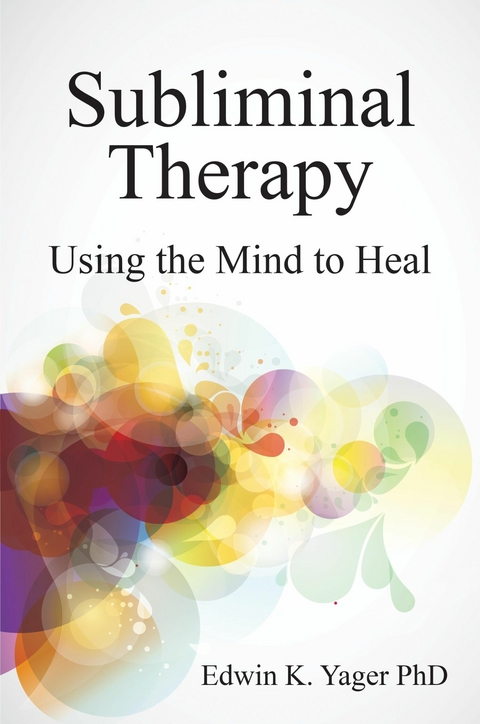
Subliminal Therapy (eBook)
288 Seiten
Crown House Publishing (Verlag)
978-1-84590-765-5 (ISBN)
Edwin K. Yager, PhD was a clinical professor in the Department of Psychiatry, UCSD School of Medicine and a staff psychologist for the UCSD Medical Group. He was a certified consultant in hypnosis by the American Society of Clinical Hypnosis and was also a president, board member and fellow of the San Diego Society of Clinical Hypnosis. In the course of his private psychology practice, using Subliminal Therapy and hypnosis, Dr Yager successfully treated thousands of patients.
Subliminal Therapy is a technique that utilizes hypnotic phenomena for therapeutic purpose without requiring a formal trance induction. The protocol is effective as a sole intervention or as an adjunct to other forms of treatment. In this volume, the reader is introduced to the concepts and applications of Subliminal Therapy and taught its protocol as well This includes establishing identifiable communication with the unconscious domain, uncovering influences that are causing current problems, and resolving those influences.The logically applied protocol of Subliminal Therapy engages unconscious process to uncover the causes of presenting problems, whether manifesting physically, emotionally, intellectually or behaviorally, and then to resolve that influence through re-framing and re-conditioning. The causes of psychogenic problems are usually not consciously recognized; only the resultant symptom - the disability - is apparent. Subliminal Therapy provides a practical, efficient and logical way to identify the cause, as well as a practical, efficient and logical way to resolve its influence. Although Subliminal Therapy may be new concept for professionals, it has been evolving over the past thirty years into a most efficient protocol. The technique has proved especially effective in the treatment of anxiety and the effects of early abuse such as sexual dysfunction, unresolved anger and psychogenic medical problems.
In this chapter, I present the conceptual framework of Subliminal Therapy and the essential assumptions made in its derivation.
Subliminal Therapy is a technique in which subconscious cognitive abilities are accessed and utilized, i.e., abilities that are commonly not recognized consciously. By using this technique, the clinician can identify causal aspects of problems. Once identified, these problems can be resolved by considering their causes in the light of present, more mature and informed knowledge, as opposed to the limited knowledge and understanding in effect at the time when the causal influence began. The therapist utilizes the patient’s present, mature understanding to alter or eliminate the influence of the original experience, by reconditioning by relearning, reframing or simply by reaching a different understanding about the cause.
The Underlying Principles of Subliminal Therapy
The following principles comprise the underpinnings of ST and are expanded upon in the following sections. These principles are rooted in the assumption that our mental processes occur in three domains: conscious, subconscious and extra-conscious.
- Our lives are largely determined by conditioning from experiences in life, whether from Pavlovian or operant conditioning. Values, beliefs and behaviors are all learned and can be relearned in a different way with different consequences provided certain conditions are met. Change will not happen unless these conditions are met:
–– We must be aware that it is possible to change conditioning.
–– We must know how to accomplish the change.
–– We must be motivated to do so.
- We have conscious awareness of only a very small part of our total mental functioning. Most of our mental capacity, as well as our mental functioning, takes place without conscious awareness.
- We possess a higher order of intelligence than we possess in the conscious domain, even though we are seldom taught how to recognize or to utilize it.
- Our subconscious domain is not a unified whole. Rather, it is fragmented, consisting of a great many parts – parts that represent the influences from past experiences. For example, when we learn a new skill, something is there now (in our mind) that was not there before. That something is referred to in ST as a ‘part’. In similar form, if someone learns to fear spiders, that fear is represented by another newly formed part of the mind. Thus, a part may represent a skill, value, limitation or any other influence that was learned.
- These parts of the subconscious domain are the products of life experiences and may continue to exert the influence of those past experiences, even though to do so may be maladaptive and detrimental to the welfare of the person.
- We can influence (as opposed to command) these subconscious parts in desired ways by taking the following steps:
–– Recognize their existence.
–– Establish communication with them.
–– Educate them about current reality, needs and values, thereby persuading them to exert their influence in currently appropriate ways.
- Our higher-level mental capability, which for convenience I call Centrum, is in a position to communicate with, and to educate and influence, other subconscious parts. In utilizing these innate capacities, this higher-level ability is enlisted to assist in accomplishing consciously desired change.
The Assumptions of Subliminal Therapy
The superstructure of ST rests on four assumptions:
- Intelligent, subconscious capability exists.
- The subconscious domain can communicate with the conscious mind in identifiable ways.
- The subconscious domain consists largely of subsystems, (parts) which may function autonomously.
- There is an entity that may best be described as a ‘higher intelligence’ – an entity that is not well defined, yet is easily authenticated subjectively. This entity, which I have named Centrum, is described in Chapter I.
The First Assumption
Subconscious intelligence has been recognized by Cheek (1994), Erickson (1989a), Ewin (2006) and Watkins (1993) among many others:
It is very important for a person to know their subconscious is smarter than they are. There is greater wealth of stored material in the subconscious. We know the subconscious can do things, and it is important to assure your patient that it can. They have to be willing to let their subconscious do things and not depend so much on their conscious mind. This is a great aid to their functioning. (Erickson & Rossi, 1976, p. 346)
In Subliminal Therapy, the therapist persuades patients to allow their subconscious minds to work in a logical, organized, sequential process, either through the guidance of the therapist or, under limited conditions, self-guided by the patient.
The Second Assumption
Centrum can communicate with the conscious mind, doing so in identifiable ways. In my classes I illustrate this communication by asking, “How do you spell cat?” I will point out that, although the students know how to spell ‘cat’, that was not on their minds before I asked the question. And, that since it was not on their minds, the answer had to have been communicated to consciousness from the subconscious domain. The letters were communicated to consciousness by one of the senses; perhaps they saw the letters, or perhaps they heard the letters. I will then ask for a show of hands as to which sense was engaged. I usually see slightly more “I saw them” hands than “I heard them” hands. Also, the phenomena of memory itself can be considered an illustration of subconscious-to-conscious communication in that information is perceived via visual, auditory or other senses.
The Third Assumption
The subconscious mind consists of multiple parts. The literature is rich with examples of recognition of the existence of such parts. Hilgard (1978a) states, “Personality is much less unified than we would like to believe and volition is subject to dissociation just as are perceptual processes.” James’s (1890) assertion that “Consciousness is split into parts that ignore each other,” and Janet’s (1907) interpretation that “Systems of ideas are split off from the major personality, subconscious but capable of becoming represented in consciousness through hypnosis,” support this concept. Green and Green (1977) describe, “the autonomous entities working for themselves as subconscious parts of our psyche.” Subliminal Therapy enlists these ‘autonomous entities’ for therapeutic purposes. Although I pointed out their differences in Chapter I, in respect to the concept of parts, ST is similar to Assagioli’s Psychosynthesis (1965), which is described as a process of integration of the parts of the psyche, and to Watkins and Watkins’s (1979) Ego State Therapy, in which various ‘states’ are ‘cathected’.
The parts that constitute much, if not all, of the subconscious domain, seem limited in knowledge about the person and the world about them. They know only the information that pertained to the experience from which they were created. They lack ‘personality’ as a result of a complexity of factors. On the other hand, they are able to communicate directly with consciousness, as suggested by Watkins’s Ego State Therapy.
The subconscious domain is made up of parts representing different ages and maturity levels, depending upon the stage of life in which they were conceived. Yet, all are intelligent, meaning that they are capable of learning, and all are disposed positively toward the welfare of the individual. However, they influence life in accordance with what they perceive to be advisable, which may be regarded by the patient as dysfunctional. In illustration, a part that is causing a conversion reaction is doing so in the best interests of the individual as it perceives that best interest to be, despite the opposing, conscious opinions of the patient.
The Fourth Assumption
The fourth assumption is that Centrum exists, an assumption not supported by reference to the literature with the exception of the work of Williams (2008). I originally assumed the existence of a higher level of subconscious functioning as an explanation for various phenomena I observed clinically, phenomena which defied other explanation. As the therapist engages the services of Centrum in the process of ST, communication takes place with the patient usually being consciously aware of the process, and the consistent beneficial outcome convincingly validates Centrum’s existence.
As I conceive the organization of our minds, Centrum is simply a name for that higher order of intelligence. And yet, communicating with Centrum quickly impresses the clinician that Centrum has personality, a personality that usually, but not always, conforms with the personality of the patient. On occasion, Centrum has presented as being wholly separate from the patient, autonomouslyand indifferently directing events, but this situation is not common.
While usually consistent in presentation, Centrum may be of unexpected gender, or of no apparent gender, and may demonstrate changes in strengths and values as therapy proceeds.
Centrum...
| Erscheint lt. Verlag | 17.1.2012 |
|---|---|
| Verlagsort | London |
| Sprache | englisch |
| Themenwelt | Geisteswissenschaften ► Psychologie ► Biopsychologie / Neurowissenschaften |
| Geisteswissenschaften ► Psychologie ► Humanistische Psychotherapien | |
| Medizin / Pharmazie ► Gesundheitsfachberufe | |
| Medizin / Pharmazie ► Medizinische Fachgebiete ► Psychiatrie / Psychotherapie | |
| ISBN-10 | 1-84590-765-5 / 1845907655 |
| ISBN-13 | 978-1-84590-765-5 / 9781845907655 |
| Informationen gemäß Produktsicherheitsverordnung (GPSR) | |
| Haben Sie eine Frage zum Produkt? |
 EPUB (Wasserzeichen)
DRM: Digitales Wasserzeichen
Dieses eBook enthält ein digitales Wasserzeichen und ist damit für Sie personalisiert. Bei einer missbräuchlichen Weitergabe des eBooks an Dritte ist eine Rückverfolgung an die Quelle möglich.
Dateiformat: EPUB (Electronic Publication)
EPUB ist ein offener Standard für eBooks und eignet sich besonders zur Darstellung von Belletristik und Sachbüchern. Der Fließtext wird dynamisch an die Display- und Schriftgröße angepasst. Auch für mobile Lesegeräte ist EPUB daher gut geeignet.
Systemvoraussetzungen:
PC/Mac: Mit einem PC oder Mac können Sie dieses eBook lesen. Sie benötigen dafür die kostenlose Software Adobe Digital Editions.
eReader: Dieses eBook kann mit (fast) allen eBook-Readern gelesen werden. Mit dem amazon-Kindle ist es aber nicht kompatibel.
Smartphone/Tablet: Egal ob Apple oder Android, dieses eBook können Sie lesen. Sie benötigen dafür eine kostenlose App.
Geräteliste und zusätzliche Hinweise
Buying eBooks from abroad
For tax law reasons we can sell eBooks just within Germany and Switzerland. Regrettably we cannot fulfill eBook-orders from other countries.
aus dem Bereich