Occupation-Centred Practice with Children (eBook)
John Wiley & Sons (Verlag)
978-1-119-05775-8 (ISBN)
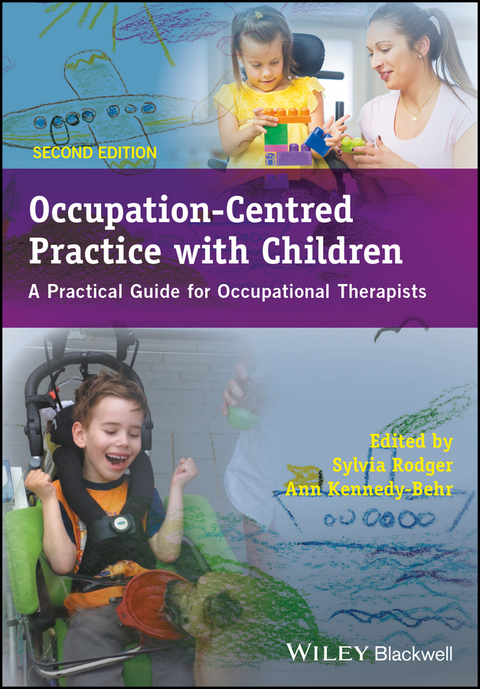
Occupation-Centred Practice with Children remains the only occupational therapy book which supports the development and implementation of occupation-centred practice with children. Drawing on the latest occupational therapy theory and research, this new edition has been fully updated throughout, and includes new chapters on occupational transitions for children and young people, assessing children's occupations and participation, intervention within schools, the arts and children's occupational opportunities, as well as using animals to support children's occupational engagement.
Key features:
- Written by an international expert team of contributors.
- Each chapter begins with preliminary questions to assist with consideration of current knowledge, and then reflection questions at the conclusion to allow revision of key content in order to support independent learning.
- Highly practical, with a range of case studies, key point summaries, reflective questions, best practice guidelines, and a range of tools, interventions and techniques to aid applications to practice.
- A new appendix outlining all the assessments referred to in the book has now been included.
Occupation-Centred Practice with Children is a practical, theoretically grounded and evidence based guide to contemporary occupational therapy practice, and is important reading for all occupational therapy students and therapists wishing to make a real difference to children and their families' lives.
About the Editors
Sylvia Rodger AM, Emeritus Professor, University of Queensland, Australia and Director of Research and Education Cooperative Research Centre for Living with Autism (Autism CRC).
Ann Kennedy-Behr, Lecturer and Program Coordinator - Discipline of Occupational Therapy, School of Health and Sports Science, University of the Sunshine Coast, Australia.
Occupation-Centred Practice with Children remains the only occupational therapy book which supports the development and implementation of occupation-centred practice with children. Drawing on the latest occupational therapy theory and research, this new edition has been fully updated throughout, and includes new chapters on occupational transitions for children and young people, assessing children s occupations and participation, intervention within schools, the arts and children s occupational opportunities, as well as using animals to support children s occupational engagement. Key features: Written by an international expert team of contributors. Each chapter begins with preliminary questions to assist with consideration of current knowledge, and then reflection questions at the conclusion to allow revision of key content in order to support independent learning. Highly practical, with a range of case studies, key point summaries, reflective questions, best practice guidelines, and a range of tools, interventions and techniques to aid applications to practice. A new appendix outlining all the assessments referred to in the book has now been included. Occupation-Centred Practice with Children is a practical, theoretically grounded and evidence based guide to contemporary occupational therapy practice, and is important reading for all occupational therapy students and therapists wishing to make a real difference to children and their families lives.
About the Editors Sylvia Rodger AM, Emeritus Professor, University of Queensland, Australia and Director of Research and Education Cooperative Research Centre for Living with Autism (Autism CRC). Ann Kennedy-Behr, Lecturer and Program Coordinator - Discipline of Occupational Therapy, School of Health and Sports Science, University of the Sunshine Coast, Australia.
Title Page 5
Copyright Page 6
Contents 7
Notes on Contributors 13
Foreword 17
Preface 19
Acknowledgements 21
Chapter 1 Introduction to Occupation-centred Practice for Children 23
Introduction 23
Re-affirming occupation: The core of occupational therapy 27
External influences impacting occupational therapy practice 28
International Classification of Functioning, Disability and Health (ICF) 30
United Nations’ declarations 31
World Fit for Children 31
Millennium Development Goals 32
The evolution of occupational therapy practice with children 33
Changing views of child development and maturation 33
Emerging views about occupational development 35
Re-focusing occupational therapy with children 36
Conclusion 37
References 38
Chapter 2 Becoming an Occupation-centred Practitioner 43
Introduction 43
Theoretical underpinnings of occupational therapy with children 44
Occupation-centred and performance-component focused approaches to practice with children 45
Characteristics of occupation-centred practice for children 50
Client-centred orientation (child- and family-centred) 50
Based on collaborative relationships 51
Client-chosen goals (child- and family-chosen goals) 51
Contextual relevance 52
Active engagement of children and parents 52
Individualisation of intervention 52
Focus on occupational performance and participation throughout the process 52
Information gathering focuses on roles, occupations, performance and environment 53
Intervention focuses on roles, occupations, performance and environment 56
Means versus ends 57
Interventions are whole or finite 59
Occupation-centred evaluation of intervention outcomes 60
Conclusion 61
References 62
Chapter 3 Child and Family-centred Service Provision 67
Introduction 67
Defining the client: Who and how many? 68
Client-centred practice 68
Unequal power in relationships 69
Recognising expertise and goal setting 69
Child-centred practice 70
Family-centred practice and service provision 71
Family-centred practice, family-centred services and family-centred care 73
Becoming a child- and/or family-centred practitioner 74
Relationship development 74
Goal identification and setting 74
Shared decision-making 76
Developing family-centred services 77
Considerations for delivering family-centred practice 77
Outcomes of family-centred practice and family-centred services and their measurement 83
The extended family and community 86
Conclusion 87
References 88
Chapter 4 Cultural Influences and Occupation-centred Practice with Children and Families 95
Introduction 95
Culture and the occupations of the child 96
Culturally responsive occupational therapy 97
The child’s and family’s stories are central 98
Getting connected 99
Being connected 100
Staying connected 102
Building connections 104
Case studies 104
Making the invisible visible 110
Conclusion 110
References 111
Chapter 5 Occupational Goal Setting with Children and Families 113
Introduction 113
Giving children and families a voice 114
Goal setting and motivation 115
Goal setting and outcomes 116
Tools to facilitate goal setting with children and families 116
Perceived Efficacy and Goal Setting System 116
Family Goal Setting Tool 119
Canadian Occupational Performance Measure 123
Child Occupational Self Assessment 123
Paediatric and Preschool Activity Card Sort 123
Summary 124
Goal setting contributes to outcome measurement 124
Case studies: Goal setting with children and parents 125
Conclusion 128
References 128
Chapter 6 Occupational Transitions for Children and Young People 133
Introduction 133
Definition of transition using a life course perspective 134
Transition from home to early childcare centres 134
Transition from early childhood care to primary school 138
School readiness 140
Transition to secondary school 143
Person changes 143
Environment 143
Occupation 144
Degree of ‘fit’ 144
Tips for transition to secondary school 147
Transition to post-school options 149
Conclusion 151
References 151
Chapter 7 Assessing Children’s Occupations and Participation 155
Introduction 155
Bottom-up or top-down approaches to assessment? 157
Occupation- and Participation-Centred Assessment with Children (OP-CAC) framework 159
Implementation of Occupation- and Participation-Centred Assessment with Children (OP-CAC) framework: Assessment in action 160
Occupation- and Participation-Centred Assessment with Children (OP-CAC) framework: Tools 163
Conclusion 181
References 181
Chapter 8 Cognitive Orientation for Daily Occupational Performance (CO-OP): An Occupation-centred Intervention 187
Introduction 187
CO-OP: A brief overview 188
CO-OP Approach: An occupation-centred intervention 191
Child- and family-centred orientation 191
Collaborative partnerships 192
Child-chosen goals 192
Contextual relevance 194
Active engagement of children and parent(s) 194
Individualisation of intervention 196
Focus on occupational performance and participation 197
Information gathering about roles, occupations, performance and environments 198
Intervention is occupation-focused, ‘whole’ or ‘finite’ 199
Occupation-centred evaluation of intervention outcomes 199
Review of handwriting intervention 205
Conclusion 205
References 206
Chapter 9 Perceive, Recall, Plan and Perform (PRPP): Occupation-centred Task Analysis and Intervention System 211
Introduction 211
Information processing, cognitive strategy use and occupational performance 212
The Perceive, Recall, Plan and Perceive (PRPP) System of Task Analysis and intervention 214
PRPP assessment 214
PRPP intervention 216
Using the PRPP system of task analysis and intervention: David 218
‘Perceive’: Observing and prompting sensory processing strategies during task performance 220
Assessment of David: Perceive 220
‘Recall’: Observing strategies used for storage and retrieval of information during task performance 221
Assessment: Recall 221
‘Plan’: Processing information for organizing and problem?solving 223
Assessment: ‘Plan’ 223
‘Perform’: Processing output and performance feedback 225
Assessment: ‘Perform’ 225
Intervention 226
Conclusion 227
References 228
Chapter 10 Occupational Performance Coaching (OPC): Enabling Caregivers’ and Children’s Occupational Performance 231
Introduction 231
Theoretical and philosophical basis 232
Three enabling domains 233
Structured process 233
Collaborative Performance Analysis 236
Emotional support 246
Information exchange 247
Research about OPC 250
OPC with caregivers other than parents 250
Conclusion 251
References 251
Chapter 11 Occupation-centred Intervention in the School Setting 255
Understanding the occupations of the school student 257
Educationally relevant occupational therapy in schools 258
Ways of working in schools 260
Planning educational programmes for diverse learners 260
Occupation-centred information gathering in educational settings 262
Occupation-centred programme planning and intervention in schools 266
Collaboration in service delivery 267
Conclusion 271
References 272
Chapter 12 Occupation-centred Practice: When the Classroom Is Your Client 279
Introduction 279
Practicalities of implementing occupation-centred classroom-based practice 281
The Classroom Intervention Reasoning Approach: Description and overview 283
Partnering for Change: A description of the model 291
Tier 1: Universal Design for Learning 292
Tier 2: Differentiated Instruction 293
Tier 3: Accommodation 293
Challenges and possibilities for occupation-centred whole-class or whole-school practice 296
Conclusion 297
Acknowledgements 297
References 300
Appendix 12.1 Occupational performance analysis template 302
Appendix 12.2 Occupational performance skills included in the OTIPM: Motor, process, and social interaction 306
Chapter 13 Enablement of Children’s Leisure Participation 311
Introduction 311
Outcomes of leisure engagement 313
Engaging and Coaching for Health – Child: Model of leisure coaching 314
Engagement 314
Coaching 315
Community participation 315
Step One: Creating successful engagements 316
Step Two: Coaching to promote personal growth 320
A client-centred approach 320
Specialised interventions 322
A?=?Autonomy principles to promote personally meaningful choice 324
R?=?Relatedness interventions to promote social connectivity 324
C?=?Competence interventions to promote mastery 325
Community climate 326
Conclusion 330
References 330
Chapter 14 The Arts and Children’s Occupational Opportunities 333
Introduction 333
The affordances of the arts 334
Overview of arts in children’s health care 334
Role of creativity and the performing arts within childhood play: Identity, imitation and imagination 335
Skill acquisition and empowerment 338
Motivation and motivationally enhanced learning 339
Self-reflection, feedback and competition 340
Emerging evidence for creative performing arts in therapies for children 342
Circus experiences 342
Magic experiences 343
Music experiences 345
Conclusion 345
References 346
Chapter 15 Using Animals to Support Children’s Occupational Engagement 351
Introduction 351
AAT as an enabler of occupational engagement 353
Theory in AAT 354
Attachment patterns, secure child–therapist relationships, and the effects of human–animal interaction 354
Physiological stress response 355
Understanding the individual meaning of engagement in human–animal interaction 356
Methods of AAT 357
AAT to support an increase in desired social behaviours/attention in social interaction 358
Using AAT to facilitate social interaction and positive social attention 359
Assisting participation in meaningful activities 361
Decision-making in AAT 363
Step 1: Identification of occupational performance issues 364
Step 2: Consideration of AAT, if barriers to goal achievement are found in the areas of: 364
Step 3: Screening of participants 364
Step 4: Conditions/requirements 366
Conclusion 366
References 367
Chapter 16 Decision-making for Occupation-centred Practice with Children 371
Introduction 371
Decision-making and information sources 372
Information from clients, families and their contexts 373
The child’s age and developmental stage 373
The child’s current abilities and functioning across different environmental contexts 375
The child’s personal characteristics, interests and motivators 377
Health and history of previous intervention 377
Home environment and family functioning 378
What the family wants and expects from the service 378
Information about the practice context 378
Information from empirical research 379
Is it applicable to my practice? 380
Does it tell me all I need to know? 381
Structures and supports for accessing, interpreting and applying research 381
Information from clinical experience 382
Integrating information given alternatives and uncertainties 383
Evidence-based practice and decision-making 383
Clinical reasoning 385
Choosing and combining intervention approaches 386
Shared decision-making 387
Conclusion 389
References 390
Appendix 1 Assessments Referred to Throughout the Book 395
Index 399
EULA 410
| Erscheint lt. Verlag | 16.3.2017 |
|---|---|
| Sprache | englisch |
| Themenwelt | Medizin / Pharmazie ► Allgemeines / Lexika |
| Medizin / Pharmazie ► Medizinische Fachgebiete ► Pädiatrie | |
| Medizin / Pharmazie ► Physiotherapie / Ergotherapie ► Ergotherapie | |
| Schlagworte | Ergotherapie • Ergotherapie mit Kindern • Ergotherapie / Praxis • Gesundheits- u. Sozialwesen • Health & Social Care • occupational therapy • Occupational Therapy Practice • Occupational Therapy with Children • Occupation-centred, practice, children, child, family, family-centred, service, provision, young, participation, intervention, coaching, therapy |
| ISBN-10 | 1-119-05775-2 / 1119057752 |
| ISBN-13 | 978-1-119-05775-8 / 9781119057758 |
| Informationen gemäß Produktsicherheitsverordnung (GPSR) | |
| Haben Sie eine Frage zum Produkt? |
 PDF (Adobe DRM)
Kopierschutz: Adobe-DRM
Adobe-DRM ist ein Kopierschutz, der das eBook vor Mißbrauch schützen soll. Dabei wird das eBook bereits beim Download auf Ihre persönliche Adobe-ID autorisiert. Lesen können Sie das eBook dann nur auf den Geräten, welche ebenfalls auf Ihre Adobe-ID registriert sind.
Details zum Adobe-DRM
Dateiformat: PDF (Portable Document Format)
Mit einem festen Seitenlayout eignet sich die PDF besonders für Fachbücher mit Spalten, Tabellen und Abbildungen. Eine PDF kann auf fast allen Geräten angezeigt werden, ist aber für kleine Displays (Smartphone, eReader) nur eingeschränkt geeignet.
Systemvoraussetzungen:
PC/Mac: Mit einem PC oder Mac können Sie dieses eBook lesen. Sie benötigen eine
eReader: Dieses eBook kann mit (fast) allen eBook-Readern gelesen werden. Mit dem amazon-Kindle ist es aber nicht kompatibel.
Smartphone/Tablet: Egal ob Apple oder Android, dieses eBook können Sie lesen. Sie benötigen eine
Geräteliste und zusätzliche Hinweise
Buying eBooks from abroad
For tax law reasons we can sell eBooks just within Germany and Switzerland. Regrettably we cannot fulfill eBook-orders from other countries.
aus dem Bereich