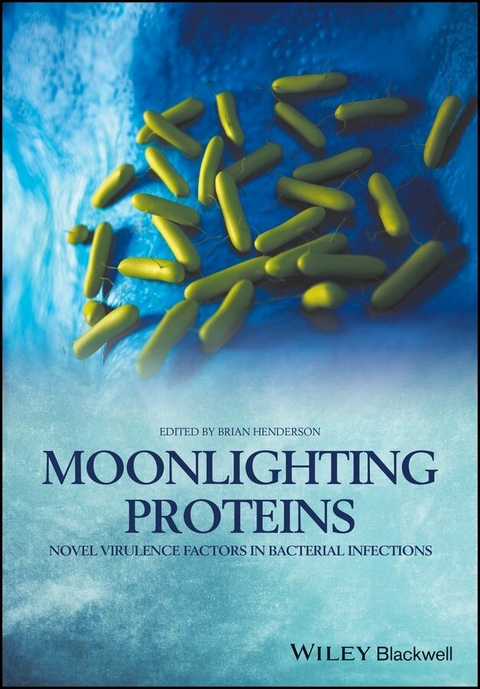
Moonlighting Proteins (eBook)
472 Seiten
Wiley-Blackwell (Verlag)
978-1-118-95112-5 (ISBN)
The book explores the pathogenicity of bacterial moonlighting proteins, demonstrating the plasticity of protein evolution as it relates to protein function and to bacterial communication. Highlighting the latest discoveries in the field, it details the approximately 70 known bacterial proteins with a moonlighting function related to a virulence phenomenon. Chapters describe the ways in which each moonlighting protein can function as such for a variety of bacterial pathogens and how individual bacteria can use more than one moonlighting protein as a virulence factor. The cutting-edge research contained here offers important insights into many topics, from bacterial colonization, virulence, and antibiotic resistance, to protein structure and the therapeutic potential of moonlighting proteins.
Moonlighting Proteins: Novel Virulence Factors in Bacterial Infections will be of interest to researchers and graduate students in microbiology (specifically bacteriology), immunology, cell and molecular biology, biochemistry, pathology, and protein science.
About the Editor
Brian Henderson, Division of Infection and Immunity, University College London, London, UK
Brian Henderson is Professor of Biochemistry in the Department of Microbial Diseases at the UCL-Eastman Dental Institute, University College London. He has worked in academia, both in the UK and North America, and also in the pharmaceutical and biopharmaceutical industry. He has been a cell biologist, immunologist and pharmacologist and over the past twenty years has focused on bacteria-host interactions in relation to human infection and the maintenance of the human microbiota. This is the discipline of Cellular Microbiology and Henderson published the first book on this subject in 1999. At the inception of his career as a cellular microbiologist he discovered a potent bone-destroying protein generated by a pathogenic bacterium. This protein, surprisingly, was the cell stress protein, heat shock protein (Hsp)60. This was one of the earliest bacterial moonlighting proteins discovered and is the reason that the editor has spent the last 20 years exploring the role of protein moonlighting in the life of the bacterium and its interactions with its human host. Henderson has written or edited 17 books and monographs and was the senior editor of the Cambridge University Press Monograph series: Advances in Molecular and Cellular Microbiology.
Title Page 5
Copyright Page 6
Contents 7
List of Contributors 17
Preface 21
About the Editor 25
Part I Overview of Protein Moonlighting 27
Chapter 1 What is Protein Moonlighting and Why is it Important? 29
1.1 What is Protein Moonlighting? 29
1.2 Why is Moonlighting Important? 31
1.2.1 Many More Proteins Might Moonlight 31
1.2.2 Protein Structure/Evolution 31
1.2.3 Roles in Health and Disease 34
1.2.3.1 Humans 34
1.2.3.2 Bacteria 36
1.3 Current questions 37
1.3.1 How Many More Proteins Moonlight? 37
1.3.2 How Can We Identify Additional Proteins That Moonlight and all the Moonlighting Functions of Proteins? 37
1.3.3 In Developing Novel Therapeutics, How Can We Target the Appropriate Function of a Moonlighting Protein and Not Affect Other Functions of the Protein? 38
1.3.4 How do Moonlighting Proteins get Targeted to More Than One Location in the Cell? 38
1.3.5 What Changes in Expression Patterns Have Occurred to Enable the Protein to be Available in a New Time and Place to Perform a New Function? 38
1.4 Conclusions 39
References 39
Chapter 2 Exploring Structure–Function Relationships in Moonlighting Proteins 47
2.1 Introduction 47
2.2 Multiple Facets of Protein Function 48
2.3 The Protein Structure–Function Paradigm 49
2.4 Computational Approaches for Identifying Moonlighting Proteins 51
2.5 Classification of Moonlighting Proteins 52
2.5.1 Proteins with Distinct Sites for Different Functions in the Same Domain 53
2.5.1.1 ?-Enolase, Streptococcus pneumonia 53
2.5.1.2 Albaflavenone monooxygenase, Streptomyces coelicolor A3(2) 55
2.5.1.3 MAPK1/ERK2, Homo sapiens 56
2.5.2 Proteins with Distinct Sites for Different Functions in More Than One Domain 56
2.5.2.1 Malate synthase, Mycobacterium tuberculosis 57
2.5.2.2 BirA, Escherichia coli 57
2.5.2.3 MRDI, Homo sapiens 59
2.5.3 Proteins Using the Same Residues for Different Functions 59
2.5.3.1 GAPDH E. coli 59
2.5.3.2 Leukotriene A4 hydrolase, Homo sapiens 59
2.5.4 Proteins Using Different Residues in the Same/Overlapping Site for Different Functions 60
2.5.4.1 Phosphoglucose isomerase, Oryctolagus cuniculus, Mus musculus, Homo sapiens 60
2.5.4.2 Aldolase, Plasmodium falciparum 62
2.5.5 Proteins with Different Structural Conformations for Different Functions 62
2.5.5.1 RfaH, E. coli 62
2.6 Conclusions 63
References 65
Part II Proteins Moonlighting in Prokarya 71
Chapter 3 Overview of Protein Moonlighting in Bacterial Virulence 73
3.1 Introduction 73
3.2 The Meaning of Bacterial Virulence and Virulence Factors 73
3.3 Affinity as a Measure of the Biological Importance of Proteins 75
3.4 Moonlighting Bacterial Virulence Proteins 76
3.4.1 Bacterial Proteins Moonlighting as Adhesins 78
3.4.2 Bacterial Moonlighting Proteins That Act as Invasins 85
3.4.3 Bacterial Moonlighting Proteins Involved in Nutrient Acquisition 85
3.4.4 Bacterial Moonlighting Proteins Functioning as Evasins 86
3.4.5 Bacterial Moonlighting Proteins with Toxin?like Actions 89
3.5 Bacterial Moonlighting Proteins Conclusively Shown to be Virulence Factors 90
3.6 Eukaryotic Moonlighting Proteins That Aid in Bacterial Virulence 92
3.7 Conclusions 93
References 94
Chapter 4 Moonlighting Proteins as Cross-Reactive Auto-Antigens 107
4.1 Autoimmunity and Conservation 107
4.2 Immunogenicity of Conserved Proteins 108
4.3 HSP Co-induction, Food, Microbiota, and T-cell Regulation 110
4.3.1 HSP as Targets for T-Cell Regulation 111
4.4 The Contribution of Moonlighting Virulence Factors to Immunological Tolerance 113
References 114
Part III Proteins Moonlighting in Bacterial Virulence 119
Part 3.1 Chaperonins: A Family of Proteins with Widespread Virulence Properties 121
Chapter 5 Chaperonin 60 Paralogs in Mycobacterium tuberculosis and Tubercle Formation 123
5.1 Introduction 123
5.2 Tuberculosis and the Tuberculoid Granuloma 123
5.3 Mycobacterial Factors Responsible for Granuloma Formation 124
5.4 Mycobacterium tuberculosis Chaperonin 60 Proteins, Macrophage Function, and Granuloma Formation 126
5.4.1 Mycobacterium tuberculosis has Two Chaperonin 60 Proteins 126
5.4.2 Moonlighting Actions of Mycobacterial Chaperonin 60 Proteins 127
5.4.3 Actions of Mycobacterial Chaperonin 60 Proteins Compatible with the Pathology of Tuberculosis 128
5.4.4 Identification of the Myeloid?Cell?Activating Site in M. tuberculosis Chaperonin 60.1 131
5.5 Conclusions 132
References 132
Chapter 6 Legionella pneumophila Chaperonin 60, an Extra- and Intra-Cellular Moonlighting Virulence-Related Factor 137
6.1 Background 137
6.2 HtpB is an Essential Chaperonin with Protein-folding Activity 138
6.3 Experimental Approaches to Elucidate the Functional Mechanisms of HtpB 138
6.3.1 The Intracellular Signaling Mechanism of HtpB in Yeast 139
6.3.2 Yeast Two-Hybrid Screens 144
6.4 Secretion Mechanisms Potentially Responsible for Transporting HtpB to Extracytoplasmic Locations 146
6.4.1 Ability of GroEL and HtpB to Associate with Membranes 147
6.4.2 Ongoing Mechanistic Investigations on Chaperonins Secretion 148
6.5 Identifying Functionally Important Amino Acid Positions in HtpB 150
6.5.1 Site-Directed Mutagenesis 151
6.6 Functional Evolution of HtpB 152
6.7 Concluding Remarks 153
References 155
Part 3.2 Peptidylprolyl Isomerases, Bacterial Virulence, and Targets for Therapy 161
Chapter 7 An Overview of Peptidylprolyl Isomerases (PPIs) in Bacterial Virulence 163
7.1 Introduction 163
7.2 Proline and PPIs 163
7.3 Host PPIs and Responses to Bacteria and Bacterial Toxins 164
7.4 Bacterial PPIs as Virulence Factors 164
7.4.1 Proposed Mechanism of Virulence of Legionella pneumophila Mip 166
7.5 Other Bacterial PPIs Involved in Virulence 166
7.6 Conclusions 168
References 168
Part 3.3 Glyceraldehyde 3-Phosphate Dehydrogenase (GAPDH): A Multifunctional Virulence Factor 173
Chapter 8 GAPDH: A Multifunctional Moonlighting Protein in Eukaryotes and Prokaryotes 175
8.1 Introduction 175
8.2 GAPDH Membrane Function and Bacterial Virulence 176
8.2.1 Bacterial GAPDH Virulence 177
8.2.2 GAPDH and Iron Metabolism in Bacterial Virulence 179
8.3 Role of Nitric Oxide in GAPDH Bacterial Virulence 179
8.3.1 Nitric Oxide in Bacterial Virulence: Evasion of the Immune Response 180
8.3.2 Formation of GAPDHcys-NO by Bacterial NO Synthases 181
8.3.3 GAPDHcys-NO in Bacterial Virulence: Induction of Macrophage Apoptosis 181
8.3.4 GAPDHcys-NO in Bacterial Virulence: Inhibition of Macrophage iNOS Activity 182
8.3.5 GAPDHcys-NO in Bacterial Virulence: Transnitrosylation to Acceptor Proteins 183
8.4 GAPDH Control of Gene Expression and Bacterial Virulence 184
8.4.1 Bacterial GAPDH Virulence 185
8.5 Discussion 186
Acknowledgements 188
References 188
Chapter 9 Streptococcus pyogenes GAPDH: A Cell-Surface Major Virulence Determinant 195
9.1 Introduction and Early Discovery 195
9.2 GAS GAPDH: A Major Surface Protein with Multiple Binding Activities 196
9.3 AutoADP-Ribosylation of SDH and Other Post-Translational Modifications 198
9.4 Implications of the Binding of SDH to Mammalian Proteins for Cell Signaling and Virulence Mechanisms 199
9.5 Surface Export of SDH/GAPDH: A Cause or Effect? 204
9.6 SDH: The GAS Virulence Factor-Regulating Virulence Factor 206
9.7 Concluding Remarks and Future Perspectives 209
References 209
Chapter 10 Group B Streptococcus GAPDH and Immune Evasion 221
10.1 The Bacterium GBS 221
10.2 Neonates are More Susceptible to GBS Infection than Adults 221
10.3 IL-10 Production Facilitates Bacterial Infection 222
10.4 GBS Glyceraldehyde-3-Phosphate Dehydrogenase Induces IL-10 Production 223
10.5 Summary 225
References 226
Chapter 11 Mycobacterium tuberculosis Cell-Surface GAPDH Functions as a Transferrin Receptor 231
11.1 Introduction 231
11.2 Iron Acquisition by Bacteria 232
11.2.1 Heme Uptake 232
11.2.2 Siderophore-Mediated Uptake 233
11.2.3 Transferrin Iron Acquisition 233
11.3 Iron Acquisition by Intracellular Pathogens 233
11.4 Iron Acquisition by M. tb 234
11.4.1 Heme Uptake 234
11.4.2 Siderophore-Mediated Iron Acquisition 235
11.4.3 Transferrin-Mediated Iron Acquisition 235
11.5 Glyceraldehyde-3-Phosphate Dehydrogenase (GAPDH) 236
11.6 Macrophage GAPDH and Iron Uptake 236
11.6.1 Regulation 236
11.6.2 Mechanism of Iron Uptake and Efflux 237
11.6.3 Role of Post-Translational Modifications 237
11.7 Mycobacterial GAPDH and Iron Uptake 238
11.7.1 Regulation 238
11.7.2 Mechanism of Iron Uptake 241
11.7.3 Uptake by Intraphagosomal M. tb 242
11.8 Conclusions and Future Perspectives 242
Acknowledgements 244
References 245
Chapter 12 GAPDH and Probiotic Organisms 251
12.1 Introduction 251
12.2 Probiotics and Safety 251
12.3 Potential Risk of Probiotics 253
12.4 Plasminogen Binding and Enhancement of its Activation 254
12.5 GAPDH as an Adhesin 255
12.6 Binding Regions 258
12.7 Mechanisms of Secretion and Surface Localization 260
12.8 Other Functions 261
12.9 Conclusion 262
References 263
Part 3.4 Cell-Surface Enolase: A Complex Virulence Factor 271
Chapter 13 Impact of Streptococcal Enolase in Virulence 273
13.1 Introduction 273
13.2 General Characteristics 274
13.3 Expression and Surface Exposition of Enolase 275
13.4 Streptococcal Enolase as Adhesion Cofactor 278
13.4.1 Enolase as Plasminogen?Binding Protein 278
13.4.1.1 Plasminogen-Binding Sites of Streptococcal Enolases 279
13.4.2 Role of Enolase in Plasminogen-Mediated Bacterial-Host Cell Adhesion and Internalization 280
13.4.3 Enolase as Plasminogen-Binding Protein in Non-Pathogenic Bacteria 281
13.5 Enolase as Pro-Fibrinolytic Cofactor 282
13.5.1 Degradation of Fibrin Thrombi and Components of the Extracellular Matrix 283
13.6 Streptococcal Enolase as Cariogenic Factor in Dental Disease 284
13.7 Conclusion 284
Acknowledgement 285
References 285
Chapter 14 Streptococcal Enolase and Immune Evasion 295
14.1 Introduction 295
14.2 Localization and Crystal Structure 297
14.3 Multiple Binding Activities of ?-Enolase 299
14.4 Involvement of ?-Enolase in Gene Expression Regulation 302
14.5 Role of Anti-?-Enolase Antibodies in Host Immunity 303
14.6 ?-Enolase as Potential Therapeutic Target 305
14.7 Questions Concerning ?-Enolase 307
References 307
Chapter 15 Borrelia burgdorferi Enolase and Plasminogen Binding 317
15.1 Introduction to Lyme Disease 317
15.2 Life Cycle 318
15.3 Borrelia Virulence Factors 318
15.4 Plasminogen Binding by Bacteria 319
15.5 B. burgdorferi and Plasminogen Binding 320
15.6 Enolase 321
15.7 B. burgdorferi Enolase and Plasminogen Binding 323
15.8 Concluding Thoughts 327
Acknowledgements 327
References 327
Part 3.5 Other Glycolytic Enzymes Acting as Virulence Factors 335
Chapter 16 Triosephosphate Isomerase from?Staphylococcus aureus and Plasminogen Receptors on Microbial Pathogens 337
16.1 Introduction 337
16.2 Identification of Triosephosphate Isomerase on S. aureus as a Molecule that Binds to the Pathogenic Yeast C. neoformans 338
16.2.1 Co-Cultivation of S. aureus and C. neoformans 338
16.2.2 Identification of Adhesins on S. aureus and C. neoformans 338
16.2.3 Mechanisms of C. neoformans Cell Death 339
16.3 Binding of Triosephosphate Isomerase with Human Plasminogen 340
16.4 Plasminogen-Binding Proteins on Trichosporon asahii 340
16.5 Plasminogen Receptors on C. neoformans 342
16.6 Conclusions 342
References 343
Chapter 17 Moonlighting Functions of Bacterial Fructose 1,6-Bisphosphate Aldolases 347
17.1 Introduction 347
17.2 Fructose 1,6-bisphosphate Aldolase in Metabolism 347
17.3 Surface Localization of Streptococcal Fructose 1,6-bisphosphate Aldolases 348
17.4 Pneumococcal FBA Adhesin Binds Flamingo Cadherin Receptor 349
17.5 FBA is Required for Optimal Meningococcal Adhesion to Human Cells 350
17.6 Mycobacterium tuberculosis FBA Binds Human Plasminogen 351
17.7 Other Examples of FBAs with Possible Roles in Pathogenesis 352
17.8 Conclusions 353
References 353
Part 3.6 Other Metabolic Enzymes Functioning in Bacterial Virulence 359
Chapter 18 Pyruvate Dehydrogenase Subunit B and Plasminogen Binding in Mycoplasma 361
18.1 Introduction 361
18.2 Binding of Human Plasminogen to M. pneumoniae 363
18.3 Localization of PDHB on the Surface of M. pneumoniae Cells 366
18.4 Conclusions 369
References 370
Part 3.7 Miscellaneous Bacterial Moonlighting Virulence Proteins 375
Chapter 19 Unexpected Interactions of Leptospiral Ef-Tu and Enolase 377
19.1 Leptospira –Host Interactions 377
19.2 Leptospira Ef-Tu 378
19.3 Leptospira Enolase 379
19.4 Conclusions 380
References 380
Chapter 20 Mycobacterium tuberculosis Antigen 85 Family Proteins: Mycolyl Transferases and Matrix-Binding Adhesins 383
20.1 Introduction 383
20.2 Identification of Antigen 85 384
20.3 Antigen 85 Family Proteins: Mycolyl Transferases 385
20.3.1 Role of the Mycomembrane 385
20.3.2 Ag85 Family of Homologous Proteins 385
20.3.3 Inhibition and Knockouts of Ag85 386
20.4 Antigen 85 Family Proteins: Matrix-Binding Adhesins 387
20.4.1 Abundance and Location 387
20.4.2 Ag85 a Fibronectin-Binding Adhesin 388
20.4.3 Ag85 an Elastin-Binding Adhesin 389
20.4.4 Implication in Disease 390
20.5 Conclusion 391
Acknowledgement 391
References 391
Part 3.8 Bacterial Moonlighting Proteins that Function as Cytokine Binders/Receptors 397
Chapter 21 Miscellaneous IL-1?-Binding Proteins of Aggregatibacter actinomycetemcomitans 399
21.1 Introduction 399
21.2 A. actinomycetemcomitans Biofilms Sequester IL-1? 400
21.3 A. actinomycetemcomitans Cells Take in IL-1? 401
21.3.1 Novel Outer Membrane Lipoprotein of ?A. actinomycetemcomitans Binds IL-1? 401
21.3.2 IL-1? Localizes to the Cytosolic Face of the Inner Membrane and in the Nucleoids of ?A. actinomycetemcomitans 403
21.3.3 Inner Membrane Protein ATP Synthase Subunit ? Binds IL-1? 403
21.3.4 DNA-Binding Histone-Like Protein HU Interacts with IL-1? 404
21.4 The Potential Effects of IL-1? on A. actinomycetemcomitans 405
21.4.1 Biofilm Amount Increases and Metabolic Activity Decreases 405
21.4.2 Potential Changes in Gene Expression 406
21.5 Conclusions 407
References 408
Part 3.9 Moonlighting Outside of the Box 413
Chapter 22 Bacteriophage Moonlighting Proteins in the Control of Bacterial Pathogenicity 415
22.1 Introduction 415
22.2 Bacteriophage T4 I-TevI Homing Endonuclease Functions as a Transcriptional Autorepressor 417
22.3 Capsid Psu Protein of Bacteriophage P4 Functions as a Rho Transcription Antiterminator 420
22.4 Bacteriophage Lytic Enzymes Moonlight as Structural Proteins 424
22.5 Moonlighting Bacteriophage Proteins De-Repressing Phage-Inducible Chromosomal Islands 424
22.6 dUTPase, a Metabolic Enzyme with a Moonlighting Signalling Role 427
22.7 Escherichia coli Thioredoxin Protein Moonlights with T7 DNA Polymerase for Enhanced T7 DNA Replication 430
22.8 Discussion 430
References 432
Chapter 23 Viral Entry Glycoproteins and Viral Immune Evasion 439
23.1 Introduction 439
23.2 Enveloped Viral Entry 440
23.3 Moonlighting Activities of Viral Entry Glycoproteins 441
23.3.1 Viral Entry Glycoproteins Moonlighting as Evasins 442
23.3.2 Evading the Complement System 443
23.3.3 Evading Antibody Surveillance 445
23.3.3.1 The Viral Glycan Shield 445
23.3.3.2 Shed Viral Glycoproteins: An Antibody Decoy 447
23.3.3.3 Antigenic Variations in Viral Glycoproteins 447
23.3.3.4 Shed Viral Glycoproteins and Immune Signal Modulation 449
23.3.4 Evading Host Restriction Factors 449
23.3.5 Modulation of Other Immune Pathways 450
23.4 Viral Entry Proteins Moonlighting as Saboteurs of Cellular Pathways 453
23.4.1 Sabotaging Signal Transduction Cascades 453
23.4.2 Host Surface Protein Sabotage 454
23.5 Conclusions 455
References 455
Index 465
Supplemental Images 480
EULA 496
| Erscheint lt. Verlag | 14.3.2017 |
|---|---|
| Sprache | englisch |
| Themenwelt | Medizin / Pharmazie ► Medizinische Fachgebiete |
| Studium ► Querschnittsbereiche ► Infektiologie / Immunologie | |
| Naturwissenschaften ► Biologie ► Biochemie | |
| Naturwissenschaften ► Biologie ► Genetik / Molekularbiologie | |
| Naturwissenschaften ► Biologie ► Mikrobiologie / Immunologie | |
| Technik | |
| Schlagworte | Biochemie • biochemistry • Biowissenschaften • clinical microbiology • Klinische Mikrobiologie • Life Sciences • Proteine u. Makromoleküle • Proteins & Macromolecules |
| ISBN-10 | 1-118-95112-3 / 1118951123 |
| ISBN-13 | 978-1-118-95112-5 / 9781118951125 |
| Informationen gemäß Produktsicherheitsverordnung (GPSR) | |
| Haben Sie eine Frage zum Produkt? |
 PDF (Adobe DRM)
Kopierschutz: Adobe-DRM
Adobe-DRM ist ein Kopierschutz, der das eBook vor Mißbrauch schützen soll. Dabei wird das eBook bereits beim Download auf Ihre persönliche Adobe-ID autorisiert. Lesen können Sie das eBook dann nur auf den Geräten, welche ebenfalls auf Ihre Adobe-ID registriert sind.
Details zum Adobe-DRM
Dateiformat: PDF (Portable Document Format)
Mit einem festen Seitenlayout eignet sich die PDF besonders für Fachbücher mit Spalten, Tabellen und Abbildungen. Eine PDF kann auf fast allen Geräten angezeigt werden, ist aber für kleine Displays (Smartphone, eReader) nur eingeschränkt geeignet.
Systemvoraussetzungen:
PC/Mac: Mit einem PC oder Mac können Sie dieses eBook lesen. Sie benötigen eine
eReader: Dieses eBook kann mit (fast) allen eBook-Readern gelesen werden. Mit dem amazon-Kindle ist es aber nicht kompatibel.
Smartphone/Tablet: Egal ob Apple oder Android, dieses eBook können Sie lesen. Sie benötigen eine
Geräteliste und zusätzliche Hinweise
Buying eBooks from abroad
For tax law reasons we can sell eBooks just within Germany and Switzerland. Regrettably we cannot fulfill eBook-orders from other countries.
aus dem Bereich