Inflammatory Bowel Diseases (eBook)
John Wiley & Sons (Verlag)
978-1-119-07762-6 (ISBN)
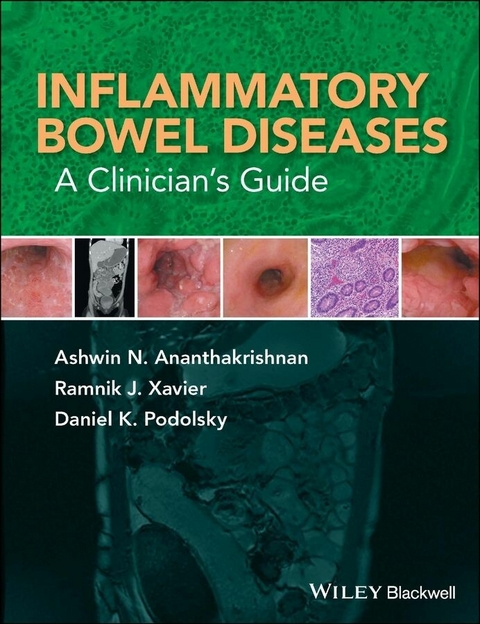
Inflammatory Bowel Diseases: A Clinician's Guide provides practical guidance for the diagnosis and management of those suspected or known to have one of the forms of these complex diseases. It is perfect both for gastroenterology trainees learning to care for these patients and the experienced physician as a concise and practical resource for day to day use.
Written by the experts, Inflammatory Bowel Diseases: A Clinician's Guide is an essential tool for all gastroenterologists managing patients with inflammatory bowel disease.Ashwin N. Ananthakrishnan MD, MPH, Assistant Professor of Medicine, Harvard Medical School; Director, Crohn's and Colitis Center, Massachusetts General Hospital, Boston, MA, USA.
Ramnik J. Xavier MD, Kurt Isselbacher Professor of Medicine, Harvard Medical School; Chief of Gastroenterology, Massachusetts General Hospital; Institute Member, Broad Institute of MIT and Harvard, Boston, MA, USA.
Daniel K. Podolsky MD, President, University of Texas Southwestern Medical Center; Professor of Internal Medicine, University of Texas Southwestern Medical School, Dallas, TX, USA.
Inflammatory Bowel Diseases: A Clinician s Guide provides practical guidance for the diagnosis and management of those suspected or known to have one of the forms of these complex diseases. It is perfect both for gastroenterology trainees learning to care for these patients and the experienced physician as a concise and practical resource for day to day use. Written by the experts, Inflammatory Bowel Diseases: A Clinician s Guide is an essential tool for all gastroenterologists managing patients with inflammatory bowel disease.
Ashwin N. Ananthakrishnan MD, MPH, Assistant Professor of Medicine, Harvard Medical School; Director, Crohn's and Colitis Center, Massachusetts General Hospital, Boston, MA, USA. Ramnik J. Xavier MD, Kurt Isselbacher Professor of Medicine, Harvard Medical School; Chief of Gastroenterology, Massachusetts General Hospital; Institute Member, Broad Institute of MIT and Harvard, Boston, MA, USA. Daniel K. Podolsky MD, President, University of Texas Southwestern Medical Center; Professor of Internal Medicine, University of Texas Southwestern Medical School, Dallas, TX, USA.
Preface ix
Section I Pathogenesis and Clinical Features 1
1 Epidemiology and Pathogenesis 3
2 Clinical Features and Diagnosis of Crohn's Disease 17
3 Clinical Features and Diagnosis of Ulcerative Colitis 33
4 Extraintestinal Manifestations of Inflammatory Bowel Diseases 49
Section II Therapeutic Agents 63
5 Aminosalicylates 65
6 Corticosteroids 75
7 Immunomodulators 85
8 Biologic Therapies 101
9 Antibiotics 123
Section III Management 131
10 Medical Management of Ulcerative Colitis 133
11 Medical Management of Crohn's Disease 149
12 Surgical Management of Inflammatory Bowel Diseases 159
13 Complications of Inflammatory Bowel Diseases 171
Section IV Special Considerations 189
14 Nutrition in Inflammatory Bowel Diseases 191
15 Pregnancy, Conception, and Childbirth 199
16 Inflammatory Bowel Disease During Childhood and Adolescence 209
Index 217
"This is a valuable book that everybody taking care of IBD patients should have. It is very concise but at the same time very complete" Henrique Fernandez, MD, FACP, Parkview Medical Center on behalf of Doody's
1
Epidemiology and Pathogenesis
Clinical Take Home Messages
- Inflammatory bowel diseases (IBDs) have a peak incidence in the second through fourth decades of life but may have their onset at any age.
- Most studies have suggested comparable rates of incidence across both genders but risk of disease varies among ethnic populations, e.g., higher frequency in the Ashkenazi Jewish population.
- Family history is the strongest risk factor for development of IBD. At least 163 distinct genetic polymorphisms have been described in association with Crohn’s disease (CD) or ulcerative colitis (UC) but explain less than one‐quarter of the variance in risk for either disease.
- Disease risk alleles highlight the importance of various genetic pathways in the pathogenesis of these diseases, including innate immunity, adaptive immune response, intestinal barrier function, and pathogen sensing and response. However, polymorphisms at these loci have not been consistently associated with natural history and phenotype of IBD except for correlation between NOD2 polymorphisms and ileal fibrostenosing CD.
- Several environmental factors may influence risk of disease and subsequent natural history. The most robust data support an effect of cigarette smoking (increasing risk of CD and reducing risk of UC), but other factors including diet, stress and depression, antibiotic exposure, environmental hygiene, vitamin D, physical activity, and hormones may play a role.
Epidemiology
Crohn’s disease (CD) and ulcerative colitis (UC) are chronic, immunologically mediated diseases. They may occur at any age but most often have an onset during young adulthood and a protracted course characterized by remissions and relapses over the course of their natural history. They affect an estimated 2.2 million individuals in Europe and 1.5 million in the United States. The incidence and prevalence appear to be increasing in areas of the world where historically rates have been far lower than found in Northern Europe and North America, such as Asia. The peak age of onset of CD is between 20 and 30 years whereas UC has a peak incidence a decade later between the ages of 30 and 40 years. However, up to 15% of patients may have their first presentation of inflammatory bowel disease (IBD) after the age of 65 years, and a bimodal pattern of incidence with a second smaller peak in the sixth and seventh decades of life has been described, particularly for UC. In addition, a subset of patients can manifest IBD at a very early age, less than 2 years old, termed very early‐onset IBD (VEOIBD), which is characterized by distinct genetic predisposition and clinical phenotype characterized by treatment refractoriness, severe perianal disease, and response to bone marrow transplant.
The incidence of UC in several countries in the Western Hemisphere is informed by large population‐based cohorts tracking secular trends. However, incidence data are lacking from other parts of the world where the emergence of these diseases has been more recent. In North America, the incidence of UC ranges from 0 to 19.2 per 100 000 persons and a similar distribution exists in Europe. CD has a similar incidence, ranging between 0.3 and 12.7 per 100 000 persons in Europe and between 0 and 20.2 per 100 000 persons in North America. Serial estimates of incidence from population‐based cohorts dating back to the mid‐twentieth century reveal interesting secular trends. In Olmsted County, Minnesota, the incidence of UC rose from 0.6 per 100,000 in 1940–1943 to 8.3 per 100 000 in 1990–1993, with the steepest increase in incidence in the 1970s. CD similarly rose from 1.0 per 100,000 person‐years in 1940–1943 to 6.9 cases per 100 000 person‐years in 1984–1993. A systematic review of all studies examining trends in disease incidence suggested that over 75% of the studies involving CD and 60% of the studies involving UC identified secular increases in disease incidence. Virtually no study has reported a consistent decrease in incidence in any population over time. Both CD (incidence 0–5.0 per 100 000) and UC (incidence 0.1–6.3 per 100 000) remain relatively uncommon in Asia compared with Western populations. However, increasing incidence, potentially paralleling westernization of life style, has been found in several Asian countries over the past few decades, including Japan, China, Taiwan, and Korea (Figure 1.1). Interestingly, the incidence for UC generally occurs first, followed a decade later by an increase in the incidence of CD.
Figure 1.1 Geographic variation in incidence of Crohn’s disease and ulcerative colitis.
Source: Adapted from Cosnes et al. 2011 [26]. Reproduced with permission of Elsevier.
There are well‐recognized ethnic differences in risk for CD and UC, and less consistently a difference by gender. In most studies, CD and UC occur equally frequently among men and women, although in some studies there is a slight predominance of men among patients with UC (60%) and a predominance of women among those with CD. The incidence of both diseases is more common in the Jewish population; the risk of CD is 3–8‐fold that of non‐Jews, with a more modest but still elevated risk of UC [1]. The incidence is lower among Sephardic than Ashkenazi Jews and in Israeli than American and European Jews. An international cohort of eight countries in the Asia–Pacific region identified higher incidences of both diseases in Australia than in Asia, but also geographic and ethnic variations within the different countries in Asia [2]. IBD is also uncommon in certain subpopulations even within a high‐incidence geographic region such as the First Nations population in Canada and the Aboriginal population in Australia. Within North America, the prevalence of CD and UC was initially reported to be lower in African American and Hispanic populations, but recent data suggest a rising incidence within these populations and an incidence comparable to the lower end of that reported for Caucasians [3]. The risk of IBD varies with migration from a low‐ to a high‐incidence area. Studies in the United Kingdom and Sweden have demonstrated that the risk, particularly of UC, in immigrants from low‐incidence countries rapidly approaches the rate in the local population within one or two generations. However, this change in risk is dependent on the country of origin. Individuals of South Asian or West Asian origin experience a greater increase in disease risk whereas the risk in those from East Asia remains lower than in the country of residence [4].
Pathogenesis
The key mechanism underlying the development of IBD appears to be a dysregulated immune response to commensal flora in a genetically susceptible individual (Figure 1.2). Family history is one of the strongest risk factors for the development of disease. Only 10–20% of patients will have an affected first‐degree relative. However, the risk of the offspring developing IBD increases 2–13‐fold if one parent is affected. This absolute risk can be as high as 36% if both parents are affected. The concordance of disease is greater in monozygotic twins (30–35%) than dizygotic twins, also supporting an important role for genetics in these diseases. However, genetic mutations alone are not sufficient for disease except in the rare VEOIBD owing to high‐penetrance mutations involving the interleukin (IL)‐10 receptor.
Figure 1.2 Inflammatory bowel disease develops as a result of a complex interplay between genetics, the microbiome, immunologic dysregulation, and the external environment.
Genetics
An international consortium has identified 163 common risk loci for IBD. Most loci are shared between both diseases; 30 loci are distinctly associated with CD whereas 23 loci demonstrate genome‐wide significant association with UC alone. These loci together explain only 13.6% of the variance in risk of CD and 7.5% of the variance in risk for UC. Although most common loci demonstrate an effect in the same direction, two loci demonstrate divergent effects. NOD2 and PTPN22 polymorphisms are associated with an increased risk of CD but are inversely associated with UC. Several of the loci are also implicated in other autoimmune diseases, including psoriasis and celiac disease, suggesting considerable sharing of pathogenic pathways across various autoimmune or inflammatory diseases. Although the spectrum of immunologic disruption as a consequence of these genetic polymorphisms is wide, several pathways emerge as being important in the development of IBD. These include the innate immunity, autophagy, adaptive immune responses, pathogen sensing, maintenance of the intestinal barrier through the mucous layer and epithelial integrity, and response to oxidative stress. Several genes may influence the same pathway. For example, HNF4A, MUC19, CDH1, and GNA12 all influence intestinal barrier integrity whereas NOD2, ATG16L1, IRGM, and LRRK2 affect autophagy. The pathways may act in isolation, in combination with each other, or in conjunction with environmental insults. For example, the functional consequences of autophagy defects on Paneth cell function are triggered by infection with the Norovirus. The identified genetic polymorphisms also...
| Erscheint lt. Verlag | 2.3.2017 |
|---|---|
| Sprache | englisch |
| Themenwelt | Medizin / Pharmazie ► Allgemeines / Lexika |
| Medizin / Pharmazie ► Medizinische Fachgebiete ► Chirurgie | |
| Medizinische Fachgebiete ► Innere Medizin ► Gastroenterologie | |
| Schlagworte | Chronisch-entzündliche Darmerkrankungen • Clinical Pharmacology & Therapeutics • Gastroenterologie • Gastroenterologie u. Hepatologie • Gastroenterology & Hepatology • Gastrointestinal surgery • IBD, Inflammatory Bowel Disease, Chronic, Crohn's, Ulcerative Colitis, Colitis, Bowel, Autoimmune, Gastroenterology, Endoscopy, Colonoscopy • Klinische Pharmakologie u. Therapie • Magen-Darm-Chirurgie • Medical Science • Medizin |
| ISBN-10 | 1-119-07762-1 / 1119077621 |
| ISBN-13 | 978-1-119-07762-6 / 9781119077626 |
| Informationen gemäß Produktsicherheitsverordnung (GPSR) | |
| Haben Sie eine Frage zum Produkt? |
 EPUB (Adobe DRM)
Kopierschutz: Adobe-DRM
Adobe-DRM ist ein Kopierschutz, der das eBook vor Mißbrauch schützen soll. Dabei wird das eBook bereits beim Download auf Ihre persönliche Adobe-ID autorisiert. Lesen können Sie das eBook dann nur auf den Geräten, welche ebenfalls auf Ihre Adobe-ID registriert sind.
Details zum Adobe-DRM
Dateiformat: EPUB (Electronic Publication)
EPUB ist ein offener Standard für eBooks und eignet sich besonders zur Darstellung von Belletristik und Sachbüchern. Der Fließtext wird dynamisch an die Display- und Schriftgröße angepasst. Auch für mobile Lesegeräte ist EPUB daher gut geeignet.
Systemvoraussetzungen:
PC/Mac: Mit einem PC oder Mac können Sie dieses eBook lesen. Sie benötigen eine
eReader: Dieses eBook kann mit (fast) allen eBook-Readern gelesen werden. Mit dem amazon-Kindle ist es aber nicht kompatibel.
Smartphone/Tablet: Egal ob Apple oder Android, dieses eBook können Sie lesen. Sie benötigen eine
Geräteliste und zusätzliche Hinweise
Buying eBooks from abroad
For tax law reasons we can sell eBooks just within Germany and Switzerland. Regrettably we cannot fulfill eBook-orders from other countries.
aus dem Bereich