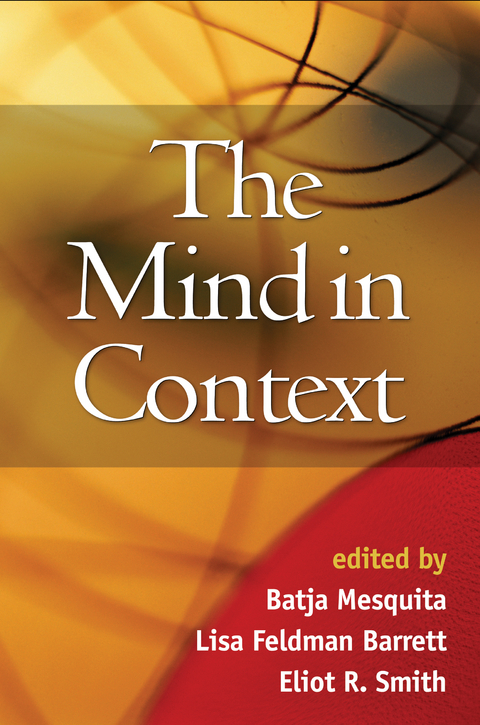
Mind in Context (eBook)
371 Seiten
Guilford Publications (Verlag)
978-1-60623-554-6 (ISBN)
Batja Mesquita, PhD, is Professor of the Psychology of Emotion and Motivation at the Center for Cultural and Social Psychology at the University of Leuven in Belgium. Most of her research focuses on the constitutional role of cultural contexts in emotion. Dr. Mesquita has published widely on topics related to cultural differences in emotions and on acculturation and emotion. She has served as Associate Editor of Cognition and Emotion and Emotion Review and is currently on the editorial boards of Emotion, Personality and Social Psychology Bulletin, and Social and Personality Psychology Compass. Dr. Mesquita is a Fellow of the Royal Netherlands Academy of Arts and Sciences, the Association for Psychological Science, the Society for Personality and Social Psychology, the American Psychological Association, and the Society of Experimental Social Psychology. Lisa Feldman Barrett, PhD, is Professor of Psychology and Director of the Interdisciplinary Affective Science Laboratory at Boston College, with appointments at Harvard Medical School and Massachusetts General Hospital. Her research focuses on the nature of emotion from social-psychological, psychophysiological, cognitive science, and neuroscience perspectives, and takes inspiration from anthropology, philosophy, and linguistics. Dr. Barrett is the recipient of numerous awards, most recently a National Institutes of Health’s Pioneer Award and a National Institute of Mental Health’s Independent Scientist Research Award. She is Co-Editor-in-Chief of Emotion Review and sits on the editorial boards of other top-tier journals in the field. Dr. Barrett has published over 100 papers, chapters, and books. She is a Fellow of the American Association for the Advancement of Science, the Association for Psychological Science, the American Psychological Association, the Society of Experimental Social Psychology, and the Society for Personality and Social Psychology. Eliot R. Smith, PhD, is Classes of the War Years Chancellor’s Professor of Psychological and Brain Sciences at Indiana University. His research interests include the role of emotion in prejudice and intergroup behavior, as well as socially situated cognition. Dr. Smith’s research has been recognized by the Thomas M. Ostrom Award for lifetime contributions to social cognition from Indiana University, as well as the Theoretical Innovation Prize from the Society for Personality and Social Psychology. He has served as Editor of Personality and Social Psychology Review and as Associate Editor of the Journal of Personality and Social Psychology: Attitudes and Social Cognition. He is a Fellow of the Association for Psychological Science, the Society for Personality and Social Psychology, the American Psychological Association, and the Society of Experimental Social Psychology.
1. The Context Principle, Lisa Feldman Barrett, Batja Mesquita, and Eliot R. SmithI. Genes and the Brain2. Epigenetic Inheritance, Lawrence V. Harper 3. Brain Networks and Embodiment, Olaf Sporns 4. Social Modulation of Hormones, Sari M. van Anders II. Cognition and Affect5. Emoting: A Contextualized Process, Batja Mesquita6. Meaning in Context: Meta-Cognitive Experiences, Norbert Schwarz 7. Situated Cognition, Eliot R. Smith and Elizabeth C. Collins III. The Person8. The Situated Person, Walter Mischel and Yuichi Shoda 9. Implicit Independence and Interdependence: A Cultural Task Analysis, Shinobu Kitayama and Toshie Imada10. Platonic Blindness and the Challenge of Understanding Context, Yarrow Dunham and Mahzarin R. Banaji11. Social Tuning of Ethnic Attitudes, Stacey Sinclair and Janetta LunIV. Behavior12. The Multiple Forms of "Context" in Associative Learning Theory, Mark E. Bouton13. Threat, Marginality, and Reactions to Norm Violations, Deborah A. Prentice and Thomas E. Trail 14. Behavior as Mind in Context: A Cultural Psychology Analysis of "Paranoid" Suspicion in West African Worlds, Glen Adams, Phia S. Salter, Kate M. Pickett, Tugçe Kurtis, and Nia L. Phillips15. Challenging the Egocentric View of Coordinated Perceiving, Acting, and Knowing, Michael J. Richardson, Kerry L. Marsh, and R. C. Schmidt16. Conclusion: On the Vices of Nominalization and the Virtues of Contextualizing, Lawrence W. Barsalou, Christine D. Wilson, and Wendy Hasenkamp
| Erscheint lt. Verlag | 29.1.2010 |
|---|---|
| Sprache | englisch |
| Maße | 150 x 150 mm |
| Themenwelt | Geisteswissenschaften ► Psychologie ► Allgemeine Psychologie |
| Geisteswissenschaften ► Psychologie ► Biopsychologie / Neurowissenschaften | |
| Geisteswissenschaften ► Psychologie ► Psychoanalyse / Tiefenpsychologie | |
| Geisteswissenschaften ► Psychologie ► Sozialpsychologie | |
| Geisteswissenschaften ► Psychologie ► Verhaltenstherapie | |
| Medizin / Pharmazie ► Medizinische Fachgebiete ► Neurologie | |
| Schlagworte | Affect • brain • Cognition • contextualism • Cultural • Culture • Emotions • genes • Identity • Mind • Neuroscience • Personality • Personhood • self • Social behavior • Social Psychology • "substance abuse, behavior change, psychotherapy, interventions, addictions, ambivalence, resistance, therapy, counseling field, counseling students, interviewing skills, meth addiction, life coaching, helping professionals, therapeutic relationship, helping professions, professional counselor, core concepts, social workers, transpersonal, rationales, person-centered, exam, cognitive-behavioral, court-ordered, modality, clinicians, evidence-based, revisions, trainers, therapists, counselors, seminar, exerci |
| ISBN-10 | 1-60623-554-0 / 1606235540 |
| ISBN-13 | 978-1-60623-554-6 / 9781606235546 |
| Informationen gemäß Produktsicherheitsverordnung (GPSR) | |
| Haben Sie eine Frage zum Produkt? |
 EPUB (Adobe DRM)
Kopierschutz: Adobe-DRM
Adobe-DRM ist ein Kopierschutz, der das eBook vor Mißbrauch schützen soll. Dabei wird das eBook bereits beim Download auf Ihre persönliche Adobe-ID autorisiert. Lesen können Sie das eBook dann nur auf den Geräten, welche ebenfalls auf Ihre Adobe-ID registriert sind.
Details zum Adobe-DRM
Dateiformat: EPUB (Electronic Publication)
EPUB ist ein offener Standard für eBooks und eignet sich besonders zur Darstellung von Belletristik und Sachbüchern. Der Fließtext wird dynamisch an die Display- und Schriftgröße angepasst. Auch für mobile Lesegeräte ist EPUB daher gut geeignet.
Systemvoraussetzungen:
PC/Mac: Mit einem PC oder Mac können Sie dieses eBook lesen. Sie benötigen eine
eReader: Dieses eBook kann mit (fast) allen eBook-Readern gelesen werden. Mit dem amazon-Kindle ist es aber nicht kompatibel.
Smartphone/Tablet: Egal ob Apple oder Android, dieses eBook können Sie lesen. Sie benötigen eine
Geräteliste und zusätzliche Hinweise
Buying eBooks from abroad
For tax law reasons we can sell eBooks just within Germany and Switzerland. Regrettably we cannot fulfill eBook-orders from other countries.
aus dem Bereich