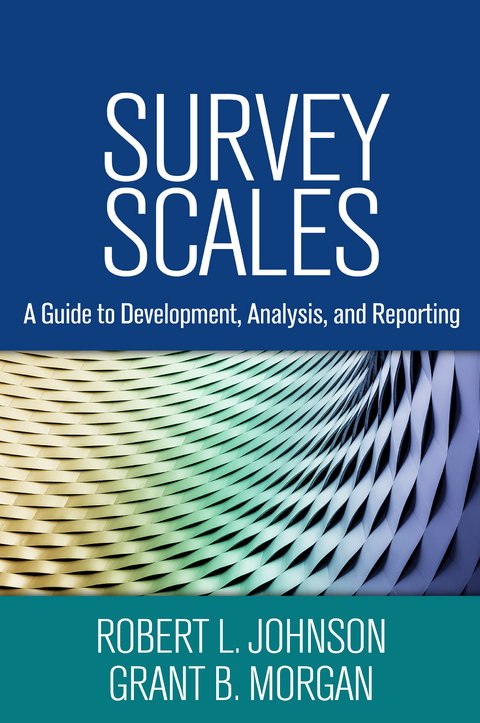
Survey Scales (eBook)
269 Seiten
Guilford Publications (Verlag)
978-1-4625-2699-4 (ISBN)
Robert L. Johnson, PhD, is Professor in the Department of Educational Studies at the University of South Carolina. His research focuses on the ethics of classroom assessment practices and the scoring of performance assessments in the language arts and the visual and performing arts. He also writes about the teaching of program evaluation and involvement of stakeholders in evaluations. Dr. Johnson's research has been published in such journals as Applied Measurement in Education, Language Assessment Quarterly, Assessing Writing, Teaching and Teacher Education, Assessment and Evaluation in Higher Education, and the American Journal of Evaluation. He teaches courses related to educational research, assessment, survey methodology, and program evaluation. Grant B. Morgan, PhD, is Associate Professor in the Department of Educational Psychology at Baylor University. His primary methodological research focuses on latent variable models, classification, and psychometrics. His research has been published in such journals as Structural Equation Modeling,Computational Statistics and Data Analysis, Psychological Assessment, School Psychology Quarterly, Language Assessment Quarterly, and Quality and Quantity. Dr. Morgan has evaluation experience at the local, state, and federal levels, and has extensive experience developing and using survey scales. He teaches graduate-level courses covering latent variable models, item response theory, psychometric theory, measurement and evaluation, experimental design, and research methods.
1. Scales in Surveys Introduction An Overview of the Survey Scale Development Process Attitudes, Knowledge, and Behaviors Key Qualities of a Survey Scale: Reliability and Validity Further Reading Chapter Exercises 2. Adopting or Adapting an Existing Scale Introduction Reviewing Potential Instruments for Adoption or Adaptation The Mental Measurements Yearbook: A Source for Reviews of Instruments Plagiarism and Copyright Infringement Further Reading Chapter Exercises 3. Establishing a Framework for the Development of a Survey Scale Introduction Elements and Format Functions of the Conceptual Framework in the Development of a Survey Scale Construction of a Conceptual Framework Further Reading Chapter Exercises 4. Item-Writing Guidelines Introduction Addressing Relevance Addressing Audience Addressing Language Addressing Item Structure Addressing Conventions Guidelines Specific to Item Type Number of Items Further Reading Chapter Exercises 5. Development of Response Scales Introduction Length of the Item Response Scale Numeric and Verbal Response Labels The Questionable Middle Position Further Reading Chapter Exercises 6. Formatting and Reviewing Introduction Survey Format and Administration Method Item Formats Specific to Administration Methods Complete Reviews and a Pilot of the Survey Scale Further Reading Chapter Exercises 7. Analysis of Survey Scale Data Introduction Levels of Measurement Frequencies Measures of Central Tendency Measures of Variability Measures of Association Obtaining Descriptive Statistics Further Reading Chapter Exercises 8. Investigating Scale Quality Introduction Field Testing Response Distributions: Item Quality Investigating Reliability Investigating Validity Further Reading Chapter Exercises 9. Factor Analysis Introduction General Purposes and Processes Associated with Factor-Analytic Procedures Testing Assumptions Dimensionality Extraction: Principal Axis Factoring Determining the Number of Factors (Model Selection) Rotation How to Interpret Factor Solutions Calculating Factor Scores Sample Size Steps after EFA How to Obtain an EFA Model Further Reading Chapter Exercises 10. Documenting the Development of the Survey Scale Introduction Determining the Need for a Data Display Developing Tables Table Structure Table Data Developing Graphs Structure of a Graph Organization of Data in a Graph Narrative about Table or Graph Concluding Thoughts Further Reading Chapter Exercises Appendix. Analysis of Data: Inferential Statistics Introduction Sampling Inferential Statistics Inferential Procedures Nonparametric Inferential Statistics Further Reading Appendix Exercises Sample Solutions to Chapter Exercises Glossary of Key Terms References Author Index Subject Index About the Authors
| Erscheint lt. Verlag | 5.7.2016 |
|---|---|
| Sprache | englisch |
| Maße | 160 x 160 mm |
| Themenwelt | Sachbuch/Ratgeber ► Natur / Technik ► Natur / Ökologie |
| Geisteswissenschaften ► Psychologie | |
| Medizin / Pharmazie ► Pflege | |
| Sozialwissenschaften ► Pädagogik | |
| Sozialwissenschaften ► Soziologie ► Empirische Sozialforschung | |
| Schlagworte | Assessment • Design • instruments • item response scales • Likert scales • Measurement • Methodology • Psychometrics • Quantitative • Research methods • Scale development • "substance abuse, behavior change, psychotherapy, interventions, addictions, ambivalence, resistance, therapy, counseling field, counseling students, interviewing skills, meth addiction, life coaching, helping professionals, therapeutic relationship, helping professions, professional counselor, core concepts, social workers, transpersonal, rationales, person-centered, exam, cognitive-behavioral, court-ordered, modality, clinicians, evidence-based, revisions, trainers, therapists, counselors, seminar, exerci • survey scales • Testing |
| ISBN-10 | 1-4625-2699-3 / 1462526993 |
| ISBN-13 | 978-1-4625-2699-4 / 9781462526994 |
| Informationen gemäß Produktsicherheitsverordnung (GPSR) | |
| Haben Sie eine Frage zum Produkt? |
 PDF (Adobe DRM)
Kopierschutz: Adobe-DRM
Adobe-DRM ist ein Kopierschutz, der das eBook vor Mißbrauch schützen soll. Dabei wird das eBook bereits beim Download auf Ihre persönliche Adobe-ID autorisiert. Lesen können Sie das eBook dann nur auf den Geräten, welche ebenfalls auf Ihre Adobe-ID registriert sind.
Details zum Adobe-DRM
Dateiformat: PDF (Portable Document Format)
Mit einem festen Seitenlayout eignet sich die PDF besonders für Fachbücher mit Spalten, Tabellen und Abbildungen. Eine PDF kann auf fast allen Geräten angezeigt werden, ist aber für kleine Displays (Smartphone, eReader) nur eingeschränkt geeignet.
Systemvoraussetzungen:
PC/Mac: Mit einem PC oder Mac können Sie dieses eBook lesen. Sie benötigen eine
eReader: Dieses eBook kann mit (fast) allen eBook-Readern gelesen werden. Mit dem amazon-Kindle ist es aber nicht kompatibel.
Smartphone/Tablet: Egal ob Apple oder Android, dieses eBook können Sie lesen. Sie benötigen eine
Geräteliste und zusätzliche Hinweise
Buying eBooks from abroad
For tax law reasons we can sell eBooks just within Germany and Switzerland. Regrettably we cannot fulfill eBook-orders from other countries.
aus dem Bereich