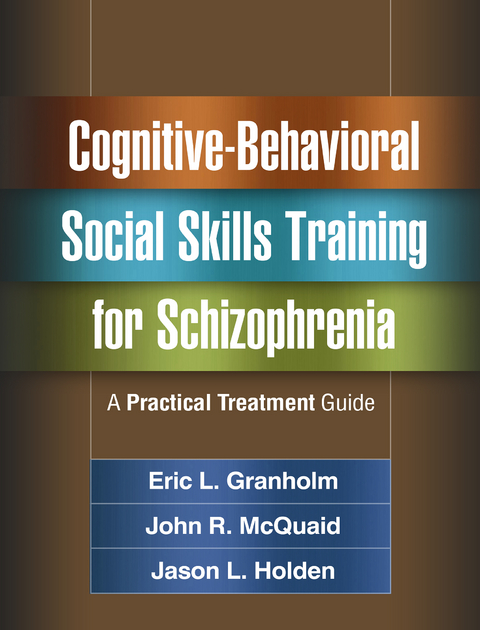
Cognitive-Behavioral Social Skills Training for Schizophrenia (eBook)
322 Seiten
Guilford Publications (Verlag)
978-1-4625-2473-0 (ISBN)
Eric L. Granholm, PhD, is Professor of Psychiatry at the University of California, San Diego and Director of the Center of Recovery Education at the Veterans Affairs San Diego Healthcare System. Dr. Granholm is an active basic and clinical researcher in the areas of social skills training, cognitive-behavioral therapy for psychosis, mobile assessments and interventions, and cognitive neuropsychology in consumers with schizophrenia. He has conducted five federally-funded clinical trials of CBSST for schizophrenia, has over 100 publications, and has been an investigator on over 20 grants to study psychosocial interventions, neurocognition, and functional outcome in schizophrenia. John R. McQuaid, PhD, is Associate Chief of Mental Health at the San Francisco Veterans Affairs Medical Center and Professor of Clinical Psychology in the Department of Psychiatry at the University of California, San Francisco. Dr. McQuaid’s clinical and research expertise is in the development and use of cognitive-behavioral interventions for psychiatric disorders and health management issues. He has over 60 publications and has served as an investigator or consultant on more than 15 grants in the areas of stress, psychopathology, and psychosocial treatment for psychiatric disorders and behavioral health. Jason L. Holden, PhD, is a Research Health Scientist and Project Manager at the Veterans Medical Research Foundation and Veterans Affairs San Diego Healthcare System. He has been providing clinical services to individuals with psychosis for over 10 years, including cognitive-behavioral therapy, social skills training, and other evidence-based practices. Dr. Holden was a co-investigator on two CBSST clinical trials, a CBSST therapist in these trials, and a supervisor and trainer of other CBSST providers. His research also focuses on ecological momentary assessments and interventions using mobile technology in serious mental illness.
I. Background, Research Evidence, and Implementation 1. Improving Functioning in Schizophrenia 2. CBSST as an Evidence-Based Practice 3. Getting Started 4. Assessment: Measuring Effects of CBSST II. Practical Guide 5. Introduction and Goal-Setting Session 6. Cognitive Skills Module 7. Social Skills Module 8. Problem-Solving Skills Module 9. Special Populations III. CBSST Consumer Workbooks Cognitive Skills Module Session 1: Introduction and Goal Setting Session 2: The Thoughts–Feelings–Behaviors Link Session 3: The 3 C’s—Catch It, Check It, Change It Session 4: The 3 C’s—Check It Session 5: The 3 C’s—Change It Session 6: 3 C’s Practice Social Skills Module Session 1: Introduction and Goal Setting Session 2: Communicate Effectively to Achieve Our Goals Session 3: Expressing Pleasant Feelings Session 4: Making Positive Requests Session 5: Asking for Help with Your Goals Session 6: Expressing Unpleasant Feelings Problem-Solving Skills Module Session 1: Introduction and Goal Setting Session 2: Introduction to SCALE Session 3: Specify the Problem Session 4: Consider All Solutions Session 5: Lay Out a Plan Session 6: Solving Problems Related to Goals Appendix A. Assessment Measures Appendix B. Games to Engage and Teach Appendix C. Additional Handouts and Materials References Index
| Erscheint lt. Verlag | 27.6.2016 |
|---|---|
| Vorwort | Kim T. Mueser, Alan S. Bellack |
| Sprache | englisch |
| Maße | 200 x 200 mm |
| Themenwelt | Geisteswissenschaften ► Psychologie ► Persönlichkeitsstörungen |
| Medizin / Pharmazie ► Gesundheitsfachberufe | |
| Medizin / Pharmazie ► Medizinische Fachgebiete ► Psychiatrie / Psychotherapie | |
| Schlagworte | behavioral activation • CBSST • CBT • Cognitive-behavioral therapy • Consumers • Evidence-based Treatments • Independent living • Interventions • Mental Illness • problem-solving training • psychiatric rehabilitation • Psychosis • Psychosocial • psychotherapy • Recovery • Schizophrenia • severe disorders • Social skills training • "substance abuse, behavior change, psychotherapy, interventions, addictions, ambivalence, resistance, therapy, counseling field, counseling students, interviewing skills, meth addiction, life coaching, helping professionals, therapeutic relationship, helping professions, professional counselor, core concepts, social workers, transpersonal, rationales, person-centered, exam, cognitive-behavioral, court-ordered, modality, clinicians, evidence-based, revisions, trainers, therapists, counselors, seminar, exerci • treatment manuals |
| ISBN-10 | 1-4625-2473-7 / 1462524737 |
| ISBN-13 | 978-1-4625-2473-0 / 9781462524730 |
| Informationen gemäß Produktsicherheitsverordnung (GPSR) | |
| Haben Sie eine Frage zum Produkt? |
 PDF (Adobe DRM)
Kopierschutz: Adobe-DRM
Adobe-DRM ist ein Kopierschutz, der das eBook vor Mißbrauch schützen soll. Dabei wird das eBook bereits beim Download auf Ihre persönliche Adobe-ID autorisiert. Lesen können Sie das eBook dann nur auf den Geräten, welche ebenfalls auf Ihre Adobe-ID registriert sind.
Details zum Adobe-DRM
Dateiformat: PDF (Portable Document Format)
Mit einem festen Seitenlayout eignet sich die PDF besonders für Fachbücher mit Spalten, Tabellen und Abbildungen. Eine PDF kann auf fast allen Geräten angezeigt werden, ist aber für kleine Displays (Smartphone, eReader) nur eingeschränkt geeignet.
Systemvoraussetzungen:
PC/Mac: Mit einem PC oder Mac können Sie dieses eBook lesen. Sie benötigen eine
eReader: Dieses eBook kann mit (fast) allen eBook-Readern gelesen werden. Mit dem amazon-Kindle ist es aber nicht kompatibel.
Smartphone/Tablet: Egal ob Apple oder Android, dieses eBook können Sie lesen. Sie benötigen eine
Geräteliste und zusätzliche Hinweise
Buying eBooks from abroad
For tax law reasons we can sell eBooks just within Germany and Switzerland. Regrettably we cannot fulfill eBook-orders from other countries.
aus dem Bereich