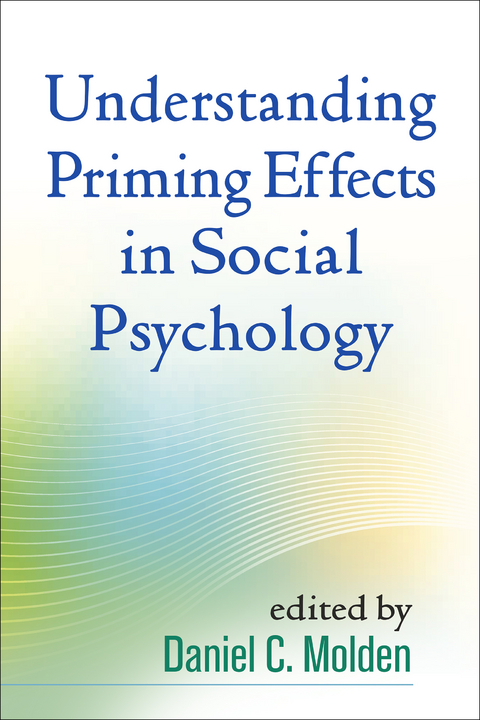
Understanding Priming Effects in Social Psychology (eBook)
264 Seiten
The Guilford Press (Verlag)
978-1-4625-1936-1 (ISBN)
Daniel C. Molden, PhD, is Associate Professor of Psychology at Northwestern University. His research examines how activating different motivational mindsets influences the ways in which people (1) gather, integrate, and interpret social information, and (2) pursue, represent, and react to social interactions. His work has been featured in publications such as the Journal of Personality and Social Psychology, the Journal of Experimental Psychology: General, Psychological Science, and American Psychologist. Dr. Molden has held fellowships from the National Institute of Child Health and Human Development and the National Institute of Mental Health, and has received funding for his research from the National Science Foundation.
I. What is "Social Priming"?1. Understanding priming effects in social psychology: What is “social priming” and how does it occur?, Daniel C. Molden2. On the other side of the mirror: Priming in cognitive and social psychology, Stéphane Doyen, Oliver Klein, Daniel Simons, & Axel Cleeremans3. Effects of evaluation: An example of robust "social" priming, Melissa J. Ferguson & Thomas C. Mann4. Priming is not priming is not priming, Dirk Wentura & Klaus Rothermund5. Structured vs. unstructured regulation: On procedural mindsets and the mechanisms of priming effects, Kentaro Fujita & Yaacov TropeII. When and How Social Priming Occurs6. Prime numbers: Anchoring and its implications for theories of behavior priming, Ben R. Newell & David R. Shanks7. Understanding prime-to-behavior effects: Insights from the active-self account, S. Christian Wheeler, Kenneth G. DeMarree, & Richard E. Petty8. Replicability and models of priming: What a resources computation framework can tell us about expectations of replicability, Joseph Cesario & Kai J. Jonas9. Situated inference and the what, who, and where of priming, Chris Loersch & B. Keith Payne10. Priming: Constraint satisfaction and interactive competition, Tobias Schröder & Paul ThagardIII. Considering New Sources of Social Primes11. Grounding social embodiment, Daniël Lakens12. Priming from others' observed or simulated responses, Eliot R. Smith & Diane M. MackieIV. From the Past of Social Priming to Its Future13. Evaluating behavior priming research: Three observations and a recommendation, Ap Dijksterhuis, Ad van Knippeberg, & Rob W. Holland14. The historical origins of priming as the preparation of behavioral responses: Unconscious carry-over and contextual influences of real-world importance, John A. Bargh15. Priming . . . Shmiming: It's about knowing when and why stimulated memory representations become active, E. Tory Higgins & Baruch Eitam16. Understanding priming effects in social psychology: An overview and integration, Daniel C. Molden
| Erscheint lt. Verlag | 12.9.2014 |
|---|---|
| Sprache | englisch |
| Maße | 180 x 180 mm |
| Themenwelt | Geisteswissenschaften ► Psychologie ► Allgemeine Psychologie |
| Geisteswissenschaften ► Psychologie ► Sozialpsychologie | |
| Geisteswissenschaften ► Psychologie ► Verhaltenstherapie | |
| Medizin / Pharmazie ► Medizinische Fachgebiete ► Psychiatrie / Psychotherapie | |
| Schlagworte | Cognitive Psychology • priming behaviors • priming effects • priming research • Social Cognition • social priming • Social Psychology • social representations |
| ISBN-10 | 1-4625-1936-9 / 1462519369 |
| ISBN-13 | 978-1-4625-1936-1 / 9781462519361 |
| Informationen gemäß Produktsicherheitsverordnung (GPSR) | |
| Haben Sie eine Frage zum Produkt? |
 EPUB (Adobe DRM)
Kopierschutz: Adobe-DRM
Adobe-DRM ist ein Kopierschutz, der das eBook vor Mißbrauch schützen soll. Dabei wird das eBook bereits beim Download auf Ihre persönliche Adobe-ID autorisiert. Lesen können Sie das eBook dann nur auf den Geräten, welche ebenfalls auf Ihre Adobe-ID registriert sind.
Details zum Adobe-DRM
Dateiformat: EPUB (Electronic Publication)
EPUB ist ein offener Standard für eBooks und eignet sich besonders zur Darstellung von Belletristik und Sachbüchern. Der Fließtext wird dynamisch an die Display- und Schriftgröße angepasst. Auch für mobile Lesegeräte ist EPUB daher gut geeignet.
Systemvoraussetzungen:
PC/Mac: Mit einem PC oder Mac können Sie dieses eBook lesen. Sie benötigen eine
eReader: Dieses eBook kann mit (fast) allen eBook-Readern gelesen werden. Mit dem amazon-Kindle ist es aber nicht kompatibel.
Smartphone/Tablet: Egal ob Apple oder Android, dieses eBook können Sie lesen. Sie benötigen eine
Geräteliste und zusätzliche Hinweise
Buying eBooks from abroad
For tax law reasons we can sell eBooks just within Germany and Switzerland. Regrettably we cannot fulfill eBook-orders from other countries.
aus dem Bereich