


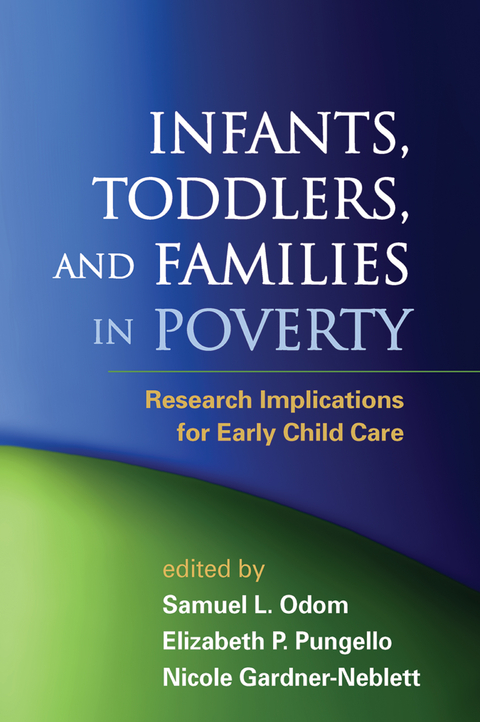
Infants, Toddlers, and Families in Poverty (eBook)
382 Seiten
The Guilford Press (Verlag)
978-1-4625-0497-8 (ISBN)
Samuel L. Odom, PhD, is Director of the Frank Porter Graham Child Development Institute (FPG) and Professor in the School of Education at the University of North Carolina at Chapel Hill. He has published over 100 journal articles and seven books on early childhood intervention and developmental disabilities. Dr. Odom's research interests include preschool prevention and school readiness, effectiveness of programs for children and youth with autism spectrum disorders, and early intervention for infants and toddlers with or at risk for disability. He is a recipient of the Special Education Research Award from the Council for Exceptional Children.Elizabeth P. Pungello, PhD, is a Scientist at FPG, a Research Associate Professor in the Developmental Psychology Program at the University of North Carolina at Chapel Hill, and a Mentor Faculty member at the Center for Developmental Science. Her research focuses on closing the achievement gap between at-risk and other children. She helps lead the FPG Infant/Toddler Child Care Initiative in the development and evaluation of a model of high-quality center care for infants and toddlers raised in poverty.Nicole Gardner-Neblett, PhD, is an Investigator at FPG at the University of North Carolina at Chapel Hill. Her main focus is the FPG Infant/Toddler Child Care Initiative, where she works to design and implement a model for infant/toddler care to promote the early learning, development, and health of children living in poverty. Her principal research interests are the effects of parenting practices and the classroom context on children's language and literacy development.
Introduction, 1. Poor and Low-Income Families, Infant/Toddler Development, and the Prospects for Change: Back to the Future, Lawrence AberI. Cognitive Development2. The Development of Attention in Infancy and Early Childhood: Implications for Early Childhood and Early Intervention, John Colombo, Kathleen N. Kannass, Dale Walker, and Caitlin C. Brez3. Facilitating Learning and Memory in Infants and Young Children: Mechanisms and Methods, Patricia J. BauerII. Language Development4. How Babies Talk: Six Principles of Early Language Development, Kathy Hirsh-Pasek and Roberta Michnick Golinkoff5. Bilingual Language Learners, Erika Hoff and Silvia PlaceIII. Social–Emotional Development6. The Development of Self-Regulation in Infancy and Early Childhood: An Organizing Framework for the Design and Evaluation of Early Care and Education Programs for Children in Poverty, Clancy Blair, Daniel J. Berry, and Allison H. Friedman7. Temperament as a Tool in Promoting Early Childhood Development, John E. Bates8. Leveraging Attachment Research to Re-vision Infant/Toddler Care for Poor Families, Lisa J. BerlinIV. Health and Physical Development9. Nutrition and Physical Activity, Robert C. Whitaker and Rachel A. Gooze10. Impact of Early Childhood on Health throughout the Lifespan, Barry S. ZuckermanV. Implications for Families11. An Ecological View of the Socialization Process of Latino Children, Natasha J. Cabrera12. Infant/Toddler Care and High-Risk Families: Quality Services for “Omitted” Children, Brenda Jones Harden, Colleen Monahan, and Meryl YochesVI. Infant/Toddler Care and Education13. Beginnings of School Readiness in Infant/Toddler Development: Evidence from Early Head Start, John M. Love, Rachel Chazan-Cohen, Jeanne Brooks-Gunn, Helen Raikes, Cheri A. Vogel, and Ellen Eliason Kisker14. Research-Based Approaches for Individualizing Caregiving and Educational Interventions for Infants and Toddlers in Poverty, Judith J. Carta, Charles Greenwood, Kathleen Baggett, Jay Buzhardt, and Dale WalkerConclusion15. Translating Contemporary Developmental and Health Science: Designing an Early Childhood Program for Young Children and Their Families Living in Poverty, Samuel L. Odom, Elizabeth P. Pungello, and Nicole Gardner-Neblett
| Erscheint lt. Verlag | 21.8.2012 |
|---|---|
| Sprache | englisch |
| Maße | 150 x 150 mm |
| Themenwelt | Geisteswissenschaften ► Psychologie ► Entwicklungspsychologie |
| Medizin / Pharmazie ► Medizinische Fachgebiete ► Psychiatrie / Psychotherapie | |
| Sozialwissenschaften ► Pädagogik ► Didaktik | |
| Sozialwissenschaften ► Pädagogik ► Sozialpädagogik | |
| Sozialwissenschaften ► Soziologie | |
| Schlagworte | Achievement Gap • at-risk children • child care programs • Developmental Psychology • Early childhood education • early intervention programs • Educational Psychology • Families • Health Care • Infants • low-income • low socioeconomic status • Poor • Poverty • Preschoolers • prevention • "substance abuse, behavior change, psychotherapy, interventions, addictions, ambivalence, resistance, therapy, counseling field, counseling students, interviewing skills, meth addiction, life coaching, helping professionals, therapeutic relationship, helping professions, professional counselor, core concepts, social workers, transpersonal, rationales, person-centered, exam, cognitive-behavioral, court-ordered, modality, clinicians, evidence-based, revisions, trainers, therapists, counselors, seminar, exerci • toddlers |
| ISBN-10 | 1-4625-0497-3 / 1462504973 |
| ISBN-13 | 978-1-4625-0497-8 / 9781462504978 |
| Informationen gemäß Produktsicherheitsverordnung (GPSR) | |
| Haben Sie eine Frage zum Produkt? |
 EPUB (Adobe DRM)
Kopierschutz: Adobe-DRM
Adobe-DRM ist ein Kopierschutz, der das eBook vor Mißbrauch schützen soll. Dabei wird das eBook bereits beim Download auf Ihre persönliche Adobe-ID autorisiert. Lesen können Sie das eBook dann nur auf den Geräten, welche ebenfalls auf Ihre Adobe-ID registriert sind.
Details zum Adobe-DRM
Dateiformat: EPUB (Electronic Publication)
EPUB ist ein offener Standard für eBooks und eignet sich besonders zur Darstellung von Belletristik und Sachbüchern. Der Fließtext wird dynamisch an die Display- und Schriftgröße angepasst. Auch für mobile Lesegeräte ist EPUB daher gut geeignet.
Systemvoraussetzungen:
PC/Mac: Mit einem PC oder Mac können Sie dieses eBook lesen. Sie benötigen eine
eReader: Dieses eBook kann mit (fast) allen eBook-Readern gelesen werden. Mit dem amazon-Kindle ist es aber nicht kompatibel.
Smartphone/Tablet: Egal ob Apple oder Android, dieses eBook können Sie lesen. Sie benötigen eine
Geräteliste und zusätzliche Hinweise
Buying eBooks from abroad
For tax law reasons we can sell eBooks just within Germany and Switzerland. Regrettably we cannot fulfill eBook-orders from other countries.
aus dem Bereich


