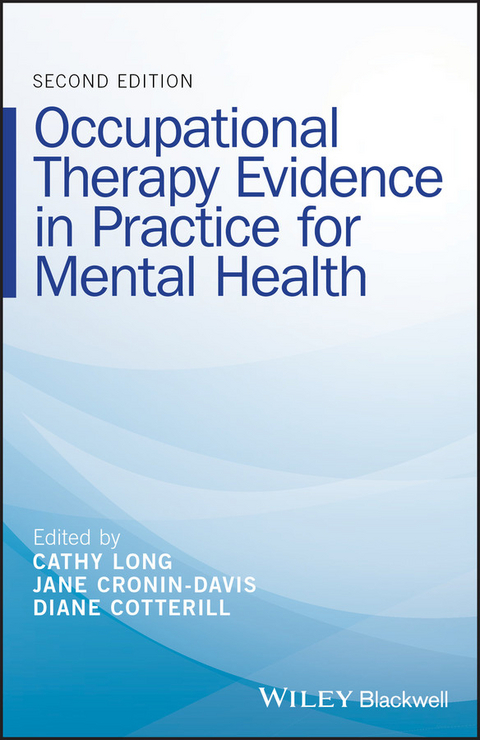
Occupational Therapy Evidence in Practice for Mental Health (eBook)
John Wiley & Sons (Verlag)
978-1-118-99055-1 (ISBN)
Occupational Therapy Evidence in Practice for Mental Health is an accessible and informative guide to the application of theory and the evidence-base to contemporary clinical practice. Fully updated throughout, chapters cover a range of mental health issues, approaches and settings, including service user and carer involvement, group work, services for older people, interventions, forensic mental health, and managing depression.
Key Features
- Written by an expert author team, drawing on a wide range of evidence, service contexts, national policy and legislation.
- Focus on person-centred practice in mental health services.
- Each chapter also contains a variety of learning features, including task boxes, reflective questions and further readings, to aid understanding and demonstrate the use of evidence to inform clinical decision-making.
The second edition of this easy-to-read and practical textbook is an ideal resource for occupational therapy students, clinical practitioners, and anyone looking for a concise, accessible guide to evidence-based practice and how it informs occupational therapy in mental health.
About the Editors
Cathy Long is a former Senior Lecturer in Occupational Therapy in the School of Health Sciences at York St. John University, UK.
Jane Cronin-Davis is a Senior Lecturer in the School of Health Sciences at York St. John University, UK.
Diane Cotterill is a Senior Lecturer in the School of Health Sciences at York St. John University, UK.
Occupational Therapy Evidence in Practice for Mental Health is an accessible and informative guide to the application of theory and the evidence-base to contemporary clinical practice. Fully updated throughout, chapters cover a range of mental health issues, approaches and settings, including service user and carer involvement, group work, services for older people, interventions, forensic mental health, and managing depression. Key Features Written by an expert author team, drawing on a wide range of evidence, service contexts, national policy and legislation. Focus on person-centred practice in mental health services. Each chapter also contains a variety of learning features, including task boxes, reflective questions and further readings, to aid understanding and demonstrate the use of evidence to inform clinical decision-making. The second edition of this easy-to-read and practical textbook is an ideal resource for occupational therapy students, clinical practitioners, and anyone looking for a concise, accessible guide to evidence-based practice and how it informs occupational therapy in mental health.
About the Editors Cathy Long is a former Senior Lecturer in Occupational Therapy in the School of Health Sciences at York St. John University, UK. Jane Cronin-Davis is a Senior Lecturer in the School of Health Sciences at York St. John University, UK. Diane Cotterill is a Senior Lecturer in the School of Health Sciences at York St. John University, UK.
Title Page 5
Copyright Page 6
Contents 9
List of Contributors 11
Preface 17
Chapter 1 An Introduction: Tracking Developments in Mental Health Practice 23
Mental Health Legislation, Policy and Developments Influencing Occupational Therapy in Mental Health 24
Mental Health Occupational Therapy Roles and Diversity of Clinical Practice 28
The Importance of Using and Applying Evidence 30
Overcoming Barriers to Using Evidence-Based Practice 31
Values-Based Practice 32
Value of Leadership 32
The Future for Occupational Therapists in Mental Health 33
References 35
Chapter 2 Service User and Carer Involvement: Co-production 39
The Policy Context 41
Co-production in Mental Health 43
Detailed Framework 47
Successful Strategic Collaborations Between Professional and Service User: A Case Study 52
Conclusions 54
References 54
Chapter 3 Creativity as a Transformative Process 57
Background 58
Supportive Environments 58
Recovery 60
Occupational Therapy and Creativity 61
The Model of Creative Ability 62
Community Arts Projects 64
Value of Narrative 64
Converge – A Community of Learners 65
Converge Buddy Scheme 66
Converge Support and Progression Work – Lucy Coleman Case Study 67
A Sense of Belonging 68
Labels and Language 69
Us and Them 70
Identity 71
Creativity 72
Challenges Encountered 72
Conclusions 73
Acknowledgement 74
References 74
Chapter 4 Group Work in Occupational Therapy: Generic Versus Specialist Practice 81
The Phoenix Programme 82
Amy – Expert by Profession or Expert by Experience 83
Policy 83
Jenny – Service User Perspective 84
Theory into Practice 85
The Relational Model of Group Development 86
Community Meetings – Generic or Specialist? 88
Occupation-Centred Practice 90
Shop and Cook Group 92
Occupational Therapy Process 93
Establish the Client-Centred Performance Context 93
Identify and Prioritise Reported Strengths and Problems of Occupational Performance 93
Observe Client’s Task Performance and Implement Performance Analyses 94
Define and Describe Actions the Client Does and Does Not Perform Effectively 94
Establish/Finalize or Redefine Client-Centred Goals 96
Define/Clarify or Interpret Cause 97
Select Intervention Model and Plan and Implement Occupation-Based Interventions 98
Re-evaluate for Enhanced and Satisfying Occupational Performance 103
Amy’s Reflections on Learning 103
Conclusions 104
References 105
Chapter 5 Working with Alice Smith: Services for Older People 109
Service context 110
Adapted from Dallas Dixon’s story: Alzheimer’s Society (2016) 111
Introduction to Alice Smith 112
Referral Information 112
Assessment Process 113
Intervention Plan 118
Evaluation 123
Discharge 124
Conclusions 125
References 125
Chapter 6 Occupational Therapy Interventions for Someone Experiencing Severe and Enduring Mental Illness 131
The Occupational Therapy Pathway 134
Example of Practice 134
Background 134
Referral, Engagement and Assessment 135
Exploring the Evidence of Individual Interventions 137
Coping Strategy Enhancement 137
Cognitive-Behavioural Family Interventions 144
Education Package 148
Stress Management 148
Goal Setting 149
Evaluation of Interventions 151
Conclusions 152
References 153
Chapter 7 Forensic Mental Health: Creating Occupational Opportunities 161
Framework for Forensic Mental Health Services 162
Service User Involvement 164
Multi-disciplinary Team and Setting 164
Nathan: A Service User 166
Early Life 166
Admission to Medium Secure Unit 167
Occupational Therapy: A Process of Interventions 168
Stage 1: Name, Validate, Prioritise Occupational Performance Issues 168
Stage 2: Select Theoretical Approaches 170
Stage 3: Identify Occupational Performance Components and Environmental Conditions 174
Stage 4: Identify Strengths and Resources (Service User and External Resources) 175
Stage 5: Negotiated Targets and Action Plans 176
Stage 6: Implement Plans Through Occupation 176
Stage 7: Evaluate Outcomes 179
Conclusions 180
References 180
Chapter 8 Promoting Self-Efficacy in Managing Major Depression 187
Improving Access to Psychological Therapy Programme 188
Nature and Impact of Depression on Occupation 189
Sean Smith: Case Study 190
Initial Assessment 191
Study Assignment 3 192
Screening for Suitability 192
Therapy Option 1: Cognitive-Behavioural Therapy 193
Therapy Option 2: Behavioural Activation 194
Core Principles of Behavioural Activation 195
Style of Therapy in Behavioural Activation 195
Collaborative Goal Setting 196
Developing a Case Formulation to Guide Treatment 197
Levels of Behavioural Activation 198
Activity Scheduling and Mood Monitoring 199
Between Session Assignments 202
Problem-Solving 203
Prevention of Relapse 203
Key Skills in Relapse Prevention 204
Outcome of Therapy 204
Clinical Reasoning and the Evidence Base 205
Conclusions 206
Supplementary Information 207
References 207
Chapter 9 Veterans: Understanding Military Culture and the Possible Effects on Engagement 213
Joining the UK Armed Forces 216
Military Culture 216
‘It’s a Lifestyle Not a Job’ 216
Alcohol and Drug Use 219
Mental Health 220
Prosthetics 222
Transition from Military to Civilian Life 224
Definition of a Veteran 227
Ask the Question 228
Armed Forces Covenant, Community and Corporate Covenants 229
The NHS Constitution 230
Reservists 231
Families 232
Criminal Justice System 233
Conclusions 235
References 236
Index 245
EULA 259
| Erscheint lt. Verlag | 21.2.2017 |
|---|---|
| Sprache | englisch |
| Themenwelt | Medizin / Pharmazie ► Allgemeines / Lexika |
| Medizin / Pharmazie ► Pflege | |
| Medizin / Pharmazie ► Physiotherapie / Ergotherapie ► Ergotherapie | |
| Schlagworte | carer • Clinical • Depression • Ergotherapie • Ergotherapie / Praxis • Ergotherapie u. psychische Verfassung • Evidence-based Health Care • Evidenzbasierte Forschung im Gesundheitswesen • Forensic • Gesundheits- u. Sozialwesen • Group • Health • Health & Social Care • Interventions • Medical Science • Medizin • Mental • Occupational • Occupational Therapy and Mental Health • Occupational Therapy Practice • Practice • Practitioner • Psychische Gesundheit • therapy • Work |
| ISBN-10 | 1-118-99055-2 / 1118990552 |
| ISBN-13 | 978-1-118-99055-1 / 9781118990551 |
| Informationen gemäß Produktsicherheitsverordnung (GPSR) | |
| Haben Sie eine Frage zum Produkt? |
 PDF (Adobe DRM)
Kopierschutz: Adobe-DRM
Adobe-DRM ist ein Kopierschutz, der das eBook vor Mißbrauch schützen soll. Dabei wird das eBook bereits beim Download auf Ihre persönliche Adobe-ID autorisiert. Lesen können Sie das eBook dann nur auf den Geräten, welche ebenfalls auf Ihre Adobe-ID registriert sind.
Details zum Adobe-DRM
Dateiformat: PDF (Portable Document Format)
Mit einem festen Seitenlayout eignet sich die PDF besonders für Fachbücher mit Spalten, Tabellen und Abbildungen. Eine PDF kann auf fast allen Geräten angezeigt werden, ist aber für kleine Displays (Smartphone, eReader) nur eingeschränkt geeignet.
Systemvoraussetzungen:
PC/Mac: Mit einem PC oder Mac können Sie dieses eBook lesen. Sie benötigen eine
eReader: Dieses eBook kann mit (fast) allen eBook-Readern gelesen werden. Mit dem amazon-Kindle ist es aber nicht kompatibel.
Smartphone/Tablet: Egal ob Apple oder Android, dieses eBook können Sie lesen. Sie benötigen eine
Geräteliste und zusätzliche Hinweise
Buying eBooks from abroad
For tax law reasons we can sell eBooks just within Germany and Switzerland. Regrettably we cannot fulfill eBook-orders from other countries.
aus dem Bereich