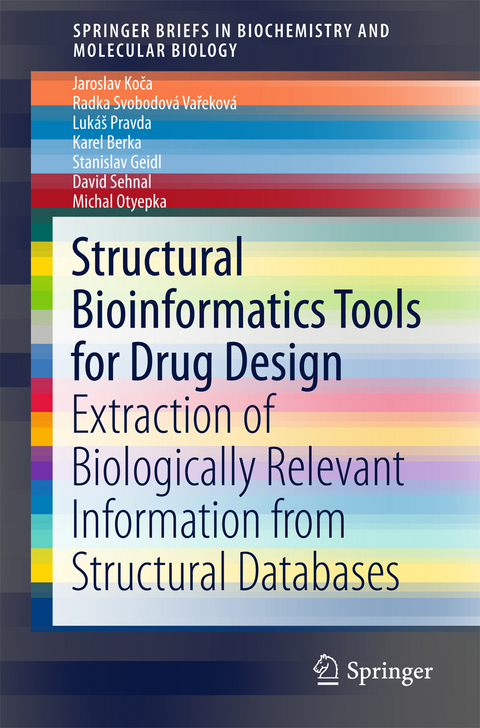
Structural Bioinformatics Tools for Drug Design (eBook)
XIII, 144 Seiten
Springer International Publishing (Verlag)
978-3-319-47388-8 (ISBN)
The book describes the individual steps necessary for biomacromolecular fragments analysis, as well as a list of essential software tools. For each step, it also shows corresponding web-based tools in detail and provides practical examples of their use.
All tools and databases mentioned in the examples are available free of charge, platform-independent, web-based, user-friendly and do not require a prior IT background to be fully used.
Prof. RNDr. Jaroslav Koca, DrSc., is director of the Central European Institute of Technology and Head of the research group Computational Chemistry at Masaryk University in Brno, Czech Republic.
His field of expertise is mathematical and computer assisted chemistry and biochemistry, computer assisted molecular modeling of biologically interesting chemical species, information technology in chemistry, biochemistry, and environmental chemistry. Last years´ projects were mainly on conformational search, molecular docking and molecular dynamics simulations on peptides, proteins, oligonucleotides, nucleotide sugars, and carbohydrates. Methods for analysis conformational potential energy surfaces and energy landscapes of chemical reactions using molecular mechanics and quantum chemistry techniques. For more information see: http://www.chemi.muni.cz/-jkoca/
Prof. RNDr. Jaroslav Koca, DrSc., is director of the Central European Institute of Technology and Head of the research group Computational Chemistry at Masaryk University in Brno, Czech Republic. His field of expertise is mathematical and computer assisted chemistry and biochemistry, computer assisted molecular modeling of biologically interesting chemical species, information technology in chemistry, biochemistry, and environmental chemistry. Last years´ projects were mainly on conformational search, molecular docking and molecular dynamics simulations on peptides, proteins, oligonucleotides, nucleotide sugars, and carbohydrates. Methods for analysis conformational potential energy surfaces and energy landscapes of chemical reactions using molecular mechanics and quantum chemistry techniques. For more information see: http://www.chemi.muni.cz/~jkoca/
1. Introduction
Description of current situation about biomacromolecular structural data, their amount, growth, availability. Motivation, why it has sense to process and analyze these data, including applications towards drug design. Description of basic steps of their analysis via structural bioinformatics approaches.
2. Biomacromolecular fragments3. Databases
Status of current structural databases focused on biomacromolecules, ligands, fragments, structural patterns etc. Practical examples based on PDBe and PDBsum.
4. Detection & Extraction
Languages and formalisms for description, detection, extraction and comparison of biomacromolecular fragments and structural patterns. Practical examples based on PatternQuery and SiteBinder.Approaches and software tools for extraction of channels and pores. Practical examples based on MOLE.
5. Validation
Methodologies and software tools for validation of biomacromolecules and ligands. Practical examples based on MotiveValidator, ValidatorDB and PDBe validation reports.
6. Characterization
Calculation of partial atomic charges of biomacromolecules and ligands. Practical examples based on AtomicChargeCalculator.Calculation of channel characteristics (radius, length, lining residues, physico-chemical properties). Practical examples based on MOLE. 7. Selected Examples
Few biologically relevant examples where all or most of the tools would be used. Small exemplary bioinformatics project. Problem formulation -> fragment(s) definition -> database search and data extraction -> data validation -> atomic charges calculation/biomacromolecular channel ^ conclusions.
| Erscheint lt. Verlag | 24.1.2017 |
|---|---|
| Reihe/Serie | SpringerBriefs in Biochemistry and Molecular Biology | SpringerBriefs in Biochemistry and Molecular Biology |
| Zusatzinfo | XIII, 144 p. 62 illus. |
| Verlagsort | Cham |
| Sprache | englisch |
| Themenwelt | Mathematik / Informatik ► Informatik |
| Medizin / Pharmazie | |
| Naturwissenschaften ► Biologie ► Genetik / Molekularbiologie | |
| Technik | |
| Schlagworte | atomic charges calculation in biomacromolecules • databases of molecular structure • detection of biomacromolecular patterns and fragments • detection of channels and pores • drug design • Structural bioinformatics tools • validation of ligands |
| ISBN-10 | 3-319-47388-3 / 3319473883 |
| ISBN-13 | 978-3-319-47388-8 / 9783319473888 |
| Informationen gemäß Produktsicherheitsverordnung (GPSR) | |
| Haben Sie eine Frage zum Produkt? |
 PDF (Wasserzeichen)
DRM: Digitales Wasserzeichen
Dieses eBook enthält ein digitales Wasserzeichen und ist damit für Sie personalisiert. Bei einer missbräuchlichen Weitergabe des eBooks an Dritte ist eine Rückverfolgung an die Quelle möglich.
Dateiformat: PDF (Portable Document Format)
Mit einem festen Seitenlayout eignet sich die PDF besonders für Fachbücher mit Spalten, Tabellen und Abbildungen. Eine PDF kann auf fast allen Geräten angezeigt werden, ist aber für kleine Displays (Smartphone, eReader) nur eingeschränkt geeignet.
Systemvoraussetzungen:
PC/Mac: Mit einem PC oder Mac können Sie dieses eBook lesen. Sie benötigen dafür einen PDF-Viewer - z.B. den Adobe Reader oder Adobe Digital Editions.
eReader: Dieses eBook kann mit (fast) allen eBook-Readern gelesen werden. Mit dem amazon-Kindle ist es aber nicht kompatibel.
Smartphone/Tablet: Egal ob Apple oder Android, dieses eBook können Sie lesen. Sie benötigen dafür einen PDF-Viewer - z.B. die kostenlose Adobe Digital Editions-App.
Buying eBooks from abroad
For tax law reasons we can sell eBooks just within Germany and Switzerland. Regrettably we cannot fulfill eBook-orders from other countries.
aus dem Bereich