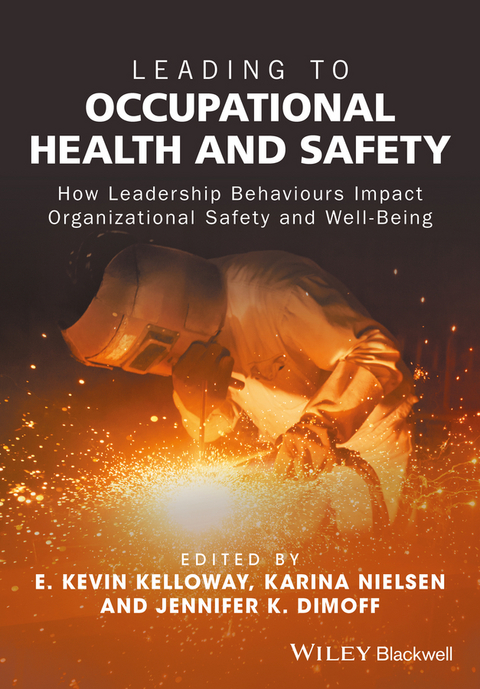
Leading to Occupational Health and Safety (eBook)
John Wiley & Sons (Verlag)
978-1-118-97371-4 (ISBN)
Leading to Occupational Health and Safety brings together prominent researchers to explore the pervasive roles that leaders play in determining the health, safety and mental well-being of employees in organizations.
- The first text to directly link organizational leadership behaviours with health and safety outcomes, covering theory, research and evidence-based best practice
- Argues that a leader's impact can be far more far-reaching than is commonly realized, and examines the effects of leadership on safety, physical wellness and wellbeing, and psychological wellbeing
- Explores the theoretical underpinnings of effective leadership styles and behaviors, and advances both research and practice in order to encourage better leadership and healthier, safer organizations
- Features contributions from internationally known and respected researchers including Sharon Clarke, Kara Arnold, Fred Luthans, Ståle Einarsen, Julian Barling, and Emma Donaldson-Feilder
E. Kevin Kelloway is Professor of Psychology and Canada Research Chair in Occupational Health Psychology at Saint Mary's University, where he was Founding Director for the CN Centre for Occupational Health and Safety and a founding principal of the Centre for Leadership Excellence. He is a recipient of the Distinguished Psychologist in Management Award from the Society for Psychologists in Management, and currently serves as President of the Canadian Psychological Association. He has published widely and is an associate editor of Work & Stress, The Journal of Occupational Psychology and The Journal of Organizational Effectiveness. Karina Nielsen is Professor of Work and Organisational Psychology at Norwich Business School, University of East Anglia, and a research affiliate at the CPH-NEW, US and Karolinska Institutet, Sweden. She has published more than 100 books chapters and articles. She is currently on the editorial boards of Human Relations, The Leadership Quarterly, and Journal of Business and Psychology and is an associate editor of Work & Stress. Jennifer K. Dimoff is a doctoral candidate in Industrial/Organizational Psychology at Saint Mary's University, where she completed her master's degree in Applied Psychology. Her research interests include workplace mental health, leadership training, and psychological resilience. Her graduate work has focused primarily on the development and evaluation of manager-focused workplace mental health training programs.
Notes on Contributors vii
Introduction 1
E. Kevin Kelloway, Karina Nielsen and Jennifer K. Dimoff
1 Leadership and Safety: A Self-Regulation and Social Learning Perspective 9
Sharon Clarke, Sara Guediri and Allan Lee
2 Senior Management Safety Leadership Behaviour 33
Kate C. Bowers, Mark Fleming and Andrea Bishop
3 Developing Safety Leadership 49
Jennifer Wong, Timur Ozbilir and Jane Mullen
4 The Antecedents of Transformational Leadership and Its Consequences for Occupational Health and Safety 69
Susanne Tafvelin
5 Leading to a Respectful Workplace 93
Annilee M. Game
6 Leading the Psychologically Healthy Workplace: The RIGHT Way 113
E. Kevin Kelloway, Samantha A. Penney and Jennifer K. Dimoff
7 Leadership and Work-Family Conflict 129
Ana Isabel Sanz-Vergel and Alfredo Rodríguez-Muñoz
8 Leaders as Resources: How Managers and Supervisors Can Socially Support Employees Towards Better Mental Health and Well-Being 149
Jennifer K. Dimoff and E. Kevin Kelloway
9 Destructive Forms of Leadership and Their Relationships with Employee Well-Being 163
Anders Skogstad, Morten Birkeland Nielsen and Ståle Einarsen
10 Leaders Can Make or Break an Intervention - But Are They the Villains of the Piece? 197
Karina Nielsen
11 Developing Positive Leadership for Employee Well-Being and Engagement 211
Emma Donaldson?-Feilder and Rachel Lewis
12 Mindful Leadership and Employee Well-Being: The Mediating Role of Leader Behaviours 235
Megan M. Walsh and Kara A. Arnold
13 Leading and Developing Health and Safety through Collective Psychological Capital 255
Julie Dyrdek Broad and Fred Luthans
14 'Choose a Job You Love, and You Will Never Have to Work a Day in your Life': A Strengths-based Leadership Approach to Optimal Functioning at Work 281
Philippe Dubreuil and Jacques Forest
15 Leadership and Mental Illness: Realities and New Directions 307
Erica L. Carleton and Julian Barling
Index 323
Notes on Contributors
Kara A. Arnold is Professor of Organizational Behaviour and Human Resource Management at the Faculty of Business Administration at Memorial University in St. John’s, NL, Canada. Her research focuses on transformational leadership, employee and leader well‐being, and gender issues in organizations. Her work has been published in the Journal of Occupational Health Psychology, Work & Stress, the Journal of Applied Psychology, Human Resource Management, and the Leadership & Organization Development Journal, as various book chapters, and has been presented at leading international conferences.
Julian Barling is the Borden Chair of Leadership at the Queen’s School of Business, Canada, and author of The Science of Leadership: Lessons from Research for Organizational Leaders (Oxford University Press, 2014). His research focuses on the effects of leaders’ psychological well‐being on the quality of their leadership behaviours, and the development of leadership behaviours. He is co‐editor (with Christopher Barnes, Erica Carleton and David Wagner) of Sleep and Work: Research Insights for the Workplace (Oxford University Press, 2016).
Andrea Bishop is a Postdoctoral Fellow at the IWK Health Centre/School of Nursing, Dalhousie University, Canada. She completed her Interdisciplinary PhD at Dalhousie University, exploring patient engagement in patient safety. She went on to complete a postdoctoral fellowship in the Department of Psychology at Saint Mary’s University, Canada, with a focus on organizational safety culture. She is currently developing expertise in knowledge translation research methods during her two‐year postdoctoral work with the Strengthening Transitions in Pediatric Care Research Program. Her research interests include transitions of care, patient safety, and patient engagement.
Kate C. Bowers completed a Bachelor of Arts (Hons.) degree in Psychology at Grenfell Campus, Memorial University of Newfoundland, before pursuing graduate studies at Saint Mary’s University, Canada. Under the direction of Mark Fleming, Kate completed a Master’s of Science in Applied Psychology (Industrial/Organizational specialization) where she focused on safety culture and understanding how management practices inform organizational safety outcomes. Kate is a recipient of numerous academic awards including the Joseph‐Armand Bombardier Master’s Scholarship. At present, Kate is employed as a Human and Organizational Factors Specialist with the National Energy Board of Canada where she combines her specialized training with research and innovation to advance industry safety.
Julie Dyrdek Broad is completing her doctoral studies at George Washington University, US, where she studies organizational sciences, focusing her research on the emergence of collective Psychological Capital (cPsyCap) for intact groups and teams. She has more than 24 years of global executive experience, and is currently working at Booz Allen Hamilton, where she has supported the DoD, to include the Army Resiliency Directorate, Comprehensive Soldier & Family Fitness program. Ms Broad’s research stream also includes work on serious gaming solutions to build PsyCap in the workplace, and on how PsyCap can be leveraged in the treatment of traumatic brain injuries (TBIs).
Erica L. Carleton is Assistant Professor of Organizational Behavior at Edwards School of Business, University of Saskatchewan. She was formerly a Postdoctoral Research Fellow at Ivey Business School, Western University, Canada. She completed her PhD in Organizational Behavior at the Smith School of Business, Queen’s University, under the supervision of Julian Barling. Her research interests include leadership, sleep and well‐being. She conducted her dissertation research on sleep, well‐being and leadership. She is a co‐editor (with Julian Barling, Christopher Barnes and David Wagner) of Sleep and Work: Research Insights for the Workplace (Oxford University Press, 2016).
Sharon Clarke is a full Professor of Organizational Psychology at Alliance Manchester Business School, University of Manchester, UK. She has research interests in safety culture, safety climate, leadership, well‐being and health. Her work has been widely published in leading academic and practitioner journals and in co‐authored books, including Human Safety and Risk Management, now in its third edition (CRC Press, 2015). She is currently Editor‐in‐Chief of the Journal of Occupational and Organizational Psychology and has served on the editorial boards of the Journal of Occupational Health Psychology and the International Journal of Stress Management.
Jennifer K. Dimoff is an Assistant Professor of Industrial/Organizational (I/O) Psychology at Portland State University (PSU). She completed her Ph.D. in I/O Psychology from Saint Mary’s University, Canada, in 2016, where she also received her MSc. in Applied Psychology. Dr. Dimoff received her Honors BSc. in the Biological Sciences at Queen’s University, where she was also a research assistant in Organizational Behavior at the Smith School of Business. Her key research interests include workplace mental health, leadership training, and psychological resilience. Dr. Dimoff’s most recent work has focused primarily on the development and evaluation of manager‐focused workplace mental health training programs, notably the Mental Health Awareness Training (MHAT) for workplace leaders.
Emma Donaldson‐Feilder is a Chartered Occupational Psychologist and Director of both Affinity Health at Work and Affinity Coaching and Supervision, UK. She specializes in supporting organizations to achieve sustainable performance through positive employee health, well‐being and engagement, with a particular emphasis on people management and leadership. In order to have the best possible evidence base for her work, she is actively involved in research; conversely, her consultancy and coaching with a range of organizations ensure that the research is of genuine practical use in real‐world settings. She is also involved in public policy, writing and presenting on health and work issues.
Philippe Dubreuil is an Industrial/Organizational Psychologist and Professor at the Université du Québec à Trois‐Rivières, Canada. He completed his doctoral studies at the Université de Sherbrooke, Canada, where his work mainly focused on the psychological processes involved in the relation between strengths use and work performance. His research topics concern strengths, passion, engagement and well‐being at work and his contributions are published in academic journals such as The Journal of Positive Psychology and Human Relations. As a consultant, he also works with leaders, teams and organizations, helping them increase their engagement and performance through better awareness and use of their strengths.
Ståle Einarsen is Professor in Work and Organizational Psychology at the Faculty of Psychology, University of Bergen, Norway, where he is head of Bergen Bullying Research Group. Professor Einarsen has published extensively in issues related to workplace bullying, sexual harassment, whistle‐blowing, destructive leadership, innovation and creativity in organizations, and health and well‐being at work. He is a co‐founder of the International Association on Workplace Bullying and Harassment and has co‐edited three international volumes on this subject.
Mark Fleming is the CN Professor of Safety Culture in the Department of Psychology at Saint Mary’s University, Canada. Mark is an applied psychologist with over 20 years of experience in health and safety research in offshore oil and gas, patient safety, nuclear power, petrochemical and construction. His research includes investigating methods for measuring and improving safety culture, safety motivation, safety leadership and rail safety. He is dedicated to developing practical and valid tools to assist organizations to prevent harm.
Jacques Forest is a professor‐researcher, organizational psychologist and CHRP in the organization and human resources department at the École des sciences de la gestion de l’Université du Québec à Montréal (ESG UQAM), the biggest French‐speaking business school in Canada. His research and interventions specialize in human motivation and optimal functioning using strengths management and self‐determination theory. The underlying concern of his work is to activate, develop and sustain high‐quality motivation so that performance and well‐being can be experienced on a daily basis for long periods of time.
Annilee M. Game is a Lecturer in Organizational Behaviour and Business Ethics at the University of East Anglia, UK. Her research focuses on how individual experiences of work and careers can be enhanced through healthy, respectful and effective relationships. She conducts both quantitative and qualitative research. Specific topics of interest include ethics in leadership and decision‐making, workplace incivility, emotions and well‐being, adult attachment in organizations, and skilled migrant careers.
Sara Guediri is a Lecturer in Organizational Psychology at Alliance Manchester Business School, University of Manchester, UK. Her research explores issues of occupational safety and well‐being, with a focus on...
| Erscheint lt. Verlag | 25.1.2017 |
|---|---|
| Sprache | englisch |
| Themenwelt | Geisteswissenschaften ► Psychologie ► Arbeits- und Organisationspsychologie |
| Medizin / Pharmazie ► Medizinische Fachgebiete ► Psychiatrie / Psychotherapie | |
| Studium ► Querschnittsbereiche ► Prävention / Gesundheitsförderung | |
| Wirtschaft ► Betriebswirtschaft / Management ► Personalwesen | |
| Schlagworte | Applied Psychology • Arbeitsschutz u. Arbeitssicherheit • Arbeitssicherheit • Business & Management • business liability • employee psychology • Employee well-being • Gesundheits- u. Sozialwesen • Gesundheit und Sicherheit am Arbeitsplatz • Health & Social Care • health and safety • Human Resources • Management f. Führungskräfte • Management f. Führungskräfte • Management / Leadership • Mindful Leadership • Occupational Health • Occupational Health & Safety • Occupational psychology • on the job • Organizational & Industrial Psychology • Psychologie • Psychologie i. d. Arbeitswelt • Psychology • safety at work • Wirtschaft u. Management |
| ISBN-10 | 1-118-97371-2 / 1118973712 |
| ISBN-13 | 978-1-118-97371-4 / 9781118973714 |
| Informationen gemäß Produktsicherheitsverordnung (GPSR) | |
| Haben Sie eine Frage zum Produkt? |
 EPUB (Adobe DRM)
Kopierschutz: Adobe-DRM
Adobe-DRM ist ein Kopierschutz, der das eBook vor Mißbrauch schützen soll. Dabei wird das eBook bereits beim Download auf Ihre persönliche Adobe-ID autorisiert. Lesen können Sie das eBook dann nur auf den Geräten, welche ebenfalls auf Ihre Adobe-ID registriert sind.
Details zum Adobe-DRM
Dateiformat: EPUB (Electronic Publication)
EPUB ist ein offener Standard für eBooks und eignet sich besonders zur Darstellung von Belletristik und Sachbüchern. Der Fließtext wird dynamisch an die Display- und Schriftgröße angepasst. Auch für mobile Lesegeräte ist EPUB daher gut geeignet.
Systemvoraussetzungen:
PC/Mac: Mit einem PC oder Mac können Sie dieses eBook lesen. Sie benötigen eine
eReader: Dieses eBook kann mit (fast) allen eBook-Readern gelesen werden. Mit dem amazon-Kindle ist es aber nicht kompatibel.
Smartphone/Tablet: Egal ob Apple oder Android, dieses eBook können Sie lesen. Sie benötigen eine
Geräteliste und zusätzliche Hinweise
Buying eBooks from abroad
For tax law reasons we can sell eBooks just within Germany and Switzerland. Regrettably we cannot fulfill eBook-orders from other countries.
aus dem Bereich