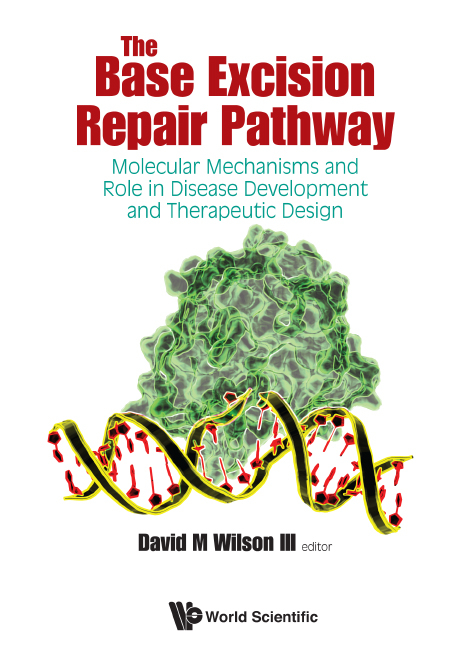
BASE EXCISION REPAIR PATHWAY, THE (eBook)
824 Seiten
World Scientific Publishing Company (Verlag)
978-981-4719-73-5 (ISBN)
This book will serve as the preeminent text book on the topic of "base excision repair", a key DNA repair pathway that protects cells from most spontaneous forms of DNA damage, including oxidative lesions that arise both in the nuclear and mitochondrial genomes. The book, which includes contributions from many of the world leaders in the field, provides a detailed description of the molecular mechanisms of base excision repair, as well as its emerging relationship to epigenetic regulation, the aging process and human disease, such as cancer susceptibility, immunological defects and neurological disorders. The book will also cover the state-of-the-art technologies being developed to assess base excision repair capacity among individuals in the population, in addition to the strategies being employed to target base excision repair as part of therapeutic paradigms to eradicate disease, namely cancer.
This book represents one of the most extensive efforts to date to cover the topic of "base excision repair". It includes chapters by many of the most established investigators in the field, from all over the world.
Contents:- Genomic Uracil — Dangers and Benefits in Processing (Hans E Krokan, Geir Slupphaug and Bodil Kavli)
- The GO Repair Pathway: OGG1 and MUTYH (Amelia H Manlove, Nicole N Nuñez and Sheila S David)
- The DNA Glycosylases that Recognize and Remove Free Radical-damaged Pyrimidines (Andrea J Lee and Susan S Wallace)
- Alkyladenine DNA Glycosylases (Carrie M Margulies and Leona D Samson)
- The Abasic Endonuclease APE1: Much More Than a DNA Repair Enzyme (Mattia Poletto, Lisa Lirussi, Giulia Antoniali and Gianluca Tell)
- Central Steps in Mammalian BER and Regulation by PARP1 (Rajendra Prasad, Julie K Horton, Yuan Liu and Samuel H Wilson)
- Processing Strand Break Termini in the DNA Single-Strand Break Repair Pathway (Zahra Shire, Bingcheng Jiang, Ismail Abdou and Michael Weinfeld)
- The PARP-XRCC1 Axis in Base Excision Repair (Vincent Pennaneach and Janet Hall)
- DNA Ligases in Base Excision Repair (Alan E Tomkinson and Ishtiaque Rashid)
- Base Excision Repair and Epigenetic Regulation (Alain R Weber, Primo Schär and David Schuermann)
- Base Excision Repair in the Immune System (Carol E Schrader and Jeroen E J Guikema)
- Base Excision Repair in the Etiology of Lupus and Cancer (Khadijeh Alnajjar, Sreerupa Ray, Allison N Schechter, Alireza G Senejani, Stephany Robison, Lindsey A Criswell, Julie Dragon and Joann B Sweasy)
- Base Excision Repair in Trinucleotide Repeat Expansion Disorders (Margherita Bignami and Filomena Mazzei)
- Neurodegeneration Caused by Accumulation of an Oxidized Base Lesion, 8-oxoguanine, in Nuclear and Mitochondrial DNA: From Animal Models to Human Diseases (Yusaku Nakabeppu)
- Assessing BER Capacity in the Human Population (Isaac Alexander Chaim and Zachary David Nagel)
- Prognostic and Predictive Significance of Base Excision Repair in Human Cancers (Reem Ali and Srinivasan Madhusudan)
- Enzymes in the Base Excision Repair Pathway as Targets for Small Molecule Mediated Therapeutics (Eric F Johnson, Amanda K McCullough and R Stephen Lloyd)
- Mitochondrial Base Excision Repair (Mateus P Mori, Daniela Tathiana Soltys and Nadja C de Souza Pinto)
- Base Excision Repair in Aging (Ricardo Gredilla, Vilhelm A Bohr and Tinna Stevnsner)
Readership: Researchers, academics, scientists and clinicians, particularly for radiological and medical oncologists, epidemiologists, cancer prevention specialists, and graduate students in cancer biology, who are interested in DNA repair mechanisms and related susceptibility to cancer.
| Erscheint lt. Verlag | 8.12.2016 |
|---|---|
| Verlagsort | Singapore |
| Sprache | englisch |
| Themenwelt | Medizin / Pharmazie ► Medizinische Fachgebiete ► Onkologie |
| Medizin / Pharmazie ► Physiotherapie / Ergotherapie ► Orthopädie | |
| Naturwissenschaften ► Biologie ► Biochemie | |
| Naturwissenschaften ► Biologie ► Genetik / Molekularbiologie | |
| ISBN-10 | 981-4719-73-0 / 9814719730 |
| ISBN-13 | 978-981-4719-73-5 / 9789814719735 |
| Informationen gemäß Produktsicherheitsverordnung (GPSR) | |
| Haben Sie eine Frage zum Produkt? |
 PDF (Adobe DRM)
Kopierschutz: Adobe-DRM
Adobe-DRM ist ein Kopierschutz, der das eBook vor Mißbrauch schützen soll. Dabei wird das eBook bereits beim Download auf Ihre persönliche Adobe-ID autorisiert. Lesen können Sie das eBook dann nur auf den Geräten, welche ebenfalls auf Ihre Adobe-ID registriert sind.
Details zum Adobe-DRM
Dateiformat: PDF (Portable Document Format)
Mit einem festen Seitenlayout eignet sich die PDF besonders für Fachbücher mit Spalten, Tabellen und Abbildungen. Eine PDF kann auf fast allen Geräten angezeigt werden, ist aber für kleine Displays (Smartphone, eReader) nur eingeschränkt geeignet.
Systemvoraussetzungen:
PC/Mac: Mit einem PC oder Mac können Sie dieses eBook lesen. Sie benötigen eine
eReader: Dieses eBook kann mit (fast) allen eBook-Readern gelesen werden. Mit dem amazon-Kindle ist es aber nicht kompatibel.
Smartphone/Tablet: Egal ob Apple oder Android, dieses eBook können Sie lesen. Sie benötigen eine
Geräteliste und zusätzliche Hinweise
Buying eBooks from abroad
For tax law reasons we can sell eBooks just within Germany and Switzerland. Regrettably we cannot fulfill eBook-orders from other countries.
aus dem Bereich