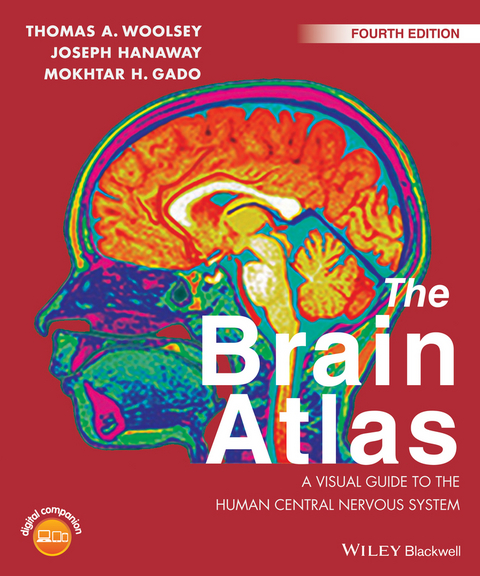
The Brain Atlas (eBook)
John Wiley & Sons (Verlag)
978-1-118-43876-3 (ISBN)
Dorian J. Pritchard is former lecturer in Human Genetics, University of Newcastle-upon-Tyne, UK and former Visiting Lecturer in Medical Genetics, International Medical University, Kuala Lumpur, Malaysia.
Bruce Korf is Wayne H. and Sara Crews Finley Chair in Medical Genetics, Professor and Chair, Department of Genetics, and Director of the Heflin Center for Genomic Sciences at the University of Alabama at Birmingham, USA.
The Brain Atlas: A Visual Guide to the Human Central Nervous System integrates modern neuroscience with clinical practice and is now significantly revised and updated for a Fourth Edition. The book's five sections cover: Background Information, The Brain and Its Blood Vessels, Brain Slices, Histological Sections, and Pathways. These are depicted in over 350 high quality intricate figures making it the best available visual guide to human neuroanatomy.
Dorian J. Pritchard is former lecturer in Human Genetics, University of Newcastle-upon-Tyne, UK and former Visiting Lecturer in Medical Genetics, International Medical University, Kuala Lumpur, Malaysia. Bruce Korf is Wayne H. and Sara Crews Finley Chair in Medical Genetics, Professor and Chair, Department of Genetics, and Director of the Heflin Center for Genomic Sciences at the University of Alabama at Birmingham, USA.
"Of the many neuroanatomical texts available, I found this beautifully illustrated Brain Atlas particularly helpful in developing confidence in neuroanatomy, aided by such comprehensive and well-presented information"....."This book is ideal for trainees in any neuroscience specialty. Medical students will also find this one of the better neuroanatomical texts on the market"...."Apart from being an essential resource for any practitioner requiring detailed knowledge in neuroanatomy, this book would prove extremely beneficial to those analysing whole brains and brain sections at both the macroscopic and microscopic levels" Abel Devedass, Addenbrooke's Hospital on behalf of the Neuropathology and Applied Neurobiology Journal, Oct 2017
Introduction
Overview
The human nervous system is complex and sophisticated. It is the most remarkable system in biology. A major challenge for neuroscience, psychology, medicine, and, indeed, for civilization is to understand the nervous system at the same fundamental levels at which we now understand other organ systems. Early in the 21st century, only 50 years after the discovery of the genetic “alphabet,” the complete human genome has been mapped. Likewise, new knowledge about the brain and diseases that afflict the nervous system is exploding. One goal for future work on the human brain is to reach a level of detailed understanding similar to that now possible for the genome.
An anchor in this quest is information about the structure and organization of the central nervous system (CNS). The Brain Atlas: A Visual Guide to the Human Central Nervous System was prepared to help students and professionals understand the normal human brain and guide interpretation of clinical and experimental work.
Clear charts and maps of biological structures have been teaching aids from the earliest times. In the biological sciences, the first detailed and illustrated text based on direct observation was the De Fabrica Humani Corporis (1543) and its synoptic Epitome (1543) by Andreas Vesalius (1514–1564). Those books have been said to “mark the beginning of modern science.” Publication of the Fabrica also was a major landmark in book publishing. The highly popular Epitome was intended as a primer but served very much as a modern day atlas. Such works have evolved and today are used in the same way maps are used to plan travel and understand geographic relationships.
In the mid to late 19th century, instructional programs in universities and medical schools were developed to teach students to make accurate observations from specimens. This skill enables students to generate and retain mental conceptualizations of complex three-dimensional (3D) structures in the body. In part, this was to prepare students to interpret observations that could be made only at the surfaces of living organisms. Experience with these teaching aids was so positive that, even today, instruction at nearly every level now uses charts and atlases to aid the study of gross anatomy, embryology, histology, and neuroscience. Atlases have been developed for a wide range of other related disciplines, such as pathology, radiology, and surgery. These books support varied and flexible learning plans, styles, and objectives. At their best, such works are ready references for efficient recall and lifelong study—rapidly accessible sources of information. The Brain Atlas is intended to be such a work: a reference serving different needs for students learning about the human brain and a resource for rapid clarification in self-directed study, in the classroom, in the laboratory, and in the clinic.
Because of recent stunning advances in imaging, the information included in The Brain Altas is more crucial than ever for medical practice, human and animal brain research, and certain branches of psychology. For example, strokes (brain attacks) resulting from insufficient blood supply to parts of the CNS are the leading cause of disability in adults and the third leading cause of death in the United States. Intense efforts are now directed at reducing risk and improving therapy for this disease. The quick access to information on the brain and its blood supply in The Brain Atlas is crucial for such efforts. Other forms of “brain disease,” such as mental illness, dementia, substance abuse, and a host of genetic syndromes, can be investigated and understood only by reference to the detailed organization of the human brain. Alterations in brain function, such as learning difficulties or speech problems, have also now been directly linked to altered brain structures. In the future, access to basic information about brain structure will be even more essential for evaluating patients at risk for specific diseases and for monitoring and assessing the effects of therapeutic interventions.
New imaging and other innovative techniques have spurred a revolution in the study of the way in which the brain works. Functional imaging of healthy individuals at all ages provides a wide range of new and compelling information on how the brain executes different tasks, from speaking different languages to reacting to pain. Such imaging promises to reveal, for example, the ways in which the brains of individuals with special talents may differ. The human brain is no longer a “black box” from which one only rarely and fortuitously records activity. Instead, the precise locations in the brain associated with many uniquely human tasks can be specified. Therefore, ready anatomical reference works are crucial for cognitive psychologists and research scientists.
The Brain Atlas is divided into five parts, with key features summarized at the beginning of each. This introduction (Part I) summarizes several general aspects of the brain to help the novice get started or refresh the knowledge of advanced students and practicing professionals. The balance of this overview outlines terminology used in this volume, as well as special features designed to assist in identification, study, and navigation. Information on the sources and preparation of the anatomical images that appear in this book is provided. The main parts of the volume (Parts II–V) are designed to flow logically and progressively, from overall surface anatomy of the CNS (Part II), through cross-section-al gross anatomy (Part III) and selected regional histology (Part IV), and ending with diagrams of the major neuronal systems that are responsible for the brain’s magnificent array of functions (Part V). Because each part illustrates a different aspect of the structure and organization of the CNS, the book is arranged so that users can navigate easily between topics for efficient learning and comprehension.
The Nervous System
Cells
The cells of the nervous system are of two principal types: nerve cells or neurons, which are directly responsible for conveying and processing information; and glial cells (Gr., glia, glue), that support the neurons and make them more efficient and effective. Neurons exhibit a wide range of shapes, sizes, functional characteristics, and chemical attributes. Most neurons are not visible without magnification. Neurons differ from all other cells in that they have numerous microscopic processes extending for great distances from the cell body (soma; Fig. 1). All neurons are polarized, that is, different parts are specialized to receive or send information. For most nerve cells, these functions are segregated in two different classes of processes. Dendrites, shorter processes (~1 mm or less) that are tapered and branched much like limbs on a tree, receive and integrate incoming information. Most neurons have several dendrites. Axons (usually only one per neuron) have a relatively uniform diameter, can be highly branched, and extend for considerable distances, up to almost 2 m in tall people. Axons distribute signals to other cells (neurons, muscle cells, secretory cells, etc.) without attenuation. The principal mode of communication between neurons and from neurons to other tissues, such as muscle, is through specialized contacts called synapses (Gr., syn + haptein, clasp). Synapses are small and require magnification under a microscope to be seen. Axons convey information through synapses throughout the brain to activate specific targets.
Figure 1 Schematic illustration of major elements of the central nervous system that are sources and targets of connections that facilitate different functions. Gray matter is rich in neurons, connecting axons, and contact points called synapses. For example, a gray matter area, the cerebral cortex, connects to a gray matter nucleus via a myelinated axon of a nerve cell. The full extent of the axon is not shown (//) but could extend for more than 1 m. One synapse is enlarged. Some but not all of the neurons in the gray matter are diagrammed as they would appear with cell body stains (blue circles and triangles; see pp. 165 and 166). Note the scale bars for the gray matter and the enlarged depiction of a synapse. These can be compared with actual images of gray and white matter in Figure 2.
Gray Matter/White Matter
Different parts of the brain and spinal cord have distinctive appearances. These anatomical distinctions can be correlated almost without exception to specific functional attributes, such as the sense of touch, language understanding, or the ability to execute complex movements such as dancing. Because of the appearance of fresh brain tissue, areas rich in neurons, synapses and glia are called gray matter, and areas containing mainly axons and glia are called white matter (Figs. 1 and 2). This distinction is useful in understanding anatomical studies from normal or autopsy specimens and, increasingly, from images of living individuals.
Figure 2 Differences between gray matter (regions that are neuron and synapse rich) and white matter (regions rich in myelinated axons and surrounding glia) are shown with three different...
| Erscheint lt. Verlag | 19.1.2017 |
|---|---|
| Sprache | englisch |
| Themenwelt | Medizin / Pharmazie ► Medizinische Fachgebiete ► Neurologie |
| Studium ► 1. Studienabschnitt (Vorklinik) ► Physiologie | |
| Schlagworte | Biowissenschaften • blood vessel images and territories • brain • brain pathways • brain sections • brain slices • brain stem • cerebellum • Cognitive Neuropsychology & Cognitive Neuroscience • Human nervous system • Kognitive Neuropsychologie u. Neurowissenschaft • Life Sciences • Magnetic Resonance Imaging • Medical Science • Medizin • nerve fiber bundles • Neuroanatomy • Neurologie • Neurology • Neurophysiologie • Neurophysiology • Neuropsychologie • Neuroscience • Neurowissenschaften • Psychologie • Psychology • spinal cord |
| ISBN-10 | 1-118-43876-0 / 1118438760 |
| ISBN-13 | 978-1-118-43876-3 / 9781118438763 |
| Informationen gemäß Produktsicherheitsverordnung (GPSR) | |
| Haben Sie eine Frage zum Produkt? |
 EPUB (Adobe DRM)
Kopierschutz: Adobe-DRM
Adobe-DRM ist ein Kopierschutz, der das eBook vor Mißbrauch schützen soll. Dabei wird das eBook bereits beim Download auf Ihre persönliche Adobe-ID autorisiert. Lesen können Sie das eBook dann nur auf den Geräten, welche ebenfalls auf Ihre Adobe-ID registriert sind.
Details zum Adobe-DRM
Dateiformat: EPUB (Electronic Publication)
EPUB ist ein offener Standard für eBooks und eignet sich besonders zur Darstellung von Belletristik und Sachbüchern. Der Fließtext wird dynamisch an die Display- und Schriftgröße angepasst. Auch für mobile Lesegeräte ist EPUB daher gut geeignet.
Systemvoraussetzungen:
PC/Mac: Mit einem PC oder Mac können Sie dieses eBook lesen. Sie benötigen eine
eReader: Dieses eBook kann mit (fast) allen eBook-Readern gelesen werden. Mit dem amazon-Kindle ist es aber nicht kompatibel.
Smartphone/Tablet: Egal ob Apple oder Android, dieses eBook können Sie lesen. Sie benötigen eine
Geräteliste und zusätzliche Hinweise
Buying eBooks from abroad
For tax law reasons we can sell eBooks just within Germany and Switzerland. Regrettably we cannot fulfill eBook-orders from other countries.
aus dem Bereich