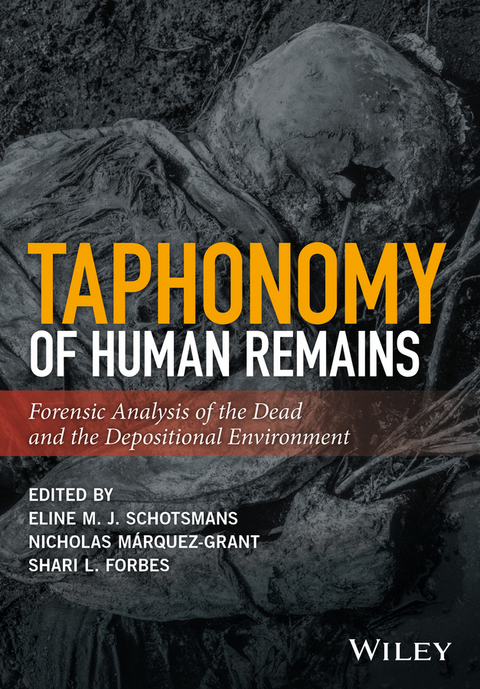
Taphonomy of Human Remains (eBook)
544 Seiten
Wiley-Blackwell (Verlag)
978-1-118-95334-1 (ISBN)
A truly interdisciplinary approach to this core subject within Forensic Science
- Combines essential theory with practical crime scene work
- Includes case studies
- Applicable to all time periods so has relevance for conventional archaeology, prehistory and anthropology
- Combines points of view from both established practitioners and young researchers to ensure relevance
Eline M. J. Schotsmans is a post-doctoral researcher in forensic archaeology and taphonomy at the Laboratory of Anthropology of Past and Present Populations (PACEA) at the University of Bordeaux, France, and an honorary fellow at the University of Bradford, UK. She has worked on various forensic cases and conducts research in taphonomy that lies at the interface between archaeo-anthropology and forensic sciences. Nicholas Márquez-Grant is a Lecturer in Forensic Anthropology and Course Director MSc in Forensic Archaeology and Anthropology at Cranfield University, UK. He is also a Research Associate at the University of Oxford. He has analysed human remains from a number of countries and chronological periods and currently undertakes forensic casework in the UK. Shari Forbes is a Professor and ARC Future Fellow in the Centre for Forensic Science at the University of Technology Sydney. She is also the Director of the Australian Facility for Taphonomic Experimental Research (AFTER), the first facility in Australia that allows scientists to study the decomposition of human cadavers. She is regularly consulted on forensic casework and assists police to search for and locate human remains using police dogs and geophysical equipment.
List of Contributors
Maurice C.G. Aalders
Academic Medical Center
Amsterdam
The Netherlands
Esma Alicehajic
European Union Rule of Law Mission (EULEX)
Kosovo
Ruggero D'Anastasio
Museo Universitario
Università ‘G. d'Annunzio’
Chieti e Pescara
Italy
Caroline Barker
Independent Forensic Anthropologist and Archaeologist
Ronald G. Beckett
Quinnipiac University
Hamden
Connecticut
USA
Bram Bekaert
KU Leuven - University of Leuven
Department of Imaging & Pathology
Forensic Biomedical Sciences
Leuven
Belgium
University Hospitals Leuven
Department of Forensic Medicine
Laboratory of Forensic Genetics and Molecular Archaeology
Leuven
Belgium
Jelena J. Bekvalac
Centre for Human Bioarchaeology
Museum of London
UK
Charles E.H. Berger
Netherlands Forensic Institute (NFI)
The Hague
The Netherlands
Institute for Criminal Law and Criminology
Faculty of Law
Leiden University
Leiden
The Netherlands
Frédérique Blaizot
Inrap
Centre Archéologique Rhône-Alpes-Auvergne
Lyon
France
PACEA De la Préhistoire à l'Actuel: Culture, Environnement et Anthropologie, UMR 5199
CNRS-Université de Bordeaux
Pessac
France
Soren Blau
Victorian Institute of Forensic Medicine
Southbank
Australia
Department of Forensic Medicine
School of Public Health and Preventive Medicine
Monash University
Australia
Martin Brown
The Plugstreet Project
Belgium
David O. Carter
Forensic Sciences Unit
Division of Natural Sciences and Mathematics
Chaminade University of Honolulu
Hawaii
Annalisa Cappella
LABANOF (Laboratorio di antropologia e odontologia forense)
Sezione di Medicina Legale e delle Assicurazioni
Dipartimento di Scienze Biomediche per la Salute
Università degli Studi di Milano
Italy
José Luis Cascallana
Instituto de Medicina Legal de Galicia
Unidad de Antropología Forense
Hospital de Verin
Ourense
Spain
Dominique Castex
PACEA De la Préhistoire à l'Actuel: Culture, Environnement et Anthropologie, UMR 5199
CNRS-Université de Bordeaux
Pessac
France
Cristina Cattaneo
LABANOF (Laboratorio di antropologia e odontologia forense)
Sezione di Medicina Legale e delle Assicurazioni
Dipartimento di Scienze Biomediche per la Salute
Università degli Studi di Milano
Italy
Emily Cline
Cranfield Forensic Institute
Defence Academy of the United Kingdom
Cranfield University
Shrivenham
UK
Jenna L. Comstock
Faculty of Science
University of Ontario Institute of Technology
Ontario
Canada
Anne Coulombeix
Institut de Recherche Criminelle de la Gendarmerie Nationale (IRCGN)
Pontoise
France
Eva Cuypers
KU Leuven - University of Leuven
Toxicology and Pharmacology
Campus Gasthuisberg
Leuven
Belgium
Franklin E. Damann
Defense POW/MIA Accounting Agency
Central Identification Laboratory
Offutt Air Force Base
Nebraska
USA
Ronny Decorte
KU Leuven - University of Leuven
Department of Imaging & Pathology
Forensic Biomedical Sciences
Leuven
Belgium
University Hospitals Leuven
Department of Forensic Medicine
Laboratory of Forensic Genetics and Molecular Archaeology
Leuven
Belgium
Roosje de Leeuwe
Netherlands Forensic Institute (NFI)
The Hague
The Netherlands
Julio Del Olmo
Asociación para la Recuperación de la Memoria Histórica de Valladolid
Spain
Maria Cristina de Mendonça
Instituto Nacional de Medicina Legal e Ciências Forenses
Coimbra
Portugal
Joanne B. Devlin
Forensic Anthropology Center
Department of Anthropology
University of Tennessee Knoxville
Tennessee
USA
Marie Christine Dussault
Department of Anatomy
Faculty of Health Sciences
University of Pretoria
South Africa
Faculty of Science and Technology
Bournemouth University
UK
Gerda J. Edelman
Netherlands Forensic Institute (NFI)
The Hague
The Netherlands
Francisco Etxeberría
Sociedad de Ciencias Aranzadi
Spain
Universidad del Pais Vasco
Spain
Julie Evans
ROAR Forensics
Malvern Hills Science Park
Malvern
Worcestershire
UK
Elissa Fleak
Los Angeles County Department of Medical Examiner-Coroner
Los Angeles
California
USA
Leonardo R. Flores Pérez
Universidad Autónoma Chapingo
Texcoco
México
Jean-François Focant
CART, Organic and Biological Analytical Chemistry Group
Chemistry Department
University of Liège
Belgium
Shari L. Forbes
Centre for Forensic Science
University of Technology Sydney
Sydney
Australia
Heather Gill-Frerking
NTK Services
Concord
New Hampshire
USA
David Gonçalves
Research Centre for Anthropology and Health (CIAS)
University of Coimbra
Coimbra
Portugal
Laboratório de Arqueociências
Direção Geral do Património Cultural and LARC/CIBIO/InBIO
Lisboa
Portugal
Laboratory of Forensic Anthropology
Department of Life Sciences
University of Coimbra
Coimbra
Portugal
Michael A. Green
Department of Forensic Pathology
University of Sheffield
Sheffield
UK
W.J. Mike Groen
Netherlands Forensic Institute (NFI)
The Hague
The Netherlands
Department of Archaeological Sciences
Faculty of Archaeology
Leiden University
Leiden
The Netherlands
Stuart J. Hamilton
East Midlands Forensic Pathology Unit
Leicester Royal Infirmary
Leicester
UK
Karl Harrison
Cranfield Forensic Institute
Defence Academy of the United Kingdom
Cranfield University
Shrivenham
UK
Lourdes Herrasti
Sociedad de Ciencias Aranzadi
Spain
Jean-Bernard Huchet
Archéozoologie, Archéobotanique: Sociétés, Pratiques et Environnements, UMR 7209
Muséum National d'Histoire Naturelle
Paris
France
Institut de Systématique, Évolution, Biodiversité (ISYEB), UMR 7205
Département Systématique et Evolution (Entomologie)
Muséum National d'Histoire Naturelle
Paris
France
PACEA De la Préhistoire à l'Actuel: Culture, Environnement et Anthropologie, UMR 5199
CNRS-Université de Bordeaux
Pessac
France
Rob C. Janaway
School of Archaeological Sciences
University of Bradford
Bradford
UK
Lee Meadows Jantz
Forensic Anthropology Center
Department of Anthropology
University of Tennessee
Knoxville
Tennessee
USA
Emily N. Junkins
Department of Microbiology and Plant Biology
University of Oklahoma
Norman
Oklahoma
USA
Richard Lloyd
Cranfield Forensic Institute
Defence Academy of the United Kingdom
Cranfield University
Shrivenham
UK
Nicholas Márquez-Grant
Cranfield Forensic Institute
Defence Academy of the United Kingdom
Cranfield University
Shrivenham
UK
Institute of Human Sciences
School of Anthropology and Museum Ethnography
University of...
| Erscheint lt. Verlag | 24.1.2017 |
|---|---|
| Sprache | englisch |
| Themenwelt | Studium ► 2. Studienabschnitt (Klinik) ► Rechtsmedizin |
| Naturwissenschaften ► Biologie | |
| Naturwissenschaften ► Chemie | |
| Naturwissenschaften ► Geowissenschaften ► Mineralogie / Paläontologie | |
| Recht / Steuern ► Strafrecht ► Kriminologie | |
| Sozialwissenschaften ► Soziologie ► Mikrosoziologie | |
| Technik | |
| Schlagworte | Analytische Chemie / Forensik • Anthropologie • Anthropology • archaeology • Biowissenschaften • Chemie • Chemistry • Decay • Decomposition • depositional environment • Forensic • Forensics • Forensic Science • Forensik • Human remains • Life Sciences • mummification • Preservation • taphonomy |
| ISBN-10 | 1-118-95334-7 / 1118953347 |
| ISBN-13 | 978-1-118-95334-1 / 9781118953341 |
| Informationen gemäß Produktsicherheitsverordnung (GPSR) | |
| Haben Sie eine Frage zum Produkt? |
 EPUB (Adobe DRM)
Kopierschutz: Adobe-DRM
Adobe-DRM ist ein Kopierschutz, der das eBook vor Mißbrauch schützen soll. Dabei wird das eBook bereits beim Download auf Ihre persönliche Adobe-ID autorisiert. Lesen können Sie das eBook dann nur auf den Geräten, welche ebenfalls auf Ihre Adobe-ID registriert sind.
Details zum Adobe-DRM
Dateiformat: EPUB (Electronic Publication)
EPUB ist ein offener Standard für eBooks und eignet sich besonders zur Darstellung von Belletristik und Sachbüchern. Der Fließtext wird dynamisch an die Display- und Schriftgröße angepasst. Auch für mobile Lesegeräte ist EPUB daher gut geeignet.
Systemvoraussetzungen:
PC/Mac: Mit einem PC oder Mac können Sie dieses eBook lesen. Sie benötigen eine
eReader: Dieses eBook kann mit (fast) allen eBook-Readern gelesen werden. Mit dem amazon-Kindle ist es aber nicht kompatibel.
Smartphone/Tablet: Egal ob Apple oder Android, dieses eBook können Sie lesen. Sie benötigen eine
Geräteliste und zusätzliche Hinweise
Buying eBooks from abroad
For tax law reasons we can sell eBooks just within Germany and Switzerland. Regrettably we cannot fulfill eBook-orders from other countries.
aus dem Bereich