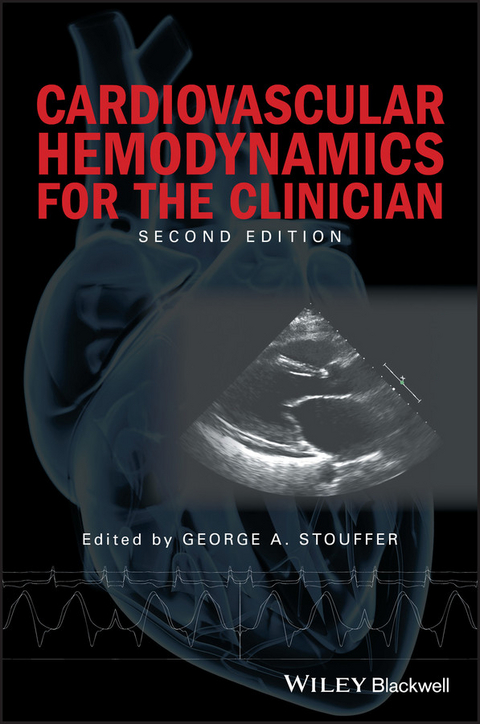
Cardiovascular Hemodynamics for the Clinician (eBook)
John Wiley & Sons (Verlag)
978-1-119-06650-7 (ISBN)
- Concise handbook to help both practicing and prospective clinicians better understand and interpret the hemodynamic data used to make specific diagnoses and monitor ongoing therapy
- Numerous pressure tracings throughout the book reinforce the text by demonstrating what will be seen in daily practice
- Topics include coronary artery disease; cardiomyopathies; valvular heart disease; arrhythmias; hemodynamic support devices and pericardial disease
- New chapters on TAVR, ventricular assist devices, and pulmonic valve disease, expanded coverage of pulmonary hypertension, fractional flow reserve, heart failure with preserved ejection fraction and valvular heart disease
- Provides a basic overview of circulatory physiology and cardiac function followed by detailed discussion of pathophysiological changes in various disease states
Cardiovascular Hemodynamics for the Clinician, 2nd Edition, provides a useful, succinct and understandable guide to the practical application of hemodynamics in clinical medicine for all trainees and clinicians in the field. Concise handbook to help both practicing and prospective clinicians better understand and interpret the hemodynamic data used to make specific diagnoses and monitor ongoing therapy Numerous pressure tracings throughout the book reinforce the text by demonstrating what will be seen in daily practice Topics include coronary artery disease; cardiomyopathies; valvular heart disease; arrhythmias; hemodynamic support devices and pericardial disease New chapters on TAVR, ventricular assist devices, and pulmonic valve disease, expanded coverage of pulmonary hypertension, fractional flow reserve, heart failure with preserved ejection fraction and valvular heart disease Provides a basic overview of circulatory physiology and cardiac function followed by detailed discussion of pathophysiological changes in various disease states
George A. Stouffer, MD. is Chief of Cardiology and the Henry A. Foscue Distinguished Professor of Medicine at the University of North Carolina. He served as Director of the Cardiac Catheterization Laboratories and Director of Interventional Cardiology for 14 years before assuming his current role. He has published three textbooks and more than 120 articles, including several dealing with the hemodynamics of heart disease.
Title Page 5
Copyright Page 6
Contents 7
List of contributors 10
Part I Basics of hemodynamics 13
Chapter 1 Introduction to basic hemodynamic principles 15
1. Energy in the blood stream exists in three interchangeable forms: pressure arising from cardiac output and vascular resistance, “hydrostatic” pressure from gravitational forces, and kinetic energy of blood flow 15
2. Blood flow is a function of pressure gradient and resistance 16
3. Resistance to flow can be estimated using Poiseuille’s law 18
4. Reynold’s number can be used to determine whether flow is laminar or turbulent 19
5. Force developed by the ventricles is a function of preload or stretch—the Frank–Starling law 21
6. Wall tension is a function of pressure and radius divided by wall thickness—the Laplace relationship 22
7. The normal venous system is a low pressure, large volume reservoir of blood which enables rapid increases in cardiac output 23
8. The pressure and velocity of a fluid in a closed system are related 24
9. The velocity of blood increases and pressure decreases as the cross-sectional area of the blood vessel decreases 25
10. Resistance increases when blood vessels are connected in series and decreases when blood vessels are connected in parallel 26
Chapter 2 The nuts and bolts of right heart catheterization and PA catheter placement 29
The pulmonary artery catheter 29
Brief review of physiology relevant to right heart and pulmonary artery catheterization 31
Vascular access 33
Right heart catheterization and placement of a PA catheter 34
Ensuring that accurate data is obtained from a PA catheter 36
Cardiac output 40
Calculating systemic vascular resistance and pulmonary vascular resistance 41
SvO2 monitoring 42
Complications of pulmonary artery catheterization 44
References 48
Chapter 3 Normal hemodynamics 49
Cardiac chambers 53
Left ventricular function 59
Respiratory variation 64
Chapter 4 Arterial pressure 68
Aortic pressure 70
Mean arterial pressure 70
Pressure waveform 71
Effects of respiration on aortic pressure 74
Peripheral amplification 77
Noninvasive measurement of blood pressure 77
Oscillometric blood pressure devices 79
References 80
Chapter 5 The atrial waveform 81
The components of the atrial wave 81
Abnormalities in atrial pressures 83
Physical exam 89
Important points 92
References 92
Chapter 6 Cardiac output 94
Fick method 96
Thermodilution method 97
Doppler echocardiographic measurement of cardiac output 99
Cardiac output measurement in intensive care units 100
References 101
Chapter 7 Detection, localization, and quantification of intracardiac shunts 103
Detection of an intracardiac shunt 103
Oxygen saturation run 105
Limitations of using oximetry to detect and quantify intracardiac shunts 106
Diagnosis of intracardiac shunts at right heart catheterization 107
Quantifying a left-to-right shunt 107
Shunt management 109
Right-to-left shunting 110
References 111
Part II Valvular heart disease 113
Chapter 8 Aortic stenosis 115
Physical exam 117
Echocardiographic hemodynamics 117
Determination of severity of AS by echocardiography 120
Comparison between invasive and echocardiographic measurements of hemodynamics 121
Invasive hemodynamics 122
Common pitfalls 123
The challenge of low-gradient AS 126
The challenge of estimating aortic valve area in patients with AS and significant AR 127
Carabello’s sign 129
Subaortic membrane 129
References 130
Chapter 9 Hemodynamics of transcatheter and surgical aortic valve replacement 131
Selection of appropriate patients 132
Low flow–low-gradient aortic stenosis 132
Using hemodynamics to avoid pitfalls during TAVR 133
Assessing aortic insufficiency 136
Expected residual gradients after surgical valve replacement 137
Long term follow-up after valve replacement 139
References 139
Chapter 10 Mitral stenosis 141
Cardiac hemodynamics in patients with MS 143
Cardiac output 146
Quantification of severity of MS 146
Calculating mitral valve area 149
Physical examination in MS 150
Echocardiography 151
Hemodynamics of mitral valve surgery and percutaneous balloon mitral valvuloplasty (PBMV) 153
References 153
Chapter 11 Aortic regurgitation 155
Hemodynamic changes of chronic aortic regurgitation 156
Aortic pressures 156
Left ventricular pressures 157
Hemodynamic changes detected by physical exam 157
Hemodynamic changes detected by echocardiography 159
Acute aortic regurgitation 159
Pharmacologic treatment of AR 160
Hemodynamic tracings of a patient with severe AR 160
References 165
Chapter 12 Mitral regurgitation 166
Pathology 166
Acute MR 167
Hemodynamic concepts in patients with chronic MR 168
Compensatory mechanisms in chronic MR 169
Cardiac catheterization and MR hemodynamics 170
Physical examination 171
Echocardiography 173
Important points 173
Hemodynamics of mitral regurgitation 173
Reference 174
Chapter 13 The tricuspid valve 175
Tricuspid regurgitation 175
Tricuspid stenosis 179
References 182
Chapter 14 Hemodynamic findings in pulmonic valve disease 183
Pulmonic valve stenosis 183
Non-invasive imaging 185
Cardiac catheterization and invasive hemodynamics 185
Treatment of PS 185
Pulmonic regurgitation 188
Hemodynamic changes in chronic PR 188
Right ventricular function in chronic PR 190
Hemodynamic changes detected by non-invasive imaging in chronic PR 192
Natural history of chronic PR 192
Pregnancy 193
References 193
Part III Cardiomyopathies 195
Chapter 15 Hypertrophic cardiomyopathy 197
Physical exam 198
Hemodynamics 200
Findings at cardiac catheterization 201
Left atrium or pulmonary capillary wedge pressure 201
LV pressure 202
Aortic pressure 202
Outflow tract gradient 202
Echocardiography 206
Septal reduction for refractory symptoms 208
References 210
Chapter 16 Heart failure 212
Directly measured intracardiac pressures 215
Derived parameters from measured intracardiac pressures 218
Important points: Hemodynamics in HF 222
References 222
Chapter 17 Restrictive cardiomyopathy 224
Hemodynamic principles 224
Differentiating restrictive cardiomyopathy from constrictive pericarditis 225
Echocardiography 227
References 229
Part IV Pericardial disease 231
Chapter 18 Constrictive pericarditis 233
Hemodynamics of constrictive pericarditis 234
Hemodynamic principles 234
Physical exam 238
Pericardial imaging techniques 239
Findings at cardiac catheterization 239
Sensitivity and specificity of various hemodynamic findings in constrictive pericarditis 241
Findings on echocardiography 241
Differentiation of constrictive pericarditis and restrictive cardiomyopathy 242
References 245
Chapter 19 Cardiac tamponade 246
Hemodynamic pathophysiology 246
Hemodynamic findings 249
Physical exam findings 253
Hemodynamics of cardiac tamponade as measured with echocardiography 255
References 259
Chapter 20 Effusive–constrictive pericarditis 260
Hemodynamics of effusive–constrictive pericarditis 261
Physical examination 261
Pericardial imaging techniques 262
Findings on echocardiography 262
References 263
Part V Hemodynamic support 265
Chapter 21 Hemodynamics of intra-aortic balloon counterpulsation 267
History and uses 267
Description 267
Hemodynamic effects 268
Intra-aortic balloon pump timing 271
Conclusion 275
References 277
Chapter 22 Hemodynamics of left ventricular assist device implantation 278
Initial evaluation 280
Early post-implantation period 282
The chronic LVAD patient 285
Conclusion 286
References 286
Part VI Coronary hemodynamics 289
Chapter 23 Coronary hemodynamics 291
Basic principles of coronary blood flow 291
Regulation of coronary blood flow 293
Clinical measurement of coronary hemodynamics in the cardiac catheterization laboratory: Doppler and pressure wires 295
Measurement of coronary blood flow 296
Doppler wire and coronary flow reserve 296
Pressure wire and fractional flow reserve 298
References 299
Chapter 24 Fractional flow reserve 300
Concept of fractional flow reserve 300
Key clinical studies of FFR 304
Limitations of FFR measurement 306
Instantaneous wave-free ratio 307
References 308
Part VII Miscellaneous 311
Chapter 25 Right ventricular myocardial infarction 313
The effects of ischemia on the right ventricle 313
Clinical presentation, ECG changes, and echocardiographic findings in RV infarction 314
Hemodynamics of RV infarction 314
Findings at cardiac catheterization 317
Diagnosis of RV infarction with hemodynamics 320
Management 320
References 321
Chapter 26 Pulmonary hypertension 322
Hemodynamic changes associated with pulmonary hypertension 324
Special population: Pulmonary hypertension in patients being evaluated for cardiac transplantation 327
Hemodynamic changes detected by history and physical exam 329
Two-dimensional echocardiography in pulmonary hypertension 330
Take-home message 331
References 331
Chapter 27 Hemodynamics of arrhythmias and pacemakers 333
Premature atrial and ventricular contractions 333
Heart block 335
Cannon A waves 336
Ventricular tachycardia 336
Junctional rhythm 336
Atrial fibrillation and atrial flutter 340
Sinus bradycardia or tachycardia 342
Cardiac pacing 343
Physiology and pathophysiology of AV synchrony 345
Pacemakers in specific patient populations 347
References 352
Chapter 28 Systematic evaluation of hemodynamic tracings 353
Unknowns 356
Reference 368
Index 369
EULA 384
| Erscheint lt. Verlag | 28.12.2016 |
|---|---|
| Sprache | englisch |
| Themenwelt | Medizin / Pharmazie ► Allgemeines / Lexika |
| Medizinische Fachgebiete ► Innere Medizin ► Kardiologie / Angiologie | |
| Schlagworte | Anästhesie • Anästhesie • anesthesia • Aortic regurgitation • Aortic stenosis • Aortic Valve • Arrhythmias • arterial pressure • Atrial Waveform • basic hemodynamic principles • Basics of Hemodynamics • Blood pressure • cardiac output • Cardiomyopathies • Cardiovascular Disease • Cardiovascular Hemodynamics for the Clinician • constrictive pericarditis • Coronary hemodynamics • effusive - constrictive pericarditis • electrophysiology • Elektrophysiologie • Fractional Flow Reserve • George Stouffer • Heart Failure • hemodynamic principles • Hypertrophic Cardiomyopathy • intra-aortic balloon counterpulsation • Intracardiac Shunts • Kardiovaskuläre Erkrankung • Kardiovaskuläre Erkrankungen • Kardiovaskuläre Erkrankung • Kardiovaskuläre Erkrankungen • Medical Science • Medizin • Mitral regurgitation • Mitral stenosis • Mitral Valve • Myocardial Infarction • Normal Hemodynamics • Pericardial disease • Pulmonary hypertension • pulmonic regurgitation • pulmonic stenosis • pulmonic valve • Restrictive cardiomyopathy • right heart catheterization • right ventricular myocardial infarction • tamponade • TAVR • tricuspid regurgitation • Tricuspid valve • triscuspid stenosis • Valve Replacement • Valvular Heart Disease • Ventricular Assist Devices |
| ISBN-10 | 1-119-06650-6 / 1119066506 |
| ISBN-13 | 978-1-119-06650-7 / 9781119066507 |
| Informationen gemäß Produktsicherheitsverordnung (GPSR) | |
| Haben Sie eine Frage zum Produkt? |
 EPUB (Adobe DRM)
Größe: 87,5 MB
Kopierschutz: Adobe-DRM
Adobe-DRM ist ein Kopierschutz, der das eBook vor Mißbrauch schützen soll. Dabei wird das eBook bereits beim Download auf Ihre persönliche Adobe-ID autorisiert. Lesen können Sie das eBook dann nur auf den Geräten, welche ebenfalls auf Ihre Adobe-ID registriert sind.
Details zum Adobe-DRM
Dateiformat: EPUB (Electronic Publication)
EPUB ist ein offener Standard für eBooks und eignet sich besonders zur Darstellung von Belletristik und Sachbüchern. Der Fließtext wird dynamisch an die Display- und Schriftgröße angepasst. Auch für mobile Lesegeräte ist EPUB daher gut geeignet.
Systemvoraussetzungen:
PC/Mac: Mit einem PC oder Mac können Sie dieses eBook lesen. Sie benötigen eine
eReader: Dieses eBook kann mit (fast) allen eBook-Readern gelesen werden. Mit dem amazon-Kindle ist es aber nicht kompatibel.
Smartphone/Tablet: Egal ob Apple oder Android, dieses eBook können Sie lesen. Sie benötigen eine
Geräteliste und zusätzliche Hinweise
Zusätzliches Feature: Online Lesen
Dieses eBook können Sie zusätzlich zum Download auch online im Webbrowser lesen.
Buying eBooks from abroad
For tax law reasons we can sell eBooks just within Germany and Switzerland. Regrettably we cannot fulfill eBook-orders from other countries.
 PDF (Adobe DRM)
Kopierschutz: Adobe-DRM
Adobe-DRM ist ein Kopierschutz, der das eBook vor Mißbrauch schützen soll. Dabei wird das eBook bereits beim Download auf Ihre persönliche Adobe-ID autorisiert. Lesen können Sie das eBook dann nur auf den Geräten, welche ebenfalls auf Ihre Adobe-ID registriert sind.
Details zum Adobe-DRM
Dateiformat: PDF (Portable Document Format)
Mit einem festen Seitenlayout eignet sich die PDF besonders für Fachbücher mit Spalten, Tabellen und Abbildungen. Eine PDF kann auf fast allen Geräten angezeigt werden, ist aber für kleine Displays (Smartphone, eReader) nur eingeschränkt geeignet.
Systemvoraussetzungen:
PC/Mac: Mit einem PC oder Mac können Sie dieses eBook lesen. Sie benötigen eine
eReader: Dieses eBook kann mit (fast) allen eBook-Readern gelesen werden. Mit dem amazon-Kindle ist es aber nicht kompatibel.
Smartphone/Tablet: Egal ob Apple oder Android, dieses eBook können Sie lesen. Sie benötigen eine
Geräteliste und zusätzliche Hinweise
Buying eBooks from abroad
For tax law reasons we can sell eBooks just within Germany and Switzerland. Regrettably we cannot fulfill eBook-orders from other countries.
aus dem Bereich