


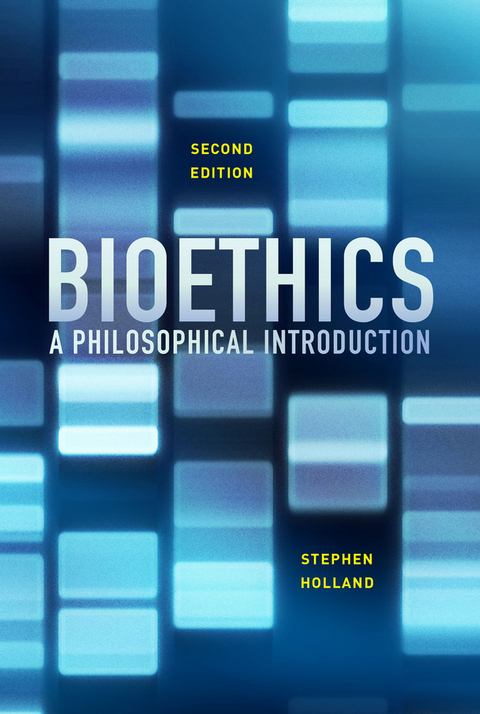
Bioethics (eBook)
John Wiley & Sons (Verlag)
978-0-7456-9063-6 (ISBN)
This book provides a clear and comprehensive introduction to contemporary bioethics. It also presents provocative, philosophically informed arguments on current bioethical issues. Holland engages with debates ranging from the more familiar - such as euthanasia, advance decisions to refuse treatment, and new reproductive technologies - to the philosophical implications of recent developments in genetics, including prenatal genetic therapy, genetic enhancement and human cloning. The book is built around four crucial themes. The first is moral status: what are the implications of the moral status of human embryos or animals for our biomedical practices? The second theme - life, death and killing - looks at the ethics of ending, or failing to lengthen, human life. Holland then explores various questions of personal identity raised in contemporary bioethical debates. Finally, he presents and develops a version of the argument from nature - which continues to be influential in bioethics - in order to make sense of the objection that some biomedical innovations are 'unnatural'. Structuring the discussions in this way creates an engaging introduction to bioethics that is an ideal textbook for students, whilst offering much to stimulate colleagues in the field.
This second edition has been thoroughly and comprehensively updated to reflect the most recent advances in bioethics, and includes an entirely new chapter on the ethical treatment of patients in the minimally conscious state.
Stephen Holland is Reader in the Departments of Philosophy and Health Sciences at the University of York.
This book provides a clear and comprehensive introduction to contemporary bioethics. It also presents provocative, philosophically informed arguments on current bioethical issues. Holland engages with debates ranging from the more familiar such as euthanasia, advance decisions to refuse treatment, and new reproductive technologies to the philosophical implications of recent developments in genetics, including prenatal genetic therapy, genetic enhancement and human cloning. The book is built around four crucial themes. The first is moral status: what are the implications of the moral status of human embryos or animals for our biomedical practices? The second theme life, death and killing looks at the ethics of ending, or failing to lengthen, human life. Holland then explores various questions of personal identity raised in contemporary bioethical debates. Finally, he presents and develops a version of the argument from nature which continues to be influential in bioethics in order to make sense of the objection that some biomedical innovations are 'unnatural'. Structuring the discussions in this way creates an engaging introduction to bioethics that is an ideal textbook for students, whilst offering much to stimulate colleagues in the field. This second edition has been thoroughly and comprehensively updated to reflect the most recent advances in bioethics, and includes an entirely new chapter on the ethical treatment of patients in the minimally conscious state.
Stephen Holland is Reader in the Departments of Philosophy and Health Sciences at the University of York.
Acknowledgements vii
Introduction 1
Part I Moral Status
Introduction to Part I 9
1 Stem Cell Therapy 11
2 Xenotransplantation 29
Part I: Concluding Remarks 48
Part II Life, Death and Killing
Introduction to Part II 53
3 The Value of Life 55
4 What is Death? 68
5 Killing versus Letting Die 85
Part II: Concluding Remarks 103
Part III Personal Identity
Introduction to Part III 107
6 Prenatal Genetic Intervention 111
7 Advance Directives 127
Part III: Concluding Remarks 147
Part IV The Normativity of the 'Natural'
Introduction to Part IV 151
8 Managing Reproduction 159
9 Genetic Enhancement 172
10 Human Cloning 191
Part IV: Concluding Remarks 203
Concluding Remark: Deontic Constraints on Biomedicine 205
References 208
Index 218
"Steven Holland?s Bioethics has become established as the best one volume introduction to philosophical bioethics. I recommend it warmly to students of philosophy and bioethics, but the general reader will also find it enjoyable and accessible. I am delighted to welcome its second edition."
Richard Ashcroft, Queen Mary University of London
"Anyone wishing to get their bearings on the fundamental philosophical questions about moral status, personal identity, life, death, killing, and appeals to nature, that underlie issues in bioethics, should start with Stephen Holland?s book. It is an excellent, balanced work that introduces bioethics in the way that it should be introduced, that is, with some philosophical depth."
John P. Lizza, Kutztown University of Pennsylvania
| Erscheint lt. Verlag | 27.12.2016 |
|---|---|
| Sprache | englisch |
| Themenwelt | Geisteswissenschaften ► Philosophie ► Allgemeines / Lexika |
| Geisteswissenschaften ► Philosophie ► Ethik | |
| Medizin / Pharmazie ► Medizinische Fachgebiete ► Medizinethik | |
| Studium ► Querschnittsbereiche ► Geschichte / Ethik der Medizin | |
| Studium ► Querschnittsbereiche ► Prävention / Gesundheitsförderung | |
| Sozialwissenschaften ► Politik / Verwaltung | |
| Sozialwissenschaften ► Soziologie | |
| Schlagworte | Ãffentlicher Gesundheitsdienst u. Gesundheitspolitik • Angewandte Ethik • Applied Ethics • Bioethics • Bioethik • ethics • Ethik • Gesundheits- u. Sozialwesen • Gesundheits- u. Sozialwesen / Recht u. Ethik • Health & Social Care • Law & Ethics in Health & Social Care • Moral Philosophy • Öffentlicher Gesundheitsdienst u. Gesundheitspolitik • Philosophie • Philosophy • Public Health Services & Policy |
| ISBN-10 | 0-7456-9063-7 / 0745690637 |
| ISBN-13 | 978-0-7456-9063-6 / 9780745690636 |
| Informationen gemäß Produktsicherheitsverordnung (GPSR) | |
| Haben Sie eine Frage zum Produkt? |
 EPUB (Adobe DRM)
Kopierschutz: Adobe-DRM
Adobe-DRM ist ein Kopierschutz, der das eBook vor Mißbrauch schützen soll. Dabei wird das eBook bereits beim Download auf Ihre persönliche Adobe-ID autorisiert. Lesen können Sie das eBook dann nur auf den Geräten, welche ebenfalls auf Ihre Adobe-ID registriert sind.
Details zum Adobe-DRM
Dateiformat: EPUB (Electronic Publication)
EPUB ist ein offener Standard für eBooks und eignet sich besonders zur Darstellung von Belletristik und Sachbüchern. Der Fließtext wird dynamisch an die Display- und Schriftgröße angepasst. Auch für mobile Lesegeräte ist EPUB daher gut geeignet.
Systemvoraussetzungen:
PC/Mac: Mit einem PC oder Mac können Sie dieses eBook lesen. Sie benötigen eine
eReader: Dieses eBook kann mit (fast) allen eBook-Readern gelesen werden. Mit dem amazon-Kindle ist es aber nicht kompatibel.
Smartphone/Tablet: Egal ob Apple oder Android, dieses eBook können Sie lesen. Sie benötigen eine
Geräteliste und zusätzliche Hinweise
Buying eBooks from abroad
For tax law reasons we can sell eBooks just within Germany and Switzerland. Regrettably we cannot fulfill eBook-orders from other countries.
aus dem Bereich


