


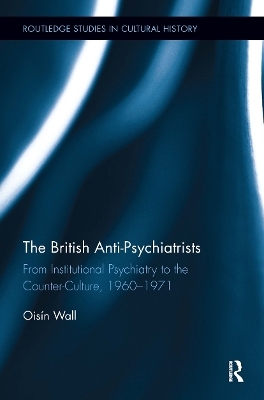
The British Anti-Psychiatrists
From Institutional Psychiatry to the Counter-Culture, 1960-1971
Seiten
2017
Routledge (Verlag)
978-1-138-04856-0 (ISBN)
Routledge (Verlag)
978-1-138-04856-0 (ISBN)
The British anti-psychiatric group, which formed around R.D. Laing, David Cooper, and Aaron Esterson in the 1960s, burned bright, but briefly, and has left a long legacy. This book follows their practical, social, and theoretical trajectory away from the structured world of institutional psychiatry and into the social chaos of the counter-culture. It explores the rapidly changing landscape of British psychiatry in the mid-Twentieth Century and the apparently structureless organisation of the part of the counter-culture that clustered around the anti-psychiatrists, including the informal power structures that it produced.
The book also problematizes this trajectory, examining how the anti-psychiatrists distanced themselves from institutional psychiatry while building links with some of the most important people in post-war psychiatry and psychoanalysis. The anti-psychiatrists bridged the gap between psychiatry and the counter-culture, and briefly became legitimate voices in both. Wall argues that their synthesis of disparate discourses was one of their strengths, but also contributed to the group’s collapse.
The British Anti-Psychiatrists offers original historical expositions of the Villa 21 experiment and the Anti-University. Finally, it proposes a new reading of anti-psychiatric theory, displacing Laing from his central position and looking at their work as an unfolding conversation within a social network.
The book also problematizes this trajectory, examining how the anti-psychiatrists distanced themselves from institutional psychiatry while building links with some of the most important people in post-war psychiatry and psychoanalysis. The anti-psychiatrists bridged the gap between psychiatry and the counter-culture, and briefly became legitimate voices in both. Wall argues that their synthesis of disparate discourses was one of their strengths, but also contributed to the group’s collapse.
The British Anti-Psychiatrists offers original historical expositions of the Villa 21 experiment and the Anti-University. Finally, it proposes a new reading of anti-psychiatric theory, displacing Laing from his central position and looking at their work as an unfolding conversation within a social network.
Oisín Wall is the Research Curator of the Medicine Galleries at the Science Museum, London.
1. Introduction: "A Vista of Broken Clocks" 2. "Psychiatry’s Third Revolution": The Therapeutic Community, Community Care, And Deinstitutionalisation 3. The Anti-Hospital and the Therapeutic Community: Two Anti-Psychiatric Communities 4. "With Co-Operation We Could All Actually Win’: Three Anti-Psychiatric Events 5. "Society is a Concentration Camp": Existential Reality and Liberation 6. "A Depersonalized, Dehumanized World": The Politics of the Family 7. Conclusion
| Erscheinungsdatum | 06.09.2017 |
|---|---|
| Reihe/Serie | Routledge Studies in Cultural History |
| Verlagsort | London |
| Sprache | englisch |
| Maße | 152 x 229 mm |
| Gewicht | 453 g |
| Themenwelt | Geschichte ► Teilgebiete der Geschichte ► Kulturgeschichte |
| Medizin / Pharmazie ► Medizinische Fachgebiete ► Psychiatrie / Psychotherapie | |
| Studium ► Querschnittsbereiche ► Geschichte / Ethik der Medizin | |
| ISBN-10 | 1-138-04856-9 / 1138048569 |
| ISBN-13 | 978-1-138-04856-0 / 9781138048560 |
| Zustand | Neuware |
| Informationen gemäß Produktsicherheitsverordnung (GPSR) | |
| Haben Sie eine Frage zum Produkt? |
Mehr entdecken
aus dem Bereich



aus dem Bereich
Die Revolution des Gemeinen Mannes
Buch | Softcover (2024)
C.H.Beck (Verlag)
CHF 16,80
Eine Geschichte des Geschmacks
Buch | Hardcover (2025)
C.H.Beck (Verlag)
CHF 49,95
vom Mittelalter bis zur Gegenwart
Buch | Softcover (2024)
C.H.Beck (Verlag)
CHF 16,80


