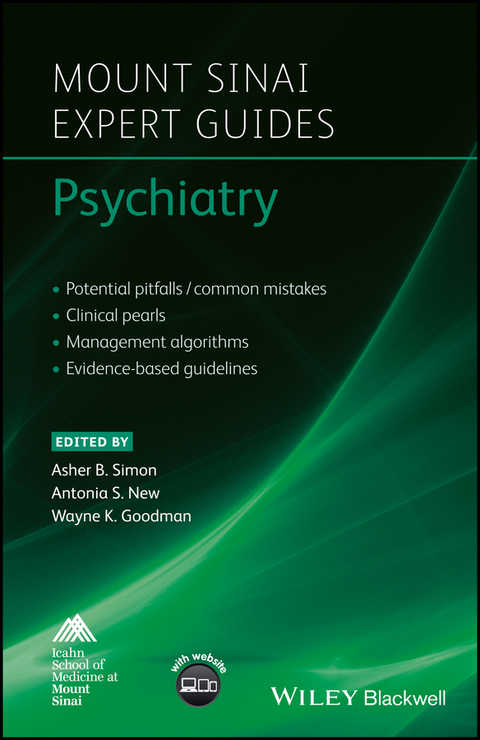
The Mount Sinai Expert Guides, published by Wiley and endorsed by Mount Sinai School of Medicine in New York, provide rapid access, point-of-care clinical information on the most common diseases in a range of different therapeutic areas. Each title focuses on a different speciality and emphasis throughout is on providing rapid-access, clear clinical guidance to aid physicians with point-of-care management of their patients.
Each title is edited by a renowned specialist from Mount Sinai, normally the Chair of the department, who is responsible for recruiting key faculty members to author the chapters. A chapter template has been developed to which each chapter author must adhere, so as to ensure complete consistency across all the chapters in each book and also across every book in the series. Accompanying each book is a companion website containing accessory materials such as case studies, video clips, MCQs, patient advice and PQRI/ICD codes.
Mount Sinai Expert Guides: Psychiatry will provide specialist trainees and recently qualified specialists in psychiatry with an extremely clinical, affordable and accessible handbook covering the specialty. It will be used as both a point-of-care resource in the hospital and clinical setting, and also as a refresher guide during preparation for board exams and re-certification.
Focused on providing 100% clinical guidance on the most common conditions that psychologists encounter, it will present the very best in expert information in an attractive, easy to navigate informative and well-structured manner, with features such as key points, potential pitfalls, management algorithms, and national/international guidelines on treatment.
Asher B. Simon, MD
Assistant Professor of Psychiatry, Associate Director of Residency Training, Department of Psychiatry, Icahn School of Medicine at Mount Sinai, New York, NY, USA
Antonia S. New, MD
Professor of Psychiatry; Vice Chair for Education; Director of Residency Training, Department of Psychiatry, Icahn School of Medicine at Mount Sinai, New York, NY, USA
Wayne K. Goodman, MD
Esther and Joseph Klingenstein Professor; Chair, Department of Psychiatry and Behavioral Health System; Professor of Neuroscience, Icahn School of Medicine at Mount Sinai, New York, NY, USA&
Series editor
Scott L. Friedman, MD
Fishberg Professor of Medicine; Dean for Therapeutic Discovery; Chief, Division of Liver Diseases, Icahn School of Medicine at Mount Sinai, New York, NY, USA
The Mount Sinai Expert Guides, published by Wiley and endorsed by Mount Sinai School of Medicine in New York, provide rapid access, point-of-care clinical information on the most common diseases in a range of different therapeutic areas. Each title focuses on a different speciality and emphasis throughout is on providing rapid-access, clear clinical guidance to aid physicians with point-of-care management of their patients. Each title is edited by a renowned specialist from Mount Sinai, normally the Chair of the department, who is responsible for recruiting key faculty members to author the chapters. A chapter template has been developed to which each chapter author must adhere, so as to ensure complete consistency across all the chapters in each book and also across every book in the series. Accompanying each book is a companion website containing accessory materials such as case studies, video clips, MCQs, patient advice and PQRI/ICD codes. Mount Sinai Expert Guides: Psychiatry will provide specialist trainees and recently qualified specialists in psychiatry with an extremely clinical, affordable and accessible handbook covering the specialty. It will be used as both a point-of-care resource in the hospital and clinical setting, and also as a refresher guide during preparation for board exams and re-certification. Focused on providing 100% clinical guidance on the most common conditions that psychologists encounter, it will present the very best in expert information in an attractive, easy to navigate informative and well-structured manner, with features such as key points, potential pitfalls, management algorithms, and national/international guidelines on treatment.
Asher B. Simon, MD Assistant Professor of Psychiatry, Associate Director of Residency Training, Department of Psychiatry, Icahn School of Medicine at Mount Sinai, New York, NY, USA Antonia S. New, MD Professor of Psychiatry; Vice Chair for Education; Director of Residency Training, Department of Psychiatry, Icahn School of Medicine at Mount Sinai, New York, NY, USA Wayne K. Goodman, MD Esther and Joseph Klingenstein Professor; Chair, Department of Psychiatry and Behavioral Health System; Professor of Neuroscience, Icahn School of Medicine at Mount Sinai, New York, NY, USA& Series editor Scott L. Friedman, MD Fishberg Professor of Medicine; Dean for Therapeutic Discovery; Chief, Division of Liver Diseases, Icahn School of Medicine at Mount Sinai, New York, NY, USA
Title Page 5
Copyright Page 6
Contents 7
Contributors 11
Series Foreword 20
Preface 21
List of Abbreviations 22
About the Companion Website 28
Part 1 Introduction 29
Chapter 1 DSM-5 31
Discussion of topic and guidelines 31
Reading list 36
Chapter 2 Research Domain Criteria (RDoC) 37
Discussion of topic and guidelines 37
Reading list 39
Chapter 3 Functional Neuroanatomy 40
Discussion of topic and guidelines 40
Reading list 45
Chapter 4 Translational Neuroscience in Clinical Psychiatry 46
Genetics of psychiatric disorders 46
Epigenetics in psychiatric disorders 47
Animal and cell based models in psychiatric disorders 48
Brain imaging and cognitive neuroscience in psychiatry 49
Future directions 50
Reading list/references 50
Chapter 5 Neuropsychological Assessment and Psychological Tests 52
Introduction 52
Neuropsychological assessment 53
Psychological assessment 54
Conclusion 55
Reading list 55
Chapter 6 Clinical Use of Laboratory Tests, Brain Imaging, and Biomarkers 56
Discussion of topic and guidelines 56
Reading list 66
Chapter 7 Neuromodulation Treatments 68
Discussion of topic and guidelines 68
Reading list 71
Chapter 8 General Principles of Psychotherapy 72
Discussion of topic and guidelines 72
Reading list 78
Chapter 9 Clinical Documentation: What to Include in the Psychiatric Record 80
Discussion of topic and guidelines 80
Reading list 84
Part 2 Adult Disorders 85
Chapter 10 Depressive Disorders 87
Background 87
Prevention 89
Diagnosis 90
Treatment 93
Special populations 99
Prognosis 99
Reading list 99
Guidelines 100
Evidence 100
Chapter 11 Bipolar Disorders 102
Background 102
Prevention 103
Diagnosis 104
Treatment 107
Special populations 112
Prognosis 113
Reading list 114
Guidelines 114
Evidence 115
Chapter 12 Anxiety Disorders 116
Background 116
Prevention 119
Diagnosis 119
Treatment 123
Special populations 126
Prognosis 128
Reading list 128
Guidelines 129
Evidence 129
Chapter 13 Trauma- and Stressor-Related Disorders 131
Background 131
Prevention 133
Diagnosis 134
Treatment 137
Special populations 138
Prognosis 138
Reading list 138
Guidelines 139
Evidence 139
Chapter 14 Obsessive-Compulsive and Related Disorders 141
Background 141
Prevention 142
Diagnosis 143
Treatment 146
Special populations 147
Prognosis 150
Reading list 150
Guidelines 151
Evidence 151
Chapter 15 Schizophrenia Spectrum and Other Psychotic Disorders 153
Background 153
Prevention 154
Diagnosis 154
Treatment 159
Special populations 162
Prognosis 162
Reading list 162
Guidelines 162
Evidence 163
Images 164
Chapter 16 Substance Use and Addictive Disorders 166
Background 166
Prevention 168
Diagnosis 168
Treatment 172
Special populations 176
Prognosis 177
Reading list/references 177
Guidelines 178
Evidence 178
Chapter 17 Personality Disorders: Assessment and Treatment 180
Background 180
Borderline personality disorder 180
Avoidant personality disorder 184
Reading list 187
Guidelines 187
Evidence (BPD) 188
Chapter 18 Psychiatric Presentations of Primary Medical Illness 189
Discussion of topic and guidelines 189
Reading list 193
Chapter 19 Neuropsychiatric Illnesses 195
Background 195
Prevention 197
Diagnosis 197
Treatment 201
Special populations 202
Prognosis 202
Reading list 202
Guidelines 203
Chapter 20 Somatic Symptom and Related Disorders, Including Illness Anxiety, Factitious, Malingering, and Conversion Disorders 204
Background 204
Prevention 206
Diagnosis 207
Treatment 210
Prognosis 211
Reading list 212
Evidence 212
Chapter 21 Sexual Dysfunctions, Gender Dysphoria, and Paraphilic Disorders 213
Background 213
Prevention 215
Diagnosis 216
Treatment 219
Special populations 222
Prognosis 223
Reading list 223
Guidelines 224
Evidence 225
Chapter 22 Eating Disorders 226
Predictive/risk factors 226
Prevention 226
Clinical diagnosis 227
Diagnosis 228
Treatment 230
Special populations 233
Prognosis 233
Reading list 233
Chapter 23 Sleep-Wake Disorders 235
Background 235
Prevention 236
Diagnosis 236
Treatment 239
Special populations 243
Prognosis 243
Reading list 243
Guidelines 244
Evidence 244
Part 3 Child/Adolescent Disorders 245
Chapter 24 Assessment of Child Development 247
Discussion of topic and guidelines 247
Reading list 252
Chapter 25 Autism Spectrum Disorder 253
Background 253
Prevention 254
Diagnosis 255
Treatment 257
Prognosis 258
Reading list 258
Guidelines 259
Evidence 259
Chapter 26 Intellectual Developmental Disorders in Children and into Adulthood 261
Background 261
Prevention 262
Diagnosis 263
Treatment 265
Special populations 268
Prognosis 268
Reading list 268
Guidelines 269
Evidence 269
Chapter 27 Child and Adolescent Anxiety Disorders 270
Background 270
Prevention 271
Diagnosis 272
Treatment 274
Prognosis 276
Reading list 277
Guidelines 277
Evidence 278
Chapter 28 Attention-Deficit/Hyperactivity Disorder 279
Background 279
Prevention 280
Diagnosis 280
Treatment 283
Special populations 286
Prognosis 286
Reading list 287
Guidelines 288
Evidence 288
Chapter 29 Child and Adolescent Disruptive, Impulse Control, and Conduct Disorders 290
Background 290
Prevention 291
Diagnosis 292
Treatment 293
Special populations 295
Prognosis 295
Reading list 295
Guidelines 296
Evidence 296
Chapter 30 Mood Disorders in Childhood and Adolescence 297
Background 297
Prevention 298
Diagnosis 299
Treatment 303
Prognosis 306
Reading list 307
Guidelines 307
Evidence 307
Chapter 31 Tics and Other Motor Disorders 309
Background 309
Prevention 310
Diagnosis 311
Treatment 313
Special populations 314
Prognosis 315
Reading list 315
Guidelines 315
Evidence 316
Part 4 Geriatric Disorders 317
Chapter 32 Dementia and Other Neurocognitive Disorders 319
Background 319
Prevention 321
Diagnosis 322
Treatment 326
Special populations 329
Prognosis 330
Reading list 330
Guidelines 331
Evidence 331
Chapter 33 Delirium 333
Background 333
Prevention 335
Diagnosis 335
Treatment 337
Prognosis 338
Reading list 338
Guidelines 339
Chapter 34 Late-Life Depression 340
Background 340
Prevention 341
Diagnosis 342
Treatment 345
Prognosis 348
Reading list 348
Guidelines 349
Evidence 349
Chapter 35 Late-Life Psychosis 350
Background 350
Prevention 351
Diagnosis 352
Treatment 354
Prognosis 356
Reading list 356
Guidelines 356
Evidence 357
Part 5 Special Topics 359
Chapter 36 Approach to the Violent, Aggressive, and Agitated Patient 361
Typology and diagnosis of aggression in the psychiatric patient 361
Primary prevention and education to reduce aggression and violence 362
Acute management of immediate threat in clinical settings 362
Chronic treatment of the agitated and aggressive patient 363
Reading list 364
Chapter 37 Approach to the Suicidal Patient 366
Reading list 370
Chapter 38 Approach to the Non-Adherent Patient 371
Discussion of topic and guidelines 371
Reading list 373
Chapter 39 Psychiatric Ethics 374
Discussion of topic and guidelines 374
Reading list 377
Chapter 40 Psychiatric Illness during Pregnancy and the Postpartum Period 378
Discussion of topic and guidelines 378
Reading list 383
Chapter 41 Resilience 384
Discussion of topic and guidelines 384
Reading list 388
Chapter 42 Emergency Psychiatry 390
Discussion of topic and guidelines 390
Reading list 395
Chapter 43 Forensic Psychiatry 396
Discussion of topic and guidelines 396
Reading list 400
Chapter 44 Global and Disaster Psychiatry 401
Discussion of topic and guidelines 401
Reading list 405
Chapter 45 Symptomatology and Psychopharmacology Across Cultures 406
Discussion of topic and guidelines 406
Reading list 410
Chapter 46 Complementary and Alternative Medicine in Psychiatry 411
Discussion of topic and guidelines 411
Reading list 415
Chapter 47 Models for Delivery of Care 416
Discussion of topic and guidelines 416
Reading list 419
Index 420
EULA 442
| Erscheint lt. Verlag | 29.11.2016 |
|---|---|
| Reihe/Serie | Mount Sinai Expert Guides | Mount Sinai Expert Guides |
| Sprache | englisch |
| Themenwelt | Medizin / Pharmazie ► Gesundheitsfachberufe |
| Medizin / Pharmazie ► Medizinische Fachgebiete ► Psychiatrie / Psychotherapie | |
| Schlagworte | ACCESS • across • algorithms • area • Clinical • Common • complications • Diagnosis • emphasize • Expert • Guides • Information • Key • Medical Science • Medicine • Medizin • Physicians • Pitfalls • pointofcare • provide • Psychiatrie • Psychiatry • Quick • Range • Scientific • Sinai • Specialist • Therapeutic • Treatment |
| ISBN-10 | 1-118-65427-7 / 1118654277 |
| ISBN-13 | 978-1-118-65427-9 / 9781118654279 |
| Informationen gemäß Produktsicherheitsverordnung (GPSR) | |
| Haben Sie eine Frage zum Produkt? |
 PDF (Adobe DRM)
Kopierschutz: Adobe-DRM
Adobe-DRM ist ein Kopierschutz, der das eBook vor Mißbrauch schützen soll. Dabei wird das eBook bereits beim Download auf Ihre persönliche Adobe-ID autorisiert. Lesen können Sie das eBook dann nur auf den Geräten, welche ebenfalls auf Ihre Adobe-ID registriert sind.
Details zum Adobe-DRM
Dateiformat: PDF (Portable Document Format)
Mit einem festen Seitenlayout eignet sich die PDF besonders für Fachbücher mit Spalten, Tabellen und Abbildungen. Eine PDF kann auf fast allen Geräten angezeigt werden, ist aber für kleine Displays (Smartphone, eReader) nur eingeschränkt geeignet.
Systemvoraussetzungen:
PC/Mac: Mit einem PC oder Mac können Sie dieses eBook lesen. Sie benötigen eine
eReader: Dieses eBook kann mit (fast) allen eBook-Readern gelesen werden. Mit dem amazon-Kindle ist es aber nicht kompatibel.
Smartphone/Tablet: Egal ob Apple oder Android, dieses eBook können Sie lesen. Sie benötigen eine
Geräteliste und zusätzliche Hinweise
Buying eBooks from abroad
For tax law reasons we can sell eBooks just within Germany and Switzerland. Regrettably we cannot fulfill eBook-orders from other countries.
aus dem Bereich