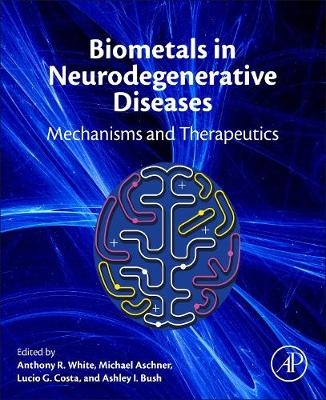
Biometals in Neurodegenerative Diseases
Academic Press Inc (Verlag)
9780128045626 (ISBN)
This book is written for academic researchers, clinicians and advanced graduate students studying or treating patients in neurodegeneration, neurochemistry, neurology and neurotoxicology. The scientific literature in this field is advancing rapidly, with approximately 300 publications per year adding to our knowledge of how biometals contribute to neurodegenerative diseases.
Despite this rapid increase in our understanding of biometals in brain disease, the fields of biomedicine and neuroscience have often overlooked this information. The need to bring the research on biometals in neurodegeneration to the forefront of biomedical research is essential in order to understand neurodegenerative disease processes and develop effective therapeutics.
Associate Professor Anthony White is a Group Leader at the QIMR Berghofer Medical Research Institute in Queensland, Australia. He is also an Honorary Principal Research Fellow at The University of Melbourne, and an Adjunct Professor in Translational Neuroscience at A.I. Virtanen Institute, University of Eastern Finland. He investigates the cellular pathology of neurodegenerative diseases, and has a strong focus on the role of biometals in neurodegenerative processes, and as novel targets for neurotherapeutics. His research has led to the development of first-in-class metal-drugs as a potential new therapeutic approach to treat motor neuron, Parkinson’s and Alzheimer’s diseases through the targeting of complementary biometal pathways in these disorders. He has published over 120 original research papers, reviews and book chapters, is Associate Editor for Neurochemistry International and co-founded a start-up biotech company (Procypra Therapeutics) that has delivered a novel copper-based metal-drug to clinical trials for motor neuron disease. He has been awarded prestigious research fellowships including National Health and Medical Research Council (NHMRC) R.D Wright Fellowship, and Senior Research Fellowship, and Australian Research Council (ARC) Future Fellowship. His research has contributed to the understanding of copper interactions with the amyloid precursor protein (APP) and amyloid beta peptide in Alzheimer’s disease, and more recently, the key role of copper in cell signaling and neuroinflammatory processes. Dr. Michael Aschner is currently the Harold and Muriel Block Chair in Molecular Pharmacology at Albert Einstein College of Medicine where he is also a Professor in the Departments of Molecular Pharmacology, Neuroscience, and Pediatrics. He is a leading expert in neurotoxicology and neurodevelopmental and neurodegenerative diseases. In addition to serving as a past president of the Society of Toxicology (2022-23), he served on numerous toxicology panels (U.S. EPA and CDC), been an expert reviewer for multiple federal agencies in the US and abroad, and is a member of the Neurotoxicology and Alcohol study section (NIH). He is a past recipient of the prestigious Society of Toxicology Merit Award (2010) and the Distinguished Neurotoxicologist Award (2020). He is a co-editor of the Elsevier series, Advancements in Neurotoxicology in addition to edited other Elsevier titles. He has published numerous articles and has served as an associate editor for multiple high impact factor journals. Dr. Lucio G. Costa is Professor of Toxicology at the University of Washington in Seattle, and of Pharmacology/Toxicology at the University of Parma Medical School. He received a doctorate in Pharmacology from the University of Milano in 1977, and was a postdoctoral fellow at the University of Texas at Houston. He is a member of several national and international professional organizations, a Fellow of the Academy of Toxicological Sciences, and a European Certified Toxicologist. He received various award for his scientific accomplishments, including the Achievement Award from the Society of Toxicology. He serves in various editorial capacities for several toxicology journals, and is an active manuscript and grant reviewer. Dr. Costa has been the member of dozens of panels and committees at the national and international level dealing with toxicology and risk assessment issues. He has chaired and/or organized symposia at scientific meetings in the United States and internationally. He has been teaching classes in the area of toxicology, neurotoxicology and pharmacology to graduate and medical students for 30 years. He keeps an active research program in the area of neurotoxicology. Dr. Bush is a Professor at the Florey Institute of Neuroscience and Mental Health in Parkville, Victoria, Australia. He is also the Director of the Oxidation Biology Unit. Dr. Bush’s laboratory looks at how key proteins interact inappropriately with metals in the brain to cause oxidative stress in diseases including Alzheimer’s and Parkinson’s. He is actively working to develop disease-modifying drugs for Alzheimer’s and Parkinson's diseases, as well as blood tests for the disorders.
1. Biometals and Alzheimer’s Disease
2. Copper in Alzheimer’s Disease
3. The Role of Selenium in Neurodegenerative Diseases
4. Does HFE Genotype Impact Macrophage Phenotype in Disease Process and Therapeutic Response?
5. Chemical Elements and Oxidative Status in Neuroinflammation
6. Metals and Neuroinflammation
7. Metals and Prions: Twenty Years of Mining the Awe
8. Manganese and Neurodegeneration
9. Zinc in Autism
10. Metals and Motor Neuron Disease
11. Metals and Lysosomal Storage Disorders
12. Developmental Exposure to Metals and its Contribution to Age-Related Neurodegeneration
13. Metal Biology Associated with Huntington’s Disease
14. Metal-Binding to Amyloid-β Peptide: Coordination, Aggregation, and Reactive Oxygen Species Production
15. Metals and Mitochondria in Neurodegeneration
16. Metal Transporters in Neurodegeneration
17. Metal Imaging in the Brain
18. Metalloregulation of Protein Clearance: New Therapeutic Avenues for Neurodegenerative Diseases
19. Metals and Autophagy in Neurotoxicity
20. An Overview of Multifunctional Metal Chelators as Potential Treatments for Neurodegenerative Diseases
21. Abnormal Function of Metalloproteins Underlies Most Neurodegenerative Diseases
| Erscheinungsdatum | 12.05.2017 |
|---|---|
| Verlagsort | San Diego |
| Sprache | englisch |
| Maße | 191 x 235 mm |
| Gewicht | 1130 g |
| Themenwelt | Medizin / Pharmazie ► Medizinische Fachgebiete ► Neurologie |
| Naturwissenschaften ► Biologie ► Humanbiologie | |
| Naturwissenschaften ► Biologie ► Zoologie | |
| ISBN-13 | 9780128045626 / 9780128045626 |
| Zustand | Neuware |
| Informationen gemäß Produktsicherheitsverordnung (GPSR) | |
| Haben Sie eine Frage zum Produkt? |
aus dem Bereich