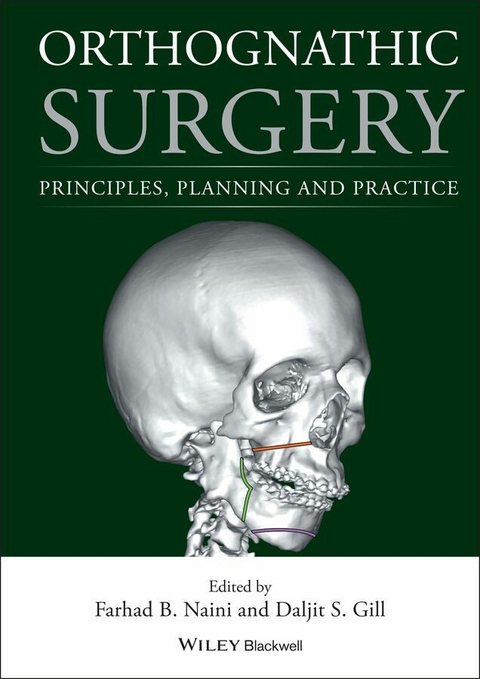
Orthognathic Surgery (eBook)
John Wiley & Sons (Verlag)
978-1-118-64996-1 (ISBN)

Orthognathic Surgery: Principles, Planning and Practice is a definitive clinical guide to orthognathic surgery, from initial diagnosis and treatment planning to surgical management and postoperative care.
- Addresses the major craniofacial anomalies and complex conditions of the jaw and face that require surgery
- Edited by two highly experienced specialists, with contributions from an international team of experts
- Enhanced by case studies, note boxes and more than 2000 clinical photographs and illustrations
- Serves as an essential reference for higher trainees and practicing clinicians in cranio-maxillofacial surgery, orthodontics, plastic and reconstructive surgery and allied specialties
Farhad B. Naini is a Consultant Orthodontist at Kingston Hospital and St George's Hospital and Medical School, London, UK. He is co-editor of Orthodontics: Principles and Practice (Wiley-Blackwell, 2011), and author of the reference text Facial Aesthetics: Concepts and Clinical Diagnosis (Wiley-Blackwell, 2011).
Daljit S. Gill is a Consultant Orthodontist at Great Ormond Street Hospital NHS Foundation Trust and UCLH Eastman Dental Hospital, London, UK. He is author of Orthodontics at a Glance (Wiley-Blackwell, 2008), co-author of Hypodontia: A Team Approach to Management (Wiley-Blackwell, 2010) and co-editor of Orthodontics: Principles and Practice (Wiley-Blackwell, 2011).
ORTHOGNATHIC SURGERY Orthognathic Surgery: Principles, Planning and Practice is a definitive clinical guide to orthognathic surgery, from initial diagnosis and treatment planning to surgical management and postoperative care. Addresses the major craniofacial anomalies and complex conditions of the jaw and face that require surgery Edited by two highly experienced specialists, with contributions from an international team of experts Enhanced by case studies, note boxes and more than 2000 clinical photographs and illustrations Serves as an essential reference for higher trainees and practicing clinicians in cranio-maxillofacial surgery, orthodontics, plastic and reconstructive surgery and allied specialties
Farhad B. Naini is a Consultant Orthodontist at Kingston Hospital and St George's Hospital and Medical School, London, UK. He is co-editor of Orthodontics: Principles and Practice (Wiley-Blackwell, 2011), and author of the reference text Facial Aesthetics: Concepts and Clinical Diagnosis (Wiley-Blackwell, 2011). Daljit S. Gill is a Consultant Orthodontist at Great Ormond Street Hospital NHS Foundation Trust and UCLH Eastman Dental Hospital, London, UK. He is author of Orthodontics at a Glance (Wiley-Blackwell, 2008), co-author of Hypodontia: A Team Approach to Management (Wiley-Blackwell, 2010) and co-editor of Orthodontics: Principles and Practice (Wiley-Blackwell, 2011).
Orthognathic Surgery 3
Contents 3
Foreword 9
Preface 21
‘Aesthetics and Function in Harmony’ 23
Acknowledgements 23
Contributors 25
1 Introduction: Orthognathic Surgery – A Lifes Work 33
Introduction 33
Historical remarks 33
How did the sagittal splitting procedure come into being? 33
Trauners inverted L-shaped osteotomy of the ramus 34
My first successful sagittal splitting of the mandibular ramus 35
My final technique for many years (Figure1-5) 35
International reaction 36
Transoral chin correction 36
The mobilization of the maxilla–itshistory 37
Operative technique for mobilization of the maxilla 38
Modifications of the procedures 38
New procedures 38
Segmental alveolar osteotomies 39
Problems of maxillary anomalies in secondary cleft deformity cases 40
The Le Fort III + I osteotomy 41
The correction of hypertelorism 43
Recurrence 48
Special instruments 49
Concluding remarks 52
Acknowledgements 52
References 52
Part I: Principles and Planning 53
2 Historical Evolution of Orthognathic Surgery 55
Introduction 55
Mandibular osteotomies 56
Mandibular body ostectomies and osteotomies 56
Surgery to the condyle and condylar neck 69
Mandibular ramus osteotomies 73
Osseous genioplasty 84
Maxillary osteotomies 86
The Le Fort I-type maxillary osteotomy 86
Segmental maxillary osteotomies 90
Blood supply to the osteotomized maxilla 95
Rigid fixation 95
Influence of craniofacial surgery 97
Psychosocial implications of facial deformities 109
Frances Cooke Macgregor 109
Katharine Phillips 111
Conclusion 111
References 111
3 Orthognathic Surgery: Preliminary Considerations 115
Definition of orthognathic surgery 115
Aetiology of dentofacial deformities 116
Nature vs. nurture 116
Classification of dentofacial deformities 117
Morphological–aetiological classification of dentofacial deformities 117
Terminology for orthognathic surgical procedures 119
Maxillary surgery (Le Fort I level osteotomy) 119
Mandibular surgery 119
Mandibular autorotation 119
Chin surgery (osseous genioplasty) 120
Prevalence of dentofacial deformities 120
Objectives of orthognathic surgery 120
1. Aesthetics 120
2. Function 120
3. Stability 121
Effectiveness of orthognathic surgery 121
Treatment need – who will benefit from orthognathic surgery? 122
Measurable criteria 122
Index of Orthodontic Treatment Need (IOTN) 122
Index of Orthognathic Functional Treatment Need (IOFTN) 123
Facial attractiveness research studies 123
Scope of orthodontic treatment and growth guidance 124
Dentofacial orthopaedics/growth guidance 124
Orthodontic camouflage 129
A specific problem – the young severe Class III patient 133
Surgical camouflage 133
References 139
4 Orthognathic Surgery: The Patient Pathway 141
Introduction 141
The orthognathic team 141
Orthognathic treatment pathway – the clinicians role 143
Sequencing of treatment and coordination of care 143
Initial referral 144
Initial consultation and interview 145
Subsequent consultation and interview 145
Joint ‘diagnosis’ clinic 145
Preoperative orthodontics 146
Joint ‘definitive planning’ clinic 146
Surgery 146
Initial postoperative period 146
Postoperative orthodontics 147
Joint ‘result check’ clinic 147
Joint ‘follow up’ clinics 147
References 147
5 Patient Evaluation and Clinical Diagnosis 148
Introduction 148
Patient interview 148
Presenting complaint 149
History of presenting complaint 150
Psychosocial history 150
Medical history 151
Suitability for orthognathic treatment 152
Clinical diagnostic records 152
Purpose of clinical records 152
Mandatory records for orthognathic surgery 152
Additional records for orthognathic surgery 154
Patient evaluation – the basics 156
Modified subunit principle 156
Planes of space and axes of rotation 156
Evaluation in repose and animation 158
Cephalometric landmarks and definitions 158
Systematic clinical evaluation 161
The diagnostic process 161
Clinical facial evaluation 164
Cephalometric analysis 186
Dental-occlusal relationship evaluation 194
Concluding remarks 200
References 200
6 Principles of Orthognathic Treatment Planning 202
Introduction 202
1. Preoperative diagnosis 203
Evaluation of principle diagnostic parameters 203
Chair side techniques to aid clinical diagnosis 203
Skeletal expansion vs. contraction and effects on the overlying soft tissues 220
2. Vectorial analysis 221
Case example 222
Lip–incisor relationship: The foundation stone of treatment planning 228
Case example 228
Sequencing the planning process 229
3. Prediction planning 231
Cephalometric prediction planning 232
Photographic ‘montage’ prediction planning 237
Photo-cephalometric prediction planning techniques 237
4. Model surgery 243
Concluding remarks 244
References 244
7 Smile Aesthetics: Specific Considerations in the Orthognathic Patient 246
Introduction 246
The alignment of the teeth 246
Sagittal position and inclination of the maxillary incisors 247
The visibility of the dentition in the vertical dimension 247
The smile line 247
The smile arc 248
The visibility of the dentition in the transverse dimension 250
The buccal corridors 250
Symmetry 251
Dental midlines 251
Maxillary cants 251
Conclusions 251
References 251
8 Orthodontic and Orthognathic Surgery Planning Using CBCT 253
Introduction 253
3D CBCT diagnosis and treatment planning 254
Tooth morphology and relative position within the alveolar bone 254
Temporomandibular joint health and disease 254
Airway assessment 254
Dentofacial deformities and craniofacial anomalies 255
Longitudinal assessments using CBCT 260
Radiation from CBCT acquisition 261
Construction of 3D surface models 261
Image registration 261
Quantitative measurements 262
Conclusions 263
References 263
9 Psychological Evaluation and Body Dysmorphic Disorder 267
Introduction 267
Prevalence of BDD 267
Definition and clinical features of BDD 268
Definition of BDD 268
Body areas of concern 268
Core BDD symptoms 268
Associated features of BDD 269
Co-occurring disorders 269
Age at onset and course of illness 269
A patient with BDD 269
Treatment of BDD 269
Cosmetic treatment 269
Psychiatric treatment 270
Assessment of patients with BDD 271
Preoperative screening interview 271
Screening questionnaires 273
How surgeons can approach patients with BDD 273
Conclusions 273
References 274
10 Patient Information Provision 277
Introduction 277
Effective communication 277
In the clinic and on the ward 277
Time management 278
Retention of information 278
Selective recall 278
Dissatisfaction with treatment 278
Information-seeking behaviour inpatients 279
Methods of information provision 279
Verbal information 279
Written information 288
Audiovisual information 291
World Wide Web 293
Conclusion 293
References 294
11 Consent and Medicolegal Considerations 295
Introduction 295
UK perspective 295
International perspective 296
Informed consent essential requirements 296
Informed consent for orthognathic surgery 297
Who may legally give consent? 297
Adults who lack capacity 298
Conclusions 300
References 300
12 Preparatory and Postoperative Orthodontics: Principles, Techniques and Mechanics 302
Introduction 302
Preoperative orthodontics 303
Types of orthodontic appliance 303
Objectives of preoperative orthodontics 305
Preparation for the preoperative ‘joint clinic’ 331
Immediate preoperative appointment 331
Intraoperative orthodontic requirements 333
Immediate postoperative appointment 334
Postoperative orthodontics 338
Working archwires 338
Kobayashi ligatures 339
Intermaxillary working elastics 339
Orthodontic ‘salvage’ 342
Space closure 342
Root ‘paralleling’ 342
Orthodontic settling and finishing 342
Retention 342
Retention protocol 343
Types of retainer 343
Concluding remarks 344
References 344
13 Model Surgery 345
Introduction 345
Definitions 345
Model surgery – principles 346
Stages of model surgery 346
Isolated mandibular surgery 346
Isolated maxillary or bimaxillary surgery 346
Model surgery – technique 347
Dental impressions, facebow record and occlusal registration 347
Transferring the maxillary model to the articulator 348
Articulating the mandibular model to the maxillary model 350
Maxillary movement 350
Mandibular movement 351
Construction of the occlusal wafer splints 352
Virtual model surgery 355
Conclusions 356
Acknowledgements 356
References 356
14 Perioperative Considerations and Anaesthesia for Orthognathic Surgery 357
Introduction 357
Preoperative assessment 357
Airway assessment 359
Medication 359
Premedication 360
Intraoperative care 360
Airway management 360
Patient positioning 361
Anaesthetic technique 362
Postoperative care 364
Antibiotics 365
Conclusions 365
References 365
15 Postoperative Care, Nutritional Support and Oral Hygiene in the Orthognathic Surgical Patient 366
Postoperative care of the orthognathic surgical patient 366
Introduction 366
Ward-based care 367
Nutritional support 369
Oral hygiene measures 370
Introduction 370
Brushing techniques for the orthognathic patient 370
Adjunctive chemotherapeutic agents 371
Conclusions 371
References 371
16 The Soft Tissue Effects of Orthognathic Surgery 373
Introduction 373
The immediate response to orthognathic surgery 374
Soft tissue changes with maxillary surgery 374
The Le Fort I osteotomy 374
Maxillary advancement 375
Maxillary superior repositioning (impaction) 375
Maxillary inferior repositioning (setdown) 376
Maxillary set-back 376
Soft tissue changes with mandibular surgery 376
Bilateral sagittal split osteotomy (BSSO) 376
Mandibular advancement 376
Mandibular set-back 377
Genioplasty 377
Conclusions 377
References 377
17 Early Orthognathic Surgery: Considerations for Surgical Management 379
Introduction 379
Diagnostic considerations 380
General considerations 380
Jaw growth considerations 380
TMJ considerations 380
Habitual considerations 380
Mandibular deformities 381
Mandibular hypoplasia/retrognathism 381
Mandibular retrognathism with TMJ disorders 383
Mandibular hyperplasia/prognathism 384
Mandibular osteotomy techniques for growing patients 387
Inverted ‘L’ osteotomy (ILO), and vertical ramus osteotomy (VRO) 387
TMJ high condylectomy 388
TMJ low condylectomy 389
Maxillary deformities 389
Maxillary anteroposterior hypoplasia 389
Maxillary anteroposterior hyperplasia 390
Maxillary vertical deformities 390
Maxillary osteotomy techniques for growing patients 390
Double jaw orthognathic surgery 391
Conclusions 391
References 392
18 Stability of Orthognathic Surgery 393
Introduction 393
The principles of stability 393
Growth 394
Physiological adaptation after surgery 394
Rigid fixation 396
Surgical planning using the hierarchy of stability 396
The UNC database 396
The hierarchy of post-surgical stability 397
Stability of Class II correction 398
Stability of Class III correction 400
Stability of early surgical treatment 401
Stability of transverse correction 402
Stability of asymmetry correction 402
Conclusion 403
Acknowledgements 403
References 403
19 Management of Select Complications in Orthognathic Surgery 405
Introduction 405
Orthodontic factors 405
(i) Poor and/or inadequate bracket placement 405
(ii) Bolton discrepancy 405
(iii) Inappropriate transverse therapy 406
(iv) Segmental vs. continuous archwire (Figure 19-4) 406
(v) Communication between the orthodontist and the surgeon 407
Maxillary surgery 407
Ramping in maxillary advancement surgery 407
Avoidance of the use of large pterygoid chisel to achieve pterygomaxillary separation 407
Serious bleeding after Le Fort I osteotomy 407
Mandibular surgery 408
Mandibular body ostectomy 408
Sagittal split ramus osteotomy (SSRO) 408
SSRO and third molars (Figure 19-9) 408
Summary of orthognathic surgery complications 409
References 409
20 Patient Satisfaction and Patient-Centred Outcome Measures in Orthognathic Surgery 410
Introduction 410
Immediate postoperative disturbances 411
Postoperative nausea and vomiting 411
Postoperative discomfort 412
Return to everyday life 413
Long-term disturbances and physical impacts 414
Complications 414
Function 415
Long-term satisfaction and perception of improvement 416
Self-confidence 416
Interpersonal support and relationships 416
Quality of life 416
Aesthetics 417
Overall satisfaction 417
Recommendations 418
Acknowledgements 418
References 418
Part II: Clinical Practice and Techniques 421
Section 1: Orthognathic Surgical Planning and Techniques 425
21 Introduction: Perspectives on Treatment Planning 426
22 Le Fort I Osteotomy and Maxillary Advancement 429
Introduction 429
History of the Le Fort I osteotomy 429
Assessment of the maxilla 430
Anatomy 431
Blood supply 431
Surgical technique 433
Submental intubation 433
Surgical technique – Le Fort I osteotomy 436
Technique 436
Design of the osteotomy 437
Nasal changes – specific considerations and minimizing undesirable changes 440
Variations of the Le Fort I osteotomy 445
Quadrilateral (quadrangular) osteotomy 445
Subspinal osteotomy 446
Complications associated with the Le Fort I osteotomy – occurrence, prevention and management 446
Haemorrhage 447
Nerve damage 448
Positioning 448
Stability 448
Non-union 448
Infection 449
Undesirable nasal changes 449
Dental problems 449
Case examples 449
References 452
23 Total Maxillary Set-Back Osteotomy 454
Introduction 454
Treatment planning 455
Surgical technique and considerations 455
General remarks 455
Case report 457
Acknowledgements 459
References 459
24 Sagittal Split Osteotomy and Mandibular Advancement 460
Introduction 460
Indications 461
Treatment planning 462
Preoperative orthodontics 462
Anteroposterior orthodontic preparation 463
Transverse orthodontic preparation 463
Vertical orthodontic preparation 463
Surgical technique 464
Third molars and mandibular osteotomies 466
Osteosynthesis 466
Complications 467
Neurosensory deficit 467
Haemorrhage 467
Unfavourable split 467
Plate breakage 467
Airway obstruction 467
Relapse 468
Fibrous union of the bone 468
Infection 468
Postoperative orthodontics 468
Case report 468
References 470
25 Mandibular Set-Back Procedures 472
Introduction 472
Clinical assessment and planning 472
Preoperative orthodontic treatment 473
Surgical techniques 474
Bilateral sagittal split set-back osteotomy versus the intraoral vertical subsigmoid osteotomy 474
Bilateral sagittal split set-back osteotomy 474
Intraoral vertical mandibular ramus osteotomy 476
Postoperative management 476
Orthodontic retention 478
Case report 478
Reference 479
26 Surgical Correction of Vertical Maxillary Excess (VME) 480
Introduction 480
Diagnosis and aetiology 480
Presenting features of VME 480
Principles in planning the surgical correction of vertical maxillary excess 485
Lower anterior face height 486
Upper lip–maxillary incisor relationship 487
Orthodontic preparation 488
Surgical technique 488
Postoperative orthodontics 490
Case examples 491
Case 1 491
Case 2 491
Alternative treatment options 491
Conclusion 494
References 494
27 Surgical Management of Vertical Maxillary Deficiency (VMD) 495
Introduction 495
Pathology 495
The idiopathic deformity 495
Cleft lip and palate 496
Syndromal 496
Post-trauma 496
Iatrogenic 497
Treatment planning 497
Idiopathic vertical maxillary deficiency 498
Cleft lip and palate 501
Syndromes 502
Post-trauma 502
Iatrogenic 503
Surgical techniques 505
Ancillary surgical techniques 508
Outcomes and complications 509
Conclusions 510
Acknowledgements 511
References 511
28 Surgical Correction of Skeletal Anterior Open Bite: Segmental Maxillary Surgery 512
Introduction 512
Development of the open bite malocclusion 512
Diagnosis 513
Treatment of growing patients 514
Treatment of skeletally mature patients 514
Orthodontic correction of anterior open bite 514
Combined orthodontic and surgical treatment 514
Vertical maxillary excess – orthodontic preparation 514
Planning the position of the interdental osteotomies 515
Surgery 516
The amount of superior repositioning of the maxilla 516
Mandibular position after autorotation (Figure 28-14) 519
Correction of transverse discrepancies 522
Open bite secondary to short mandibular ramus with a normal condyle: mandibular surgery 524
Orthodontic preparation 524
Surgery 524
Open bite secondary to a combination of vertical maxillary excess and short mandibular ramus 524
Open bite secondary to short mandibular ramus with condylar resorption 524
Idiopathic condylar resorption 524
Degenerative joint disease (osteoarthrosis) 526
Conclusions 527
References 529
29 Surgical Correction of Anterior Open Bite: Differential Posterior Maxillary Impaction 530
Introduction 530
Diagnosis and aetiology 531
Presenting features 533
Principles in planning the surgical correction of skeletal anterior open bite 539
Approximate rules of thumb to aid chair side planning 542
Orthodontic preparation 542
Incisor inclination preparation 542
Levelling of the arches 543
Maxillary occlusal plane inclination and the smile curvature 546
Transverse maxillary deficiency 546
Surgical technique 546
Postoperative orthodontics 551
Conclusion 551
References 551
30 Surgical Treatment of Anterior Open Bite with Mandibular Osteotomies 553
Introduction 553
Aetiology and description of skeletal anterior open bite 553
Treatment decisions for surgery 554
Techniques for maximizing stability when anticlockwise rotation of the mandible is used 556
References 560
31 Rotation of the Maxillomandibular Complex 562
Introduction 562
Principles of conventional treatment designs 562
Principles of rotation of the maxillomandibular complex treatment design 565
Geometry and visualization of the rotation of the maxillomandibular complex 565
Indications and treatment designs using the constructed maxillomandibular triangle 567
Control of the aesthetic treatment effect 567
Surgical compromise for orthodontic compromise 568
Orthodontic treatment considerations 568
Rotation points and direction of rotation 568
Clockwise rotation of the maxillomandibular complex 569
Centre of rotation at ANS 569
Centre of rotation at the upper incisor tip 573
Centre of rotation at Pogonion 574
Centre of rotation at points posterior to ANS (i.e. zygomatic buttress or PNS) 576
Counterclockwise rotation of the maxillomandibular complex 577
Centre of rotation at ANS 577
Centre of rotation at the zygomatic buttress 578
Centre of rotation at the PNS 578
Step-by-step development of a cephalometric surgical visual treatment objective 580
Reconciling the cephalometric prediction rotation point with the surgical rotation point 584
Stability after clockwise and counterclockwise rotation of the maxillomandibular complex 584
References 585
32 Specific Considerations in the ‘Low Angle’ Patient 587
Introduction 587
Definition 587
Aetiology and consequences 587
Common features of low angle cases 587
Other features 588
Case assessment and treatment planning 588
General 588
Clinical and cephalometric assessments for a low angle case 588
Temporomandibular joint considerations 589
Soft tissue factors and lip musculature 589
Periodontal considerations 589
Restorative considerations 590
Cephalometric assessment 590
Treatment planning 590
Prediction of surgical outcome 591
Orthodontic management 593
Sequence of treatment 593
Pre-surgical orthodontics 593
Pre-surgical planning 596
Post-surgical orthodontics 596
Retention 597
Surgical aspects 597
Adjunctive procedures 600
Rhinoplasty 600
Mandibular re-contouring 600
Implants to improve facial contours 600
Lip and submental procedures 600
Post-surgical stability and evidence of effectiveness 601
Acknowledgements 601
References 601
33 Osseous Genioplasty 603
Introduction 603
Anatomy 603
Bone 603
Muscles 603
Nerves 604
Blood supply 604
Patient evaluation 605
Clinical examination 605
Patient and procedure selection 606
Surgical technique 609
Postoperative complications 610
References 612
34 Asymmetries of the Maxilla and Mandible 613
Introduction 613
Aetiology and classification 614
Classification of maxillary asymmetry 614
Classification of mandibular asymmetry 617
Clinical evaluation 618
Principles in planning the surgical correction of maxillary and mandibular asymmetry 629
Define the location and level (i.e. facial thirds) of the asymmetry 630
Define the type and extent of the asymmetry 630
Determine which tissues are involved 631
Correct transverse cants 631
Maintain/improve exposure of maxillary incisors 631
Maintain/improve lower anterior face height (LAFH) proportion 631
Maintain/improve sagittal skeletal relationships (maxilla, mandible and chin) 631
Correct midlines (to facial midline) 631
Improve dental occlusion 632
Orthodontic preparation 632
Preoperative model surgery 632
Surgical technique 632
Postoperative orthodontics 634
Case Examples 634
Case example 1 (Figure 34-26) 634
Case example 2 (Figure 34-27) 635
Case example 3 (Figure 34-28) 636
Case example 4 (Figure 34-29) 637
Conclusion 638
References 638
35 Temporomandibular Joint Replacement Surgery in the Orthognathic Patient 640
Introduction 640
History of TMJ reconstruction 640
Alloplastic grafts 640
Autogenous grafts 641
Autogenous or alloplastic? 641
Guidelines for TMJ replacement 641
Surgical planning for TMJ reconstruction 641
Virtual planning 642
Surgical procedure 643
Orthognathic procedures 644
TMJ pathology related to the orthognathic patient 644
Condylar resorption 645
Ankylosis 645
Condylar overgrowth 645
Surgical ‘work-up’ 645
History 645
Examination 645
Investigations 645
Management 645
Case studies 646
Case 1: Idiopathic condylar resorption (ICR) 646
Case 2: Iatrogenic malocclusion 648
Case 3: Post-traumatic facial asymmetry 649
Acknowledgements 650
References 650
36 Surgically Assisted Rapid Maxillary Expansion 652
Introduction 652
Rapid maxillary expansion 653
Treatment planning – surgical options to widen the maxilla 654
Patient selection and case assessment for SARPE 655
SARPE protocol 656
Presurgical orthodontic considerations 656
Evaluation of surgical techniques for SARPE 656
General complications 657
Dental complications 657
Postoperative management and appliance activation 657
Bone-borne appliance 658
Complications 659
Evidence for stability of expansion achieved with SARPE 659
The future 659
References 660
37 Mandibular Midline Osteotomy 662
Introduction 662
Literature review 663
Techniques 664
Conclusion 666
References 666
38 Segmental Surgery of the Maxilla 667
Introduction 667
Treatment planning 668
Surgical technique 668
Segmental Le Fort I osteotomy 668
Anterior maxillary segmental osteotomy 670
Wassmund technique 670
Wunderer technique 671
Posterior maxillary segmental osteotomy 671
Case report 672
Acknowledgment 673
References 673
39 Total Subapical Mandibular Osteotomy 674
Introduction 674
History of the technique 674
Case 1 675
Case 2 676
Discussion 677
Conclusions 678
References 678
40 Endoscopy in Maxillary and Mandibular Orthognathic Surgery 679
Introduction 679
Maxillary orthognathic surgery 680
Mandibular orthognathic surgery 680
Endoscopic orthognathic surgery for the orthodontist 682
Future directions 684
References 684
41 The Role of the Orthognathic Surgeon in Facial Feminization Surgery 686
Introduction 686
Male and female faces: aesthetics 686
Surgical procedures of special interest to the orthognathic surgeon 687
Forehead reduction 688
Planning 688
Surgical procedure 689
Rhinoplasty 690
Cheek implants 690
Surgical procedure 691
Angle shave and taper 691
Planning 691
Surgical procedure 691
Genioplasty 692
Planning 692
Surgical procedure 692
Discussion 693
References 694
42 Contemporary Approach to Surgical Timing in Orthognathic Surgery: The ‘Surgery First’ Concept 695
Introduction 695
Surgery first 696
Concept 696
Inclusion criteria 697
Exclusion criteria 697
Diagnostic workup 698
Preoperative planning 698
Surgical protocol 698
Postoperative orthodontics 701
Definition of the appropriate timing for surgery 701
References 705
43 Neurosurgical Access Surgery: The Role of the Orthognathic Surgeon 707
Introduction 707
History of skull base surgery 708
Anatomy of the skull base 708
The skull base 708
Anterior skull base 708
Middle cranial fossa 709
Anatomy of the infratemporal fossa 709
Posterior skull base 709
Pathology 710
Access osteotomies 710
General techniques 711
Coronal flap 711
Calvarial bone grafts 712
Access to the anterior part of the anterior cranial base and treatment of the frontal sinus (removal of the frontal bandeau/frontal bar) 713
Access to the central compartment 713
Transmandibular approach to the central compartment 714
Access to the lateral compartments/infratemporal fossa/middle cranial fossa 716
Complications 720
Secondary correction of complications 720
References 721
44 Obstructive Sleep Apnoea Syndrome 722
Introduction 722
PCAV Risk Score Index 724
Patient risks 724
Clinical analysis 724
Anatomical measurements 725
Volumetric analysis 725
Pathophysiology 726
Treatment planning 726
Preoperative work-up 727
Choice of surgical technique in treatment planning 727
Surgical technique 728
Perioperative 728
Maxilla 728
Mandible 729
Chin 730
Closure 730
Postoperative 730
New developments 730
Case report 730
Conclusions 731
References 732
45 Mandibular Intraoral Distraction Osteogenesis 733
Introduction and history 733
Indications 733
Contraindications 733
Mandibular widening 733
Surgical technique 736
Bilateral mandibular lengthening 736
Posterior body osteotomy 736
Surgical procedure 737
Parasymphyseal osteotomy 737
Surgical procedure 737
Distraction protocol 739
Unilateral mandibular lengthening 739
Ramus lengthening procedure 739
Postoperative considerations 743
References 744
46 Maxillary Intraoral Distraction Osteogenesis 745
Introduction and history 745
Indications 746
Contraindications 746
Maxillary Le Fort I level advancement 746
Surgical technique 746
Maxillary Le Fort I level advancement in clefts 748
Surgical technique 748
Modified Le Fort III midface advancement 748
Subcranial Le Fort III midface advancement 750
Distraction protocol 750
Postoperative considerations 750
References 752
Section 2: Adjunctive Surgery 753
47 Introduction: Adjunctive Surgery 754
References 755
48 Rhinoplasty and Nasal Changes In Relation to Orthognathic Surgery 756
Introduction 756
Nasal analysis 757
Basic steps in rhinoplasty 759
Nasal function following maxillary osteotomies 761
Aesthetic changes in the nose following orthognathic surgery 761
Alar region 761
Nasal tip and supratip region 762
Nasolabial angle 763
Nasal dorsum 764
Columella 764
Nasal septum 764
Intraoperative procedures to manage nasal changes with orthognathic surgery 764
Alar base cinch suture 764
Pyriform guttering 766
ANS recontouring/subspinal osteotomy 766
V-Y closure 767
Septal trimming and septal fixation with suture 767
Secondary nasal procedures following orthognathic surgery 768
Alar soft tissue techniques 768
Septoplasty 768
Columellar retraction 768
Dorsal augmentation 768
Concluding remarks 768
References 769
49 Deep Plane Facelift 771
Anatomy 771
Preoperative evaluation 772
Assessment 772
Counselling and consent 773
Photography 773
Surgical technique 773
Anaesthesia and positioning 773
Submentoplasty 773
Skin incisions 773
Skin flap elevation 775
Superficial musculo-aponeurotic system (SMAS) flap 775
SMAS draping 776
Skin redraping 776
Skin closure 776
Dressing 777
Postoperative care 777
Complications 777
Haematoma 777
Scarring/flap necrosis 777
Alopecia 777
Facial nerve injury 778
Loss of sensation 778
Parotid injury 778
Infection 778
Submental deformities 778
Ear deformity 778
References 778
50 Soft Tissue Resuspension 779
Introduction 779
Surgical technique 779
Discussion 782
Acknowledgements 782
References 782
51 Soft Tissue Augmentation and Fat Grafting 783
Introduction 783
Fat grafting 783
Biology of fat grafting 784
Surgical technique 786
Harvesting 786
Refinement and preparation 786
Placement 786
Postoperative care 787
Complications 787
Discussion 787
Conclusions 788
References 789
52 Aesthetic Surgery of the Submental-Cervical Region 790
Introduction 790
Anatomy 790
Submental fat 790
Platysma muscle 791
Submental and cervical skin 791
Position of mandible and chin 791
Aging process 791
Surgical options and evaluation 791
Surgical procedures 792
Submental liposuction 792
Cervicoplasty 792
Genioplasty 792
Discussion 794
Conclusion 794
References 794
53 Surgical Options for Aesthetic Enhancement of the Lips and Perioral Region 795
Introduction 795
Patient assessment and communication – not everyone needs bigger lips 795
Mucosal reduction cheiloplasty procedure 796
Complications 798
Case presentations 798
Cutaneous lip reduction 800
Intraoral soft tissue surgery for excessive gingival display 805
References 806
Section 3: Orthognathic Surgery in the Cleft Patient and Orthognathic Aspects of Craniofacial Surgery 809
54 Introduction: Craniofacial Surgery 810
References 811
55 Developmental Disorders of the Craniofacial Complex 812
Introduction 812
Development of the craniofacial region 813
Embryonic development of the face 813
Embryonic development of the secondary palate 813
Oro-facial clefting 813
Epidemiology 814
Molecular genetics 815
Holoprosencephaly 816
Molecular genetics 816
Fetal alcohol syndrome 816
Ectodermal dysplasia 816
Molecular genetics 817
Pierre Robin syndrome 817
Molecular genetics 817
Hemifacial microsomia 818
Molecular genetics 818
Treacher Collins syndrome 818
Molecular genetics 818
Nager syndrome 819
Molecular genetics 819
Miller syndrome 819
Molecular genetics 819
Craniosynostoses 819
Single suture synostosis 820
Non-syndromic craniosynostosis 820
Syndromic craniosynostoses: Apert, Crouzon and Pfeiffer 820
Molecular genetics 821
Muenke syndrome 821
Molecular genetics 821
Saethre–Chotzen syndrome 821
Molecular genetics 821
Craniofrontonasal syndrome 822
Molecular genetics 822
Carpenter syndrome 1 and 2 822
Molecular genetics 822
Greig cephalopolysyndactyly syndrome 822
Molecular genetics 822
Chromosomal abnormalities causing craniosynostosis 822
Mouse models of craniosynostosis 822
Frontonasal dysplasias 1–3 822
Molecular genetics 824
Cleidocranial dysplasia 824
Molecular genetics 824
References 824
56 Orthognathic Surgery in the Patient with Cleft Lip and Palate 828
Introduction 828
Prevalence 829
Treatment planning 829
General factors 829
Medical input 830
Dental input and orthodontic retention 830
Records 832
Timing 832
Factors in planning orthognathic care 832
Surgical input (adjunctive) 833
Dental/periodontal health and tooth quality factors 833
Orthodontic factors 834
Facial features 835
Soft tissue approaches to the maxilla 836
Maxillary surgery 837
Segmental surgery 838
Maxillary horseshoe osteotomy 838
Distraction osteogenesis 838
Choice of distractor type 838
Le Fort I distraction 838
Transport distraction 839
Early mandibular distraction in Pierre Robin sequence for compromised airway 839
Management of hard palate fistulas at the time of cleft orthognathic surgery 840
Adjunctive surgery to improve facial contouring following orthognathic procedures 840
Free fat grafting to the face 840
Cleft rhinoplasty 840
Cleft lip revisions and augmentation 841
Facial implants 841
Retention and outcomes 841
Psychological input 842
Speech and language input 842
Patient input 842
Acknowledgements 843
References 843
57 Craniofacial Asymmetry: Causes and Management 845
Introduction 845
Causes and classification of craniofacial asymmetry 845
Congenital causes of asymmetry 846
Developmental causes of asymmetry 852
Acquired causes of asymmetry 853
Evaluation and assessment 855
Component facial analysis 855
Three-dimensional data acquisition and manipulation 857
Principles of symmetry reconstruction 858
Surgical armamentarium 858
Staging and timing of intervention 862
Orthodontic considerations 867
Summary 867
References 868
58 High Level Maxillofacial Osteotomies 870
Introduction 870
Indications for midfacial osteotomies 871
Preoperative assessment 872
Surgical procedures 873
References 877
59 Le Fort-based Maxillofacial Vascularized Transplantation 878
Introduction 878
Le Fort II-based allotransplantation 879
Le Fort III-based allotransplantation 879
Orthognathic planning for maxillofacial allotransplantation 879
Facial identity and cross gender transplants 881
Pre-clinical investigation in swine 881
Planning and practice 881
Conclusions 883
Disclosures 883
References 883
Section 4: Appendix 885
60 Orthognathic Surgery – One Patients Perspective 886
Introduction 886
My orthognathic surgical treatment 887
Advice on preoperative patient preparation 887
Conclusions 888
References 888
61 Responding to Patients Psychological and Social Needs Following Orthognathic Surgery 889
Introduction 889
Living with a disfiguring jaw condition 889
The cultural context 890
How do facial deformities affect patients and their families? 891
How to respond to patients needs 892
How healthcare professionals can support their patients adjusting to their different appearance 893
What does each element of FACES mean in practice? 893
The graded approach 895
The delivery of FACES in a healthcare setting 895
References 897
Index 899
EULA 933
"To my knowledge it is the most comprehensive book on the subject...master collaboration...I am just fascinated whenever I have a look into the book" Professor Hugo Obwegeser
"This well-illustrated book provides step-by-step approaches to evaluation, planning, and treatment for just about every craniofacial deformity, as well as adjunctive techniques including cosmetic surgery approaches." (Doody Enterprises 19/05/2017)
'...a jewel, a true diamond for the specialty. The presentation, the different chapters are unique, all the photographs and diagrams are fabulous. There was a need for this book for a long time...residents in Orthodontics and Maxillofacial Surgery need to be exposed to the "State of the Art" in this unique junction between the two specialties. Postgraduate students will be exposed to the principles of Orthodontics and Surgery and help patients for generations to come...ordering and sequencing was extraordinary, and inviting the Father of Orthognathic Surgery to bring his best cases and original explanations make the book a true milestone for the years to come...the greatest contribution made to Orthognathic Surgery since William Bell and Hugo Obwegeser's books.' Professor Cesar Guerrero
'A definitive tome... multi-authored by a wide range of clinicians with a huge range of expertise, and covers all aspects of orthognathic surgery... more than just another orthodontic-surgical textbook...definitely belongs in the library of all departments that undertake orthognathic surgery. It is beautifully illustrated throughout and contains numerous clinical cases...extraordinary range of the different authors, which includes not just surgeons and orthodontists but psychologists, speech and language therapists, nutritionists and even a patient!...a pleasure to read.' (Journal of Orthodontics, 44:2, 2017)
'This textbook is unique. There are 61 chapters and 95 contributing authors. The book begins with a wonderful introductory chapter on the historical background of orthognathic surgery written by the father of modern orthognathic surgery, Prof. Hugo Obwegeser. As Dr Naini is an orthodontist, he has included many chapters on pre-operative and post-operative orthodontic consideration for orthognathic surgery. The details about surgical technique are also covered in detail. This book should be added to the catalogue of must-read books for both oral and maxillofacial surgeons and orthodontists.' (Maxillofacial Plastic and Reconstructive Surgery, 39:20, 2017)
'This text addresses all aspects of orthognathic surgery. It is separated into two parts, the first on principles and treatment planning and the second on clinical practice, including meticulous instructions for surgical planning and specific techniques for an impressive number of dentofacial deformities. Each chapter contains tables, case studies, and graphs to enhance the concepts described. With contributions from a number of experts, this book will be a valuable resource for practicing oral surgeons, as well as for those clinicians and students wanting to improve their surgical skills.' (Journal of Clinical Orthodontics, 2017)
| Erscheint lt. Verlag | 14.11.2016 |
|---|---|
| Sprache | englisch |
| Themenwelt | Medizin / Pharmazie ► Allgemeines / Lexika |
| Medizin / Pharmazie ► Gesundheitsfachberufe | |
| Medizin / Pharmazie ► Zahnmedizin ► Chirurgie | |
| Schlagworte | braces • Cleft Palate • Craniofacial abnormalities • dentistry • Malocclusion • Mund-, Kiefer- u. Gesichtschirurgie • Oral & Maxillofacial Surgery • oral and maxillofacial surgery • Orthodontics • Orthodontik • orthognathic surgery • Retainers • Sleep Apnea • temporomandibular joint • Zahnmedizin |
| ISBN-10 | 1-118-64996-6 / 1118649966 |
| ISBN-13 | 978-1-118-64996-1 / 9781118649961 |
| Informationen gemäß Produktsicherheitsverordnung (GPSR) | |
| Haben Sie eine Frage zum Produkt? |
 PDF (Adobe DRM)
Kopierschutz: Adobe-DRM
Adobe-DRM ist ein Kopierschutz, der das eBook vor Mißbrauch schützen soll. Dabei wird das eBook bereits beim Download auf Ihre persönliche Adobe-ID autorisiert. Lesen können Sie das eBook dann nur auf den Geräten, welche ebenfalls auf Ihre Adobe-ID registriert sind.
Details zum Adobe-DRM
Dateiformat: PDF (Portable Document Format)
Mit einem festen Seitenlayout eignet sich die PDF besonders für Fachbücher mit Spalten, Tabellen und Abbildungen. Eine PDF kann auf fast allen Geräten angezeigt werden, ist aber für kleine Displays (Smartphone, eReader) nur eingeschränkt geeignet.
Systemvoraussetzungen:
PC/Mac: Mit einem PC oder Mac können Sie dieses eBook lesen. Sie benötigen eine
eReader: Dieses eBook kann mit (fast) allen eBook-Readern gelesen werden. Mit dem amazon-Kindle ist es aber nicht kompatibel.
Smartphone/Tablet: Egal ob Apple oder Android, dieses eBook können Sie lesen. Sie benötigen eine
Geräteliste und zusätzliche Hinweise
Buying eBooks from abroad
For tax law reasons we can sell eBooks just within Germany and Switzerland. Regrettably we cannot fulfill eBook-orders from other countries.
aus dem Bereich