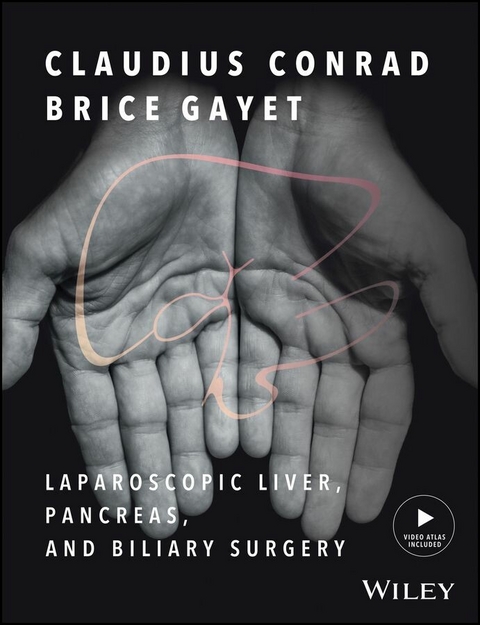
Laparoscopic Liver, Pancreas, and Biliary Surgery (eBook)
John Wiley & Sons (Verlag)
978-1-118-78115-9 (ISBN)
Laparoscopic Liver, Pancreas and Biliary Surgery: Textbook and Illustrated Video Atlas is the perfect learning tool for all surgeons managing patients requiring advanced liver, pancreas and biliary surgery minimally invasively.
This highly immersive text and video atlas will provide surgeons from trainee to advanced levels of practice, including, general surgeons, hepato-pacreatico-biliary surgeons, transplant surgeons and surgical oncologists, with a step-by-step, multi-media teaching atlas on performing laparoscopic liver surgery, anatomically correct, safely and effectively.
The atlas will teach the surgeons to perform anatomic liver resections of each liver segment expertly and logically, and will cover lobectomies, extended resections, advanced laparoscopic pancreas surgery (including Whipple) and other procedures. A special emphasis is placed on reproducibility of excellence in surgical technique.
Each video will be supported by outstanding illustrations for each technique and 3D renderings of the relevant anatomy. The educational step-by step high-definition videos teach everything you need to know, including critical aspects like patient positioning, port placement, dissection and much more.
Led by the pioneers in laparoscopic liver, pancreas and biliary surgery, Brice Gayet and Claudius Conrad, the textbook-chapters will be authored by world experts and will contain surgical tips and tricks garnered from their unique experiences, to improve care, management of complications, relevant society guidelines and excellence in oncologic care for patients with hepato-pancreato-biliary cancers.
Brice Gayet, MD, PhD, Head, Medical and Surgical Department of Digestive Diseases, Institut Mutualiste Montsouris, Paris, France.
Claudius Conrad, MD, PhD, Assistant Professor, MD Anderson Cancer Center, Department of Surgical Oncology, Houston, Texas, USA.
Laparoscopic Liver, Pancreas and Biliary Surgery: Textbook and Illustrated Video Atlas is the perfect learning tool for all surgeons managing patients requiring advanced liver, pancreas and biliary surgery minimally invasively. This highly immersive text and video atlas will provide surgeons from trainee to advanced levels of practice, including, general surgeons, hepato-pacreatico-biliary surgeons, transplant surgeons and surgical oncologists, with a step-by-step, multi-media teaching atlas on performing laparoscopic liver surgery, anatomically correct, safely and effectively. The atlas will teach the surgeons to perform anatomic liver resections of each liver segment expertly and logically, and will cover lobectomies, extended resections, advanced laparoscopic pancreas surgery (including Whipple) and other procedures. A special emphasis is placed on reproducibility of excellence in surgical technique. Each video will be supported by outstanding illustrations for each technique and 3D renderings of the relevant anatomy. The educational step-by step high-definition videos teach everything you need to know, including critical aspects like patient positioning, port placement, dissection and much more. Led by the pioneers in laparoscopic liver, pancreas and biliary surgery, Brice Gayet and Claudius Conrad, the textbook-chapters will be authored by world experts and will contain surgical tips and tricks garnered from their unique experiences, to improve care, management of complications, relevant society guidelines and excellence in oncologic care for patients with hepato-pancreato-biliary cancers.
Brice Gayet, MD, PhD, Head, Medical and Surgical Department of Digestive Diseases, Institut Mutualiste Montsouris, Paris, France. Claudius Conrad, MD, PhD, Assistant Professor, MD Anderson Cancer Center, Department of Surgical Oncology, Houston, Texas, USA.
Laparoscopic Liver, Pancreas, and Biliary Surgery 1
Contents 7
List of contributors 9
Foreword by Norihiro Kokudo 13
Foreword by Keith D. Lillemoe 14
Foreword by Jean-Nicolas Vauthey 15
Preface by Brice Gayet 17
Preface by Claudius Conrad 19
Acknowledgments 21
About the companion website 23
Part I: Textbook 25
Section 1: General considerations for advanced laparoscopic hepatopancreatobiliary surgery 27
Chapter 1: The development of minimal access hepatopancreatobiliary surgery 27
1.1 Beginnings 27
1.2 Advent of laparoscopy 29
1.3 Laparoscopic hepatopancreatobiliary (HPB) surgery 31
1.3.1 Gallbladder surgery 31
1.3.2 Bile duct surgery 32
1.3.3 Pancreatic surgery 33
1.3.3.1 Laparoscopic pancreatic enucleation 34
1.3.3.2 Laparoscopic distal pancreatectomy 34
1.3.3.3 Laparoscopic pancreaticoduodenectomy 35
1.3.3.4 Laparoscopic duodenectomy with pancreatic preservation 35
1.3.4 Laparoscopic liver surgery 36
1.4 Laparoscopic ultrasound in liver and pancreatic surgery 37
1.5 Conclusion 37
References 38
Chapter 2: Acquisition of specific laparoscopic skills for laparoscopic hepatopancreatobiliary surgery 41
2.1 Introduction 41
2.2 What skills and/or requirements are needed for laparoscopic liver and pancreatic surgery? 42
2.2.1 Surgeon's requirements 42
2.2.2 Ergonomic considerations 42
2.2.3 Port placement 43
2.2.4 Institutional requirements 44
2.2.5 Acquisition of skills 44
2.3 Conclusion 47
References 48
Chapter 3: Optimal operating room set-up and equipment used in laparoscopic hepatopancreatobiliary surgery 52
3.1 Introduction 52
3.2 Operating room set-up 52
3.2.1 Optimal equipment positioning in the operating room 53
3.2.1.1 Monitor positioning 53
3.2.1.2 Laparoscopic equipment 53
3.2.1.3 Dedicated minimally invasive surgery suite 53
3.2.2 Patient positioning 54
3.2.3 Staff positioning and fixed mounting devices 55
3.2.3.1 Operating surgeon 55
3.2.3.2 Assisting surgeon and scrub nurse 55
3.2.4 Laparoscope mounting devices 55
3.2.5 Autostatic instrument stabilizer 56
3.3 Imaging system 56
3.3.1 Standard laparoscope 56
3.3.2 Imaging for bile duct stone 57
3.3.3 Special imaging devices 58
3.4 Abdominal entry and closure 59
3.5 Energy devices 61
3.5.1 Monopolar and bipolar electrocautery 61
3.5.2 Advanced bipolar vessel sealing devices 62
3.5.3 Ultrasonic devices 62
3.5.4 Combined bipolar sealing and ultrasonic devices 62
3.5.5 Radiofrequency ablation 63
3.5.6 Argon plasma coagulation 63
3.6 Nonenergy devices 63
3.6.1 Bipolar forceps 63
3.6.2 Grasper 64
3.6.3 Retractor 64
3.6.4 Vascular clamp 65
3.6.5 Suction and irrigation 65
3.6.6 Needle holder and suture 65
3.6.7 Surgical clip 66
3.7 Endoscopic stapler 67
3.8 Tissue removal bag 67
3.9 Hemostatic agent 68
References 69
Chapter 4: Augmented reality for laparoscopic liver surgery 71
4.1 Introduction 71
4.2 Augmented reality 72
4.3 How is augmented reality achieved? 73
4.3.1 Generation of virtual data 73
4.3.2 Data alignment 74
4.3.3 Laparoscope image calibration 76
4.3.4 Instrument tracking 76
4.3.5 Image overlay 77
4.4 Application of augmented reality for laparoscopic hepatopancreatobiliary surgery 77
4.4.1 Head-mounted AR displays for laparoscopic surgery 78
4.4.2 Laparoscopic image overlay AR for structure localization 78
4.4.3 Console-integrated laparoscopic image overlay AR for robotic surgery 81
4.4.4 Image overlay projection for structure localization and port placement 81
4.5 Challenges 82
4.5.1 Organ motion and deformation 82
4.5.2 Visualization 83
4.6 The future of augmented reality for laparoscopic liver surgery 83
References 84
Chapter 5: Imaging of hepatopancreatobiliary diseases 86
5.1 Overview of available imaging modalities 86
5.1.1 Ultrasound and Doppler 86
5.1.2 Computed tomography 88
5.1.3 Magnetic resonance imaging 89
5.1.4 Nuclear medicine 90
5.2 Organ-specific imaging 94
5.2.1 Liver 94
5.2.1.1 Imaging options 94
5.2.1.2 MRI sequences, protocols, and contrast agents 94
5.2.1.3 Focal liver lesions 95
5.2.1.4 Diffuse liver disease 97
5.2.2 Biliary 98
5.2.3 Gallbladder 102
5.2.4 Pancreas 104
5.2.4.1 Cystic pancreatic lesions 104
5.2.4.2 Solid pancreatic lesions 104
References 106
Chapter 6: Role of staging laparoscopy in hepatopancreatobiliary malignancies 109
6.1 Indications for staging laparoscopy 110
6.2 Technique of staging laparoscopy 111
6.3 Extended staging laparoscopy 111
6.3.1 Lymph node biopsy 111
6.3.2 Peritoneal lavage cytology 112
6.3.3 Laparoscopic ultrasound 112
6.4 Yield of staging laparoscopy 112
6.5 Timing of staging laparoscopy: single versus two stage 113
6.6 Complications of staging laparoscopy 113
6.7 Role of staging laparoscopy in pancreatic and hepatobiliary malignancies 113
6.7.1 Pancreatic cancer 113
6.7.2 Periampullary carcinomas 115
6.7.3 Primary liver tumors: hepatocellular carcinoma 116
6.7.4 Primary liver tumors: intrahepatic cholangiocarcinoma 117
6.7.5 Metastatic liver tumors: colorectal liver metastases 117
6.7.6 Biliary tract tumor: hilar cholangiocarcinoma 118
6.7.7 Biliary tract tumor: gallbladder cancer 119
6.8 Summary and future of staging laparoscopy in pancreatic and hepatobiliary malignancies 120
References 121
Chapter 7: Interventional radiology in the management of hepatopancreatobiliary malignancy and surgical complications 124
7.1 Diagnosis 124
7.2 Interventional radiology management of postoperative complications 126
7.2.1 Catheter drainage of postoperative fluid collections 126
7.2.2 Biliary duct injury with and without biloma 129
7.2.3 Arterial injury 129
7.2.4 Portal venous hypertension 129
7.2.4.1 Prehepatic portal hypertension from portal vein obstruction 129
7.2.4.2 Portal hypertension and malignancy 130
7.3 Image-guided locoregional therapy of hepatobiliary-pancreatic malignancy 132
7.3.1 Outcomes of image-guided therapy of hepatocellular carcinoma 133
7.3.2 Outcomes of image-guided therapy of hepatic metastases 134
7.3.3 Outcomes of image-guided therapy of cholangiocarcinoma 135
7.3.4 Outcomes of image-guided therapy of pancreatic cancer 135
7.4 Palliation 136
7.4.1 Diversionary percutaneous biliary drainage for malignant occlusion 136
7.4.2 Enteral nutrition feeding options 137
7.4.3 Ascites management 138
7.5 Conclusion 139
References 139
Chapter 8: Robotic hepatopancreatic surgery 144
8.1 Introduction 144
8.2 Robotic-assisted liver surgery 145
8.2.1 Feasibility and operative outcomes 146
8.2.2 Oncological outcomes 147
8.2.3 Summary 148
8.3 Robotic-assisted pancreatic surgery 148
8.3.1 Robotic-assisted pancreaticoduodenectomy (RAPD) 150
8.3.2 Robotic-assisted distal pancreatectomy (RADP) 150
8.3.3 Robotic-assisted central pancreatectomy (RACP) 151
8.3.4 Oncological outcomes 151
8.3.5 Summary 152
8.4 Laparoscopic-assisted robotic distal pancreatectomy 152
8.4.1 Indications and contraindications 152
8.4.2 Preoperative planning 153
8.4.3 Surgery 153
8.4.3.1 Positioning 153
8.4.3.2 Incision/exposure 154
8.4.3.3 Surgical technique 154
8.4.4 Postoperative management/complications 161
8.5 Conclusion 161
References 162
Chapter 9: Enhanced recovery after hepatopancreatobiliary surgery 165
9.1 Introduction 165
9.2 Fast-track liver surgery 166
9.3 Fast-track pancreas surgery 167
References 169
Section 2: Advanced laparoscopic hepatobiliary surgery 172
Chapter 10: Relevant hepatobiliary anatomy 172
10.1 Introduction 172
10.2 Basic liver anatomy 173
10.2.1 Hepatic division 173
10.2.2 Portal vein 174
10.2.3 Hepatic vein 174
10.3 Anatomy for hemihepatectomy 178
10.3.1 Hilar vessels and hepatic vein 178
10.3.1.1 Portal vein 178
10.3.1.2 Hepatic artery 178
10.3.1.3 Bile duct 178
10.3.1.4 Hepatic vein 179
10.3.2 Pericaval ligament 180
10.3.2.1 Inferior vena cava ligament 180
10.3.2.2 Arantius' ligament 181
10.3.3 Landmarks for surgeons 182
10.3.3.1 Right hemihepatectomy 182
10.3.3.2 Left hemihepatectomy 182
10.4 Anatomy for hepatic segmentectomy 184
10.4.1 Hepatic segments 184
10.4.2 Intraoperative ultrasonography 185
10.5 Anatomy for caudate lobe resection 186
10.6 Important points 189
10.7 Conclusion 190
References 191
Chapter 11: Anesthesia for laparoscopic liver surgery 193
11.1 Introduction 193
11.2 Liver pathophysiology 193
11.2.1 Hepatic blood flow 193
11.2.2 Disease state 194
11.2.3 Changes in metabolism 194
11.2.4 Coagulation 195
11.2.5 Pathology 195
11.3 Physiology of pneumoperitoneum 195
11.3.1 Ventilatory effects 195
11.3.2 Hemodynamic changes 196
11.3.3 Central nervous system and ocular effects 196
11.3.4 Effects on hepatic physiology 197
11.4 Preoperative assessment 197
11.4.1 Cardiac evaluation 197
11.4.2 Pulmonary evaluation 197
11.4.3 Hepatic evaluation 197
11.5 Anesthetic management 198
11.5.1 Induction of anesthesia 198
11.5.2 Maintenance of anesthesia 198
11.5.3 Anesthetic techniques 198
11.5.4 Patient positioning 198
11.5.5 Intraoperative monitoring 199
11.5.6 Hemodynamic changes 199
11.5.7 Fluid management 199
11.6 Blood loss and preventive strategies 199
11.6.1 Low CVP anesthesia 200
11.6.2 Pharmacological interventions 200
11.6.3 Nonpharmacological interventions 200
11.6.4 Surgical techniques 201
11.6.4.1 Pringle maneuver 201
11.6.4.2 Total vascular exclusion 201
11.7 Complications 201
11.7.1 Trocar related 201
11.7.2 Pneumoperitoneum related 201
11.7.3 Procedure related 202
11.7.4 Positioning related 202
11.8 Postoperative recovery 202
References 204
Chapter 12: Oncological management of primary liver cancer in the era of minimal access surgery 209
12.1 Introduction 209
12.2 Hepatocellular carcinoma 209
12.2.1 Management of early-stage HCC 210
12.2.1.1 Neoadjuvant and adjuvant strategies 211
12.2.2 Management of intermediate-stage HCC 212
12.2.3 Advanced-stage HCC 212
12.2.3.1 Systemic chemotherapy 212
12.2.3.2 Molecularly targeted therapy 213
12.3 Biliary tract cancers 214
12.3.1 Resected, localized biliary tract cancers: role of adjuvant therapy 214
12.3.1.1 Adjuvant chemotherapy 215
12.3.1.2 Adjuvant radiation therapy 215
12.3.1.3 Adjuvant chemoradiation therapy 215
12.3.2 Locally advanced and metastatic biliary tract cancers 216
12.3.2.1 Radiation and chemoradiation therapy 216
12.3.2.2 Hepatic artery-based therapy 217
12.3.2.3 Chemotherapy 217
12.4 Conclusion 218
References 218
Chapter 13: Oncological management of colorectal liver metastases in the era of minimal access surgery 224
13.1 Introduction 224
13.2 Selection criteria for resection of colorectal cancer liver metastases 225
13.3 Conversion chemotherapy for unresectable colorectal cancer liver metastases 226
13.3.1 Summary: conversion chemotherapy 229
13.4 Neoadjuvant and adjuvant chemotherapy for initially resectable colorectal cancer liver metastases 229
13.4.1 Neoadjuvant chemotherapy 229
13.4.1.1 Summary: neoadjuvant therapy 230
13.4.2 Adjuvant chemotherapy 230
13.4.2.1 Summary: adjuvant therapy 231
13.5 Surgical considerations related to preoperative chemotherapy 231
13.6 Future directions 232
13.7 Conclusion 232
References 233
Chapter 14: Resection of noncolorectal liver metastases 238
14.1 Introduction 238
14.2 Neuroendocrine liver metastases 239
14.2.1 Natural history 239
14.2.2 Surgery 239
14.2.3 Laparoscopic resection 241
14.2.4 Nonresectional therapy 241
14.2.4.1 Ablation and embolization 241
14.2.4.2 Transplantation 241
14.2.4.3 Medical treatment 241
14.2.5 Summary 242
14.3 Noncolorectal, nonneuroendocrine liver metastases 242
14.3.1 Studies with multiple tumor types 242
14.3.2 Studies of specific tumor types 243
14.3.2.1 Breast 243
14.3.2.2 Gastrointestinal 243
14.3.2.3 Gynecological 245
14.3.2.4 Germ cell tumors 246
14.3.2.5 Renal cell carcinoma 246
14.3.2.6 Melanoma 246
14.3.2.7 Sarcoma 247
14.3.3 Laparoscopic resection 248
14.3.4 Patient selection for surgery 249
14.3.5 Summary 250
References 250
Chapter 15: Intraoperative laparoscopic ultrasound for laparoscopic hepatopancreatobiliary surgery 255
15.1 Introduction 255
15.2 Technical requirements for laparoscopic intraoperative ultrasonography 255
15.2.1 Intraoperative ultrasonography with contrast enhancement in liver 256
15.3 Laparoscopic ultrasonography for liver resection 257
15.3.1 Identification of hepatic and portal vessels in left lateral sectionectomy 258
15.3.2 Visualization and dissection of branches of the hepatic vein during major hepatectomy 258
15.3.3 Determination of the parenchymal transection plane in segmentectomy 259
15.3.4 Identification the tumor-bearing portal pedicles for segmentectomies 259
15.3.5 Ensuring intact vascularization in the remnant parenchyma 259
15.3.6 Visualization of the drainage of the right hepatic vein for posterosuperior segmentectomy 259
15.4 Laparoscopic ultrasonography for pancreas surgery 259
15.5 Laparoscopic ultrasonography for biliary surgery 261
References 261
Chapter 16: Minimally invasive liver surgery: indications and contraindications 262
16.1 Introduction 262
16.2 General comments 263
16.3 Aim 1: Safe 265
16.4 Aim 2: Effective 266
16.5 Aim 3: Patient centered 269
16.6 Aim 4: Efficient 270
16.7 Aim 5: Equitable 270
16.8 Aim 6: Timely 270
16.9 Conclusion 271
References 271
Chapter 17: Laparoscopy (hybrid) and hand-assisted laparoscopy in liver surgery: why, when, and how? 274
17.1 Introduction 274
17.2 The hybrid technique (laparoscopy-assisted method) 275
17.2.1 Surgical procedure 275
17.2.2 Advantages of the hybrid technique 276
17.2.3 Disadvantages of the hybrid technique 276
17.2.4 Why and when? 276
17.3 Hand-assisted laparoscopy 277
17.3.1 Surgical procedure 277
17.3.2 Advantages of HALS 278
17.3.3 Disadvantages of HALS 279
17.3.4 Why and when? 279
17.4 Conclusion 279
References 280
Chapter 18: Ablation strategies for tumors of the liver and pancreas 281
18.1 Overview of modalities 281
18.1.1 Radiofrequency ablation (RFA) 282
18.1.2 Microwave ablation 283
18.1.3 Irreversible electroporation 283
18.1.4 Cryoablation 285
18.1.5 Chemical ablation 286
18.2 Ablation of hepatocellular carcinoma 286
18.2.1 Small unresectable HCCs 287
18.2.2 Small resectable HCCs 287
18.2.3 Ablation of bulky unresectable disease 287
18.2.4 Multipolar RFA 287
18.2.5 Microwave ablation 288
18.2.6 Pre-RFA transarterial embolization 288
18.2.7 Tumor ablation as a bridge to transplant 288
18.3 Ablation of liver metastases 288
18.3.1 Colorectal cancer 288
18.3.2 Breast cancer 289
18.3.3 Neuroendocrine tumors 289
18.4 Postablation follow-up 289
18.5 Treatment approach: percutaneous, laparoscopic or open? 290
18.5.1 Percutaneous tumor ablation 290
18.5.2 Open tumor ablation 291
18.5.3 Laparoscopic tumor ablation 291
18.6 Ablation of pancreatic tumors 292
18.6.1 Thermal ablation 293
18.6.2 Irreversible electroporation 294
References 295
Chapter 19: Technical considerations for advanced laparoscopic liver resection 297
19.1 Introduction 297
19.2 General considerations 298
19.3 Operative technique 298
19.3.1 Glissonian approach 298
19.3.2 Operative technique for major liver resection 299
19.3.3 Laparoscopic segmental liver resection 299
19.3.3.1 Segment I (see Video 4) 299
19.3.3.2 Segments II and III (see Videos 2 and 3) 299
19.3.3.3 Segment IV (see Videos 5, 6, and 7) 299
19.3.3.4 Segments V and VI (see Videos 8, 9, 13, and 16) 300
19.3.3.5 Segments VII and VIII (see Videos 10, 11, 13, and 16) 300
19.4 Conclusion 301
Chapter 20: Laparoscopic left lateral sectionectomy and left hepatectomy for living donation 302
20.1 Introduction 302
20.2 Donor evaluation process 303
20.3 Surgical technique 304
20.3.1 Preparation 305
20.3.2 Access and mobilization of the left lateral section 306
20.3.3 Left pedicle preparation 306
20.3.4 Parenchymal transection 306
20.3.5 Left bile duct division 307
20.3.6 End of transection and control of the left hepatic vein 307
20.3.7 Graft harvesting 308
20.3.8 Special considerations for left living donor hepatectomy (see Video 19) 308
20.4 Postoperative care 308
20.5 Conclusion and future perspectives 309
References 310
Section 3: Advanced laparoscopic pancreas surgery 311
Chapter 21: Pancreatic anatomy in the era of extensive and less invasive surgery 311
21.1 Introduction 311
21.2 Basic vascular anatomy for pancreatectomy (see Videos 20-26) 312
21.2.1 Arterial anatomy 312
21.2.1.1 Superior mesenteric artery 312
21.2.1.2 Celiac axis 313
21.2.2 Venous anatomy 314
21.2.2.1 PV 315
21.2.2.2 SpV 315
21.2.2.3 SMV 316
21.2.3 Peripancreatic nerve plexus 316
21.2.3.1 Nerve plexus of the SMA 316
21.2.3.2 Nerve plexus of CeA and CHA 318
21.2.4 Peripancreatic nodal stations 318
21.3 Pancreatic anatomy for organ-preserving peripancreatic resection 318
21.3.1 Anatomical segmentectomy of the pancreatic head (see Video 26) 319
21.3.2 Pancreas-sparing duodenectomy 320
References 320
Chapter 22: Management of solid and cystic lesions of the pancreas 322
22.1 Introduction 322
22.2 Solid tumors of the pancreas 322
22.2.1 Management of adenocarcinoma of the pancreas 323
22.2.1.1 Risk factors 323
22.2.1.2 Presenting signs and symptoms 323
22.2.1.3 Imaging studies 323
22.2.1.4 Staging of pancreatic cancer: the emergence of "borderline resectable" disease 324
22.2.1.5 Preoperative prognostication of pancreatic adenocarcinoma 327
22.2.1.6 Adjuvant trials in pancreatic adenocarcinoma 328
22.2.1.7 Neoadjuvant trials in pancreatic adenocarcinomas 329
22.2.1.8 Approach to patients with presumed adenocarcinoma of the pancreas 330
22.2.2 Management of pancreatic neuroendocrine tumors 331
22.2.2.1 Risk factors 331
22.2.2.2 Signs and symptoms of pancreatic NETs 332
22.2.2.3 Diagnosis and staging 332
22.2.2.4 Imaging studies 332
22.2.2.5 Adjuvant therapy 333
22.2.2.6 Neoadjuvant therapy 333
22.2.3 Management of pancreatic cancer with unusual histology 334
22.3 Cystic lesions of the pancreas 335
22.3.1 Serous cystic lesions of the pancreas 335
22.3.1.1 Serous cystadenoma 335
22.3.1.2 Pancreatic pseudocyst 336
22.3.2 Mucinous cystic lesions of the pancreas 336
22.3.2.1 Mucinous cystic neoplasms 336
22.3.2.2 Intraductal papillary mucinous neoplasms 337
22.3.3 Solid pseudopapillary tumors of the pancreas 337
22.3.4 Lymphoepithelial cysts 338
22.3.5 Other primary or metastatic lesions to the pancreas 338
22.3.6 Diagnostic evaluation of cystic pancreatic lesions 339
22.3.7 Clinical management of cystic pancreatic lesions 339
References 341
Chapter 23: Laparoscopic pancreatic surgery 346
23.1 Introduction 346
23.2 Laparoscopic distal pancreatectomy 346
23.2.1 Patient selection 347
23.2.2 Technical considerations 347
23.2.3 Outcomes 349
23.2.3.1 Operative 349
23.2.3.2 Complications 349
23.2.3.3 Pathology 350
23.2.3.4 Survival 350
23.3 Pancreatic enucleation 352
23.4 Laparoscopic pancreaticoduodenectomy 353
23.5 Conclusion 358
References 358
Chapter 24: Indications and contraindications for laparoscopic pancreas surgery 361
24.1 Introduction 361
24.2 Indications, contraindications, and outcomes 363
24.2.1 Laparoscopic distal pancreatectomy (LDP) 363
24.2.2 Laparoscopic pancreas enucleation (LPE) 367
24.2.3 Laparoscopic pancreaticoduodenectomy (LPD) 367
24.2.4 Laparoscopic pancreatic necrosectomy 368
References 371
Part II: Video Atlas 373
Video and Figure Abbreviations 374
Section 1: Liver 375
Laparoscopic minor liver resection and segmentectomy 375
Video 1: Intraoperative ultrasonography for safe laparoscopic livery surgery: Video duration 9 minutes 42 seconds 375
Left lateral sectionectomy 375
Right hepatectomy 375
Segmentectomy of segment VIII 376
Posterior superior sectionectomy 376
Anatomy figures 376
Video 2: Left lateral sectionectomy: Video duration 7 minutes 17 seconds 379
Anatomy figures 382
Video 3: Left lateral sectionectomy using a laparoscopic single access device: Video duration 6 minutes 49 seconds 384
Anatomy figures 385
Video 4: Segmentectomy I with resection of inferior vena cava: Video duration 19 minutes 21 seconds 388
Anatomy figures 391
Video 5: Segmentectomy IV: Video duration 14 minutes 14 seconds 393
Anatomy figures 397
Video 6: Segmentectomy IVa: Video duration 8 minutes 33 seconds 399
Anatomy figures 403
Video 7: Segmentectomy IVb: Video duration 10 minutes 27 seconds 406
Anatomy figures 408
Video 8: Bisegmentectomy IVb and V: Video duration 9 minutes 0 seconds 410
Anatomy figures 414
Video 9: Segmentectomy VI: Video duration 9 minutes 44 seconds 416
Anatomy figures 418
Video 10: Segmentectomy VII: Video duration 8 minutes 23 seconds 420
Anatomy figures 422
Video 11: Segmentectomy VIII (transthoracic access): Video duration 6 minutes 41 seconds 424
Anatomy figures 426
Laparoscopic major liver resection 429
Video 12: Left hepatectomy: Video duration 13 minutes 24 seconds 429
Anatomy figures 432
Video 13: Right hepatectomy: Video duration 16 minutes 31 seconds 434
Anatomy figures 438
Video 14: Left trisegmentectomy with caudate lobectomy: Video duration 16 minutes 12 seconds 440
Anatomy figures 443
Video 15: Right trisegmentectomy: Video duration 19 minutes 30 seconds 446
Anatomy figures 449
Video 16: Posterior sectionectomy: Video duration 14 minutes 9 seconds 451
Anatomy figures 453
Video 17: Hilar lymphadenectomy (with right hepatectomy and caudate lobectomy for Klatskin tumor): Video duration 17 minutes 3 seconds 455
Anatomy figures 459
Video 18: Mesohepatectomy: Video duration 5 minutes 48 seconds 462
Acknowledgments 463
Anatomy figures 463
Laparoscopic living donor liver transplantation 466
Video 19: Living donor left lateral sectionectomy: Video duration 8 minutes 17 seconds 466
Anatomy figures 469
Section 2: Pancreas 471
Laparoscopic splenic resection 471
Video 20: Total splenectomy: Video duration 7 minutes 10 seconds 471
Video 21: Partial splenectomy: Video duration 8 minutes 40 seconds 473
Laparoscopic pancreas resection 475
Video 22: Pancreatic enucleation: Video duration 8 minutes 44 seconds 475
Video 23: Cystgastrostomy: Video duration 8 minutes 4 seconds 477
Video 24: Distal pancreaticosplenectomy: Video duration 11 minutes 12 seconds 479
Video 25: Spleen-preserving pancreatectomy of the body and tail: Video duration 12 minutes 56 seconds 481
Video 26: Pancreaticoduodenectomy: Video duration 20 minutes 9 seconds 484
Afterword by Beat Müller-Stich, Adrian T. Billeter, and Markus W. Büchler 489
Afterword by Pierre-Alain Clavien 491
Index 493
End User License Agreement 507
"This is a fantastic resource. It is thorough in its discussion of the pertinent anatomy and the accompanying videos help to further describe these often daunting operative approaches...Given the increasing emphasis on laparoscopy, this is a timely addition to the literature and an excellent resource for hepatobiliary surgeons." (Doody Enterprises 21/04/2017)
"This textbook is a great learning tool for surgeons interested in laparoscopic hepatopancreatobiliary (HPB) surgery. It has a unique mix of chapters and videos that are relevant to surgeons at all levels of experience in the field. The focus of the book is on what skills are needed to develop and improve laparoscopic HPB techniques. Importantly, the text stresses the need for in-depth knowledge of open HPB surgery before tackling advanced laparoscopic cases...The editors have provided helpful commentary with each chapter to alert the reader to the key messages for each selected topic. One of the highlights of the book is the online videos that provide examples of most liver, pancreas, and spleen resections. These videos include narration and schematics to demonstrate port placement. The editorial team pairs a senior HPB surgeon with a more junior HPB surgeon, creating a book with a wide audience.....This book is also useful for surgeons with some laparoscopic HPB experience who are interested in expanding theri practice...Overall, this book is worth the investment for surgeons interested in expanding their laparoscopic HPB surgery capabilities" (Journal Annals of Surgery 25th July 2017)
| Erscheint lt. Verlag | 7.11.2016 |
|---|---|
| Sprache | englisch |
| Themenwelt | Medizin / Pharmazie ► Medizinische Fachgebiete ► Chirurgie |
| Medizinische Fachgebiete ► Innere Medizin ► Hepatologie | |
| Schlagworte | Chirurgie u. chirurgische Spezialgebiete • Gastroenterologie u. Hepatologie • Gastroenterology & Hepatology • Gastrointestinal surgery • laparoscopy, liver surgery, pancreatic surgery, hepatobiliary surgery, minimally invasive surgery • Magen-Darm-Chirurgie • Medical Science • Medizin • Surgery & Surgical Specialities |
| ISBN-10 | 1-118-78115-5 / 1118781155 |
| ISBN-13 | 978-1-118-78115-9 / 9781118781159 |
| Informationen gemäß Produktsicherheitsverordnung (GPSR) | |
| Haben Sie eine Frage zum Produkt? |
 PDF (Adobe DRM)
Kopierschutz: Adobe-DRM
Adobe-DRM ist ein Kopierschutz, der das eBook vor Mißbrauch schützen soll. Dabei wird das eBook bereits beim Download auf Ihre persönliche Adobe-ID autorisiert. Lesen können Sie das eBook dann nur auf den Geräten, welche ebenfalls auf Ihre Adobe-ID registriert sind.
Details zum Adobe-DRM
Dateiformat: PDF (Portable Document Format)
Mit einem festen Seitenlayout eignet sich die PDF besonders für Fachbücher mit Spalten, Tabellen und Abbildungen. Eine PDF kann auf fast allen Geräten angezeigt werden, ist aber für kleine Displays (Smartphone, eReader) nur eingeschränkt geeignet.
Systemvoraussetzungen:
PC/Mac: Mit einem PC oder Mac können Sie dieses eBook lesen. Sie benötigen eine
eReader: Dieses eBook kann mit (fast) allen eBook-Readern gelesen werden. Mit dem amazon-Kindle ist es aber nicht kompatibel.
Smartphone/Tablet: Egal ob Apple oder Android, dieses eBook können Sie lesen. Sie benötigen eine
Geräteliste und zusätzliche Hinweise
Buying eBooks from abroad
For tax law reasons we can sell eBooks just within Germany and Switzerland. Regrettably we cannot fulfill eBook-orders from other countries.
aus dem Bereich