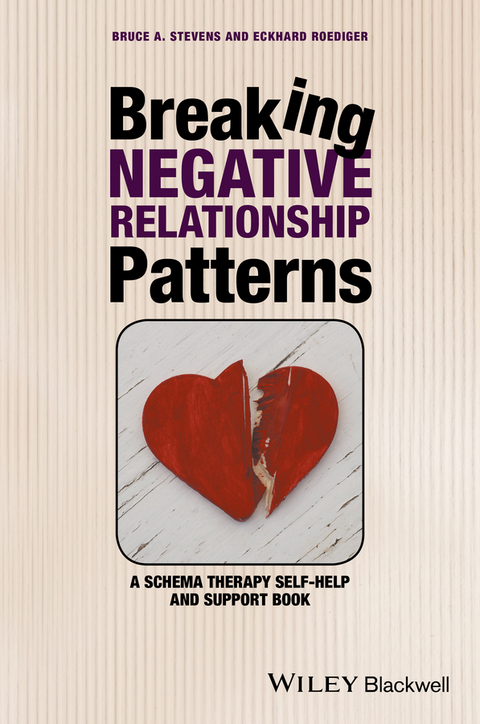
Breaking Negative Relationship Patterns (eBook)
Schema Therapy (ST) was developed to treat patients with complex disorders, especially personality disorders, with a powerful new set of interventions. Personality disorders, as well as more general problems stemming from early experience and addressed by schema therapy, are a key factor in many disturbed relationships, and as a result ST is now increasingly used for couples work. By dealing effectively with the past, ST offers a unique way to approach and address present difficulties in relationships, Couples who understand their individual patterns of thinking and behavior tend to find that their relationships make much more sense.
Breaking Negative Relationship Patterns is a readable, practical resource containing a wealth of self-help exercises that schema therapists can recommend or give to their patients. It is the ideal resource for couples undergoing schema therapy, and can also serve as an accessible self-help guide for those experiencing relationship difficulties. The authors offer a complete ST-based model for understanding complex personal problems, along with couple-specific adaptations of core ST interventions such as limited reparenting, imagery re-scripting and behavioral pattern breaking.
Bruce Stevens is Wicking Professor of Ageing and Practical Theology at Charles Sturt University. He was previously Associate Professor in Clinical Psychology at the University of Canberra, Australia, and Founder of Canberra Clinical and Forensic Psychology. He was Chair of the Canberra section of the Clinical College of the Australian Psychological Society, and gives APS-sponsored workshops on couple therapy throughout Australia.
Eckhard Roediger is a neurologist, psychiatrist and psychotherapist based in Frankfurt, Germany. He is a former chief physician of the Salus Klinik Hospital, and is currently Director of the Frankfurt Schema Therapy Institute and President of the ISST. He is author of several German language books on schema therapy.
Bruce Stevens and Eckhard Roediger are the co-authors (with Chiara Simeone-DiFrancesco) of Schema Therapy with Couples: A Practitioner's Guide to Healing Relationships (Wiley, 2015).
Schema Therapy (ST) was developed to treat patients with complex disorders, especially personality disorders, with a powerful new set of interventions. Personality disorders, as well as more general problems stemming from early experience and addressed by schema therapy, are a key factor in many disturbed relationships, and as a result ST is now increasingly used for couples work. By dealing effectively with the past, ST offers a unique way to approach and address present difficulties in relationships, Couples who understand their individual patterns of thinking and behavior tend to find that their relationships make much more sense. Breaking Negative Relationship Patterns is a readable, practical resource containing a wealth of self-help exercises that schema therapists can recommend or give to their patients. It is the ideal resource for couples undergoing schema therapy, and can also serve as an accessible self-help guide for those experiencing relationship difficulties. The authors offer a complete ST-based model for understanding complex personal problems, along with couple-specific adaptations of core ST interventions such as limited reparenting, imagery re-scripting and behavioral pattern breaking.
Bruce Stevens is Wicking Professor of Ageing and Practical Theology at Charles Sturt University. He was previously Associate Professor in Clinical Psychology at the University of Canberra, Australia, and Founder of Canberra Clinical and Forensic Psychology. He was Chair of the Canberra section of the Clinical College of the Australian Psychological Society, and gives APS-sponsored workshops on couple therapy throughout Australia. Eckhard Roediger is a neurologist, psychiatrist and psychotherapist based in Frankfurt, Germany. He is a former chief physician of the Salus Klinik Hospital, and is currently Director of the Frankfurt Schema Therapy Institute and President of the ISST. He is author of several German language books on schema therapy. Bruce Stevens and Eckhard Roediger are the co-authors (with Chiara Simeone-DiFrancesco) of Schema Therapy with Couples: A Practitioner's Guide to Healing Relationships (Wiley, 2015).
About the Authors viii
Introduction 1
1 Schema Therapy: Toward a Science of Relationships 8
2 Past Tense, Present Tense: Understanding Family Patterns 29
3 Attraction, Romance, and Schema Chemistry 40
4 Back to the Future 53
5 Modes: In the Present Tense 63
6 Mode Awareness 77
7 Managing the Modes 92
8 Past Tense: Managing the Parent Modes 99
9 The "Great Escape": Understanding the Coping Modes 112
10 Meeting the Needs of Your "Inner Child" 136
11 Mode Change 151
12 Putting "Healthy" Back in Your Adult 171
13 A Clear Path: Dealing with Conflicts, Communication, and Decision Making 191
14 Looking at Sex Through the Eyes of the Modes 211
15 Affairs 220
16 Emotional Learning 242
Epilogue 256
Index 258
Introduction
A New Start?
Why did you start reading this book? Are you just curious about how relationships work? Are you thinking in terms of preparing yourself while you’re starting a new relationship? This is probably a good idea since there are already existing marital preparation courses based on concepts like schema therapy. But maybe you’re unhappy about your relationship and are looking for some ideas to improve it. These are all good reasons to be open to fresh ideas and to develop new skills in relationships.
Research indicates that 80% of those in troubled relationships tend to separate within four or five years, without external intervention. John Gottman, the world’s leading relationships researcher, found this with more than 600 couples in his “Love Lab” in Seattle. Indeed, crisis brings risk, but also a chance for improvement and growth. And there are many crises over the course of any lasting relationship.
So you’re not alone but in very good company! We appreciate that you’re willing to do something to improve your relationship. This means paying into your relationship account. And maybe once you get started your partner will become curious and possibly involved. Improvement usually starts with the willingness of one of you. Be assured, anything you do will have some impact on your relationship. So just go ahead and start making improvements from your side. This book will give you a lot of practical advice. It doesn’t explain the whole world of relationships, but it will give you an idea why you find yourself again and again in the same life‐traps, and it shows you a way out. Isn’t that a good point to start?
Introductions
Allow us, the authors of this book, to introduce ourselves (since you’re trusting us by reading our book). Bruce Stevens is a clinical psychologist who has specialized in couples therapy for over 25 years. He’s a research professor at an Australian university. Eckhard Roediger is a neurologist, psychiatrist, and psychotherapist with two decades of clinical experience. He’s the current president of the ISST, the International Society of Schema Therapists. Both of us are advanced trainers in schema therapy and established authors.
Candidate Therapies?
If you were in a supermarket of various therapies, what would you take to the checkout? You would want the therapy you choose to make a profound difference, so it should meet the following criteria:
- Explain. The therapy will need to explain why we do what we do (including our thoughts, feelings, and behavior). A good therapy will point to the underlying causes of psychological problems.
- Childhood origins. It will find the childhood origins of adult difficulties. These are the experiences that have taught us to behave in certain ways.
- Proven effective. Therapists working from this perspective will potentially work more effectively. This will be proven by evidence from gold‐standard clinical trials.
- Practical. Such a therapy must have principles that are easy to put into practice. Interventions need to make sense, “feel relevant,” and, most importantly, be able to effect change.
- Range of effectiveness. Ideally, this therapy will be able to deal with issues that are simple and straightforward, but also make a difference to the most chronic and difficult of personal problems. It will have been road‐tested with the personality disordered, who present the greatest challenge for therapists.
- Integration. This therapy should be integrative and draw on what works from other therapies, such as mindfulness techniques, which are now widely popular.
A big ask? You might be surprised that any among the hundreds of psychological and relational therapies could meet such criteria. Happily, there’s good news. Potentially, three therapies could qualify. The best evidence of effectiveness with couples is from emotionally focused therapy for couples. This works well for most couple issues, but wasn’t designed to address difficult character problems. However, two therapies have a proven record of effectiveness with the most entrenched and difficult of personal problems. They are schema therapy and dialectical behavior therapy, but proof of effectiveness has been mostly with individuals. Besides that, John Gottman and David Schnarch are two authors who have influenced us. We have adapted schema therapy to helping couples.
We’re two of the three authors who wrote the first schema therapy book on couple relationships to guide therapists. Breaking Negative Relationship Patterns is the first schema therapy self‐help book for couples.
It’s up to You
You probably want everything that this book has to offer. In that case, you’ll have to engage with the exercises. It’s not enough to skim‐read the text, hope that a few principles will sink in and then leave the book on the shelf. You must become practically involved in the many different kinds of exercises for reflection, experience, and behavioral change. There are 90+ exercises. Choose what interests you. Some are demanding and even complex, but all are useful for getting the most out of this book. Some are adaptations of interventions routinely used by therapists who do schema therapy.
The exercises in this book generally fall into three categories:
- Reflection. You’ll be encouraged to use a journal as you read this book. This can be a locked file on a computer. Start this with a story of your life. Think of it as a psychological autobiography. You can do writing in association with visualization and changing life scripts in later chapters.
- Experiential exercises. The focus will be on trying to experience something in a different way. For example, Stuart wanted to decide whether to become a volunteer to serve overseas. He had a journal and wrote from a place of “indecision,” and then later wrote a response. He also imaginatively wrote what his deceased father might say. While this may seem artificial, it was helpful to take different perspectives, clarify the issues he faced, and try to understand what was best for him.
- Behavior change. You’ll be encouraged to try different activities. Think of these as scientific experiments. You may be asked to predict the outcome; for example, “My spouse will become angry and put me down if I ask for what I need.” This is rated in percentage terms (such as “95% likely”) and later compared with what really happened. And then you might reflect on the meaning and implication for your deeply held beliefs. This will eventually lead to behavior pattern breaking, which is described later in the book. But even if you don’t fully carry out what you had intended, it’s still a successful experiment if you manage to break through your avoidance of the issue.
All the exercises are “self‐help”. Initially, you’ll be the focus, not your partner. Usually, we prefer that our partner change first, but the greatest impact we have is on ourselves. This will enable you to make some immediate changes. You might feel better about yourself—which is a good place to begin what may be a long journey. And if you change your behavior that will have an impact on your partner.
But there’s a bitter pill right from the start: We don’t support the idea that your partner is in charge of soothing your wounds. If you don’t accept yourself, it’s not likely that anybody else will like you, either. Self‐acceptance and self‐compassion cannot be delegated to somebody else, perhaps by saying: “I hate me, but if you like me I feel better!” As in the approach of David Schnarch, our model is based on the idea of strengthening what we call the “Healthy Adult” mode within ourselves. This makes us more independent from our partners and gives each partner room to move and to grow. Healthy relationships are built on two healthy adults and not on dependency of any kind, no matter how good it might feel in the beginning. What starts as a romance might end up as a prison. This book can help you to better take care of yourself as the basis for a flourishing relationship.
To do: Are you prepared to make a contract with yourself? We suggest making a commitment to work on a practical exercise of your choice, as suggested in this book, each day for the next 90 days. We know we’re asking a lot, but that commitment will honor the importance of your relationship (actually, your happiness) and make sure that you’ll make substantial progress.
A healthy and well‐balanced intimate relationship is based on two people being emotionally grounded and balanced in themselves. Love songs usually say something different, like “I can’t live without you” or “I’ll die for you.” Both are a bit too much of a good thing, because needing your partner for your emotional balance and promising too much will both burden your relationship. You can lean in a relationship at times, but not always. To mention an important message from the very beginning: It is essential to balance your attachment need with a good deal of autonomy and assertiveness. Standing on two legs provides a good balance in a relationship. Leaning too much on the attachment leg might feel good in the beginning, but over the course of time will probably lead to...
| Erscheint lt. Verlag | 13.10.2016 |
|---|---|
| Sprache | englisch |
| Themenwelt | Sachbuch/Ratgeber |
| Geisteswissenschaften ► Psychologie ► Klinische Psychologie | |
| Medizin / Pharmazie ► Gesundheitsfachberufe | |
| Medizin / Pharmazie ► Medizinische Fachgebiete ► Psychiatrie / Psychotherapie | |
| Schlagworte | affairs • Authors • awareness • Chemistry • Clinical psychology • Decision • Emotional • Entwicklungspsychopathologie • Epilogue • Family • Future • Index • Introduction • Klinische Psychologie • Managing • Mode • modes • Patterns • present • Psychologie • Psychology • Psychotherapie • Psychotherapie u. Beratung • Psychotherapy & Counseling • Ratgeber • Ratgeber Beziehungen • relationships • Schema • Science • Self-Help • Sex • Tense • therapy |
| ISBN-13 | 9781119162810 / 9781119162810 |
| Informationen gemäß Produktsicherheitsverordnung (GPSR) | |
| Haben Sie eine Frage zum Produkt? |
 EPUB (Adobe DRM)
Kopierschutz: Adobe-DRM
Adobe-DRM ist ein Kopierschutz, der das eBook vor Mißbrauch schützen soll. Dabei wird das eBook bereits beim Download auf Ihre persönliche Adobe-ID autorisiert. Lesen können Sie das eBook dann nur auf den Geräten, welche ebenfalls auf Ihre Adobe-ID registriert sind.
Details zum Adobe-DRM
Dateiformat: EPUB (Electronic Publication)
EPUB ist ein offener Standard für eBooks und eignet sich besonders zur Darstellung von Belletristik und Sachbüchern. Der Fließtext wird dynamisch an die Display- und Schriftgröße angepasst. Auch für mobile Lesegeräte ist EPUB daher gut geeignet.
Systemvoraussetzungen:
PC/Mac: Mit einem PC oder Mac können Sie dieses eBook lesen. Sie benötigen eine
eReader: Dieses eBook kann mit (fast) allen eBook-Readern gelesen werden. Mit dem amazon-Kindle ist es aber nicht kompatibel.
Smartphone/Tablet: Egal ob Apple oder Android, dieses eBook können Sie lesen. Sie benötigen eine
Geräteliste und zusätzliche Hinweise
Buying eBooks from abroad
For tax law reasons we can sell eBooks just within Germany and Switzerland. Regrettably we cannot fulfill eBook-orders from other countries.
aus dem Bereich