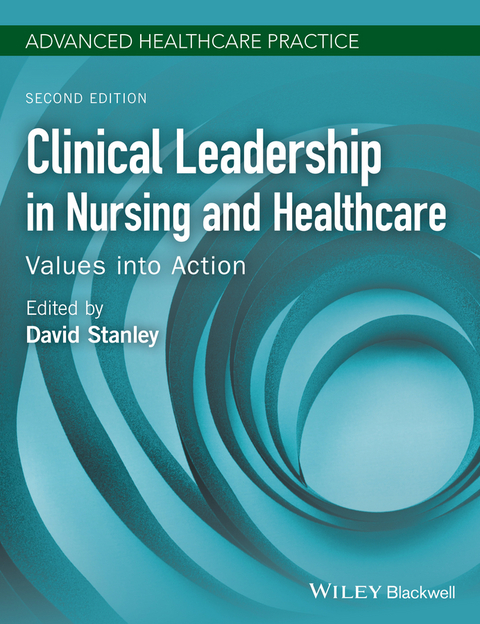
Clinical Leadership in Nursing and Healthcare (eBook)
John Wiley & Sons (Verlag)
978-1-119-25377-8 (ISBN)
Clinical leadership, along with values-based care and compassion, are critical in supporting the development of high quality healthcare service and delivery. Clinical Leadership in Nursing and Healthcare: Values into Action offers a range of tools and topics that support and foster clinically focused nurses and other healthcare professionals to develop their leadership potential.
The new edition has been updated in light of recent key changes in health service approaches to care and values. Divided into three parts, it offers information on the attributes of clinical leaders, as well as the tools healthcare students and staff can use to develop their leadership potential. It also outlines a number of principles, frameworks and topics that support nurses and healthcare professionals to develop and deliver effective clinical care as clinical leaders. Covering a wide spectrum of practical topics, Clinical Leadership in Nursing and Healthcare includes information on:
- Theories of leadership and management
- Organisational culture
- Gender
- Generational issues and leaders
- Project management
- Quality initiatives
- Working in teams
- Managing change
- Effective clinical decision making
- How to network and delegate
- How to deal with conflict
- Implementing evidence-based practice
Each chapter also has a range of reflective questions and self-assessments to help consolidate learning. Itis invaluable reading for all nursing and healthcare professionals, as well as students and those newly qualified.
David Stanley is Associate Professor in the School of Nursing, Midwifery and Indigenous Health, Charles Sturt University, Australia.
Clinical leadership, along with values-based care and compassion, are critical in supporting the development of high quality healthcare service and delivery. Clinical Leadership in Nursing and Healthcare: Values into Action offers a range of tools and topics that support and foster clinically focused nurses and other healthcare professionals to develop their leadership potential. The new edition has been updated in light of recent key changes in health service approaches to care and values. Divided into three parts, it offers information on the attributes of clinical leaders, as well as the tools healthcare students and staff can use to develop their leadership potential. It also outlines a number of principles, frameworks and topics that support nurses and healthcare professionals to develop and deliver effective clinical care as clinical leaders. Covering a wide spectrum of practical topics, Clinical Leadership in Nursing and Healthcare includes information on: Theories of leadership and management Organisational culture Gender Generational issues and leaders Project management Quality initiatives Working in teams Managing change Effective clinical decision making How to network and delegate How to deal with conflict Implementing evidence-based practice Each chapter also has a range of reflective questions and self-assessments to help consolidate learning. Itis invaluable reading for all nursing and healthcare professionals, as well as students and those newly qualified.
David Stanley is Associate Professor in the School of Nursing, Midwifery and Indigenous Health, Charles Sturt University, Australia.
Title Page 5
Copyright Page 6
Contents 9
Notes on Contributors 21
Foreword 25
Preface 27
Acknowledgements 29
Part I Clinical Leaders: Role Models for Values into Action 31
1 Clinical Leadership Explored 35
Introduction 35
Clinical Leadership: What Do We Know? 35
Attributes Less Likely to be Seen in Clinical Leaders 37
Not Controlling 37
Not Visionary 38
Not Shapers 39
Attributes More Likely to be Seen in Clinical Leaders 40
Clinical Competence/Clinical Knowledge 41
Approachability 41
Empowered/Motivator or Motivated 41
Supportiveness 42
Inspires Confidence 42
Integrity/Honesty 42
Role Model 42
Effective Communicator 42
Visible in Practice 43
Copes Well with Change 44
Other Attributes 44
Values: The Glue that Binds 44
Who are the Clinical Leaders? 45
Clinical Leadership Defined 47
Why Clinical Leadership Now? 48
A New Agenda 48
Changing Care Contexts 48
Change Equates to more Leadership 48
More Emphasis on Quality 49
Summary 50
Mind Press-ups 51
References 51
2 Leadership Theories and Styles 55
Introduction: Leadership – What Does It All Mean? 55
Leadership Defined: The Blind Man’s Elephant 57
No One Way 59
Leadership Theories and Styles 59
The Great Man Theory: Born to Lead? 59
The Big Bang Theory: From Great Events, Great People Come 60
Trait Theory: The Man, not the Game 60
Style Theory: It’s How You Play the Game 62
Situational or Contingency Theory: It’s about Relationships 64
Transformational Theory: Making Change Happen 65
Transactional Theory: Running a Tight Ship 67
Authentic/Breakthrough Leadership: True to Your Values 67
Servant Leadership: A Follower at the Front 68
The Right Leader at the Right Time 69
Summary 71
Mind Press-ups 72
References 72
3 Followership 77
Introduction: From Behind They Lead 77
Defining Followership 77
Followers’ Responsibilities 78
The Good Follower 82
The Not-So-Good Follower 83
Summary 86
Mind press-ups 86
References 87
4 Congruent Leadership 89
Introduction: A New Theory 89
Congruent Leadership: A Beginning 90
It all Started with Clinical Leadership 90
Congruent Leadership Theory Explored 99
A Solid Foundation 101
The Strengths of Congruent Leadership 104
Grassroots leaders 104
Foundation for Other Theories 105
Strong Link between Values and Actions 105
Supports Further Understanding of Clinical Leadership 106
Anyone can be a Congruent Leader 107
The Limitations of Congruent Leadership 107
New Theory 107
Similar to Authentic Leadership and Breakthrough Leadership 107
Not Driven by a Focus on Change 107
Not Suitable for Leaders with ‘Control’ as an Objective 108
Congruent Leadership, Change and Innovation 108
Congruent Leadership and Power 109
Congruent Leadership and Quality 111
Summary 115
Mind Press-ups 116
References 116
5 Leadership and Management 121
Introduction: Necessary and Essential 121
Misunderstood 122
A House Divided Cannot Stand 123
Leadership and Management: Apples and Pears? 125
Leadership and Management: Snakes and Ladders? 126
Leadership and Management: Heart and Head? 128
A Culture Shift 130
Summary 132
Mind press-ups 132
References 133
Part II Clinical Leadership Tools: How to Influence Quality, Innovation and Change 137
6 Organisational Culture, Clinical Leadership and Congruent Leadership 139
Introduction: Values First 139
What is Organisational Culture? 139
A Culture of Care and Compassion 141
Culture and Leadership 143
How Congruent Leaders Shape Culture 144
Clinical Leadership, Education and Training 148
Summary 150
Mind Press-ups 151
References 151
7 Managing Change 155
Introduction: Tools for Change 155
All Change 156
Approaches to Change 158
SWOT Analysis 158
Stakeholder Analysis 159
Pettigrew’s Model 160
The Change Management Iceberg 161
PEST or STEP 162
Kotter’s eight-stage change process 162
Nominal Group Technique 163
Process Re-Engineering 164
Force-Field Analysis 164
Restraining forces 165
Driving or facilitating forces 165
How Do You Find Either Restraining or Facilitating Forces? 165
Other Approaches 167
Initiating, Envisioning, Playing, Sustaining: A Theoretical Synthesis for Change 167
Seven S-Action Words Model for Organisational Change 167
Beckhard and Harris’s Change Equation 168
People-Mover Change Model: Effectively Transforming an Organisation 168
Instituting Organisational Change: An Examination of Environmental Influences 168
Change is Never Simple, Even with a Model 168
Resistance to Change 169
Self-Interest and Conflicting Agendas 169
Increased Stress 169
Uncertainty 170
Diverging Points of View 170
Ownership 170
Recognising the Drivers 171
Some People Just do not Like Change 171
Recognising Denial and Allowing Time for Reflection 171
Successfully Dealing with Change 171
Summary 175
Mind Press-ups 175
References 176
8 Clinical Decision Making 179
Introduction: A Choice 179
Why do We have to make Decisions? 179
What is a Decision? 180
Accountability 180
Terms 181
Decision-Making Approaches 181
Theories of Clinical Decision Making 185
Intuitive-Humanistic Model 186
Systematic-Positivist, Hypothetico-Deductive and Technical Rational Models 187
Integrated Patient-Centred Model 187
IDEALS Model 187
Managerial Decision-Making Process 188
Clinical Leadership and Decisions 188
Why Decisions Go Wrong 189
Not Using the Decision-Making Framework 189
Flawed Data 189
Bias 189
Seeking to Avoid Conflict or Change 189
Ignorance 189
Hindsight Bias 190
Availability Heuristics 190
Over-Confidence in Knowledge 190
Haste 190
Group Decision Making 190
Advantages of Group Decisions 191
Disadvantages of Group Decisions 191
Characteristics of Effective Decision Makers 191
Summary 193
Mind Press-ups 194
References 194
9 Creativity 197
Introduction: A New Way Forward 197
What is Creativity? 197
Building Creative Capacity 200
Techniques for Developing Creativity 200
Relax 200
Keep a Notebook or Journal 201
Journaling 201
Record Your Ideas 201
Do or Learn Something New Each Day 201
Learn to Draw 201
Become a Cartoonist 201
Learn to Map Your Mind 201
Try Associational Thinking 202
Go for a Walk 202
Adopt a Genius 202
Open a Dictionary 202
Study Books About Creative Thinking 202
Flood Yourself with Information 202
Attend Courses 202
Listen to Baroque Music 202
Face a New Fear Every Day 202
Develop Your Imagination 203
Leave Things Alone for a While 203
Find a Creative Space 203
Develop Your Sense of Humour 204
Define Your Problem 204
Know Yourself Well 204
Use Guided Reflection 204
Be Mindful 204
Focus 204
Do not be Afraid to Fail 204
Develop Some Techniques for Creative Thinking 204
Barriers to Creativity 205
Organisational Barriers 205
Competition 205
Organisational Structure 206
Being Too Busy to Address a Problem 206
Too Hectic an Environment 206
A Sterile Environment 206
Poor or Harsh Feedback 206
Rules 206
Unrealistic Production Demands 207
The Boss is Always Right 207
Poor Communication 207
Personal Barriers 207
Fear of Criticism 207
Our Belief that we are Not Creative 207
Fear of Change 207
Ego 207
Beliefs 208
Lack of Confidence 208
Stress 208
Previous Negative Experiences with Risk 208
Negative Self-Talk 208
Routines 208
Other Barriers 208
Daily Distractions 208
Not Having a Place to go or Time to Get There 209
Drugs 209
Leadership and Creativity 209
Summary 212
Mind Press-ups 212
References 212
10 Team Working 215
Introduction: Effective Teams 215
Healthcare Teams 216
Do We Really Need Teams? 217
Teams and groups 218
Established Teams 219
High-Performance Teams 219
Ok or Functional Teams 220
Struggling Teams 220
Creating Powerful Teams 221
Support and Challenge 222
Team Building 223
The Value of Team Work 223
Team Roles 224
Leadership and Teams 225
Self-Led Teams: The New Management 227
Summary 228
Mind Press-ups 229
References 229
11 Networking and Delegation 233
Introduction: Strength in Numbers 233
Networking 233
The Skills of Networking 234
Get Yourself Known 234
Volunteer 234
Join a Professional Organisation 235
Look Beyond Your Own Organisation 235
Be Professionally Committed and have Clear Messages 235
Join Professional Discussion Groups 235
Use the Internet 235
Engage with Professional Development 235
Go to Conferences 235
Mentor Others or be Mentored 236
Travel (for Professional Reasons) 236
Develop a Clinical Supervision Process 236
Expand Your Informal ‘Coffee’ Network 236
Publish 236
Other Ideas 236
Networking through Social Media 237
Networking Tips 237
Delegation 238
Effective Delegation 238
Common Mistakes in Delegation 240
Under-Delegation 240
Over-Delegation 240
Inappropriate Delegation 240
Failing to Provide Sufficient Supervision 240
Resistance to Delegation 240
Delegation and Clinical Leadership 241
Summary 243
Mind Press-ups 243
References 244
12 Dealing with conflict 245
Introduction: Collaboration or clash 245
Past conflict 246
Conflict Styles 246
Conflict at Work 250
Conflict Resolution 250
Responding to Conflict 251
Conflict management and clinical leaders 253
Building Bridges: Negotiation and Mediation 253
Pre-negotiation phase 254
Negotiation phase 254
Post-negotiation phase 254
Non-productive Behaviour 255
Negativity 255
Being Talkative 255
Attention Seeking 255
Arrogance 255
Arguing 256
Withdrawing 256
Aggression 256
Complaining 256
Active Listening 256
Self-talk 257
I-messages 259
Benefits of Conflict Management 259
Summary 261
Mind Press-ups 261
References 262
13 Motivation and Inspiration 265
Introduction: Inspiring Others 265
What is Motivation? 265
Models and Theories of Motivation 266
Maslow’s Hierarchy of Needs 266
Expectancy Theory 266
Job Characteristics Model 267
How to Motivate Others 268
Signs that People are Demotivated 270
The Motivational Power of Failure 270
Inspiration 272
Summary 274
Mind Press-ups 274
References 275
14 Creating a Spirit of Enquiry 277
Introduction: Is the Spirit with you? 277
Two Keys 277
Evidence-based Practice 278
Scurvy: A Word of Warning about Evidence 279
How to Create a Spirit of Enquiry 280
Role Modelling 281
Mentorship 281
Understanding the Value of a Nexus 281
Encouraging Quality Improvement Initiatives 281
Fostering Innovation 281
Rewards 281
Professional Development (PD) Opportunities 281
Being Involved 282
Collaboration 282
Journal Clubs/Engagement 282
Making it Relevant to Practice 282
Benefits of Evidence-based Practice and a Spirit of Enquiry for Nurses and Health Professionals 282
Barriers to the Development of a Spirit of Enquiry and the Use of Evidence-based Practice 283
Applying Evidence-based Practice 284
Strategies for Breaching the Evidence/Practice Nexus 284
Diffusion: A Simple Form of Nexus Development 286
Dissemination: More Involved with Wider Nexus Results 286
Implementation: Key Nexus Activity Integration 286
What can Clinical Leaders do to Promote Evidence-based Practice and a Spirit of Enquiry? 288
Summary 290
Mind Press-ups 291
References 291
15 Reflection and Emotional Intelligence 295
Introduction: The Noblest Way to Wisdom 295
What is Reflection? 295
Reflection and Learning 296
Benefits of Reflection for Clinical Leaders 296
Better Self-knowledge 296
Identification of Your Values 296
Connection to Caring 297
Empowerment 297
Learning from Mistakes 297
Models to Support Reflection 297
Using Reflective Models 297
Approaches to Reflection 298
What is Emotional Intelligence? 298
The Five Building Blocks of Emotional Intelligence 299
Reflection on Reflection and Emotional Intelligence 300
Summary 302
Mind Press-ups 302
References 303
16 Quality Initiatives and Project Management 305
Introduction: Influencing Change at a Local Level 305
The Quality Improvement Process 305
Opportunities and Challenges for Quality Initiatives 306
Quality Initiative Stories 307
Project Management 309
Project Management Explored 310
What is a Project? 310
What is Project Management? 310
What is the Role of a Project Manager? 311
How is Project Management Structured? 311
Phase 1: The Initial Phase 312
Project Management Team 312
Time, Money and Scope 312
Charter 312
Scope Statement 312
Phase 2: The Intermediate Phase 313
Planning the Project 313
Baseline 313
Progress or Executing the Project 313
Acceptance or Controlling the Project 314
Phase 3: The Final Phase 314
Closure of the Project 314
Key Issues 314
The Components of Project Management 314
Final Project Management Issues 315
Implications for Clinical Leaders 315
Summary 316
Mind Press-ups 316
References 317
Part III Clinical Leadership Issues: The Context of Values in Action 319
17 Gender, Generational Groups and Leadership 321
Introduction: The Impact of Gender and Generations 321
Is there a Difference? 321
The Case for a Difference 321
The Case for no Difference 322
Challenges for Women in Leadership 323
The Causes of Gender Differences in Leadership 324
Personal Differences 324
Professional Differences 324
Potential Barriers that Female Leaders Face 325
Recommendations to Address Gender Differences 326
Gender and Congruent Leadership 328
Generational Differences and Leadership 328
Veterans 329
Baby Boomers 329
Generation X 329
Generation Y 329
Generation Z 330
Summary 332
Mind Press-ups 333
References 333
18 Power, Politics and Leadership 339
Introduction: Power and Politics 339
A Beginning 339
Professional Power 340
Power Base 340
Influencing Styles 342
Critical Social Theory 343
Healthcare and Politics 346
Practical Politics 347
Dealing with the Media 347
Becoming Politically Active 348
It’s How You Use It! 349
Summary 351
Mind Press-ups 351
References 351
19 Empowerment and Oppression 355
Introduction: The Voice Within 355
Defining Empowerment: It’s All about You 356
The First Perspective: Empowerment as a Tool 357
The Second Perspective: Empower Walking 358
Oppression: Bridging the Power Divide 361
Liberated Leaders or Co-oppressors? 363
How can Oppressed Groups Liberate Themselves? 364
Summary 367
Mind Press-ups 368
References 368
20 Clinical Leaders and Congruent Leadership 371
Introduction: Clinical Heroes 371
Many Marys 371
Congruent Leaders beyond the Ward 373
The First Step: Finding Your True Voice 374
Innovation, Change and Quality 374
Two Final Examples: Actions from Values for the Poorest of the Poor 375
Mother Teresa 375
Tank man 376
Conclusion 376
Summary 377
References 377
Index 379
EULA 389
| Erscheint lt. Verlag | 19.10.2016 |
|---|---|
| Reihe/Serie | Advanced Healthcare Practice |
| Advanced Healthcare Practice | Advanced Healthcare Practice |
| Sprache | englisch |
| Themenwelt | Medizin / Pharmazie ► Pflege ► Pflegemanagement / Qualität / Recht |
| Schlagworte | advanced practice nursing • Ausbildung u. Perspektiven i. d. Krankenpflege • Clinical Nursing • clinical nursing support • Krankenpflege • Leitungstätigkeit u. Management i. d. Krankenpflege • Leitungstätigkeit u. Management i. d. Krankenpflege • nursing • Nursing Careers • Nursing Education & Professional Development • Nursing Leadership • Nursing management • Nursing Management & Leadership • Nursing Special Topics • Nursing Success • Nursing teams • professional nursing • Spezialthemen Krankenpflege |
| ISBN-10 | 1-119-25377-2 / 1119253772 |
| ISBN-13 | 978-1-119-25377-8 / 9781119253778 |
| Informationen gemäß Produktsicherheitsverordnung (GPSR) | |
| Haben Sie eine Frage zum Produkt? |
 PDF (Adobe DRM)
Kopierschutz: Adobe-DRM
Adobe-DRM ist ein Kopierschutz, der das eBook vor Mißbrauch schützen soll. Dabei wird das eBook bereits beim Download auf Ihre persönliche Adobe-ID autorisiert. Lesen können Sie das eBook dann nur auf den Geräten, welche ebenfalls auf Ihre Adobe-ID registriert sind.
Details zum Adobe-DRM
Dateiformat: PDF (Portable Document Format)
Mit einem festen Seitenlayout eignet sich die PDF besonders für Fachbücher mit Spalten, Tabellen und Abbildungen. Eine PDF kann auf fast allen Geräten angezeigt werden, ist aber für kleine Displays (Smartphone, eReader) nur eingeschränkt geeignet.
Systemvoraussetzungen:
PC/Mac: Mit einem PC oder Mac können Sie dieses eBook lesen. Sie benötigen eine
eReader: Dieses eBook kann mit (fast) allen eBook-Readern gelesen werden. Mit dem amazon-Kindle ist es aber nicht kompatibel.
Smartphone/Tablet: Egal ob Apple oder Android, dieses eBook können Sie lesen. Sie benötigen eine
Geräteliste und zusätzliche Hinweise
Buying eBooks from abroad
For tax law reasons we can sell eBooks just within Germany and Switzerland. Regrettably we cannot fulfill eBook-orders from other countries.
aus dem Bereich