


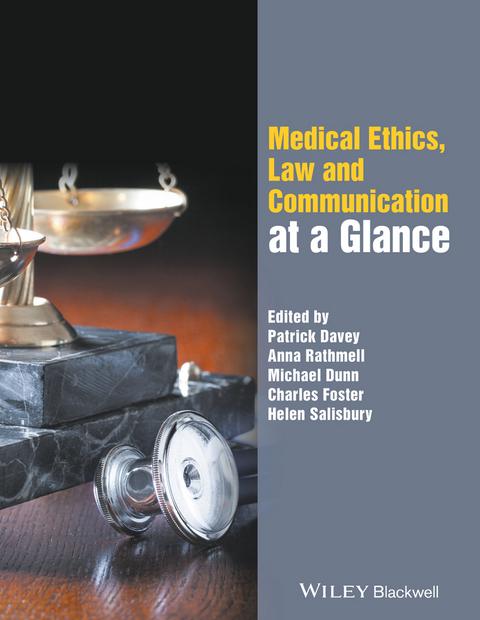
Medical Ethics, Law and Communication at a Glance (eBook)
John Wiley & Sons (Verlag)
978-1-119-26616-7 (ISBN)
Medical Ethics, Law and Communication at a Glance presents a succinct overview of these key areas of the medical curriculum.
This new title aims to provide a concise summary of the three core, interlinked topics essential to resolving ethical dilemmas in medicine and avoiding medico-legal action.
Divided into two sections; the first examines the ethical and legal principles underpinning each medical topic; while the second focuses on communication skills and the importance of good communication.
Medical Ethics, Law and Communication at a Glance offers an accessible introduction to the fundamentals of good medical practice, and will provide indispensable support for undergraduate medical students and nurses, as well as newly qualified healthcare professionals.
Patrick Davey, consultant cardiologist, has extensive experience in publishing, having edited the best selling 'Medicine at a Glance', as well as 'ECG at a Glance', and is currently editing a major new textbook for Oxford University Press on diagnosis and treatment in internal medicine.
Anna Rathmell works in the pharmaceutical industry, has recently completed an MA in medical law and ethics at Manchester University. She teaches on the undergraduate course in medical ethics and law at Oxford University. She has contributed chapters on medical ethics to 'Medicine at a Glance'.
Medical Ethics, Law and Communication at a Glance presents a succinct overview of these key areas of the medical curriculum. This new title aims to provide a concise summary of the three core, interlinked topics essential to resolving ethical dilemmas in medicine and avoiding medico-legal action. Divided into two sections; the first examines the ethical and legal principles underpinning each medical topic; while the second focuses on communication skills and the importance of good communication. Medical Ethics, Law and Communication at a Glance offers an accessible introduction to the fundamentals of good medical practice, and will provide indispensable support for undergraduate medical students and nurses, as well as newly qualified healthcare professionals.
Patrick Davey, consultant cardiologist, has extensive experience in publishing, having edited the best selling 'Medicine at a Glance', as well as 'ECG at a Glance', and is currently editing a major new textbook for Oxford University Press on diagnosis and treatment in internal medicine. Anna Rathmell works in the pharmaceutical industry, has recently completed an MA in medical law and ethics at Manchester University. She teaches on the undergraduate course in medical ethics and law at Oxford University. She has contributed chapters on medical ethics to 'Medicine at a Glance'.
Editors vii
Contributors vii
Preface ix
Part I Medical ethics and law 1
1 What is medical ethics? 2
2 Ethical theories and principles 4
3 Ethical reasoning 7
4 What is medical law? 10
5 The English legal system 13
6 Relationship between ethics, law and professionalism 16
7 Ethical decisions in practice 18
8 Negligence 20
9 Battery and assault 24
10 Confidentiality 26
11 Consent 28
12 Reproduction 34
13 Termination of pregnancy 37
14 Organ donation and transplantation 40
15 Mental health 43
16 Safeguarding children and adults 46
17 Public health 48
18 Allocation of resources 50
19 Clinical genetics 53
20 Human research 56
21 Care of older adults 58
22 End of life care 61
23 Health management 65
24 Primary care 68
Part II Communication 71
25 The importance of good communication 72
26 The patient-centred consultation 74
27 Building the relationship 75
28 Listening and questioning 76
29 Explanations 78
30 Explaining procedures 80
31 The computer in the consultation 81
32 Shared decision making 82
33 Communication of risk 84
34 Talking about lifestyle changes 86
35 Breaking bad news 88
36 Bad news: patients' reactions 90
37 Dealing with anger and aggression 92
38 Talking about sex 94
39 Communicating across cultures 96
40 Communicating with people with disabilities 98
41 Communicating with colleagues 100
42 Professionalism 102
43 Feedback 104
44 Looking after yourself 106
45 Kindness 108
Index 109
"Overall, this is a good overview. Although this book alone will not make the reader a complete doctor, it will be a good stepping stone toward that end. If readers are looking for an overview of communication skills in addition to medical ethics and law, this book is the only option because there are no books that cover all three topics." (Doody Enterprises 17/03/2017)
"Medical Ethics, Law and Communication follows along the same lines as Medical School At A Glance, with Davey and co-editors providing a no-nonsense overview of how to avoid potential minefields in the profession...Medical Ethics features a well-honed narrative ? telling the reader what they need to know, opening doors into subjects that should naturally motivate further
independent research. In sum, no prospective or practicing health care provider can afford to be without this resource." (The Electric Review, 23/03/2017)
2 Ethical theories and principles
Introduction
Consider the relatively common scenario in a district general hospital late one evening: an elderly patient who collapsed at home with a large intra-cerebral bleed is now intubated and ventilated in the emergency department. Prior to intubation the patient is deeply unconscious, with a Glasgow Coma Score of three. His case has already been discussed with the neurosurgeons who feel that the transfer to the regional neurosurgical centre for further management is not appropriate because the predicted outcome are universally poor (Figure 2.1).
What is the next course of action? He could be admitted to the intensive care unit (ICU) for further assessment and review the following morning on withholding of sedation. Or should you consider a planned withdrawal of treatment that evening with his extubation and subsequent transfer to a medical ward for palliation? Does the knowledge that he is on the organ donation register make a difference? Will the situation change if this is the last empty bed in the ICU? Now consider your responses when it transpires that the patient is 96, not 69 as first thought. Are the wishes of the patient known to the clinical team? The family have been called and will not arrive this evening. How important is their input into the decisions that are required during the evening?
Ethical reasoning is critical to resolve ethical issues such as this one. However, if such reasoning is going to be able to guide clinicians’ actions in ways that are justifiable, ethical theories and principles must be incorporated into this process. This chapter will provide the background to the main ethical theories, the ethical principles that are derived from those theories and that are relevant to contemporary medical ethics.
Three different ethical theories dominate the landscape of medical ethics. These function to determine how particular decisions or actions can be judged to be right or wrong in ethical terms. It is from these three theories that four ethical principles have been derived. The principles are well established in modern medicine. The method behind their application is intended to be simple and easy to apply across many clinical situations. These four principles are also described below.
Consequentialism
Consequentialist ethical theories claim that the rightness or wrongness of an action is judged solely by reference to the outcome of that action. For a consequentialist, the only morally relevant features of any action are its consequences.
Consequentialism is not a single ethical theory, rather it defines a category of theories. Utilitarianism is the most well-known consequentialist approach and the consequentialist theory that is most commonly applied and defended within healthcare. Utilitarianism gets its name from ‘utility’ – the value that ought to be maximised in determining the moral course of action. Utility is often interpreted in terms of ‘welfare’ or ‘well-being’. There are at least three alternative forms of utilitarianism that can be differentiated by the way that welfare is accounted for:
- Hedonistic utilitarianism, where the right action is the one that involves the maximising of happiness.
- Preference utilitarianism, where the right action is the one that involves satisfying the maximum number of fully informed and rational preferences.
- Ideal utilitarianism, where the right action is the one that involves maximising particular goods in the world – those worthwhile things or activities that are taken to have objective value – beauty, or perhaps friendship.
Part of the strength of utilitarian theories is that they are simple to comprehend and appeal to common sense. They also chime closely with the central activity of providing optimal outcomes for patients and endorse ‘well-being’ as their central value – a concept that is well recognised and understood within medical practice. However the theory faces a number of practical problems when applied to healthcare decision making. There can be difficulties in predicting and in evaluating the consequences of any particular action. For example, several consequences can arise from one act and it can be difficult to predict the probability of certain consequences following an act. The question is whether there is one consequence that will outweigh all others. Furthermore, problems can be encountered when the act under consideration will benefit one person or group but may be to the detriment of others.
Duty-based ethics
Duty-based approaches define another category of ethical theories. These theories focus on the quality of the action itself rather than the consequences of that action. This ethical approach is also called ‘deontology’ from the Greek for ‘duty’, deon. So duty-based ethics are concerned with what people are duty-bound to do, or how they are obliged to act. While such duties might extend to maximising the consequences of any action, it is not the maximisation of consequences per se that would make this action right, but that a relevant duty had been fulfilled. In other cases some actions will be wrong irrespective of the consequences. If one is duty-bound not to lie, for example, no reference to the benefits that might accrue from lying can provide an ethical justification for not telling the truth.
Much of the thinking behind duty-based ethics has arisen from the work of the eighteenth-century German philosopher Immanuel Kant, and Kantian deontology is the most common duty-based ethical theory. The basic premise of Kant’s theory is that rational human beings have the capacity to make reasonable decisions and choose the right course of action. Kant formulated his theory and account of moral duties in a number of formulations of what he called the ‘categorical imperative’, a rule that is true for all people in all circumstances. The right action must i) be one that is universal, ii) involve treating human beings as ends in themselves rather than merely as means to ends, iii) be autonomously willed by rational agents, and
iv) establish the principles for a system of common laws.
More contemporary theorists have drawn upon and revised Kant’s work on the morality of actions and rationality to reconfigure how moral duties apply and can be identified. Thomas M. Scanlon offers a different duty-based theory of ethics. He proposes that the judgement as to whether an action is right or wrong depends upon individuals identifying principles that can be mutually recognised and justified by reference to the value of ways of living with others that it would not be reasonable to reject. Scanlon offers a view into the complexities of determining universal duties, which he summarises as ‘what we owe to each other’ – a form of contractual moral agreement.
Virtue-based ethics
Arising from the ancient Greek philosophies of Plato and Aristotle, virtue ethics are based on an understanding that the rightness or wrongness of an action is based upon the character of the individual, rather than by reference to the action at all. In addition, virtue ethics provides guidance on the characteristics and behaviours a good person will demonstrate.
Virtue-based ethics focuses on the character of the person rather than their actions. The traditional virtues included prudence, justice, fortitude or bravery and finally, temperance. While one of the strengths of a virtue-based approach is that it centres on the person, the weakness is that it is unclear whether this theory can provide any guidance for action in the face of a moral dilemma.
Alasdair MacIntyre has been a key figure in contemporary virtue-based ethics. He has called the virtues or qualities of character ‘internal goods’. MacIntyre has been a proponent of how virtues change over time while at the same time emphasising the historical context of ethics. The combination of the qualities of character viewed within both the historical and social context gives an understanding of how ethical issues arise and how the good life can be cultivated.
The four principles
Principlism is a method for ethical decision making in medicine that promotes the application of four principles. These four principles are second-order principles that have been derived from the three main ethical theories to form a useful and universal approach to working through ethical decision making. The aim is to be simple, easy to apply and culturally neutral. Henceforth, when confronting a problem, it can be helpful to apply each principle to allow some clarity and transparency to the situation, taking each different ethical theoretical insight into account.
The first principle, respect for autonomy, is the obligation to allow patients to self-govern their own lives, and to make decisions about their medical care in line with their own conception of their life plans. Respecting patient autonomy is usually understood as allowing healthcare providers to discuss and, if necessary, educate the patient about the different options available, but it does not allow the healthcare provider to make the decision for the patient. Implicit within this is the premise that medical practitioners must respect and follow those wishes, even if they believe that the decision is bad or incorrect.
The principles of beneficence and non-maleficence are closely related. Beneficence is the...
| Erscheint lt. Verlag | 20.10.2016 |
|---|---|
| Reihe/Serie | At a Glance |
| At a Glance | At a Glance |
| Sprache | englisch |
| Themenwelt | Medizin / Pharmazie ► Allgemeines / Lexika |
| Medizin / Pharmazie ► Medizinische Fachgebiete ► Innere Medizin | |
| Medizin / Pharmazie ► Medizinische Fachgebiete ► Medizinethik | |
| Studium ► Querschnittsbereiche ► Geschichte / Ethik der Medizin | |
| Schlagworte | Allgemeine u. Innere Medizin • communication skills • consent • ethics • General & Internal Medicine • GMC • healthcare professionals • medical law • Medical Law & Ethics • medical practice • medical school • Medical Science • Medizin • Medizinethik • Medizinische Ethik • Medizinrecht u. Ethik • Nurse • Patient • Principle • Professionalism • undergraduate medical student |
| ISBN-10 | 1-119-26616-5 / 1119266165 |
| ISBN-13 | 978-1-119-26616-7 / 9781119266167 |
| Informationen gemäß Produktsicherheitsverordnung (GPSR) | |
| Haben Sie eine Frage zum Produkt? |
 EPUB (Adobe DRM)
Kopierschutz: Adobe-DRM
Adobe-DRM ist ein Kopierschutz, der das eBook vor Mißbrauch schützen soll. Dabei wird das eBook bereits beim Download auf Ihre persönliche Adobe-ID autorisiert. Lesen können Sie das eBook dann nur auf den Geräten, welche ebenfalls auf Ihre Adobe-ID registriert sind.
Details zum Adobe-DRM
Dateiformat: EPUB (Electronic Publication)
EPUB ist ein offener Standard für eBooks und eignet sich besonders zur Darstellung von Belletristik und Sachbüchern. Der Fließtext wird dynamisch an die Display- und Schriftgröße angepasst. Auch für mobile Lesegeräte ist EPUB daher gut geeignet.
Systemvoraussetzungen:
PC/Mac: Mit einem PC oder Mac können Sie dieses eBook lesen. Sie benötigen eine
eReader: Dieses eBook kann mit (fast) allen eBook-Readern gelesen werden. Mit dem amazon-Kindle ist es aber nicht kompatibel.
Smartphone/Tablet: Egal ob Apple oder Android, dieses eBook können Sie lesen. Sie benötigen eine
Geräteliste und zusätzliche Hinweise
Buying eBooks from abroad
For tax law reasons we can sell eBooks just within Germany and Switzerland. Regrettably we cannot fulfill eBook-orders from other countries.
aus dem Bereich


