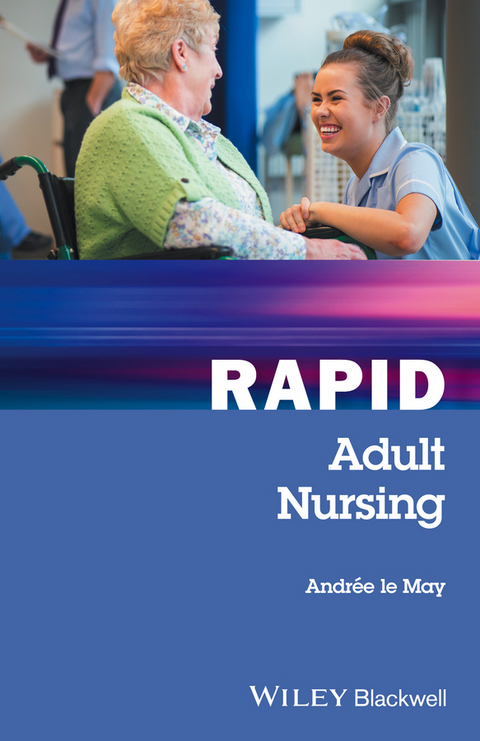
Rapid Adult Nursing (eBook)
John Wiley & Sons (Verlag)
978-1-119-11713-1 (ISBN)

Rapid Adult Nursing is an essential read for all adult nursing students, as well as a refresher for qualified adult nurses, and a 'dip into text' for other healthcare professionals. Designed for quick reference, it maps on to the essential clinical skills and knowledge required for pre-registration adult nurses, and captures the essentials of adult nursing care in an easy to read, and highly accessible format.
Covering all the key topics in adult nursing, this concise and easy-to-read title is the perfect quick-reference book for student adult nurses.
Andrée le May is Emeritus Professor of Nursing at the University of Southampton, UK.
Rapid Adult Nursing is an essential read for all adult nursing students, as well as a refresher for qualified adult nurses, and a dip into text for other healthcare professionals. Designed for quick reference, it maps on to the essential clinical skills and knowledge required for pre-registration adult nurses, and captures the essentials of adult nursing care in an easy to read, and highly accessible format. Covering all the key topics in adult nursing, this concise and easy-to-read title is the perfect quick-reference book for student adult nurses.
Andrée le May is Emeritus Professor of Nursing at the University of Southampton, UK.
Introduction viii
Acknowledgements ix
Part 1: Fundamentals of Nursing Care
Adult nursing 3
Assessment and monitoring 4
Audit 5
Communication 6
Continuing professional development 7
Dignity 8
Discharge planning 9
Documentation 10
Eating and drinking 11
Evaluation 12
Evidence-based practice 13
Fundamentals of nursing care 14
Health education and promotion 15
Infection prevention and control 16
Leadership 17
Management 18
Medicines management 19
Moving and positioning 20
Practice development 21
Quality improvement 22
Research 23
Risk assessment and management 24
Teamwork 25
Wound management 26
Part 2: Conditions
Acute coronary syndromes 29
Acute renal failure 31
Anaemias 32
Aneurysms 33
Angina 34
Appendicitis 35
Arrhythmias 36
Asthma 37
Breast lumps 38
Breathlessness 39
Cancer 40
Cardiovascular disorders 41
Cataracts 42
Cholecystitis 43
Chronic obstructive pulmonary disease 44
Chronic renal failure 45
Cirrhosis 46
Coagulation disorders 47
Constipation 48
Coronary heart disease 49
Crohn's disease 50
Dementias 51
Diabetes mellitus 52
Diarrhoea 53
Diverticular disease 54
Eczema 55
Encephalitis 56
Endocrine disorders 57
End-of-life care 58
Epilepsy 59
Fractures 60
Gallstone disease 61
Gastritis 62
Gastroenteritis 63
Gastro-oesophageal reflux disease 64
Glaucoma 65
Glomerulonephritis 66
Gout 67
Haemorrhoids 68
Hearing loss 69
Heart failure 70
Hepatitis 71
HIV 72
Hypertension 73
Hysterectomy 74
Immunodeficiency 75
Incontinence 76
Jaundice 77
Leukaemias 78
Life support: advanced adult 79
Life support: basic adult 80
Lymphomas 81
Macular degeneration 82
Meningitis 83
Multiple sclerosis 84
Myopathies 85
Nausea and vomiting 86
Neutropenia 87
Osteoarthritis 88
Osteomyelitis 89
Osteoporosis 90
Pain and discomfort 91
Pancreatitis 92
Parkinson's disease 93
Peptic ulceration 94
Peripheral vascular disease 95
Platelet disorders 96
Pneumonia 97
Post-operative care 98
Pre- and intra-operative care 99
Prostate gland disorders 100
Psoriasis 101
Raised intracranial pressure 102
Respiratory failure 103
Rheumatoid arthritis 104
Sepsis 105
Shock 106
Spinal cord compression 107
Tension pneumothorax 108
Tinnitus 109
Tuberculosis 110
Ulcerative colitis 111
Urethritis 112
Urinary calculi 113
Urinary retention 114
Urinary tract infections 115
Vaginal discharge 116
Valve disease 117
Vascular disorders of the brain 118
Venous thromboembolism 119
References and Websites 120
Index 121
A
Acute coronary syndromes
Definition
Unstable angina (UA) and heart attacks (myocardial infarctions, MI) are referred to as acute coronary syndromes (ACS) and are medical emergencies.
Their common pathology is sudden total/near total blockage of a coronary vessel, usually due to atherosclerotic plaque rupture leading to an intracoronary thrombus. The blockage may be episodic or transient (UA) or complete, resulting in reduced blood flow or complete blockage and the death of some of the myocardium (MI). Presentation and treatment depend on where the blockage is and whether it is complete or partial. MI are managed according to their type – ST elevation myocardial infarctions (STEMI) or non‐ST segment elevation myocardial infarctions (NSTEMI). STEMI shows sustained elevation of the ST segments of the ECG, indicating a large area of myocardium death. Troponins are elevated (troponins are proteins found in heart muscle and damage causes specific troponins to leak out into the bloodstream). NSTEMI causes less myocardial damage so may not cause ST elevation, but elevated troponins are present. There may be other ECG changes, such as ST depression or T‐wave inversion.
UA manifests as ACS symptoms, but there is no ST elevation/raised troponins. UA results in ischaemia, but no destruction of myocardium.
Diagnosis and investigations
Diagnosis is made by examination, history taking, 12‐lead ECGs to identify STEMI/NSTEMI/UA, and blood tests to assess myocardial damage (e.g. troponins T and I).
Common signs and symptoms
Pain usually at rest; unrelieved by nitrovasodilators; continuous and lasts longer than 15 minutes; described as crushing, tight or constricting; may radiate to arms and neck (may be described in the stomach area); sometimes no pain at all. Fear. Pallor and/or sweaty or clammy skin; cyanosis. Sometimes shortness of breath; nausea and vomiting; altered level of consciousness. Change in heart rate (usually tachycardia), rhythm and blood pressure (BP).
Treatment
In the acute phase management focuses on symptom control (pain relief usually with diamorphine, antiemetics to reduce nausea and oxygen if hypoxic), improving blood flow to the heart and reducing demand for oxygen by rest and drug therapy.
STEMI treatment focuses on reperfusion/revascularisation, either pharmacological (thrombolysis) or by percutaneous coronary intervention (PCI) – balloon catheter passed into coronary artery, balloon inflated to open narrowed vessel, stent inserted.
NSTEMI and UA are treated pharmacologically, for instance by antiplatelet therapy (e.g. aspirin), antithrombin therapy (e.g. low molecular weight heparin). Beta‐blockers and nitrates are used if needed.
Both conditions can progress to STEMI.
Following the acute phase attention focuses on education, rehabilitation, secondary prevention (e.g. long‐term aspirin, statin use) and cardiac interventions (e.g. revascularisation).
Nursing care
Providing highly skilled nursing care for people with MI is critical to their recovery. Many different nurses may be involved in a person’s care pathway, depending on where the patient presents with symptoms. Immediate care will focus on assessing pain levels, nausea and anxiety, giving medications/oxygen as prescribed, and monitoring and reporting the person’s condition (e.g. alterations in heart rate, fall in blood pressure, decreasing blood oxygen saturation, restlessness, breathlessness, falling pulse pressure). Reassuring communication with an explanation of interventions, equipment and plans will reduce anxiety. As recovery progresses, discuss with the patient suitable activity levels and monitor the effects of resumption of activity. Nurses may also be responsible for ongoing monitoring and health education and promotion once the patient is discharged from hospital.
Acute renal failure
Definition
Acute renal failure is a syndrome characterised by rapid decline (days to weeks) in glomerular filtration rate (GFR). This results in an accumulation of nitrogenous waste and problems regulating extracellular volume and electrolytes. Urine output may be reduced (oliguria) or non‐existent (anuria).
The kidneys comprise three parts: the renal cortex, the renal medulla and the renal pelvis. Kidneys primarily separate waste and excess water from blood and convert this filtrate into urine (filtration, selective reabsorption and secretion). Filtration occurs in the glomeruli (glomerular filtration). The glomeruli filter around 7 L of fluid/hour producing 50–100 ml of urine. Substances needed to maintain acid base and fluid balance are reabsorbed from the filtrate by osmosis, diffusion and active transportation. Ions, creatinine, urea and some hormones are secreted. Urine is stored in the bladder until it leaves the body via the urethra. Antidiuretic hormone (ADH) regulates the amount of urine passed.
The kidneys also have an endocrine function synthesising hormones. Renin and angiotensin regulate sodium and fluid retention and the expansion and contraction of blood vessels, and have a role in BP control. Renin controls the glomerular blood flow and filtration rate.
Acute renal failure results from a variety of causes (pre‐renal, renal and post‐renal). Pre‐renal causes largely relate to hypo‐perfusion of the kidneys. This mainly stems from other system failures, for instance cardiovascular. Renal causes result from diseases affecting the kidney. Post‐renal causes are associated with urinary tract obstructions. Disruption to the functioning of the kidneys will affect many bodily functions and systems.
Diagnosis and investigations
Patients with acute renal failure may present with a range of signs and symptoms, including oliguria/anuria, nausea/vomiting, malaise, hypertension, peripheral oedema, breathlessness (pulmonary oedema/metabolic acidosis), pericarditis, encephalopathy and hyperkalaemia. Investigations will include urinalysis, kidney function and blood tests.
Treatment
Treatment focuses on ensuring adequate oxygenation and circulation, and management of the presenting symptoms and the underlying causes. Dialysis (renal replacement therapy) may be required. Acute renal failure may be reversible.
Nursing care
Restoring and maintaining homeostasis are central aspects of care. This will involve careful monitoring of fluid balance and skilled observation of the patient’s condition for deterioration (or improvement). Focus on:
- Urinalysis (look for protein, blood, cells and casts).
- Fluid balance: intake and output measurement (over‐ or under‐hydration).
- Oxygen saturation and respiratory rate.
- Oxygen administration, recording and monitoring.
- Alterations in heart rate, rhythm and blood pressure.
- ECG: cardiac arrhythmias due to hyperkalaemia.
- Alteration in level of consciousness.
- Nutritional status/hydration (enteral/parenteral feeding may be needed).
- Signs of oedema in peripheral tissues due to fluid and electrolyte disruption.
- Compromised skin (oedema, waterlogged tissues at risk of infection).
- Signs of infection (redness around IVI sites, pyrexia).
Acute renal failure can be very frightening, so accurate, explanatory and empathic communication is essential.
Anaemias
Definition
WHO (http://www.who.int/nutrition/publications/micronutrients/global_prevalence_anaemia_2011/en/) defined anaemia as less than 12 g/dL Hb for non‐pregnant women, less than 11 g/dL Hb for pregnant women and less than 13 g/dL Hb for men. Haemoglobin (Hb) levels normally vary between individuals. Women tend to have lower levels than men. There are various types of anaemia (e.g. iron‐deficiency anaemia, thalassaemia, aplastic anaemia, pernicious anaemia and haemolytic anaemia).
Anaemia occurs because there are insufficient/poorly functioning red blood cells (RBC) or there is a reduction in haemoglobin in each RBC. Reduced haemoglobin means that RBC carry less oxygen. Anaemias are usually classified according to RBC size – microcytic/hypochromic (small red blood cells with less haemoglobin than normal); normochromic/normocytic (normal haemoglobin, normal‐sized red blood cells); or macrocytic (red blood cells are larger than normal).
Anaemias are caused by different illnesses/deficiencies. Iron deficiency is the most common cause of anaemia in the world. Iron‐deficiency anaemia may occur because of blood loss (e.g. through menstruation, gastro‐intestinal [GI] bleeding), an iron‐deficient diet, pregnancy, poor absorption of iron (e.g. coeliac disease) or hookworm infection. In pernicious anaemia vitamin B12 cannot be absorbed. Antibodies are formed against intrinsic factor (IF) or against the cells in the stomach that make IF, which stops IF from attaching to vitamin B12 and prevents its absorption. Thalassaemia is a genetic condition that affects the alpha or beta chains of haemoglobin. Consequently there is insufficient normal haemoglobin and the red blood cells break down easily. Thalassaemia is part of the group of haemolytic...
| Erscheint lt. Verlag | 12.10.2016 |
|---|---|
| Reihe/Serie | Rapid |
| Rapid | Rapid |
| Sprache | englisch |
| Themenwelt | Medizin / Pharmazie ► Pflege |
| Schlagworte | Care • Communication • Compassion • disorders • documentation • Einführungen in die Krankenpflege • Einführungen in die Krankenpflege • General Clinical Nursing • Introductions to Nursing • Klinische Krankenpflege • Krankenpflege • leadership</p> • <p>adult • Management • nursing • Risk • sympton |
| ISBN-10 | 1-119-11713-5 / 1119117135 |
| ISBN-13 | 978-1-119-11713-1 / 9781119117131 |
| Informationen gemäß Produktsicherheitsverordnung (GPSR) | |
| Haben Sie eine Frage zum Produkt? |
 EPUB (Adobe DRM)
Kopierschutz: Adobe-DRM
Adobe-DRM ist ein Kopierschutz, der das eBook vor Mißbrauch schützen soll. Dabei wird das eBook bereits beim Download auf Ihre persönliche Adobe-ID autorisiert. Lesen können Sie das eBook dann nur auf den Geräten, welche ebenfalls auf Ihre Adobe-ID registriert sind.
Details zum Adobe-DRM
Dateiformat: EPUB (Electronic Publication)
EPUB ist ein offener Standard für eBooks und eignet sich besonders zur Darstellung von Belletristik und Sachbüchern. Der Fließtext wird dynamisch an die Display- und Schriftgröße angepasst. Auch für mobile Lesegeräte ist EPUB daher gut geeignet.
Systemvoraussetzungen:
PC/Mac: Mit einem PC oder Mac können Sie dieses eBook lesen. Sie benötigen eine
eReader: Dieses eBook kann mit (fast) allen eBook-Readern gelesen werden. Mit dem amazon-Kindle ist es aber nicht kompatibel.
Smartphone/Tablet: Egal ob Apple oder Android, dieses eBook können Sie lesen. Sie benötigen eine
Geräteliste und zusätzliche Hinweise
Buying eBooks from abroad
For tax law reasons we can sell eBooks just within Germany and Switzerland. Regrettably we cannot fulfill eBook-orders from other countries.
aus dem Bereich