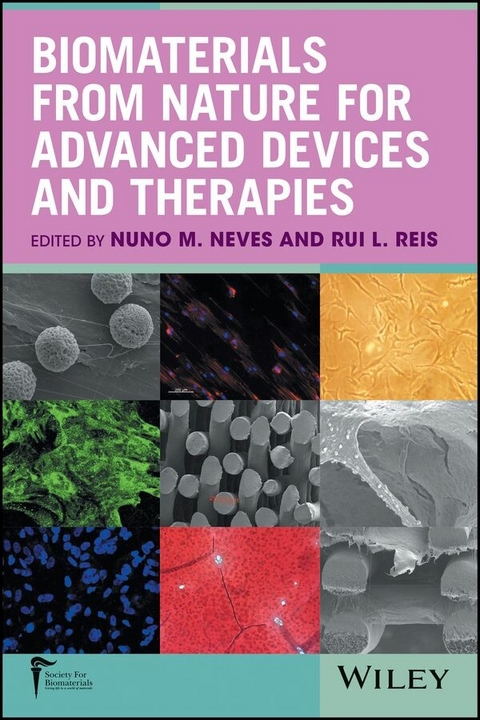

In-depth information on natural biomaterials and their applications for translational medicine!
- Undiluted expertise: edited by world-leading experts with contributions from top-notch international scientists, collating experience and cutting-edge knowledge on natural biomaterials from all over the world
- A must-have on the shelf in every biomaterials lab: graduate and PhD students beginning their career in biomaterials science and experienced researchers and practitioners alike will turn to this comprehensive reference in their daily work
- Link to clinical practice: chapters on translational research make readers aware of what needs to be considered when a biomaterial leaves the lab to be routinely used
In-depth information on natural biomaterials and their applications for translational medicine! Undiluted expertise: edited by world-leading experts with contributions from top-notch international scientists, collating experience and cutting-edge knowledge on natural biomaterials from all over the world A must-have on the shelf in every biomaterials lab: graduate and PhD students beginning their career in biomaterials science and experienced researchers and practitioners alike will turn to this comprehensive reference in their daily work Link to clinical practice: chapters on translational research make readers aware of what needs to be considered when a biomaterial leaves the lab to be routinely used
Nuno M. Neves is Professor at the Department of Polymer Engineering of the University of Minho, Portugal, where he is Vice-Director of the 3B's Research Group - Biomaterials, Biodegradables and Biomimetics. Nuno M. Neves received his PhD degree in Polymer Science and Engineering from the University of Minho in collaboration with the University of Twente, The Netherlands. His main area of research is the development of biomaterials from natural origin polymers. His research group focuses mainly on tissue engineering and regenerative medicine strategies using stem cells and advanced drug delivery scaffolds and medical devices. Rui L. Reis is Professor of Tissue Engineering, Regenerative Medicine, Biomaterials and Stem Cells at the Department of Polymer Engineering of the University of Minho, Portugal. He is the Vice-Rector for Research of the University of Minho, Director of the 3B's Research Group and the Director of the Portuguese Government Associate Laboratory ICVS/3B's. Rui L. Reis received his PhD degree in Polymer Engineering from the University of Minho in collaboration with Brunel University in London, UK. His main area of research is the development of biomaterials from natural origin polymers that his group proposes for a range of biomedical applications.
Biomaterials from Nature for Advanced Devices and Therapies 3
Contents 7
Contributors 21
Preface 31
PART I 33
1 Collagen-Based Porous Scaffolds for Tissue Engineering 35
1.1 Introduction 35
1.2 Collagen Sponges 36
1.3 Collagen Sponges with Micropatterned Pore Structures 39
1.4 Collagen Sponges with Controlled Bulk Structures 42
1.5 Hybrid Scaffolds 44
1.6 Conclusions 45
References 46
2 Marine Collagen Isolation and Processing Envisaging Biomedical Applications 48
2.1 Introduction 48
2.2 Extraction of Collagen From Marine Sources 50
2.2.1 Extraction of Collagen from Fish, Jellyfish and Molluscs 51
2.2.2 Extraction of Collagen from Other Sources: Marine Sponges 54
2.3 Collagen Characterization 54
2.3.1 Fourier Transform InfraRed Spectroscopy (FTIR) 55
2.3.2 Differential Scanning Calorimetry (DSC) 55
2.3.3 Circular Dichroism (CD) 55
2.3.4 Sodium Dodecyl Sulfate Polyacrylamide Gel Electrophoresis (SDS-PAGE) 56
2.3.5 Amino Acid Analysis 56
2.4 Marine Collagen Wide Applications 57
2.4.1 Marine Collagen-Based Biomaterials Properties 57
2.4.2 Marine Collagen Applications in Tissue Engineering 59
2.4.3 Other Tissue Engineering Applications 63
2.5 Final Remarks 64
Acknowledgements 66
References 66
3 Gelatin-Based Biomaterials For Tissue Engineering And Stem Cell Bioengineering 69
3.1 Introduction 69
3.2 Crosslinking of Gelatin 70
3.3 Physical Properties of Gelatin 71
3.4 Application of Gelatin-Based Biomaterials In Tissue Engineering 72
3.4.1 Cardiovascular Tissue Engineering 72
3.4.2 Bone Tissue Engineering 74
3.4.3 Hepatic Tissue Engineering 74
3.4.4 Ophthalmology 75
3.4.5 Dermatology 76
3.4.6 Miscellaneous Applications 77
3.5 Gelatin for Stem Cell Therapy 77
3.5.1 Embryonic Stem Cells 77
3.5.2 Adult Stem Cells 78
3.5.3 Induced Pluripotent Stem Cells 80
3.6 Application of Gelatin In Delivery Systems 81
3.7 Conclusion and Perspectives 82
Acknowledgements 82
Abbreviations 82
References 83
4 Hyaluronic Acid-Based Hydrogels on a Micro and Macro Scale 95
4.1 Classification and Structure of Hydrogels 95
4.2 Hyaluronic Acid 97
4.3 Hydrogel Mechanical Properties 98
4.3.1 Dynamic Mechanical Analysis 98
4.3.2 Stress Strain Behavior 100
4.4 HA-Based Hydrogel for Biomedical Applications 102
4.4.1 Regenerative Medicine 102
4.4.2 Drug Delivery 105
References 107
5 Chondroitin Sulfate as a Bioactive Macromolecule for Advanced Biological Applications and Therapies 111
5.1 CS Structure 113
5.2 Biological Roles of CS 113
5.3 Osteoarthritis Treatment 116
5.4 Cardio-Cerebrovascular Disease 116
5.5 Tissue Regeneration and Engineering 117
5.6 Chondroitin Sulfate-Polymer Conjugates 118
5.7 Conclusions and Future Perspectives 119
References 120
6 Keratin 125
6.1 Introduction 125
6.2 Preparation of Keratoses 130
6.3 Preparation of Kerateines 132
6.4 Oxidative Sulfitolysis 133
6.5 Summary 134
References 134
7 Elastin-Like Polypeptides: Bio-Inspired Smart Polymers for Protein Purification, Drug Delivery and Tissue Engineering 138
7.1 Introduction 138
7.2 Recombinant Protein Production Using ELPs as Purification Tags 139
7.2.1 ELP Expression 139
7.2.2 ELP Purification 140
7.2.3 Tag Removal 142
7.2.4 Biological Evaluation of Purified Protein 143
7.3 Delivery of Therapeutics with ELPs 145
7.3.1 Systemic Delivery of Soluble ELP-Drug Conjugate 147
7.3.2 Systemic Delivery of ELP with Local Hyperthermia 149
7.3.3 Hyperthermia-Triggered Multivalency 149
7.3.4 Local Delivery by Thermal Coacervation 150
7.4 Tissue Engineering with ELPs 151
7.4.1 Coacervation of Soluble ELP 152
7.4.2 Covalent Crosslinking 153
7.5 Conclusions 154
Acknowledgements 154
Abbreviations 154
References 155
8 Silk: A Unique Family of Biopolymers 159
8.1 Introduction 159
8.2 Main Silk Polymers 161
8.2.1 Bombyx mori Silk 161
8.3 Fibroin Basic Processing: Regenerated Silk Fibroin 163
8.3.1 Sericin Removal: Degumming 163
8.3.2 Fibroin Dissolution 163
8.4 Materials Fabrication of Silk Proteins 163
8.4.1 Two Dimensional Platforms 164
8.5 Advanced Material Applications of Silks 167
8.5.1 Biomedical Therapies 167
8.5.2 Silks as Photonic and Electronic Devices 167
8.6 Conclusion 168
References 169
9 Silk Protein Sericin: Promising Biopolymer for Biological and Biomedical Applications 174
9.1 Introduction 174
9.1.1 Silks 174
9.1.2 Sericin 176
9.1.3 Biochemical Properties of Sericin 177
9.2 Sericin Extraction and Processing 178
9.2.1 Directly from Glands 178
9.2.2 Heat Degradation 179
9.2.3 Acid Degradation 179
9.2.4 Alkali Degradation 179
9.2.5 Urea Method 179
9.2.6 Enzymatic Degradation 179
9.3 Potential Applications Of Sericin 179
9.3.1 Dietary Supplements 180
9.3.2 Antioxidant and Anticancer Properties 180
9.3.3 Sericin Bioconjugate 181
9.3.4 Sericin as Supplement in Animal Cell Culture 181
9.3.5 Sericin as Biomaterials 182
9.4 Immunogenicity and Toxicity Of Sericin 184
9.5 Conclusion 185
Acknowledgements 186
References 186
10 Fibrin 191
10.1 Introduction 191
10.2 Fibrin Clotting 192
10.3 Fibrin Degradation 192
10.4 Fibrin Glue 195
10.4.1 Modes of Application 195
10.4.2 Modification Options of Fibrin Glue 196
10.4.3 Usage 198
10.5 Conclusion 202
Acknowledgement 203
References 203
11 Casein Proteins 208
11.1 Introduction 208
11.2 Structures and Properties of Casein 210
11.2.1 S1-Casein 211
11.2.2 S2-Casein 213
11.2.3 -Casein 214
11.2.4 -Casein 215
11.3 Interaction of Caseins with Metal Ions 216
11.4 Conclusions 217
References 218
12 Biomaterials from Decellularized Tissues 222
12.1 Introduction 222
12.1.1 The Default Tissue Response to Injury in Adult Mammals 223
12.1.2 Extracellular Matrix Scaffolds 224
12.1.3 ECM Scaffolds – The Decellularization Process 225
12.2 Host Response to Implanted ECM-Derived Biomaterials 228
References 231
13 Demineralized Bone Matrix: A Morphogenetic Extracellular Matrix 243
13.1 Introduction 243
13.2 Demineralized Bone Matrix (DBM) 243
13.3 From DBM to Bone Morphogenetic Proteins (BMPs) 245
13.4 BMPs bind To Extracellular Matrix 248
13.5 BMP Receptors 248
13.6 Future Perspectives 250
Acknowledgements 250
References 250
PART II 253
14 Recent Developments on Chitosan Applications in Regenerative Medicine 255
14.1 Introduction 255
14.2 Chitosan and Derivatives 256
14.2.1 Synthesis of Chitosan 256
14.2.2 Physicochemical Properties 257
14.2.3 Chemical Modification of Chitosan 257
14.3 Regenerative Medicine Applications of Chitosan 259
14.3.1 Micro- and Nanoparticles Systems 260
14.3.2 Hydrogels and Scaffolds 261
14.3.3 Membranes and Tubular Structures 262
14.4 Processing Methodologies 263
14.4.1 Freeze-Drying 264
14.4.2 Electrospinning 265
14.4.3 Layer-by-Layer Deposition 265
14.4.4 Supercritical Fluid Technology 266
14.5 Final Remarks 268
Acknowledgments 269
References 269
15 Starch-Based Blends in Tissue Engineering 276
15.1 Introduction 276
15.2 Starch 277
15.3 Modification of Starch for Biomedical Applications 279
15.4 Starch-Based Blends 280
15.4.1 Starch Cellulose Acetate (SCA) 280
15.4.2 Starch Ethylene-Vinyl Alcohol (SEVA-C) 283
15.4.3 Starch Poly(Lactic Acid) [SPLA] 283
15.4.4 Starch Polycaprolactone (SPCL) 284
15.5 Conclusions and Future Perspectives 286
References 287
16 Agarose Hydrogel Characterization for Regenerative Medicine Applications: Focus on Engineering Cartilage 290
16.1 The Foundations of Agarose 290
16.2 Structure-Function Relationships of Agarose Hydrogels 291
16.3 Agarose as a Tissue Engineering Scaffold 293
16.4 Agarose In The Clinic 298
16.5 A Scaffold To Build On 299
Acknowledgements 300
References 300
17 Bioengineering Alginate for Regenerative Medicine Applications 306
17.1 Introduction 306
17.2 Regenerative Medicine: Definition and Strategies 307
17.2.1 Stem Cells 308
17.2.2 Biomaterials 309
17.3 Alginate Biomaterial 309
17.3.1 Alginate Composition and Hydrogel Formation 309
17.3.2 Degradation of Alginate and its Hydrogels 311
17.3.3 Biocompatibility 312
17.3.4 Main Applied Forms of Alginate 312
17.4 Alginate Implant: First in Man Trial for Prevention of Heart Failure 313
17.5 Alginate Hydrogel as a Vehicle for Stem Cell Delivery and Retention 316
17.5.1 Cardiovascular Repair 317
17.5.2 Osteochondral Repair 318
17.5.3 Immunomodulation 318
17.6 Engineering Alginate-Based Cell Microenvironments 319
17.6.1 Concept Design 319
17.6.2 Engineering Alginate Scaffold for Cardiac Tissue Engineering 320
17.6.3 Engineering Alginate Scaffold for Cartilage Tissue Engineering 321
17.7 Alginate Hydrogel Carrier for Growth Factor Delivery 321
17.8 Engineering Alginate For Affinity Binding And Presentation of Heparin-Binding Growth Factors 324
17.8.1 The Concept of Affinity-Binding Alginate Biomaterial 324
17.8.2 Case Study: Myocardial Repair 325
17.8.3 Case Study: Osteochondral Repair 329
17.8.4 Conclusions and Future Perspectives 331
References 332
18 Dextran 339
18.1 Introduction 339
18.2 Structure and Properties 340
18.3 Dextran Derivatives 342
18.3.1 Dextran Esters 342
18.3.2 Dextran Carbonates 344
18.3.3 Dextran Carbamates 345
18.4 Dextran Copolymers 346
18.4.1 Graft Copolymers 346
18.4.2 Block Copolymers 347
18.5 Degradation 348
18.6 Outlook 348
References 348
19 Gellan Gum-based Hydrogels for Tissue Engineering Applications 352
19.1 Introduction 352
19.2 Gellan Gum and its Derivatives 354
19.2.1 Low and High Acyl Gellan Gum: Structure and Properties 354
19.2.2 Gellan Gum Derivatives 355
19.3 Tissue Engineering Applications 357
19.3.1 Cartilage 358
19.3.2 Meniscus 359
19.3.3 Bone 359
19.3.4 Osteochondral 360
19.3.5 Peripheral Nerve 361
19.3.6 Intervertebral Disc 361
19.4 Final Remarks 363
Acknowledgments 364
References 364
PART III 369
20 Biomedical Applications of Polyhydroxyalkanoates 371
20.1 Introduction 371
20.2 Skin Tissue Engineering 373
20.3 Nerve Tissue Engineering 376
20.4 Cardiac Tissue Engineering 380
20.4.1 Pericardial Patch 383
20.4.2 Cardiovascular Stents 383
20.4.3 Congenital Cardiovascular Defects: Artery Augmentation 384
20.4.4 Heart Valves 385
20.4.5 Vascular Grafts 387
20.5 Dental Tissue Engineering 388
20.6 Bone Tissue Engineering 390
20.7 Cartilage Tissue Engineering 398
20.8 Osteochondral Tissue Engineering 400
20.9 Drug Delivery 402
20.10 Conclusions and the Future Potential of PHAs in Biomedical Applications 405
References 405
21 Bacterial Cellulose 416
21.1 Introduction 416
21.2 BC Dressings 417
21.3 Bacterial Cellulose for Tissue Engineering and Regenerative Medicine 420
21.4 Concluding Remarks 425
Acknowledgments 426
References 426
PART IV 433
22 Molecularly Imprinted Cryogels for Protein Purification 435
22.1 Introduction 435
22.2 Molecularly Imprinted Cryogels for Protein Purification 437
22.2.1 Cryogels 437
22.2.2 Magic of Freezing (Mechanisms of Ice Formation and Polymerization in Cryogels) 438
22.3 Some Selected Applications of Molecularly Imprinted Cryogels (MIC) for Macromolecules 446
22.4 Concluding Remarks And Future Perspectives 453
References 455
23 Immunogenic Reaction of Implanted Biomaterials from Nature 461
23.1 Introduction 461
23.2 Implantation Leads to Tissue Injury 462
23.3 Inflammatory Responses 463
23.3.1 Acute Inflammation 463
23.3.2 Chronic Inflammation 465
23.4 Foreign Body Reaction 465
23.5 Immunogenic Reactions Towards Natural Biomaterials 467
23.5.1 Collagens 467
23.5.2 Fibrin 467
23.5.3 Hyaluronic Acid 468
23.5.4 Alginate 468
23.5.5 Chitosan 468
23.5.6 Fibroin 469
23.5.7 Combinations 469
23.6 Final Remarks 470
References 470
24 Chemical Modification of Biomaterials from Nature 476
24.1 Protein Modification 476
24.1.1 Biological Incorporation of Non-Natural Amino Acids in Target Protein Using a Genetic Modification System 477
24.1.2 Labeling of Expressed Protein by Bioconjugation of Natural Amino Acids 478
24.1.3 Bio-Orthogonal Reactions of Proteins with Non-Natural Functional Groups 480
24.1.4 Enzymatic Site-Specific Modification 481
24.1.5 Ligand-Directed Labeling Chemistries 481
24.2 Lipid Modifications 483
24.2.1 Acetylation 484
24.2.2 Epoxidation and Hydroxylation 484
24.2.3 Hydrogenation 487
24.2.4 Esterification 488
24.3 Polysaccharide Chemical Modifications 489
24.3.1 Modifications Guided by Saccharide Oxygen Acting as Nucleophile 489
24.3.2 Modifications Guided by Saccharide Carbon Acting as Electrophile 493
24.3.3 Polysaccharides Modificated by Oxidation 494
24.3.4 Reactions of Carboxilic Groups of Polysaccharides 495
24.3.5 Modifications Guided by Saccharide Nitrogen Acting as Nucleophile 496
References 498
PART V 507
25 Processing of Biomedical Devices for Tissue Engineering and Regenerative Medicine Applications 509
25.1 Introduction 509
25.2 Processing Techniques of Naturally Derived Biomaterial 510
25.2.1 Gelation 510
25.2.2 Electrospinning 510
25.2.3 Emulsion/Freeze-Drying 511
25.2.4 Wet-spinning 512
25.2.5 Solvent Casting 513
25.2.6 Microparticles Fabrication and Agglomeration 513
25.2.7 Supercritical Fluids 514
25.3 Processing Techniques of Natural-Based Polymeric Blends 515
25.3.1 Melt Fiber Extrusion 515
25.3.2 Compression Molding and Particle Leaching 516
25.3.3 Rapid Prototyping 517
25.3.4 Hot-Embossing 517
References 519
26 General Characterization of Physical Properties of Natural-Based Biomaterials 526
26.1 Introduction 526
26.2 Bulk Properties 527
26.2.1 Bulk Microstructure 527
26.2.2 Porosimetry 528
26.2.3 Water Content 530
26.2.4 Thermal Properties 531
26.2.5 Mechanical Properties 532
26.3 Surface Properties 539
26.3.1 Wettability and Interfacial Free Energy 540
26.3.2 Topography and Roughness 541
26.4 Concluding Remarks 544
Acknowledgments 544
References 544
27 General Characterization of Chemical Properties of Natural-Based Biomaterials 549
27.1 Introduction 549
27.2 Molecular Weight and Elemental Composition 550
27.2.1 Viscosimetry 550
27.2.2 Mass Spectrometry 551
27.2.3 Nuclear Magnetic Resonance 553
27.2.4 FT-IR and UV Spectroscopies 554
27.3 Physiological Degradation 556
27.4 Concluding Remarks 559
Acknowledgments 561
References 561
28 IN VITRO Biological Testing in the Development of New Devices 564
28.1 Introduction 564
28.2 Cytotoxicity Assays 565
28.3 Evaluation of Cell Morphology and Distribution 565
28.3.1 Scanning Electron Microscopy (SEM) 565
28.3.2 Fluorescence Microscopy 566
28.3.3 Micro-Computed Tomography (CT) 566
28.4 Cell Viability Assays 567
28.5 Cell Proliferation Assays 568
28.6 Biochemical Analysis 569
28.6.1 Glucose Consumption and Lactate Production 569
28.6.2 Protein Synthesis 571
28.7 Genotypic Expression Analysis 573
28.8 Histological Assessment 574
28.8.1 Hematoxylin–Eosin 574
28.8.2 Immunodetection of Specific Proteins 575
28.9 IN VITRO Engineered Tissues 575
28.9.1 Bone 575
28.9.2 Cartilage 579
28.10 Concluding Remarks 580
References 580
29 Advanced IN-VITRO Cell Culture Methods Using Natural Biomaterials 583
29.1 Introduction 583
29.2 Bioreactors 584
29.3 Hypoxia 585
29.4 Co-Cultures 587
29.5 Transfection 587
29.6 Nanoparticles and Related Systems 590
29.7 Concluding Remarks 591
References 591
30 Testing Natural Biomaterials in Animal Models 594
30.1 Laboratory Animals as Tools in Biomaterials Testing 594
30.2 Inflammation and Host Reaction 596
30.2.1 Host Reaction Models 598
30.3 Animal Models for Tissue Engineering 600
30.3.1 Cartilage Tissue Engineering 601
30.3.2 Bone Tissue Engineering 603
30.4 Final Remarks 606
References 607
PART VI 613
31 Delivery Systems Made of Natural-Origin Polymers for Tissue Engineering and Regenerative Medicine Applications 615
31.1 Introduction 615
31.2 Advantages and Disadvantages of Natural Polymers-Based Delivery Systems 617
31.3 Fundamentals of Drug Delivery 618
31.3.1 Diffusion Controlled Systems 619
31.3.2 Chemically Controlled Systems 620
31.3.3 Solvent-Activated Systems 621
31.3.4 Externally Triggered Systems 621
31.3.5 Self-Regulated Delivery Systems 621
31.4 IN VITRO and IN VIVO Applications of Natural-Based Delivery Systems 623
31.4.1 Drug Delivery Systems 623
31.4.2 Protein Delivery Systems 625
31.4.3 Gene Delivery Systems 632
31.5 Concluding Remarks 633
References 634
32 Translational Research Into New Clinical Applications 644
32.1 Introduction 644
32.2 Cardiovascular System Applications 645
32.3 Integumentary System Applications 648
32.4 Musculoskeletal System Applications 650
32.5 Nervous System Applications 651
32.6 Respiratory System Applications 653
32.7 Gastrointestinal System Applications 654
32.8 From Idea to Product 656
Acknowledgements 658
References 658
33 Challenges and Opportunities of Natural Biomaterials for Advanced Devices and Therapies 661
33.1 Introduction 661
33.2 Challenges of Natural Biomaterials 662
33.3 Opportunities of Natural Biomaterials 663
33.4 Final Remarks 663
References 664
34 Adhesives Inspired by Marine Mussels 666
34.1 Introduction 666
34.2 Requirements for a Bioadhesive 667
34.3 Marine Mussels 668
34.4 Bulk Adhesion Testing 670
34.5 Extracted Mussel Adhesive Proteins 672
34.6 Mimics of Mussel Adhesive 673
34.7 Conclusions 677
Acknowledgement 677
References 677
35 Final Comments and Remarks 681
Index 683
Supplemental Images 702
EULA 726
| Erscheint lt. Verlag | 7.10.2016 |
|---|---|
| Reihe/Serie | Wiley-Society for Biomaterials |
| Wiley-Society for Biomaterials | Wiley-Society for Biomaterials |
| Sprache | englisch |
| Themenwelt | Medizin / Pharmazie ► Gesundheitsfachberufe |
| Medizin / Pharmazie ► Medizinische Fachgebiete | |
| Naturwissenschaften ► Biologie | |
| Technik ► Maschinenbau | |
| Technik ► Umwelttechnik / Biotechnologie | |
| Schlagworte | Applications • Biomaterialien • biomaterials • biomedical engineering • Biomedizintechnik • Biotechnologie i. d. Biowissenschaften • Biotechnology • Biowissenschaften • Book • Collagens • Contributions • Dünne Schichten, Oberflächen u. Grenzflächen • Dünne Schichten, Oberflächen u. Grenzflächen • every • Experience • Experts • indepth • Information • international • Knowledge • lab • Life Sciences • Materials Science • Materialwissenschaften • NATURAL • scientists • Thin Films, Surfaces & Interfaces • Tissue engineering • Topics • topnotch • translational • World • worldleading |
| ISBN-13 | 9781119178088 / 9781119178088 |
| Informationen gemäß Produktsicherheitsverordnung (GPSR) | |
| Haben Sie eine Frage zum Produkt? |
 PDF (Adobe DRM)
Kopierschutz: Adobe-DRM
Adobe-DRM ist ein Kopierschutz, der das eBook vor Mißbrauch schützen soll. Dabei wird das eBook bereits beim Download auf Ihre persönliche Adobe-ID autorisiert. Lesen können Sie das eBook dann nur auf den Geräten, welche ebenfalls auf Ihre Adobe-ID registriert sind.
Details zum Adobe-DRM
Dateiformat: PDF (Portable Document Format)
Mit einem festen Seitenlayout eignet sich die PDF besonders für Fachbücher mit Spalten, Tabellen und Abbildungen. Eine PDF kann auf fast allen Geräten angezeigt werden, ist aber für kleine Displays (Smartphone, eReader) nur eingeschränkt geeignet.
Systemvoraussetzungen:
PC/Mac: Mit einem PC oder Mac können Sie dieses eBook lesen. Sie benötigen eine
eReader: Dieses eBook kann mit (fast) allen eBook-Readern gelesen werden. Mit dem amazon-Kindle ist es aber nicht kompatibel.
Smartphone/Tablet: Egal ob Apple oder Android, dieses eBook können Sie lesen. Sie benötigen eine
Geräteliste und zusätzliche Hinweise
Buying eBooks from abroad
For tax law reasons we can sell eBooks just within Germany and Switzerland. Regrettably we cannot fulfill eBook-orders from other countries.
aus dem Bereich