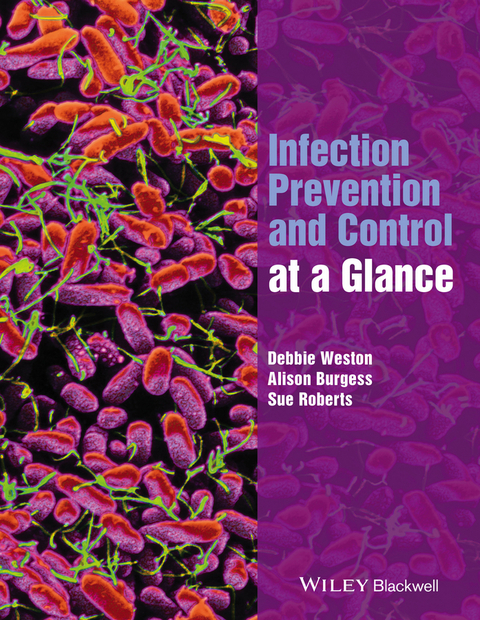
Infection Prevention and Control at a Glance (eBook)
John Wiley & Sons (Verlag)
978-1-118-97352-3 (ISBN)
Infection Prevention and Control at a Glance isthe perfect companion for study and revision for pre-registration nursing and healthcare students, as well as qualified nurses and medical students.
Infection prevention and control is one of the key five 'essential skills clusters' that is incorporated into all pre-registration nursing programmes. This highly visual and dynamic book is a thorough resource for nurses wanting to consolidate and expand their knowledge of this important part of nursing. Written by experienced infection prevention and control specialist nurses, it provides a concise and simple approach to a vast and complex subject, and equips the reader with key information in relation to various aspects of infection prevention and control practice.
- Provides a snap-shot of the application of infection prevention and control in practice and the key infections affecting patients in both acute and primary care
- A uniquely visual and accessible overview of a topic of relevance to all nursing staff
- Includes key points for clinical practice, patient management, and signposting of key national guidance documents and websites
- Available in a wide-range of digital formats - perfect for 'on the go' study and revision
Infection Prevention and Control at a Glance is the perfect companion for study and revision for pre-registration nursing and healthcare students, as well as qualified nurses and medical students. Infection prevention and control is one of the key five essential skills clusters that is incorporated into all pre-registration nursing programmes. This highly visual and dynamic book is a thorough resource for nurses wanting to consolidate and expand their knowledge of this important part of nursing. Written by experienced infection prevention and control specialist nurses, it provides a concise and simple approach to a vast and complex subject, and equips the reader with key information in relation to various aspects of infection prevention and control practice. Provides a snap-shot of the application of infection prevention and control in practice and the key infections affecting patients in both acute and primary care A uniquely visual and accessible overview of a topic of relevance to all nursing staff Includes key points for clinical practice, patient management, and signposting of key national guidance documents and websites Available in a wide-range of digital formats - perfect for 'on the go' study and revision
Debbie Weston Assistant Director Infection Prevention and Control Dartford and Gravesham NHS Trust Alison Burgess Health Protection Practitioner Public Health England Sue Roberts Deputy Director Lead Nurse, Infection Prevention and Control East Kent Hospitals University NHS Foundation Trust
Preface vii
Acknowledgements viii
Part I Introduction to infection prevention and control 1
1 Infection prevention and control (IP&C) 2
2 Communicable diseases 6
3 Bacterial classification and structure 8
4 Bacterial virulence factors 10
5 Viral classification and structure 12
6 The innate immune response 14
7 The acquired immune response 16
8 Principles of specimen collection 18
9 The microbiology laboratory 20
10 Antibiotics and prescribing 22
11 Antimicrobial resistance 24
Part II The principles of infection prevention and control 27
12 The chain of infection 28
13 Vaccination 32
14 Hand hygiene 34
15 Surgical hand preparation 38
16 Personal protective equipment 41
17 Environmental cleaning and disinfection 44
18 Sharps 46
19 Aseptic non-touch technique 48
Part III Clinical practice aspects of IP&C 53
20 The infection prevention management of intravascular devices 54
21 Isolation and cohort nursing 56
22 Management of patients with infectious diarrhoea 58
23 Investigation and management of outbreaks 60
24 Prevention and treatment of surgical site infection 62
25 Recognition and management of sepsis 64
Part IV Infections and infectious diseases 67
26 Bloodborne viruses 68
27 Bordetella pertussis 72
28 Campylobacter jejuni 74
29 Gram-negative carbapenemase-producing organisms, including Enterobacteriaceae 76
30 Catheter-associated urinary tract infection 78
31 Clostridium difficile: prevention and control 80
32 Community- and hospital-acquired pneumonia 82
33 Ebola virus disease 86
34 Infestation 92
35 Influenza 96
36 Invasive group A streptococcal disease 98
37 Legionella 100
38 Measles, mumps and rubella 102
39 Meningococcal disease 104
40 Norovirus 106
41 Pandemic influenza 108
42 Salmonella 110
43 Staphylococcus aureus and MRSA 112
44 Tuberculosis 116
45 Varicella zoster 120
Glossary 123
References 125
Index 134
'This book is an excellent resource for all who have an interest in the field of infection prevention and control (IPC), including nursing students ... The authors, who are IPC nurse specialists, have produced an exceptional publication with a concise and colourfully designed format that distinguishes it from many leading IPC publications. The book makes use of simple, user-friendly illustrated diagrams and text boxes that cover a variety of IPC topics and concerns faced by these specialist nurses on a daily basis ... The book is also fully referenced with national and international key documents and guidance. This refreshing read will be referred to time and time again by IPC nurses new to the profession, as well as their more experienced colleagues' - Nursing Standard- Feb 17
1 Infection prevention and control (IP&C)
A healthcare associated infection (HCAI) can be defined as ‘an infection occurring in a patient during the process of care in a hospital or other healthcare facility, which was not present or incubating at the time of admission. This includes infections acquired in the hospital but appearing after discharge and also occupational infections among staff of the facility’ (WHO, 2011). Figure 1.1, Boxes 1 and 2, describes individual patient and other risk factors for the development of HCAIs; Box 3 lists the top six HCAIs.
HCAIs are significant harm events and healthcare staff have to be aware of their implications, not just from an individual patient perspective (patients can, and do, die from infections that they did not come into hospital with, or contracted as a result of hospital or other healthcare intervention), but also in the wider context. It is important to have a high awareness of the possibility of HCAI in both patients and healthcare staff to ensure early and rapid diagnosis resulting in effective treatment and containment of infection.
The introduction of national reduction, and local ‘stretch’, targets for MRSA bloodstream infections (see Chapter 43) and Clostridium difficile (see Chapter 31) , has kept these organisms at the top of the Department of Health agenda and in the media spotlight since 2004. These targets have largely been successful.
The focus has been on the implementation of evidence-based best practice and adherence to sound infection prevention and control practice, supported by a large number of Department of Health / NHS England / Public Health England drives, initiatives and legislation. MRSA and C. difficile, however, are just the tip of the iceberg, as the nature of infections and infectious diseases is constantly evolving. At the time of writing, the greatest ‘infection control’ threat that the NHS is facing is not from pandemic influenza (see Chapter 41) or another outbreak of Ebola virus disease (see Chapter 33) but from multi-drug resistant Gram-negative bacteria (see Chapter 29), which presents a global public health threat and, perhaps, the beginning of a world without antibiotics. The application of, and compliance with, infection prevention and control as part of everyday practice is going to become more crucial to patient care than ever, given the risk of patients dying from infections that previously could have been treated.
Organisms causing HCAIs
Figure 1.1, Box 4, lists the ‘alert organisms’ that are commonly implicated in HCAIs, as they can cause cross-infection and outbreaks in healthcare settings. There are also a number of ‘alert conditions’ that have wider public healthcare implications (see Figure 1.1, Box 5).
While HCAIs are, on the majority of occasions, acquired as a result of cross-infection arising from exposure to other colonised or infected patients or staff, they can arise endogenously from the patient’s own resident microbial population, particularly where invasive devices (see Chapters 20 and 30) are inappropriately managed. Communicable diseases (see Chapter 2) acquired in healthcare settings through exposure to other patients, relatives or healthcare staff, can also be considered to be healthcare associated.
The Health and Social Care Act (Code of Practice)
The Code of Practice on the prevention and control of infections and related guidance (DH, 2015) came into being in 2008 as part of the Health and Social Care Act, which established the Care Quality Commission (CQC) (http://cqc.org.uk).The Health and Social Care Act 2008 and its regulations are law, and must be complied with.
Since April 2009, NHS Trusts have been legally required to register with the Care Quality Commission (CQC) under the Health and Social Care Act, 2008, and as a legal requirement of their registration must protect patients, workers and others who may be at risk of a healthcare associated infection. This has since extended to encompass other NHS bodies, independent healthcare and social care providers, primary dental care and independent sector ambulance providers and primary medical care providers.
In relation to HCAI, the CQC will monitor compliance with the statutory requirements of registration and will judge whether the requirement is met with reference to the Code of Practice. In cases of failure to comply with the registration requirements, the CQC has a range of enforcement powers that it can use to respond to breaches and which are proportionate to the risk of infection. It may draw the breach to the registered provider’s attention and give the provider an opportunity to put it right within a reasonable period of time. In extreme cases the CQC has the power to cancel registration.
Table 1.1 lists the 10 Compliance Criteria of the Code of Practice.
IP&C – everybody’s business
Infection prevention and control is an integral part of an effective risk management and patient safety programme and as such must be embedded in every aspect of patient care in every conceivable patient / healthcare setting by all healthcare staff. It is important to note that Registered Nurses and Midwives are bound by the Nursing and Midwifery Council (NMC) Professional Standards of practice and behaviour for Nurses and Midwives (The Code) (NMC, 2015), and medical staff registered with the General Medical Council (GMC) and licensed to practise medicine have to abide by the GMC’s Good Practice Guidance (2013) (http://www.gmc-uk.org/guidance/good_medical_practice.asp).
Good management and organisation are crucial to establishing high standards of infection control. All healthcare providers must ensure that they have systems in place that address:
- leadership
- management arrangements
- design and maintenance of the environment and devices
- application of evidence-based protocols and practices for both users and staff
- education, training, information and communication.
All staff are responsible for the care that they give, and are accountable or answerable to someone for their actions. They also have a duty of care, which is a legal obligation to ensure that patients in their care come to no harm as a consequence of any act or omission by the healthcare worker. The Infection Prevention and Control Team (IP&CT) are required to hold staff to account and to challenge poor practice and non-compliance (compliance essentially means acting in accordance with agreed standards or guidelines). Therefore it is essential that staff understand that they are responsible for their practice in relation to IP&C, and for protecting the patients in their care as far it is practically and reasonably possible from HCAIs, and that they are answerable to someone if they are non-compliant. For example, failure to record the visual infusion phlebitis (VIP) scores for two days on a patient with a peripheral cannula in situ (see Chapter 20) leading to a bloodstream infection (BSI – bacteraemia or septicaemia; see Chapter 25) could be viewed as negligent, meaning that harm has been caused to the patient through careless omission (as opposed to a deliberate act), and that the duty of care has been breached.
Holding staff to account however is not about apportioning blame. It is about encouraging responsibility, ownership and engagement, and the IP&CT and healthcare staff working together to reduce, prevent, control and manage HCAIs and the risk to patients. IP&C is an integral component of patient centred care, and all aspects of IP&C clinical practice must be viewed as being as important as all other aspects of patient care, not as add-ons.
Staff must have the competency or ability to undertake tasks or clinical interventions; part of this ability means possessing the necessary knowledge and skills. To undertake clinical activities / interventions without the appropriate knowledge or skills or training places patients and healthcare workers at risk. Staff must also be aware that if there are omissions or gaps in a patient’s paperwork in relation to the documentation of IP&C interventions, the legal interpretation is that care was not given.
Avoidable versus unavoidable infections
Avoidable HCAIs are essentially those where poor clinical practice and non-compliance with IP&C can be evidenced / demonstrated. Any successful reduction in HCAIs requires a zero tolerance approach by all healthcare staff with regard to poor infection control practice, non-compliance with policies, protocols and evidence-based best practice recommendations, and avoidable infections.
HCAIs and the Duty of Candour
All NHS provider bodies registered with the Care Quality Commission (CQC) have to comply with the new Statutory Duty of Candour as a requirement of their registration.
The Duty of Candour is legal duty on hospital, community and mental health Trusts to inform and apologise to patients if there have been mistakes in their care that have led to significant harm. It is therefore applicable to all healthcare professionals in all settings who have a professional responsibility to be honest with patients when things go wrong. This includes reporting incidents and near misses, being open and honest with patients / clients and their carers, and apologising. With regard to applying the Duty of Candour in relation to HCAIs, the onus is on the medical team...
| Erscheint lt. Verlag | 28.9.2016 |
|---|---|
| Reihe/Serie | At a Glance (Nursing and Healthcare) |
| Wiley Series on Cognitive Dynamic Systems | Wiley Series on Cognitive Dynamic Systems |
| Sprache | englisch |
| Themenwelt | Medizin / Pharmazie ► Medizinische Fachgebiete |
| Medizin / Pharmazie ► Pflege ► Ausbildung / Prüfung | |
| Studium ► Querschnittsbereiche ► Infektiologie / Immunologie | |
| Schlagworte | Acute Care • clinical practice • General Clinical Nursing • Infection control • infection prevention • Infectious Disease & Microbiology • Infektionskrankheiten u. Mikrobiologie • Klinische Krankenpflege • Krankenpflege • Medical Science • Medizin • nursing • nursing practice • Patient Management • Primary Care • Student nurses |
| ISBN-10 | 1-118-97352-6 / 1118973526 |
| ISBN-13 | 978-1-118-97352-3 / 9781118973523 |
| Informationen gemäß Produktsicherheitsverordnung (GPSR) | |
| Haben Sie eine Frage zum Produkt? |
 EPUB (Adobe DRM)
Kopierschutz: Adobe-DRM
Adobe-DRM ist ein Kopierschutz, der das eBook vor Mißbrauch schützen soll. Dabei wird das eBook bereits beim Download auf Ihre persönliche Adobe-ID autorisiert. Lesen können Sie das eBook dann nur auf den Geräten, welche ebenfalls auf Ihre Adobe-ID registriert sind.
Details zum Adobe-DRM
Dateiformat: EPUB (Electronic Publication)
EPUB ist ein offener Standard für eBooks und eignet sich besonders zur Darstellung von Belletristik und Sachbüchern. Der Fließtext wird dynamisch an die Display- und Schriftgröße angepasst. Auch für mobile Lesegeräte ist EPUB daher gut geeignet.
Systemvoraussetzungen:
PC/Mac: Mit einem PC oder Mac können Sie dieses eBook lesen. Sie benötigen eine
eReader: Dieses eBook kann mit (fast) allen eBook-Readern gelesen werden. Mit dem amazon-Kindle ist es aber nicht kompatibel.
Smartphone/Tablet: Egal ob Apple oder Android, dieses eBook können Sie lesen. Sie benötigen eine
Geräteliste und zusätzliche Hinweise
Buying eBooks from abroad
For tax law reasons we can sell eBooks just within Germany and Switzerland. Regrettably we cannot fulfill eBook-orders from other countries.
aus dem Bereich