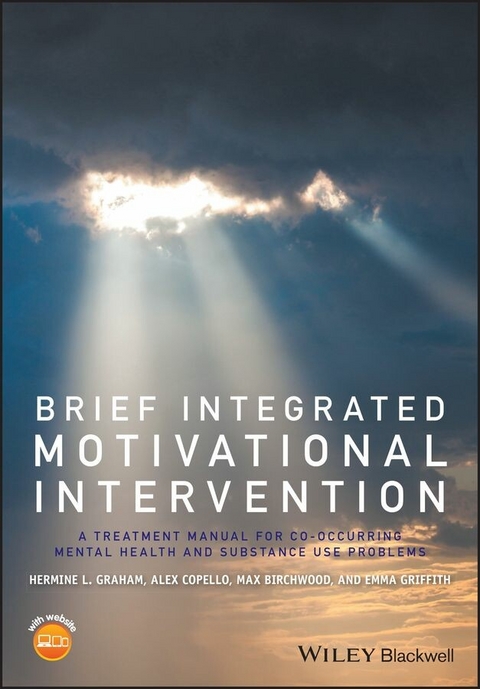
Brief Integrated Motivational Intervention (eBook)
John Wiley & Sons (Verlag)
978-1-119-16667-2 (ISBN)
A TREATMENT MANUAL FOR CO-OCCURRING MENTAL HEALTH AND SUBSTANCE USE PROBLEMS
Brief Integrated Motivational Intervention provides clinicians and specialist practitioners with a brief, evidence-based treatment approach for motivating clients who have comorbid mental health and alcohol and drug misuse issues. Developed by an expert team with many years of research and practice experience in the fields of psychosis and addiction, this approach combines cognitive behavioural therapy (CBT), motivational interviewing, and the authors' own cognitive-behavioural integrated treatment (C-BIT). It allows practitioners to engage clients in meaningful dialogue for change during short windows of opportunity following relapses or admittance to psychiatric hospital, and helps clients consider the impact of substance misuse on their mental health. Easy to understand and implement, this guide also includes helpful tools for practitioners, such as session-specific content, illustrative case material, easy-to-use worksheets, and additional information for family members and friends.
Hermine L. Graham is a Consultant Clinical Psychologist and Lecturer at the University of Birmingham, UK. She has expertise in cognitive behavioural therapy, and has led the development and research of service models and treatment approaches for people with severe mental health and co-occurring alcohol and drug problems in Birmingham. This work has been highlighted as a model of 'good practice,' and is referenced in national policy guidelines for the treatment of 'dual diagnosis' (DoH, 2002). She has published widely in academic peer-reviewed journals and is co-author of Cognitive-Behavioural Integrated Treatment (C-BIT) (Wiley, 2004) and co-editor of Substance Misuse in Psychosis (Wiley, 2003).
Alex Copello is Professor of Addiction Research at the School of Psychology at the University of Birmingham, UK, and Consultant Clinical Psychologist with the Birmingham and Solihull NHS Foundation Trust. His career has combined clinical and academic work, and his research has had a major impact on addiction treatment in the UK in recent years. He has published widely in academic journals and books.
Max Birchwood is Professor of Youth Mental Health at the University of Warwick, UK. He pioneered the concept and practice of early intervention in psychosis, and opened the UK's first Early Intervention in Psychosis service in 1994. He has published widely in the field of psychosis, and is the author of many books.
Emma Griffith is a Lecturer and Clinical Tutor at the University of Bath, UK, and a Clinical Psychologist in Avon and Wiltshire Partnership Mental Health NHS Trust. She is accredited as a Cognitive Behavioural Psychotherapist by the British Association for Behavioural & Cognitive Psychotherapies (BABCP).
BRIEF INTEGRATED MOTIVATIONAL INTERVENTION BRIEF INTEGRATED MOTIVATIONAL INTERVENTION A TREATMENT MANUAL FOR CO-OCCURRING MENTAL HEALTH AND SUBSTANCE USE PROBLEMS Brief Integrated Motivational Intervention provides clinicians and specialist practitioners with a brief, evidence-based treatment approach for motivating clients who have comorbid mental health and alcohol and drug misuse issues. Developed by an expert team with many years of research and practice experience in the fields of psychosis and addiction, this approach combines cognitive behavioural therapy (CBT), motivational interviewing, and the authors own cognitive-behavioural integrated treatment (C-BIT). It allows practitioners to engage clients in meaningful dialogue for change during short windows of opportunity following relapses or admittance to psychiatric hospital, and helps clients consider the impact of substance misuse on their mental health. Easy to understand and implement, this guide also includes helpful tools for practitioners, such as session-specific content, illustrative case material, easy-to-use worksheets, and additional information for family members and friends.
Hermine L. Graham is a Consultant Clinical Psychologist and Lecturer at the University of Birmingham, UK. She has expertise in cognitive behavioural therapy, and has led the development and research of service models and treatment approaches for people with severe mental health and co-occurring alcohol and drug problems in Birmingham. This work has been highlighted as a model of "good practice," and is referenced in national policy guidelines for the treatment of "dual diagnosis" (DoH, 2002). She has published widely in academic peer-reviewed journals and is co-author of Cognitive-Behavioural Integrated Treatment (C-BIT) (Wiley, 2004) and co-editor of Substance Misuse in Psychosis (Wiley, 2003). Alex Copello is Professor of Addiction Research at the School of Psychology at the University of Birmingham, UK, and Consultant Clinical Psychologist with the Birmingham and Solihull NHS Foundation Trust. His career has combined clinical and academic work, and his research has had a major impact on addiction treatment in the UK in recent years. He has published widely in academic journals and books. Max Birchwood is Professor of Youth Mental Health at the University of Warwick, UK. He pioneered the concept and practice of early intervention in psychosis, and opened the UK's first Early Intervention in Psychosis service in 1994. He has published widely in the field of psychosis, and is the author of many books. Emma Griffith is a Lecturer and Clinical Tutor at the University of Bath, UK, and a Clinical Psychologist in Avon and Wiltshire Partnership Mental Health NHS Trust. She is accredited as a Cognitive Behavioural Psychotherapist by the British Association for Behavioural & Cognitive Psychotherapies (BABCP).
About The Companion Website xi
About The Authors xii
Acknowledgments xv
1 Introduction 1
A Window of Opportunity 1
Brief Integrated Motivational Intervention (BIMI) 4
Approach 4
Timing 4
Structure 5
2 Getting Started: Engagement And Brief Assessment 8
Staying Motivated 8
Step 1: Building Engagement And Assessment 9
Session One Overview 10
Session One Outline 10
BIMI Brief Assessment 12
Generating The Personalized Assessment Feedback Sheet 31
Session Two Overview 36
Session Two Outline 36
Frequently Asked Questions (Faqs) 42
Alcohol 43
Drugs And Mental Health 46
Additional Resources 52
3 Making Decisions About Change 53
How To Decide On The Next Step 53
How To Decide What Step Is Appropriate For The Client 53
Step 2: Making Decisions With Your Client 56
Outline Of Sessions 57
Identifying The "Benefits" Of Using 57
Identifying Positive Thoughts And Mis-Held Beliefs About Alcohol And Drugs 58
Taking Another Look At What You Think About Alcohol And Drugs 60
Relationship Between Mental Health Problems And Substance Use 62
Reviewing Any "Costs" Of Using 65
4 Change 69
Step 3: Change Plans And Social Support 69
Outline Of Sessions 71
Taking Steps Toward My Goals 71
Coping With Setbacks 72
Strategies To Cope With Cravings And Urges 73
Social Support for Change 75
Developing Supportive Social Networks 76
Outline Of Sessions 76
Helpful Information For Family Members Or Supportive Social Network Members 78
Understanding Cannabis, Alcohol, And Other Substance Use, And How It Impacts On Family And Others 79
Do Others Experience Similar Problems? 80
How Do I Make Sense of This? 80
Why Do I Feel So Stressed? 81
To Sum It Up 82
How Can I Best Support My Family Member or Friend? 83
5 Boosting Change 85
Booster Session Content 85
Booster Session Outline 86
Review Self-Motivational Statements of Concern And Intention To Change 87
Review The Maintenance Cycle For Mental Health Problems And Substance Use 87
Review Progress With Substance-Related Goal And Skills To Tackle Setbacks 88
Review Social Support For Change 88
Link In With Community-Based Substance Misuse Treatment Services 89
Appendix Worksheets And Handouts 90
Worksheet 1: What Do I Enjoy About Using or What Keeps Me Using? 97
Worksheet 2: What I Enjoy About Using or What Keeps Me Using (Table) 99
Worksheet 3: How Does My Use Sometimes Affect Me? 100
Worksheet 4: Taking Steps Toward My Goal 101
Handout 1: Helpful Information For Family Members Or Supportive Social Network Members 102
Understanding Cannabis, Alcohol, And Other Substance Use, And How It Impacts on Family And Others 102
Do Others Experience Similar Problems? 103
How Do I Make Sense of This? 104
Why Do I Feel So Stressed? 105
To Sum It Up 105
Handout 2: How Can I Best Support My Family Member Or Friend? 107
Keeping Communication Open 107
Supporting His or Her Goals 107
References 108
Index 115
CHAPTER TWO
Getting Started: Engagement and Brief Assessment
Staying Motivated
To successfully work with a client, and not become discouraged and despondent when he or she initially engages but the next time says “I am not interested,” it may be necessary for you to take a step back and perhaps remind yourself of how long it may have taken you to change a “habit” in your own life. There is a need to take into account a number of factors that will influence how BIMI progresses and what is seen as a “successful” result. These include reminding yourself that “ambivalence” is a normal part of the change process, and that change usually occurs over time. Also, the client may not have come into treatment or hospital willingly this time or in the past, and hence may be quite angry about mental health services or being in hospital—and yet, however, may welcome having an opportunity to talk to someone. Therefore, keep an open, non‐judgmental, and reflective style; remain optimistic; and take a long‐term perspective.
During your initial session with the client, you can use the brief assessment to engage the client in talking openly about drug and alcohol use, mental health, and general well‐being. It is possible that he or she has not really had a chance to sit back and talk about the role of alcohol or drug use in poor mental health and/or hospital admissions. During this hospital admission or period, with time on their hands, it may be an opportunity for clients to reflect and develop greater awareness.
Your aim:
- Build a good working relationship with the client
- Increase the client’s awareness about the impact of alcohol and drugs
- Introduce the client to the idea that change is possible
STEP 1: Building Engagement and Assessment
| Session Content | Session Goals |
STEP 1: Building Engagement and Assessment
|
|
The assessment completed as part of BIMI is intended to be completed within the context of the broader clinical and risk assessments, and information gathering completed as part of the psychiatric inpatient admission or mental health treatment care plan. The core elements of the brief assessment do not therefore include the completion of a semi‐structured clinical interview; instead, they focus in the first session on the completion of questionnaires by the client and, in the second session, the feedback of these results to the client.
Session One Overview
The first session of BIMI is a vital session. This initial meeting represents the first time you and the client will have met specifically for the purpose of talking openly about alcohol and drug use and building motivation to change substance misuse. You may have already been working with this client as part of his or her treatment, and so it is important to ensure that BIMI sessions are seen differently and represent “protected” time for you and the client. In the first session of BIMI, when you are completing the relevant questionnaires on the BIMI Brief Assessment Sheet, it is an important opportunity to build a good collaborative working relationship with the client. Following this, the questionnaires are scored, and then personalized feedback developed. The second session then focuses on sharing the personalized Assessment Feedback Sheet, called “Your Results,” with the client and leaving him or her with a copy of it.
The initial session aims:
- To develop a non‐judgmental, working relationship where the client feels that he or she can talk openly with you about his or her alcohol and drug use
- Complete the questionnaires that are relevant to the client and develop personalized assessment feedback
Session One Outline
Remember, for this session you will need:
- The BIMI Brief Assessment Sheet to complete with the client
Start by introducing yourself and explaining what BIMI is about. You can use a statement such as the example given in the following text and adapt it according to the setting and client.
- The time people spend in hospital (or when they start to feel unwell) can be a time when they think about their lives, including about the use of drugs and alcohol. Our aim is to help support people to do this and to help them explore how drug and alcohol use may have played an important part in their being admitted to a hospital (or them feeling unwell).
- Why have you been chosen? We want to invite people who are on inpatient units (or are experiencing mental health problems) and who have used alcohol or drugs to have an opportunity to talk.
- What will it involve? We will meet for about three to six brief meetings (each will last about 15–30 minutes). This first meeting will involve some questionnaires about how you are feeling and about drugs and alcohol, and hence may take a little longer. Next time we meet, we will look together at all of this information, and you can talk about how you feel and about your drug and alcohol use. If you start to feel uncomfortable and decide that you no longer want to talk about this, we can stop, and it will not affect the care you receive.
- Let us start by talking about alcohol and drug use…
At this point, you will need to systematically take the client through the BIMI Brief Assessment Sheet (Table 2.1); all the questionnaires included in it are described in the next section titled “BIMI Brief Assessment”. This information is designed to be collected from the client using a conversational style. Completion of this assessment measure will take approximately 30–40 minutes. It is important that you adopt an open, non‐judgmental approach while collecting this information about the client’s alcohol and drug use. Remember not to express shock or surprise; your aim is simply to develop a non‐judgmental working relationship where the client feels able to talk openly and honestly about his or her alcohol and drug use. If you are not familiar with the drugs the client is using or how he or she uses them, invite him or her to describe the drugs and tell you about them. This will serve to engage the client in a collaborative working relationship with you. If you are certain that the client is using other substances but has not reported it, focus on what he or she is willing to talk about at this stage. The client may feel comfortable to bring it up at a later stage. Remember when you are completing the BIMI Brief Assessment to turn the worksheet to the client, so that he or she can see it and the information is gathered collaboratively. Ensuring the client feels involved in the process will serve to aide engagement and help them recognize their expertise in their own experience.
Table 2.1 BIMI Brief Assessment Sheet.
Source: Drug and alcohol use in the past 30 days (based on MAP, Marsden et al., 1998)
| Alcohol | Cannabis | Crack Cocaine | Cocaine Powder | Legal Highs | Heroin | Illicit Methadone | Amphetamine | Other |
| Have you used this in the past 30 days? |
| When did you last use this? |
| What is the amount you use on a typical day? |
| How much do you spend on this on a typical day? |
| What route? Oral Smoke/Chase Snort/Sniff Intravenous |
| During a typical week how frequently would you use this? |
| How old were you when you first used... |
| Erscheint lt. Verlag | 1.9.2016 |
|---|---|
| Sprache | englisch |
| Themenwelt | Geisteswissenschaften ► Psychologie ► Klinische Psychologie |
| Medizin / Pharmazie ► Allgemeines / Lexika | |
| Medizin / Pharmazie ► Gesundheitsfachberufe | |
| Medizin / Pharmazie ► Medizinische Fachgebiete ► Psychiatrie / Psychotherapie | |
| Schlagworte | addiction • Addictions • Alcohol misuse • C-BIT • CBT • Clinical psychology • Cognitive behavioral therapy (CBT) • community-based treatment • comorbidity • drug misuse • Drug use • dual diagnosis</p> • Gesundheits- u. Sozialwesen • Health & Social Care • hospital admission • Inpatient treatment • Intervention • Klinische Psychologie • Kognitive Verhaltenstherapie • <p>Substance abuse • mental health problems • mental ill health • Motivational Interviewing • Patient engagement • Psychiatry • Psychologie • Psychology • Psychosis • Relapse • Schizophrenia • severe mental health problems • Sucht • Suchtforschung |
| ISBN-10 | 1-119-16667-5 / 1119166675 |
| ISBN-13 | 978-1-119-16667-2 / 9781119166672 |
| Informationen gemäß Produktsicherheitsverordnung (GPSR) | |
| Haben Sie eine Frage zum Produkt? |
 EPUB (Adobe DRM)
Kopierschutz: Adobe-DRM
Adobe-DRM ist ein Kopierschutz, der das eBook vor Mißbrauch schützen soll. Dabei wird das eBook bereits beim Download auf Ihre persönliche Adobe-ID autorisiert. Lesen können Sie das eBook dann nur auf den Geräten, welche ebenfalls auf Ihre Adobe-ID registriert sind.
Details zum Adobe-DRM
Dateiformat: EPUB (Electronic Publication)
EPUB ist ein offener Standard für eBooks und eignet sich besonders zur Darstellung von Belletristik und Sachbüchern. Der Fließtext wird dynamisch an die Display- und Schriftgröße angepasst. Auch für mobile Lesegeräte ist EPUB daher gut geeignet.
Systemvoraussetzungen:
PC/Mac: Mit einem PC oder Mac können Sie dieses eBook lesen. Sie benötigen eine
eReader: Dieses eBook kann mit (fast) allen eBook-Readern gelesen werden. Mit dem amazon-Kindle ist es aber nicht kompatibel.
Smartphone/Tablet: Egal ob Apple oder Android, dieses eBook können Sie lesen. Sie benötigen eine
Geräteliste und zusätzliche Hinweise
Buying eBooks from abroad
For tax law reasons we can sell eBooks just within Germany and Switzerland. Regrettably we cannot fulfill eBook-orders from other countries.
aus dem Bereich