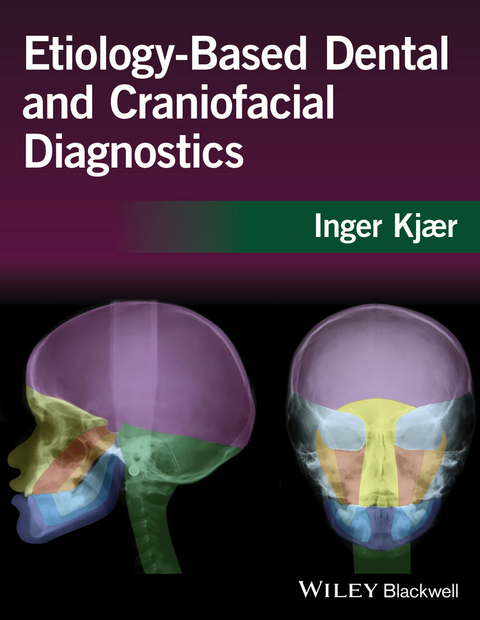
Etiology-Based Dental and Craniofacial Diagnostics (eBook)
John Wiley & Sons (Verlag)
978-1-118-91210-2 (ISBN)
Etiology-Based Dental and Craniofacial Diagnostics explores the role of embryology and fetal pathology in the assessment, diagnosis, and subsequent treatment planning of a wide range of disorders in the dentition and craniofacial region. Initial chapters cover various aspects of normal dental and craniofacial development, providing the necessary biological background for understanding abnormal patient cases. Chapters then focus on the etiology behind a wide range of cases observed in everyday practice-including deviations in tooth morphology and number, tooth eruption, root and crown resorption, and craniofacial malformations, disruptions and dysplasia.
- Unique new work from a leading authority in orthodontics, craniofacial embryology and fetal pathology
- Demonstrates how human prenatal development offers unique insights into postnatal diagnosis and treatment
- Clinical significance and implications are highlighted in summaries at the end of each chapter
- Ideal for postgraduate students in orthodontics, paediatric dentistry and oral medicine
Etiology-Based Dental and Craniofacial Diagnostics explores the role of embryology and fetal pathology in the assessment, diagnosis, and subsequent treatment planning of a wide range of disorders in the dentition and craniofacial region. Initial chapters cover various aspects of normal dental and craniofacial development, providing the necessary biological background for understanding abnormal patient cases. Chapters then focus on the etiology behind a wide range of cases observed in everyday practice including deviations in tooth morphology and number, tooth eruption, root and crown resorption, and craniofacial malformations, disruptions and dysplasia. Unique new work from a leading authority in orthodontics, craniofacial embryology and fetal pathology Demonstrates how human prenatal development offers unique insights into postnatal diagnosis and treatment Clinical significance and implications are highlighted in summaries at the end of each chapter Ideal for postgraduate students in orthodontics, paediatric dentistry and oral medicine
Inger Kjær is Professor Emerita at the University of Copenhagen, Denmark. A specialist in orthodontics, Inger has two doctoral theses; one in odontology and one in medicine. She has held university positions for 29 years and chief clinical positions in orthodontics and pediatric dentistry outside the university for 11 years. These positions have formed the basis for 214 international scientific articles and a worldwide teaching experience for pre- and postgraduate professionals. Inger is co-author of The Prenatal Human Cranium: Normal and Pathological Development (Wiley-Blackwell, 1999).
"I strongly recommend the book to specialists and postgraduate students in orthodontics and paediatrics as well as to undergraduate dental students and other medical professionals who are treating patients with craniofacial deformities. The book can also be used as a reference for researchers interested in dentoalveolar and craniofacial diagnosis and treatment." - Lars Bondemark (Danish Dental Journal March 2017)
"This book should be available in all clinics where not only children but also adult patients are being seen; it provides a wealth of material not earlier presented." - Birte Melsen (AJO-DO)
Introduction
The scientific and clinical knowledge presented in this book is primarily based on personal research in normal and pathological prenatal cranial development combined with postnatal clinical experience in pediatrics, orthodontics, and diagnostics of rare human developmental conditions.
The purpose of this book is to focus on the etiology behind the clinical questions that are encountered in everyday practice, and which make diagnostics and treatment difficult. These questions include the following.
- What is the mechanism behind tooth eruption? Can we explain this phenomenon?
- How and when does the periodontal membrane develop?
- After a tooth has emerged, it continues to erupt. What happens in the periodontal membrane during this continued eruption?
- How is continued eruption associated with growth of the alveolar process?
- Why do some areas in the jaws frequently contain abnormalities while others do not?
- Can we explain correlations between findings in the maxilla and the mandible?
- Why is there such a great difference between primary and permanent teeth regarding the occurrence of agenesis, resorption, and eruption?
- What protects a permanent tooth root from resorption?
- Are there similarities between the periodontal membrane of a primary tooth and the periodontal membrane of a permanent tooth?
- Can signs in the primary dentition predict the later development of the permanent dentition?
- How do diseases and/or the intake of medicine influence dental and craniofacial development?
All these central questions have had no clear answer until now. The issue has been that traditional research in the craniofacial region has been restricted by ethical, technical, and biological limits. In this book, experience from prenatal research is introduced and it is demonstrated how several but not all of these questions can be answered. The results presented are primarily based on the author's research referred to in the reference lists at the end of each chapter.
Limited Access to Human Material
Prenatal human studies only allow studies on spontaneous or medically induced abortions by special indications and permissions before gestational age (GA) 20 weeks. At this early stage, the roots of the primary teeth have not developed and the periodontal tissue is therefore not available for histological research. The cranium, however, is nearly completely formed and can be studied radiographically, histologically, and anthropologically. A main problem with prenatal tissue studies is that the tissue is often fragmented and it can be partially autolyzed.
Postnatal studies of the dentition are conducted clinically and are supplemented by radiological analysis, including three-dimensional (3D) analysis. These analyses concern tooth maturity and morphology. Migration of teeth before eruption can also be studied. Histological studies of normal tooth development can be done on extracted teeth, but in these cases the periodontium is often lacerated and it can be difficult to describe the structure. The entire periodontium surrounding a tooth can only be studied in autopsy materials or by surgical removal of a tooth and the surrounding tissue. Both cases provide a cross-sectional insight into a periodontal membrane which can be normal but which is most likely not normal. In cases of pathological tooth development where the tooth is removed, the specimens can provide information about the histomorphological diagnosis. Postnatally, the cranium can be studied using anthropological, radiographical, and histopathological methods.
The only studies that allow longitudinal observation are radiographical studies after birth. It is possible to conduct animal studies, but results from these studies cannot be transferred uncritically to human conditions.
Content and Structure of the Book
A book like this has not been written before. It concerns normal hard tissue development in the cranium and the dentition and creates a foundation for clinical diagnostics and for the etiology behind the diagnosis. Furthermore, this knowledge creates a basis for later genetic and molecular-biological research.
The book is structured into three main parts.
- The first part includes chapters which cover different aspects of normal dental and craniofacial development. The text is supplemented with fetal pathology cases. These chapters cover the basic biological background for understanding abnormal patient cases. Such cases are demonstrated.
- The second part (Chapter 7) demonstrates the obstacles faced in etiology-based diagnostics of the dentition and cranium. This part also introduces the international classification of abnormal development used in the final part of the book.
- The third part covers abnormal development and focuses on the etiology behind everyday cases and unusual cases sporadically observed in the clinic. The text is again highlighted with fetal pathology cases. The final chapter discuss questions on the treatment of severe cases as well as cases in which the etiologies are still unsolved. It is hoped that this text will lead to thoughtful discussions and collaborations between professionals in the clinic and the science laboratory.
In each chapter, the “why” questions will be the focus. This applies to both normal and pathological developmental processes. Some explanations of these “why” questions have been documented. Others are still hypothetical and there are others that have no clear answer. This book has been written to promote the improvement of dental and craniofacial diagnostics and to provide ideas for future research.
Acknowledgments
As a student of former Professor Arne Björk and as a colleague of former Professor Beni Solow, I would like to acknowledge the valuable and inspiring scientific environment that these distinguished teachers created in the orthodontic department in Copenhagen for science, pioneer research and critical thinking during the years 1951–2000. Professor Björk inspired me to attack scientific problems nontraditionally and he gave me complete freedom through five years to develop my own way of thinking.
This book has become a reality due to collaboration between outstanding experts in widely varied subject fields: pedodontics, orthodontics, pediatrics, fetal pathology, anthropology, and multidisciplinary hospital units for cleft lip and palate treatment and rare human developmental conditions. It is therefore both an obligation and an honor for me to thank the following co-workers for their constant support for my research which has made this book possible.
- Anatomy. Assoc. professor M. E. Matthiessen, DDS, MD is acknowledged for permission to use the laboratory facilities at the Department of Anatomy, University of Copenhagen, during a 5-years period, for fruitful collaboration and introduction to histochemistry.
- Pedodontics. A large network of dentists working in the Danish healthcare systems for children and adults as well as dentists abroad have demonstrated cases for me and also inspired my studies by forwarding more than 2900 clinical inquiries.
- Orthodontics. National and international specialists in orthodontics supported my studies by asking questions and by demonstrating difficult cases regarding orthodontic diagnostics and unexplainable treatment outcomes.
- Pediatrics. Medical doctors in pediatrics are thanked for their collaboration. These are especially doctors in the fields of neuropediatrics and pediatric endocrinology. They appear as co-authors in the references of this book and have provided valuable input for craniofacial disorders.
- Fetal pathology. Chief pathologist, Birgit Fischer Hansen, MD Dr Med, specialist in fetal pathology, has contributed tremendously to the concept of transferring the fields of embryology and fetal pathology to the clinic to allow improved diagnostics and treatments. Without Birgit Fischer Hansen's professional and encouraging support over many years, this book could not have been written.
Chief pathologist, Jean Keeling, MD, specialist in fetal pathology in the UK, has outstandingly supported the early research and promoted the international conceptualization of craniofacial diagnostics.
Several other pathologists specializing in fetal pathology are acknowledged for their support of my studies. Among these is chief pathologist Ingermarie Reintoft MD who introduced me to unique cases of malformations for which I am very grateful.
Professor in oral pathology, Jesper Reibel, DDS Dr Odont, is acknowledged for guidance in questions of oral pathology.
- Anthropology. Colleagues at the medical museum, Medicinsk Museion, Copenhagen, have introduced me to the Saxthorp collection for which I am very grateful. Special thanks to the director of the museum, Professor PhD Thomas Söderqvist. Jan Jacobsen, DDS, and Pia Bennike, PhD and MSc, are both former anthropologists at the university whom I would like to acknowledge for supporting my studies in dental and craniofacial anthropology.
- Hospital teams for rare developmental conditions. Kirsten Mølsted, DDS PhD, Head of the Cleft Lip and Palate Unit at Rigshospitalet, Copenhagen, is thanked for many fruitful years of collaboration and for scientific inspiration. Kirsten Mølsted has been an excellent colleague. Bjørn Russel, DDS, former Head of the Dental Clinic at Vangedehuse Children's Hospital for Severely Handicapped Children, is thanked for...
| Erscheint lt. Verlag | 22.8.2016 |
|---|---|
| Sprache | englisch |
| Themenwelt | Medizin / Pharmazie ► Allgemeines / Lexika |
| Medizin / Pharmazie ► Gesundheitsfachberufe | |
| Medizin / Pharmazie ► Zahnmedizin | |
| Schlagworte | craniofacial embryology • craniofacial malformations • dental deviations • Dental Diagnostics • dentistry • dentition anomalies • Disruptions • dysplasia • fetal pathology • Kinderzahnheilkunde • Mundheilkunde • Mundheilkunde / Anatomie u. Physiologie • Oral Anatomy & Physiology • oral medicine • Orthodontics • Orthodontik • paediatric dentistry • Pediatric Dentistry • root and crown resorption • tooth development • Tooth Eruption • Tooth Morphology • Zahnmedizin |
| ISBN-10 | 1-118-91210-1 / 1118912101 |
| ISBN-13 | 978-1-118-91210-2 / 9781118912102 |
| Informationen gemäß Produktsicherheitsverordnung (GPSR) | |
| Haben Sie eine Frage zum Produkt? |
 EPUB (Adobe DRM)
Kopierschutz: Adobe-DRM
Adobe-DRM ist ein Kopierschutz, der das eBook vor Mißbrauch schützen soll. Dabei wird das eBook bereits beim Download auf Ihre persönliche Adobe-ID autorisiert. Lesen können Sie das eBook dann nur auf den Geräten, welche ebenfalls auf Ihre Adobe-ID registriert sind.
Details zum Adobe-DRM
Dateiformat: EPUB (Electronic Publication)
EPUB ist ein offener Standard für eBooks und eignet sich besonders zur Darstellung von Belletristik und Sachbüchern. Der Fließtext wird dynamisch an die Display- und Schriftgröße angepasst. Auch für mobile Lesegeräte ist EPUB daher gut geeignet.
Systemvoraussetzungen:
PC/Mac: Mit einem PC oder Mac können Sie dieses eBook lesen. Sie benötigen eine
eReader: Dieses eBook kann mit (fast) allen eBook-Readern gelesen werden. Mit dem amazon-Kindle ist es aber nicht kompatibel.
Smartphone/Tablet: Egal ob Apple oder Android, dieses eBook können Sie lesen. Sie benötigen eine
Geräteliste und zusätzliche Hinweise
Buying eBooks from abroad
For tax law reasons we can sell eBooks just within Germany and Switzerland. Regrettably we cannot fulfill eBook-orders from other countries.
aus dem Bereich