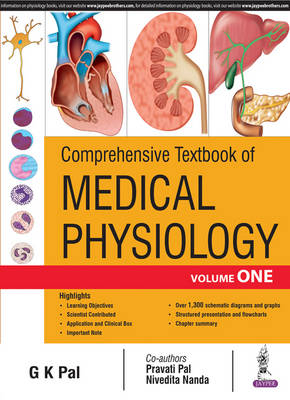
Comprehensive Textbook of Medical Physiology
Jaypee Brothers Medical Publishers (Verlag)
978-93-86056-97-9 (ISBN)
- Titel erscheint in neuer Auflage
- Artikel merken
This two volume set is a complete guide to medical physiology for undergraduate medical students.
Beginning with a general overview of the subject the following chapters each provide in depth discussion on the physiology of each anatomical system. Each section covers both clinical and applied physiology with topics enhanced by numerous photographs and diagrams.
The book features the following invaluable learning tools:
Learning objective - defined at the start of each chapter
Application boxes - key points of applied physiology highlighted in green boxes
Clinical boxes - core concepts of related diseases and patient management highlighted in pink boxes
Important notes - miscellaneous information that may be asked in viva voce examinations
Chapter summary - each chapter ends with a two-part summary outlining key concepts of the topic and listing possible long and short questions, and viva questions that may be asked in examinations
'Scientist contributed' boxes - explain historical links - highlighted in orange boxes
G K Pal MBBS BNYT MD PhD, MD FABMS FABAP FSAB Professor of Physiology, Faculty-in-Charge Pravati Pal MBBS MD MABMS Professor of Physiology Nivedita Nanda MSc PhD Assistant Professor of Biochemistry All at JIPMER, Puducherry, India
Volume 1
Section–1: General Physiology
Defining the Role of Physiology in Modern Medicine
Functional Organization of Human Body
Principles of Homeostasis
Cellular Organization and Intercellular Connections
Physiology of Genetics and Apoptosis
Transport Across the Cell Membrane
Membrane Potential
Body Fluids
Section–2: Blood and Immunity
Composition and Functions of Blood and Plasma Proteins
Bone Marrow and Hemopoiesis
Red Blood Cells
Erythropoiesis
Destruction of Red Blood Cells
Hemoglobin and Blood Indices
Pathophysiology of Anemia and Polycythemia
Blood Groups and Physiological Basis of Blood Transfusion
White Blood Cells
Thymus, Lymphoid Tissues, and Lymph
Immunity
Platelets and Their Role in Hemostasis
Blood Coagulation
Section–3: Nerve and Muscle
Part A: Nerve
Structure and Functions of Neurons
Nerve Potentials
Properties, Classification and Applied Aspects of Nerve Fibers
Part B: Neuromuscular Junction
Neuromuscular Transmission
Part C: Muscles
Structure of Skeletal Muscle: Physiological Aspects
Mechanism of Skeletal Muscle Contraction
Skeletal Muscle: Properties, Fiber Types, and Applied Aspects
Smooth Muscle and Cardiac Muscle
Section–4: Autonomic Nervous System
Functional Organization of Autonomic Nervous System
Sympathetic System
Parasympathetic System
Control of Autonomic Functions and Applied Aspects
Autonomic Function Tests
Heart Rate Variability
Section–5: Gastrointestinal System
Part A: Introduction to GI System
Functional Organization of GI System and Principles of GI Regulations
Gastrointestinal Hormones
Part B: GI Secretions
Principles of GI Secretion and Secretion of Saliva
Gastric Secretion
Pancreatic Secretion
Physiology of Liver, Liver Function Tests, and Pathophysiology of Jaundice
Biliary Secretion
Intestinal Secretion
Secretion of Large Intestine
Part C: GI Motility
Introduction to GI Motility
Chewing and Deglutition
Esophageal Motility
Gastric Motility
Small Intestinal Motility
Motility of Large Intestine
Part D: Digestion and Absorption
Principles of Digestion and Absorption
Section–6: Endocrine Physiology
Introduction to Endocrinology
Mechanisms of Hormone Action
Hypothalamus and Hypothalamo-pituitary Axis
Pituitary Gland: The Anterior Pituitary
Posterior Pituitary
Thyroid Gland
Adrenal Gland: The Adrenal Medulla
Adrenal Cortex
Endocrine Pancreas
Calcium and Phosphate Metabolism and Physiology of Bone
Parathyroid Gland, Calcitonin and Vitamin D
Pineal Gland
Local Hormones
Section–7: Reproductive System
Part A: General Reproductive Physiology
Sex Differentiation and Development, Puberty and Menopause
Physiology of Puberty and Menopause
Part B: Male Reproductive Physiology
Male Reproductive System
Part C: Female Reproductive Physiology
Female Reproductive System: Functional Anatomy, Oogenesis and Follicular Development
Menstrual Cycle and Ovulation
Ovarian Hormones and Control of Ovarian Functions
Part D: Physiology of Conception, Pregnancy, Lactation and Contraception
Physiology of Copulation
Pregnancy and Parturition
Physiology of Breast Development and Lactation
Physiology of Contraception
Section–8: Renal System
General Introduction and Functional Anatomy of Kidney
Renal Blood Flow
Glomerular Filtration
Tubular Functions
Mechanisms of Urine Concentration and Dilution
Water Excretion, Diuresis, and Diuretics
Acidification of Urine
Kidney Function Tests and Pathophysiology of Renal Failure
Physiology of Micturition, and Bladder Dysfunctions
Volume 2
Section–9: Cardiovascular System
Part A: General Introduction
Organization of Cardiovascular System
Part B: Heart
Functional Anatomy of Heart, Cardiac Muscle, Conducting System, and Cardiac Innervation
Properties of Cardiac Muscle
Electrophysiology of the Heart
Electrocardiogram
Cardiac Cycle
Cardiac Output
Heart Rate and Arterial Pulse
Part C: Circulation
Principles of Hemodynamics
Arterial System
Venous System
Capillary Circulation
Regulation of Blood Pressure
Integrated Regulation of Cardiovascular Functions
Regional Circulations
Fetal Circulation
Part D: Applied and Clinical Aspects of CVS
Pathophysiology of Hypertension and Hypotension
Pathophysiology of Shock
Pathophysiology of Heart Failure
Section–10: Respiratory System
Functional Organization of Respiratory System
Mechanics of Breathing
Alveolar Ventilation and Gas Exchange in Lungs
Pulmonary Circulation and Ventilation-Perfusion Ratio
Transport of Gases in Blood
Regulation of Respiration
Physiological Changes at High Altitude
Hypoxia and Oxygen Therapy
Hazards of Deep Sea Diving and Effects of Increased Barometric Pressure
Respiration in Abnormal Conditions and Abnormal Respirations
Artificial Ventilation and Cardiopulmonary Resuscitation
Pulmonary Function Tests
Section–11: Neurophysiology
Part A: Introduction to Neurophysiology
Functional Organization of Nervous System
Synaptic Transmission in Central Nervous System
Part B: The Sensory System
Introduction to Sensory System and Physiology of Receptors
Sensory Communication to Spinal Cord
Ascending Pathways
Physiology of Pain, Itch and Temperature
Trigeminal System
Thalamus
Sensory Cortex
Sensory Abnormalities
Part C: The Motor System
Introduction to and Organization of Motor System
Segmental Organization of Motor System
Muscle Spindle and Golgi Tendon Organ
Spinal Reflexes
Descending Pathways
Regulation of Posture and Movement
Basal Ganglia
Cerebellum
Vestibular Apparatus
Part D: Hypothalamus, EEG and Sleep; Limbic and Higher Functions; CSF
Functions of Hypothalamus
Physiology of Reticular Activating System
Electroencephalogram and Sleep
Limbic System
Physiology of Learning and Memory
Physiology of Language and Speech
Association Cortex, Cerebral Asymmetry, Lobes of the Brain, and Cortical Plasticity
Cerebrospinal Fluid
Section–12: Special Senses
Part A: Vision
Functional Anatomy of Eye
Image-forming Mechanism
Photoreceptor Mechanism
Visual Pathway and Visual Cortex
Visual Acuity, Visual Field, Light and Dark Adaptations, and Visual Reflexes
Color Vision
Movements of the Eye
Part B: Hearing
Functional Anatomy and Functions of the Ear
Auditory Pathways
Mechanism of Hearing
Hearing Defects and Hearing Tests
Part C: Smell and Taste
Physiology of Smell
Physiology of Taste
Section–13: Integrative Physiology
Structure and Functions of the Skin
Regulation of Body Temperature and Acclimatization to Hot and Cold Environments
Physiology of Exercise and Sports Science
Principles of Acid-Base Homeostasis
Regulation of Volume, Composition and Osmolality of Body Fluid Compartments
Physiology of Growth and Development
Physiology of Nutrition
Physiology of Aging and Oxidative Stress, Prevention of Aging and Physiology of Yoga
Index
| Erscheinungsdatum | 19.11.2016 |
|---|---|
| Zusatzinfo | 1300 Illustrations |
| Verlagsort | New Delhi |
| Sprache | englisch |
| Maße | 216 x 279 mm |
| Gewicht | 2100 g |
| Themenwelt | Studium ► 1. Studienabschnitt (Vorklinik) ► Physiologie |
| ISBN-10 | 93-86056-97-6 / 9386056976 |
| ISBN-13 | 978-93-86056-97-9 / 9789386056979 |
| Zustand | Neuware |
| Informationen gemäß Produktsicherheitsverordnung (GPSR) | |
| Haben Sie eine Frage zum Produkt? |
aus dem Bereich